Just now, the client that Linux users have been waiting for for two years has finally arrived.
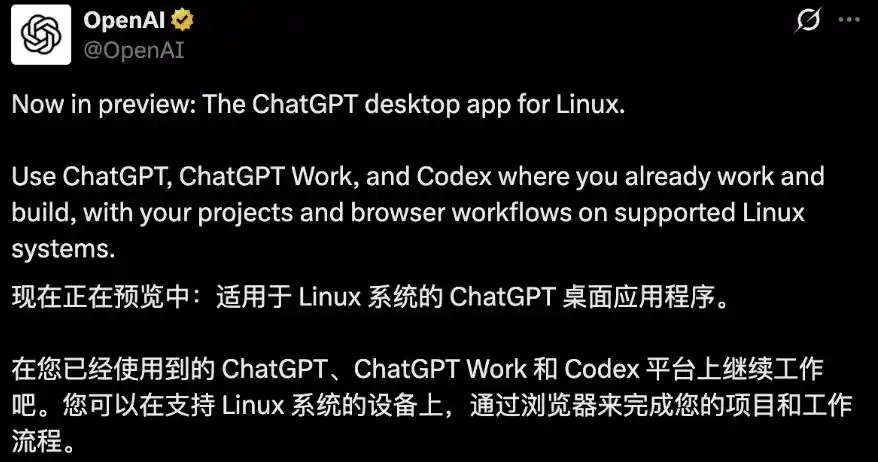
OpenAI officially announced: the Linux version of the ChatGPT desktop application is now available for preview.
ChatGPT, Work, and Codex are now all packed into the same App.
Linux is one of the systems with the highest density of developers, yet it had consistently been overlooked by the official OpenAI desktop client.
For the past two years, Windows and macOS users could summon ChatGPT with a keyboard shortcut, while Linux users could only keep it open in their browser.
But this time, what's being added is not just an entry point.
With the three-in-one suite coming in, especially Codex, it can access your projects, codebases, and terminal—places the browser can never reach.
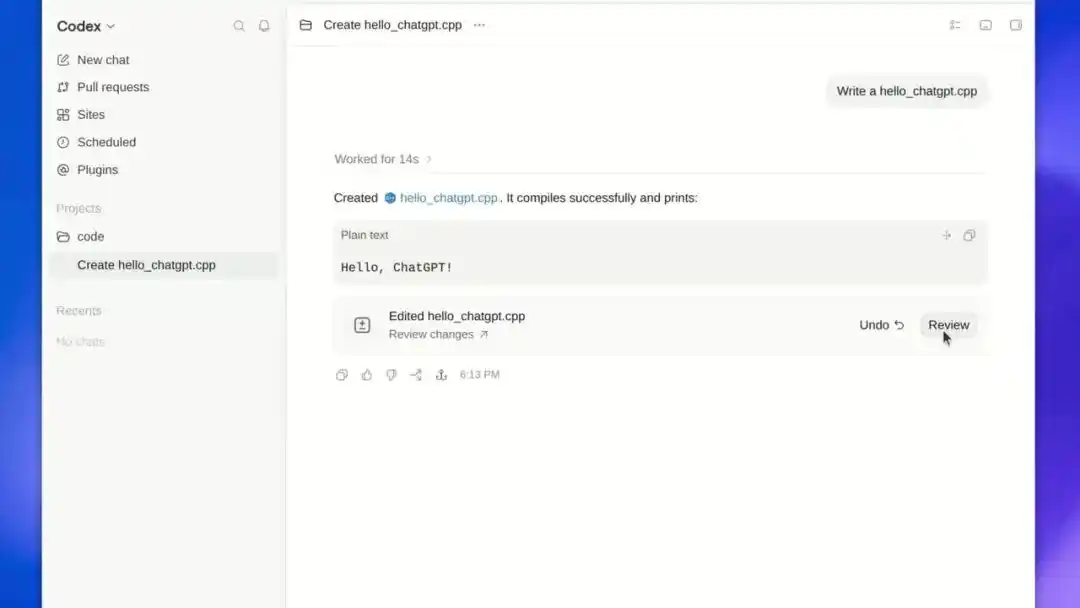
Codex view: Toggle to ChatGPT in the top-left corner; items like Pull requests and Projects in the sidebar are all present.
The first batch of supported distributions includes: Ubuntu 24.04 and 26.04 LTS, Debian 13, Fedora 43 and 44.
Linux has hundreds of distributions; OpenAI initially selected five versions from three families. The coverage isn't huge, but they are the foundations for many downstream distributions.
It supports both x64 and ARM64 architectures, providing .deb and .rpm installation packages ready for double-click installation.
According to TechCrunch, this preview version is now open globally. The new ChatGPT desktop application has completed the set for the three major desktop operating systems: macOS, Windows, and Linux.
OpenAI officially stated that Linux has always been one of the most requested platforms for the desktop client.
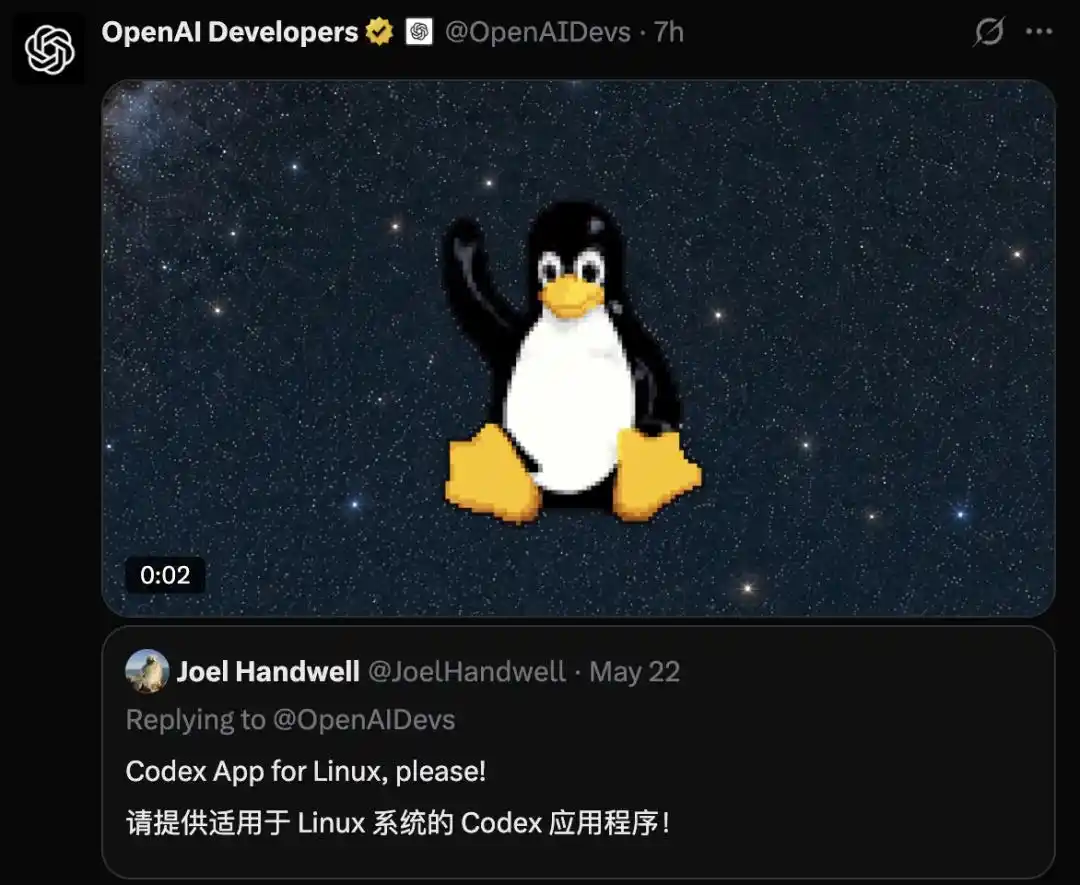
On the day of the announcement, the OpenAI Developers account unearthed an old reply from over two months ago: On May 22, a user named Joel Handwell commented, "Make a Codex App for Linux."
For an AI company often joked about as "only serving browser users," this step didn't come too early.
This is More Than Just Another Client
This time, it's not as simple as ChatGPT finally having a Linux version.
Among the three-in-one suite, ChatGPT handles conversation, Work manages complex multi-step tasks, and Codex is responsible for actually getting work done.
Here, Work refers to the agent experience for complex, multi-step tasks; its availability depends on your subscription plan and workspace settings.
As for Codex, although it's packed into the same application as ChatGPT, it still retains its own independent view.
The OpenAI Help Center documentation states: Codex's workflow hasn't changed, and its history is separate from ChatGPT's history.
You discuss requirements in ChatGPT, advance multi-step tasks in Work, and let it modify code in Codex—all without needing to switch between applications.
In a nutshell: one shell, two sets of memory, three ways of working.
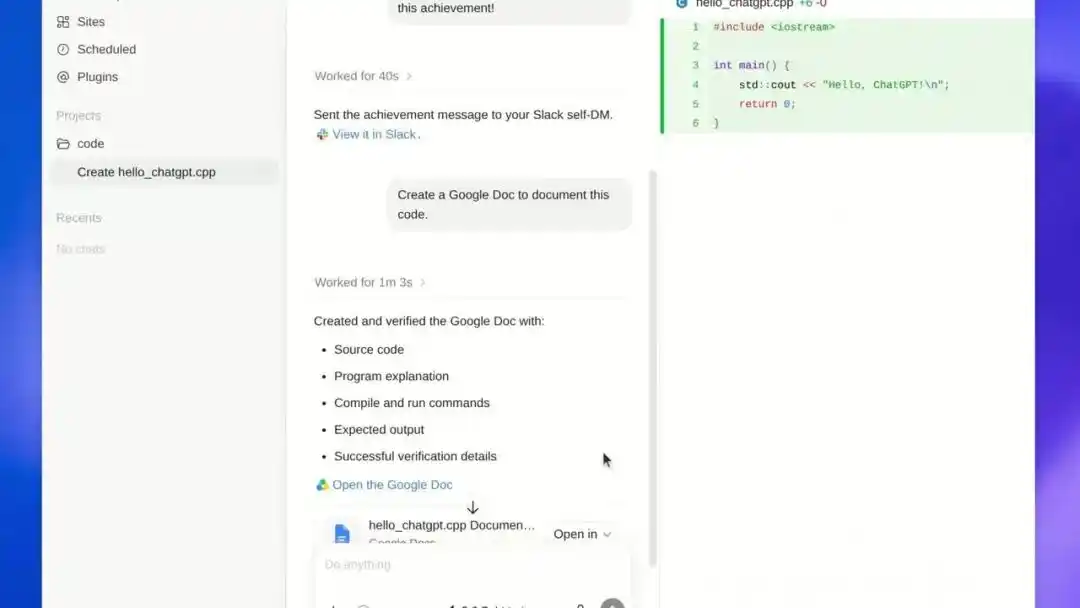
Within the same session, Codex lists five items for creating and verifying a Google Doc: source code, program description, compilation/run commands, expected output, verification details.
OpenAI Does Subtraction
Users Do Addition
Over the past two years, OpenAI's product line has been doing addition: web version, desktop version, standalone Codex App, Atlas browser.
Now, it's starting to do subtraction.
Looking at the extended timeline, this Linux addition is actually a move in this round of product consolidation.
On July 9th, OpenAI did three things at once: launched ChatGPT Work, integrated the standalone Codex application into the new ChatGPT desktop app, and incidentally discontinued the Atlas browser.
Chat, Work, and Codex—three interfaces were repackaged into a single entry point, globally available that same day on Mac and Windows, usable by all subscription plans, including the free tier.
The old desktop application was renamed ChatGPT Classic and moved aside.
On August 9th, Atlas officially stopped working.
Three days later, the Linux version launched.
This consolidation has clear benefits for both OpenAI and users.
What users gain is convenience. No more agonizing over "which app should I open for this task?"—one application, all three are there.
What OpenAI gains is user stickiness. All entry points are consolidated into one; your context, files, projects, and habits all reside within the same client.
The heavier that App installed on your computer becomes, the higher the cost to replace it.
Codex is the Real Killer Feature for the Linux Version
Why is this version particularly exciting for developers?
What Codex could access on the desktop previously, the browser version could never touch: local projects, codebases, the file system, the terminal.
These four things happen to be where an engineer spends most of their day.
Placing an agent that can read your codebase and type into your terminal directly on your computer is a completely different experience from copy-pasting code in a web page.
The former is an AI colleague; the latter can only be considered a search box.
This also marks a watershed moment for AI coding tools this year.
The act of writing code is no longer lacking in completions and suggestions; what's missing is the ability to autonomously run through the entire cycle of "read code, modify files, run commands, check errors, modify again."
And this cycle can only run locally.
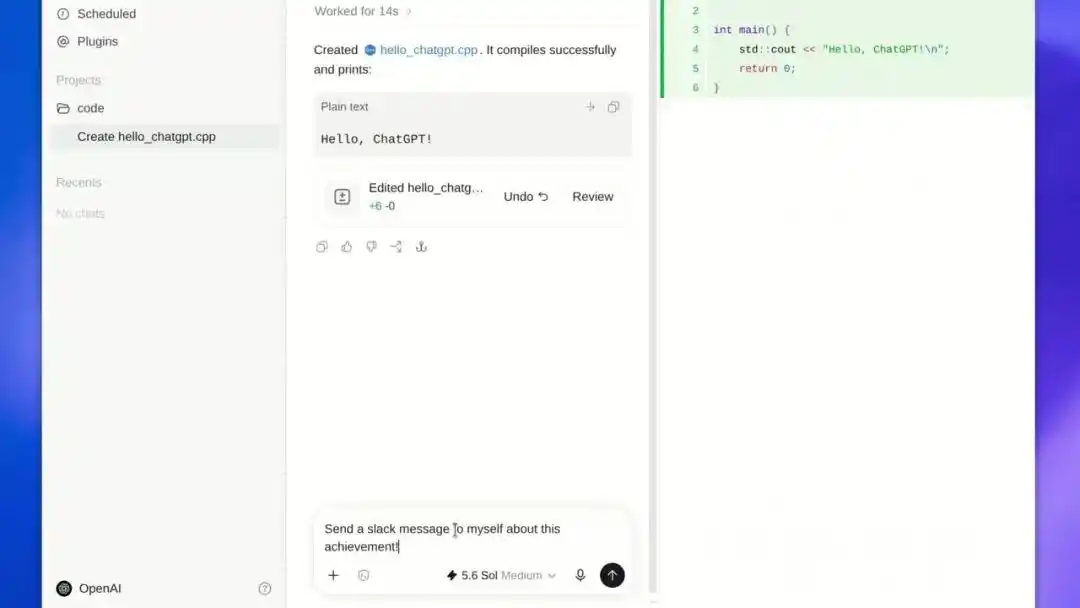
Codex writing hello_chatgpt.cpp and completing compilation on the Linux desktop, with the code area on the right and the conversation area on the left, using model 5.6 Sol Medium at the bottom.
OpenAI's positioning for this application is also clear: project management, file handling, browser workflows, plus local Codex development work.
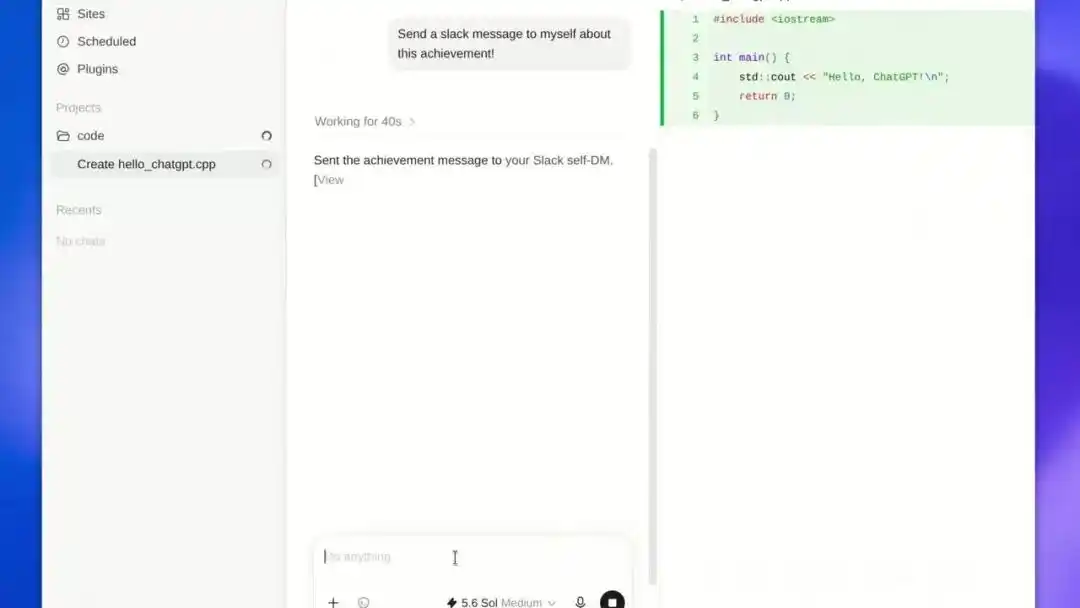
Within the same session, Codex sends a message about successful compilation to the user's private Slack chat.
Interestingly, the community has already discovered that it can also run in Windows' WSL Ubuntu 24.04 environment.
Regarding feature parity, Tibo, OpenAI's Codex lead, stated that it's largely on par with other platforms.
"Linux Version" Doesn't Mean It Installs on All Linux
"Linux version" doesn't mean it installs on all Linux.
Currently, only specified versions of Ubuntu, Debian, and Fedora are confirmed. Arch, openSUSE, RHEL, and Linux Mint are not yet on the official list.
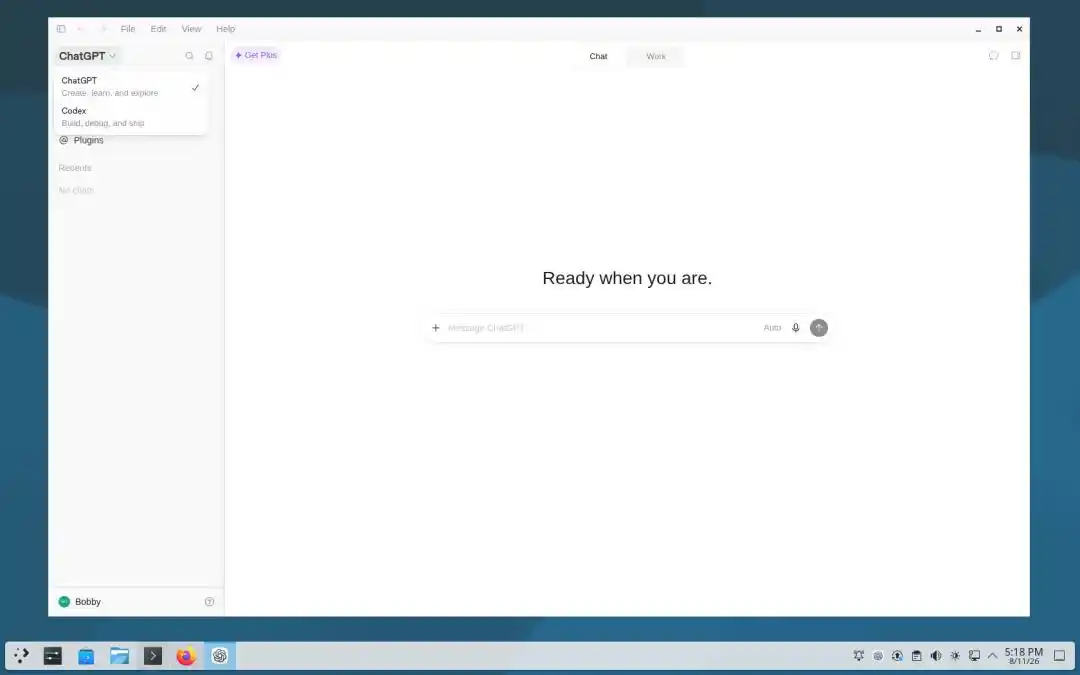
Actual screenshot of the ChatGPT desktop app running on Debian 13.
The distributions officially supported in this first batch are themselves the base for many downstream desktop distributions, so theoretically, compatibility should be broader.
But "theoretically can run" and "officially promised support" are two different things in a production environment.
Two more points need attention.
First, it's still a preview version; whether features and plans are identical to macOS and Windows has not been explicitly clarified by OpenAI.
Second, although official installation packages are also provided for the ARM architecture, it doesn't guarantee it will run on your specific ARM device. The desktop environment, system dependencies, and hardware requirements have not been fully disclosed.
Looking back, the sign-up page OpenAI left for Linux users actually appeared around mid-July.
At that time, the page had no download link, only a "Notify Me" form, and casually asked: which distribution do you use?
Options listed: Ubuntu, Debian, Arch, Fedora, RHEL.
Now Ubuntu, Debian, and Fedora are in the first batch; Arch and RHEL have to wait a bit longer.
Codex and Work being able to access local files, projects, and the terminal is their biggest selling point. But how the permission boundaries are drawn, how the sandbox is implemented, and how they are managed in enterprise environments are more important than "having a client."
An agent that can type in your terminal must first pass the IT department's scrutiny before entering company computers.
Claude Launched a Month Ago
OpenAI Rushes to Catch Up and Submit Homework
On the Linux front, OpenAI wasn't leading.
About a month ago, Anthropic's Claude desktop version launched on Linux, supporting Ubuntu 22.04+, Debian 12+, covering even older and broader version lines.
This is almost a recurring script in the recent OpenAI-Anthropic competition: one company tears open the gap first, the other catches up within a month, neither daring to cede the developer ground.
Because developers aren't just users; they are evangelists. One engineer installing a tool on a company computer often brings in an entire team.
And the coding front is precisely where the two have been competing most fiercely lately.
In February this year, OpenAI released a standalone desktop app for Codex; in early June, they announced Codex surpassed 5 million weekly active users, a figure that was only around 600,000 at the beginning of the year—an eightfold increase in five months.
The user composition is also changing: roughly 20% of Codex users are no longer developers, but knowledge workers in research, sales, and design, with growth rates over three times that of developers.
On the other side, Claude Code isn't chasing volume but defending its position as the preferred tool for professional engineers: 138k stars on GitHub, surpassing Codex CLI's under 100k.
Even pricing is matched blow for blow: three tiers—starter, advanced, top—both at $20, $100, $200 per month, the price sheets are now indistinguishable.
The real deciding factor will be who gets closer to developers' daily workflow: who gets into the terminal first, who gets onto the local machine first.
This Linux move is about seizing that position.
Counting from the macOS desktop debut in 2024, Linux users have waited a full two years.
What arrived is no longer that client from back then, merely packaging the web into a window. It's an agent workspace that can read your projects, open your browser, and enter your terminal.
Of course, the question facing developers has also changed.
It's no longer "which platform has ChatGPT," but "who are you willing to let reside in your terminal."
References:
https://x.com/OpenAIDevs/status/2087231793682694410
https://x.com/OpenAI/status/2087231350134980830
https://t.co/BUiM8ttZnI
This article is from the WeChat public account "新智元" (Xin Zhi Yuan), author: ASI启示录, editor: 元宇