SHRINCS BIP published: Quantum-secure Bitcoin comes with a catch

cointelegraphОпубліковано о 2026-08-27Востаннє оновлено о 2026-08-27

Анотація

Blockstream has published a Bitcoin Improvement Proposal (BIP) for SHRINCS, its experimental post-quantum signature scheme. Developed to secure Bitcoin against future quantum computing attacks, SHRINCS is a hash-based, stateful signature design that is significantly smaller than current NIST-approved post-quantum alternatives, allowing Bitcoin to maintain a transaction throughput similar to today's ~3 TPS. While it has been tested on Blockstream's Liquid sidechain, the proposal is not yet cryptographically mature and introduces complexity, such as requiring devices to track used keys. Blockstream is also researching lattice-based schemes and zero-knowledge proof aggregation as other potential paths for a quantum-secure Bitcoin, highlighting that governance and consensus present the major challenges for any upgrade.

Blockstream co-founder and CEO Adam Back has a reputation as a quantum computer skeptic who believes the technology is so immature the threat won’t materialize for decades.

Which makes it all the more fascinating that his company is one of the leaders in researching practical solutions to the issue. Back told Cointelegraph earlier this year “the safe thing” is to prepare for the threat well in advance.

Blockstream has already proven its experimental post-quantum signature scheme called SHRINCS works in production on its Liquid sidechain and a Bitcoin Improvement Proposal for SHRINCS was published earlier today.

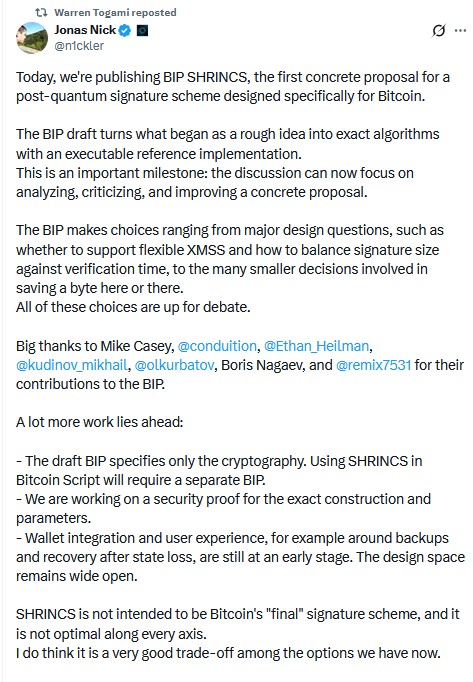
Blockstream Research’s Jonas Nick called it “the first concrete proposal for a post-quantum signature scheme designed specifically for Bitcoin.” But he added that “SHRINCS is not intended to be Bitcoin’s ‘final’ signature scheme, and it is not optimal along every axis.

”I do think it is a very good trade-off among the options we have now.”
Source: Jonas Nick

While the timeline is hotly debated, scientists agree that sufficiently advanced quantum computers will be able to reverse engineer private keys from public keys, thereby undermining Bitcoin’s security and enabling the theft of billions. That’s why the race is on to develop ways to upgrade Bitcoin to make it safe from attack.

Shrinking the size of post quantum signatures

One of Blockstream’s most promising areas of study has been in optimizing post-quantum signature schemes for Bitcoin’s requirements to enable the blockchain to keep more of the existing properties Bitcoiners hold dear.

The current crop of post-quantum secure hash and lattice-based signature schemes endorsed by the National Institute of Standards and Technology are between 38 and 123 times larger than Bitcoin’s existing ECDSA and Schnorr signatures.

Deploying any of them in Bitcoin could slow the blockchain down to a fraction of 1 TPS. Ethereum’s post-quantum team plans to deal with this issue by aggregating signatures using a tiny zero-knowledge proof for each block. That’s under consideration for Bitcoin too, and if implemented, it would see Bitcoin actually run faster than it does today, as a single proof takes less blockspace than a bunch of signatures. But in the Bitcoin world, adding zero-knowledge proofs would be a fairly radical change and face a steep uphill battle to garner enough support for activation.

Blockstream is considering that option too, but has wisely separated the proposal from the much more palatable option of figuring out how to shrink the size of NIST-approved hash based post-quantum signatures by around 13.23 times.

Related: Bitcoin’s quantum dilemma — Bigger blocks or STARK proofs?

Bitcoin optimized small(er) signatures

In December 2025, Blockstream researchers Jonas Nick and Mikhail Kudinov unveiled the SHRINCS signature scheme, and the opcode proposal was published in May. It’s a hash-based post-quantum signature scheme that has a minimum size of 548 bytes (plus the 48 byte public key) but can grow as large as 4,619 bytes.

“SHRINCS is the most Bitcoin-native post-quantum signature design anyone has produced,” explains Marin Ivezic, author of PostQuantum.com and founder of Applied Quantum.

“[It has] full BIP-39 seed recovery, and security resting on the same SHA-256 assumptions Bitcoin mining already depends on.”

He tells Magazine the scheme is still at an early stage and hasn’t been audited, nor has it benefited from the years of public cryptanalysis the NIST signatures have weathered.

But he says even at this early stage, it’s a serious contender.

“It is real code that has signed real transactions on Liquid mainnet, and I rate it the strongest answer yet to going post-quantum without wrecking Bitcoin’s block economics.”

Despite being much smaller than most post-quantum signatures, SHRINCS will still be around nine times larger than Bitcoin’s existing Schnorr signatures, which are 64 bytes, or the older ECDSA signatures, which are 70 bytes.

It might seem logical to assume that a signature nine times larger than the current ones would require Bitcoin’s block size to increase nine times to compensate, but Ivezic explains that’s not the case due to Bitcoin’s Segregated Witness.

“Under SegWit, signature bytes fit in the witness and take a quarter as much as other transaction data,” he says.

According to estimates published in Blockstream’s earlier research (using slightly different parameters), Bitcoin could run at 6.5 transactions per second if everyone used Taproot’s Schnorr signatures (about 80% of people don’t). The blockchain’s speed would drop to 0.5 TPS if Bitcoin used the NIST-approved lattice-based signature ML-DSA and to just 0.36 TPS using the NIST-approved hash-based signature SPHINCS+.

But employing SHRINCS, the blockchain could run at 3 TPS, which is similar to today.

SHRINCS was tested in production on the Liquid sidechain in March this year — they even included a copy of the Bitcoin white paper. So if it works in production, everything is fine and Bitcoin’s quantum problems are solved, right?
Source: Blockstream

SHRINCS sounds great: What’s the catch?

As the BIP warns, “a security proof is TODO” meaning that the research is promising but it is not yet a cryptographically mature proposal that has been fully validated.

It also introduces additional complexity to Bitcoin.

Every signature uses a new one-time key, and one of the reasons SPHINCS+ is so large is because it wraps all of those one-time keys in a multi-layer hash tree structure that makes the scheme stateless.

SHRINCS does away with all of that to save on space, and just stores used keys on your device (which is known as stateful) so it can quickly check keys aren’t being reused. The drawback is that signatures get larger by 16 bytes each time they are used, and if you lose your device, it requires a very large “stateless fallback” transaction around 5,777 bytes to recover.

Yoon Auh, founder of BOLTS Technologies, says in reducing the size, SHRINCS’ designers added “statefulness, compact signing paths, fallbacks, assumptions about how many times a seed is initialized, and rules for when devices must switch to larger stateless signatures.”

“That may be pragmatic engineering, but it is also complexity and fragility introduced largely to maximize throughput and minimize computation cycles. In Bitcoin, every new consensus rule becomes a permanent maintenance obligation, and every wallet-side assumption becomes a possible user failure mode.”

Refining SHRINCS and adding SHRIMPS

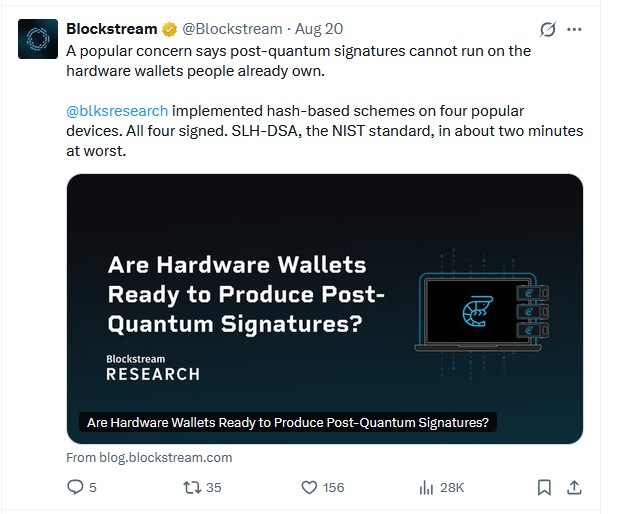
Blockstream has been researching and optimizing the scheme throughout 2026. Just last week it demonstrated that SHRINCS, and a range of other post quantum signature schemes, can effectively run on common hardware wallets. The BIP carries the warning however that this is not without risk:

SHRINCS keys generated using hypertree pruning for the stateless component are not compatible with SHRINCS implementations which do not support hypertree pruning. In fact, importing a key across such incompatible implementations may result in lost funds.

In March, the lab published a companion scheme called SHRIMPS, which was to be used in conjunction with SHRINCS to enable backup devices initialized from the same seed to be able to sign transactions. The SHRIMPS names has now been dropped for the BIP, and the scheme has been incorporated as a built in stateless path under the same 48 byte public key. It has been optimized with a non standard parameter set to be around 26% smaller than otherwise.

Blockstream has also been experimenting with lattice-based signature schemes, which are generally smaller than hash-based schemes but are seen as less proven and less reliable. It’s also considering the use of ZK proof aggregation of signatures. It estimates that if ZK proofs are used in conjunction with SHRINCS, Bitcoin’s speed could double to 6.7 TPS.

Blockstream has wisely separated the choice of signatures from questions around increasing the block size or adding ZK proof aggregation, as considering them together could sink the adoption of SHRINCS. Every post quantum upgrade to Bitcoin will be controversial and hard to gather enough support to activate.

“The binding constraint in Bitcoin’s quantum migration isn’t cryptography, it’s governance,” says Ivezic. “Between BIP-360, BIP-361, SHRINCS and STARKs, the engineering menu is filling up fast. What Bitcoin lacks is a mechanism for choosing from it before the clock runs out.”

Magazine: 5 tech predictions the mainstream media got horribly wrong


Пов'язані питання

QWhat is SHRINCS and why is its development significant for Bitcoin?

ASHRINCS is a post-quantum, hash-based signature scheme developed by Blockstream Research. It is significant because it is the first concrete BIP proposal for a post-quantum signature scheme designed specifically for Bitcoin, aiming to secure the network against future attacks from sufficiently advanced quantum computers while aiming to preserve Bitcoin's existing block economics and performance.

QHow does the size of SHRINCS signatures compare to Bitcoin's current signatures and what impact would this have on transaction throughput?

ASHRINCS signatures are approximately nine times larger than Bitcoin's current Schnorr (64 bytes) or ECDSA (70 bytes) signatures, with a minimum size of 548 bytes. Despite this increase, due to Segregated Witness (SegWit) design where witness data is discounted, estimated transaction throughput using SHRINCS would be around 3 TPS, which is similar to Bitcoin's current performance, unlike other NIST schemes which would reduce throughput to below 1 TPS.

QWhat is a key trade-off or drawback of the SHRINCS design mentioned in the article?

AA key trade-off of SHRINCS is that it is a stateful signature scheme. It saves space by storing used one-time keys on the user's device instead of using a complex stateless tree structure. The drawbacks include signatures growing by 16 bytes with each use, and the risk of requiring a very large (approx. 5,777-byte) 'stateless fallback' transaction for recovery if the device is lost, adding complexity and potential user failure modes.

QWhat role does Blockstream's Liquid sidechain play in the development of SHRINCS?

ABlockstream's Liquid sidechain serves as a testing ground for SHRINCS. The scheme was proven to work in production on Liquid in March 2026, where it was used to sign real transactions, including one that embedded a copy of the Bitcoin white paper. This demonstrates the practical feasibility of the signature scheme in a live blockchain environment.

QAccording to the article, what is described as the 'binding constraint' for Bitcoin's transition to post-quantum security?

AAccording to Marin Ivezic quoted in the article, the 'binding constraint in Bitcoin's quantum migration isn't cryptography, it's governance.' This means that while technical solutions like SHRINCS, BIPs, and STARK proofs are being developed, the main challenge is Bitcoin's decentralized governance mechanism in reaching consensus and choosing a path forward before quantum computers become a tangible threat.

Пов'язані матеріали

Inflation Has Not Improved. Will Warsh Support a Rate Hike on Friday?

U.S. inflation remained stubbornly high in July, with the PCE price index holding at a year-on-year increase of 3.7%, unchanged from June and still far above the Federal Reserve's 2% target. The core PCE index also stayed flat at 3.3%. While inflation did not worsen, the fact that it did not improve either has increased market expectations for further interest rate hikes. Futures pricing now indicates a higher probability of a rate increase in September and fully prices in one hike by year-end. The economic backdrop is mixed. Second-quarter GDP growth was revised to 1.5%, but underlying components like consumer spending and business investment were robust. However, inflation-adjusted consumer spending stalled in July, and real incomes have barely grown over the past year, eroding purchasing power. The data provides arguments for both sides of the policy debate. The "wait-and-see" camp points to the lack of acceleration in inflation and upcoming methodological changes that may lower reported figures. The "pro-hike" camp highlights that inflation remains hotter than forecasts, sticky services prices, rising diesel and chip costs, and renewed trade tensions with Canada. All eyes are now on Fed Chair Kevin Warsh's upcoming speech at Jackson Hole for clarity on his policy stance. With inflation persistently above target for over five years and midterm elections approaching where prices are a key issue, the pressure for decisive action is mounting. The speech carries significant two-way risk for markets.

marsbit44 хв тому

Inflation Has Not Improved. Will Warsh Support a Rate Hike on Friday?

marsbit44 хв тому

US Stock Market Trends (Aug 27): PCE Exceeds Expectations, Pressures Broader Market; Nvidia Rises 4% After-Hours, Nasdaq Futures Up 1%

U.S. Market Trends (Aug 27): PCE Data Weighs on Indices, Nvidia Rises 4% After-Hours, Nasdaq Futures Up 1% U.S. stocks closed slightly lower on Wednesday amid narrow trading. The S&P 500, Nasdaq, and Dow Jones all edged down, ending the Dow's two-day winning streak. The key pressure came from July's PCE inflation data, which showed a 3.7% year-over-year increase, exceeding expectations. While the core PCE met forecasts at 3.3%, the hot headline number boosted Treasury yields and the dollar, dampening hopes for imminent Fed rate cuts. Gold fell below $4,600/oz. Oil prices continued to weaken despite mixed geopolitical signals. The market's real focus was after the close. Nvidia reported Q2 revenue of $96.2 billion, beating estimates, guided for current-quarter revenue to surpass $100 billion for the first time, and projected 70% revenue growth for the next fiscal year. Its shares rose approximately 4% after-hours, lifting Nasdaq futures by about 1%. Amazon's announcement to deploy an additional 2 million GPUs further validated the data center demand narrative for Nvidia. In other sectors, chip stocks like Western Digital and Arm gained. Among the "Magnificent Seven," moves were mixed. Salesforce surged on strong guidance and an expanded partnership with Anthropic. Meta settled a youth addiction case with 29 U.S. states for up to $18 billion, a figure seen as favorable compared to earlier fears. Bitcoin retreated from recent highs, while industrial metals like copper extended their rally. The core market tension remains between inflation concerns pressuring the broader market and strong AI earnings providing sector-specific momentum, setting the tone for early September trading.

marsbit1 год тому

US Stock Market Trends (Aug 27): PCE Exceeds Expectations, Pressures Broader Market; Nvidia Rises 4% After-Hours, Nasdaq Futures Up 1%

marsbit1 год тому

A Record $70 Billion Inflow in 5 Days! Investors Are No Longer Choosy, Buying Gold and Bitcoin Together

Investors are moving beyond "either/or" choices and are simultaneously pouring money into both gold and bitcoin ETFs. Over the past five trading sessions, ETFs tracking these assets attracted a record $7 billion in combined inflows, pushing some of the largest gold and bitcoin funds to the top of the U.S. weekly ETF inflow rankings. This surge was triggered by U.S. Treasury Secretary's announcement to at least double long-term bond buybacks, which initially pressured Treasury yields and the dollar, boosting prices for both assets. Gold has risen about 13% this month, while bitcoin reclaimed the $80,000 level. The synchronized rally signals the return of the "monetary debasement trade." Amid growing concerns over fiscal sustainability and easing financial conditions, investors are seeking scarce assets perceived as outside direct government control. Gold benefits from its traditional safe-haven role, while bitcoin's fixed supply of 21 million coins positions it as a potential hedge. The SPDR Gold ETF (GLD) attracted nearly $3.4 billion, and the iShares Bitcoin Trust (IBIT) saw $1.5 billion in inflows, both ranking in the weekly top ten. Analysts note the momentum behind the flows is as significant as the volume, indicating investors are aggressively adjusting previously underweight positions. While the narrative of hedging against fiscal stress and currency debasement is gaining traction, some analysts question its sustainability, suggesting equities might be a more reliable hedge in the long run.

华尔街日报1 год тому

A Record $70 Billion Inflow in 5 Days! Investors Are No Longer Choosy, Buying Gold and Bitcoin Together

华尔街日报1 год тому

Торгівля

Спот
活动图片