Goldman Sachs Research Report Analysis: Nvidia's Earnings Exceed Expectations, Target Price of $285 Still Indicates 34% Upside Potential

marsbitОпубліковано о 2026-08-27Востаннє оновлено о 2026-08-27

Анотація

Goldman Sachs maintains a buy rating on Nvidia with a $285 price target, implying a 34% upside, following its Q2 results. Revenue of $96.2B and data center revenue of $89.0B exceeded expectations. Q3 revenue guidance midpoint of $108.0B was above consensus, though slightly below Goldman's forecast. Notably, Q3 gross margin guidance of 74% was below expectations, potentially due to initial cost pressures from the new Blackwell architecture ramp-up. Key investor focus shifts to the upcoming earnings call for details on: the potential upward revision to Nvidia's $1 trillion cumulative data center revenue target; the structure of its $500 billion partner financing platform; and the gross margin trajectory for late 2026 and 2027. While the results confirm a robust AI spending environment—a positive signal for the broader semiconductor sector including Broadcom, AMD, Marvell, Arm, and Intel—Goldman notes that optimistic expectations are largely priced in. With hyper-scalers having already raised capital expenditure forecasts, the stock may trade in a range post-earnings, requiring new catalysts for a significant re-rating.

Author: Rita

Nvidia's Q2 earnings once again surpassed market expectations.

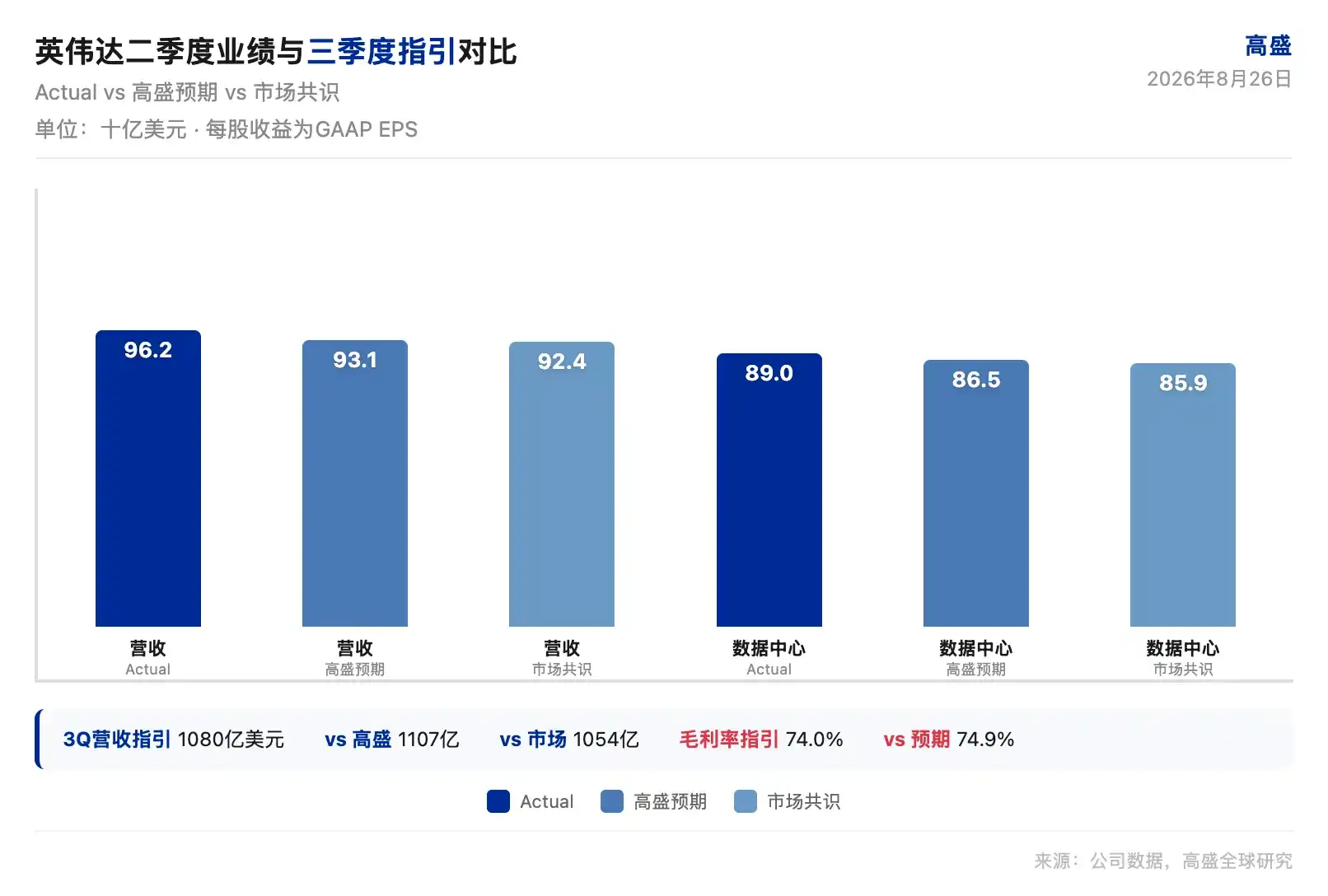
On August 26, Goldman Sachs released a flash report noting that Nvidia's Q2 revenue was $96.2 billion, with data center revenue at $89.0 billion, both exceeding Goldman Sachs and market expectations; the midpoint of Q3 revenue guidance is $108.0 billion, higher than market expectations but slightly below Goldman Sachs' forecast. Goldman Sachs maintains a Buy rating with a target price of $285, representing approximately 34% upside from the current price. Goldman Sachs expects the stock to trade within a range post-earnings, as optimistic expectations were already largely priced in following capex increases by hyperscalers.
Earnings Exceed Expectations, But Limited Surprises

All key Q2 metrics exceeded expectations. Revenue of $96.2 billion was 3.4% above Goldman Sachs' estimate and 4.2% above market consensus. Data center revenue of $89.0 billion was 2.9% and 3.6% higher, respectively. EPS of $2.22 was 4.9% and 6.1% higher, respectively. Gross margin of 75.0% was in line with expectations.

Behind the numbers, some subtle signals emerge. Inventory increased 22% quarter-on-quarter to $31.6 billion, with inventory days outstanding rising from 116 to 120 days; accounts receivable grew 55% quarter-on-quarter to $63.1 billion, with receivable days outstanding increasing from 46 to 60 days. Rapid accumulation of inventory and receivables typically indicates marginal easing in supply chain tightness or a slowdown in customer payment cycles.

Q3 guidance is also strong. The revenue guidance midpoint of $108.0 billion implies 14% sequential growth and approximately 90% year-on-year growth, higher than the market consensus of $105.4 billion but slightly below Goldman Sachs' expectation of $110.7 billion. Gross margin guidance of 74% is below Goldman Sachs' and market expectations of 74.9%. Goldman Sachs calculates an implied EPS of approximately $2.43, below its own estimate but above market expectations.

Slightly Lower Gross Margin Guidance; Three Key Topics for the Conference Call

Gross margin is the marginal negative signal from this report. Q3 gross margin guidance is about 90 basis points below market expectations and lower than Q2's 75.0%.

Pressure on gross margin may stem from product mix changes. The new Blackwell architecture GPUs likely have higher initial ramp-up costs, and new capacity investments also bring depreciation pressure. Historically, temporary gross margin pressure during new product introductions is normal; the key is whether the subsequent ramp-up pace meets expectations.

Goldman Sachs believes three issues in the earnings call are more important than the results themselves. Nvidia previously set a target for cumulative data center revenue of $1 trillion; investors want to know if there is room to raise this number. The structure and financial implications of the company's announced $500 billion partner financing platform have not been fully disclosed. With Q3 gross margin guidance signaling marginal pressure, the gross margin trend for the second half of 2026 and 2027 will be key for valuation.

Valuation and Market Expectations

Goldman Sachs' $285 target price is based on a 30x multiple applied to a normalized EPS of $9.50, implying 34% upside from the current price. The implied valuation multiple is not aggressive; Nvidia's data center revenue is still growing at triple-digit rates, and 30x is below its historical valuation average.

Market expectations are already high. Recent concentrated capex increases by hyperscalers have led to optimistic expectations for AI chip demand being largely reflected in the stock price. Goldman Sachs' mention of "range-bound trading" core meaning is: meeting expectations alone is not enough to drive a breakout in the stock price; new incremental information is needed to drive the next phase of valuation re-rating.

Implications for the Supply Chain

Goldman Sachs believes the Q3 guidance confirms the AI spending environment remains robust. For the digital semiconductor sector covered by Goldman Sachs, this signal is most positive, including Broadcom, AMD, Marvell, Arm, and Intel.

Nvidia's strong guidance implies that the expansion of AI infrastructure remains on an upward trajectory, providing demand visibility for the entire AI chip supply chain. Broadcom in custom computing chips, Marvell in connectivity chips, and AMD's competitive stance in the GPU market will all benefit from continued AI capex expansion. For Intel, as a potential beneficiary of foundry capacity, Nvidia's capacity needs could also provide incremental orders for its manufacturing business.

Nvidia's short-term earnings are not the issue; the issue is that market expectations have already run ahead. When earnings numbers fail to provide new positive surprises, the next phase of stock price momentum must be mined from the conference call. Whether Jensen Huang can articulate a sufficiently attractive incremental narrative during the Q&A session will determine Nvidia's stock direction post-earnings.

Disclaimer

This article is Tide Research's compilation and interpretation of a third-party brokerage research report (Goldman Sachs, August 26, 2026), combined with public market information. The ratings, target prices, earnings forecasts, and related judgments cited are the views of that brokerage's analysts, representing only the stance of their institution. They do not represent Tide Research's views and do not constitute any investment advice.

The market carries risks, and decisions should be made independently. This article should not be used as a basis for trading any securities.


Пов'язані питання

QAccording to Goldman Sachs' analysis, what were the key points about NVIDIA's Q2 performance and Q3 guidance?

ANVIDIA's Q2 revenue was $96.2 billion, beating both Goldman Sachs and market expectations. Data center revenue was $89.0 billion, also above expectations. However, the Q3 revenue guidance midpoint of $108.0 billion, while above market consensus, was slightly below Goldman Sachs' expectation. Furthermore, the Q3 gross margin guidance of 74% was lower than both Goldman's and market expectations.

QWhat were the potential reasons mentioned for NVIDIA's lower Q3 gross margin guidance?

AThe pressure on gross margin likely comes from changes in product mix. Specifically, the initial ramp-up phase of the new Blackwell architecture GPUs involves higher costs. Additionally, new production capacity investments bring depreciation pressure.

QWhat three issues did Goldman Sachs identify as more critical for the post-earnings conference call than the financial results themselves?

AGoldman Sachs highlighted three key topics for the conference call: 1) Whether there is potential to raise NVIDIA's previously stated $1 trillion cumulative data center revenue target. 2) More details on the structure and financial impact of the $500 billion partner financing platform announced by NVIDIA. 3) The gross margin trend for the second half of 2026 and 2027, which is seen as crucial for valuation.

QWhat is the basis for Goldman Sachs' $285 price target for NVIDIA, and what potential upside does it imply?

AThe $285 price target is based on 30 times a normalized earnings per share of $9.50. This target implies a 34% upside from the current stock price at the time of the report.

QHow might NVIDIA's strong performance and guidance positively affect other semiconductor companies in the AI chip ecosystem?

ANVIDIA's strong guidance validates a robust AI spending environment. This benefits the broader AI chip ecosystem by providing demand visibility. Specifically, it could positively impact companies like Broadcom in custom compute, Marvell in connectivity chips, and AMD in the GPU competitive landscape due to continued AI capex expansion. Intel, as a potential foundry capacity beneficiary, might also see incremental orders from NVIDIA's capacity needs.

Пов'язані матеріали

Former Nvidia AI Director Overturns Transformer, Creates 5 Trillion-Context Physical AI That Can Simulate the Entire Universe

Former NVIDIA AI Director Anima Anandkumar and her co-founder Benedikt Jenik have unveiled a groundbreaking "Physical AI" model through their startup, Accelerated Understanding. This model departs entirely from the dominant Transformer architecture, instead utilizing "Neural Operators" to directly understand and simulate physical phenomena in their full 4D spacetime (3D space + time). It achieves a staggering inference-time context window of over 5 trillion tokens—reportedly 5 million times larger than current top LLMs—enabling it to generate complete 4D trajectories of complex physical systems in a single, one-shot inference without subsampling or chunking. The model, pre-trained with 1 trillion parameters and scaled to 35 trillion in experiments, functions as a universal physics simulator capable of handling diverse domains from weather to materials science. It establishes a "simulate → improve → simulate" loop for reality validation. The founders notably turned down a lavish offer from Jeff Bezos's Project Prometheus, which included 35% equity, a $2M salary, and over $20B in committed funding. Industry speculation points to NVIDIA CEO Jensen Huang, who previously championed Anandkumar's work, as a potential key supporter behind the scenes. This development signals a paradigm shift from language/image-centric AI to physics-first intelligence.

marsbit7 хв тому

Former Nvidia AI Director Overturns Transformer, Creates 5 Trillion-Context Physical AI That Can Simulate the Entire Universe

marsbit7 хв тому

NVIDIA Earnings Report Quick Read: Quarterly Revenue on the Verge of Breaking the $100 Billion Mark, Can Still Grow 70% Next Year

NVIDIA Q2 FY2027 Earnings Report: Record Revenue Nears $100 Billion, Projects 70% Growth for Next Year NVIDIA reported exceptional Q2 FY2027 results, with revenue reaching $96.22 billion (up 106% YoY) and non-GAAP net income of $53.95 billion (up 118% YoY). Q3 revenue guidance of $108 billion signals the company's imminent entry into a "quarterly $100 billion revenue" era. The most striking projection came from the CFO, who forecasted approximately 70% revenue growth for FY2028, significantly above Wall Street's 45% expectation, and notably stated this outlook excludes any data center revenue from China. The data center segment remained the core driver, generating $89 billion (up 117% YoY), representing over 90% of total revenue. Growth continues to be primarily fueled by capital expenditures from hyperscale cloud providers like Amazon, Microsoft, Google, and Meta. A key product milestone was the confirmation that the Vera Rubin platform has entered full-scale production and begun shipments. Management stated that every 1 GW of Vera Rubin compute deployed represents a roughly $40 billion revenue opportunity, with the platform expected to contribute about 20% of data center revenue in Q3. CEO Jensen Huang noted its ramp-up is the fastest in company history, providing confidence for the strong future outlook. Management emphasized that AI demand is not slowing but accelerating and broadening into new areas like inference, enterprise AI, and robotics. The primary constraint on growth is now supply, not demand. Huang indicated that without supply limitations, the FY2028 outlook would be "much higher." Bottlenecks include components like HBM, advanced packaging, and data center power. In response, NVIDIA is expanding its role, collaborating with financial firms to mobilize over $500 billion in third-party capital for AI infrastructure and securing key resources like land and power. Crossing the $100 billion quarterly revenue mark represents a new scale for NVIDIA, while the 70% growth projection for next year suggests it may just be the starting point for the next phase.

Odaily星球日报10 хв тому

NVIDIA Earnings Report Quick Read: Quarterly Revenue on the Verge of Breaking the $100 Billion Mark, Can Still Grow 70% Next Year

Odaily星球日报10 хв тому

Inflation Has Not Improved. Will Warsh Support a Rate Hike on Friday?

U.S. inflation remained stubbornly high in July, with the PCE price index holding at a year-on-year increase of 3.7%, unchanged from June and still far above the Federal Reserve's 2% target. The core PCE index also stayed flat at 3.3%. While inflation did not worsen, the fact that it did not improve either has increased market expectations for further interest rate hikes. Futures pricing now indicates a higher probability of a rate increase in September and fully prices in one hike by year-end. The economic backdrop is mixed. Second-quarter GDP growth was revised to 1.5%, but underlying components like consumer spending and business investment were robust. However, inflation-adjusted consumer spending stalled in July, and real incomes have barely grown over the past year, eroding purchasing power. The data provides arguments for both sides of the policy debate. The "wait-and-see" camp points to the lack of acceleration in inflation and upcoming methodological changes that may lower reported figures. The "pro-hike" camp highlights that inflation remains hotter than forecasts, sticky services prices, rising diesel and chip costs, and renewed trade tensions with Canada. All eyes are now on Fed Chair Kevin Warsh's upcoming speech at Jackson Hole for clarity on his policy stance. With inflation persistently above target for over five years and midterm elections approaching where prices are a key issue, the pressure for decisive action is mounting. The speech carries significant two-way risk for markets.

marsbit54 хв тому

Inflation Has Not Improved. Will Warsh Support a Rate Hike on Friday?

marsbit54 хв тому

Торгівля

Спот
活动图片