Quantum Computing "Manhattan Project" Unveiled: Is the Encryption Industry at a Critical Turning Point?

Foresight NewsОпубліковано о 2026-06-23Востаннє оновлено о 2026-06-23

Анотація

"Quantum Computing 'Manhattan Project' Launched: Is the Crypto Industry at a Critical Juncture?" On June 22, former U.S. President Donald Trump signed two executive orders. The first mandates all federal agencies upgrade their cryptographic systems to new, quantum-resistant standards by 2030. The second orders the Department of Energy to lead the development of a national quantum computer, signaling a shift from laboratory research to a state-enforced national agenda. This creates a hard deadline. A powerful quantum computer could break current encryption. The threat is compounded by "harvest now, decrypt later" attacks, where encrypted data is stored today for future decryption. Federal agencies must appoint migration officers and complete post-quantum cryptography (PQC) upgrades for key establishment by 2030 and digital signatures by 2031. Procurement rules will also be changed, forcing government contractors to comply. The crypto industry faces a direct threat. Bitcoin's ECDSA signatures are theoretically vulnerable. Research indicates millions of Bitcoin with exposed public keys are at risk if quantum computers advance. While projects like Bitcoin Quantum testnets and efforts by Ethereum, Solana, NEAR, and Zcash are exploring quantum-resistant solutions, achieving consensus in decentralized networks remains a major challenge. The centralized U.S. government has started a 5-year countdown. For decentralized crypto networks, the real test is whether they can complete th...


Author: Ma He, Foresight News

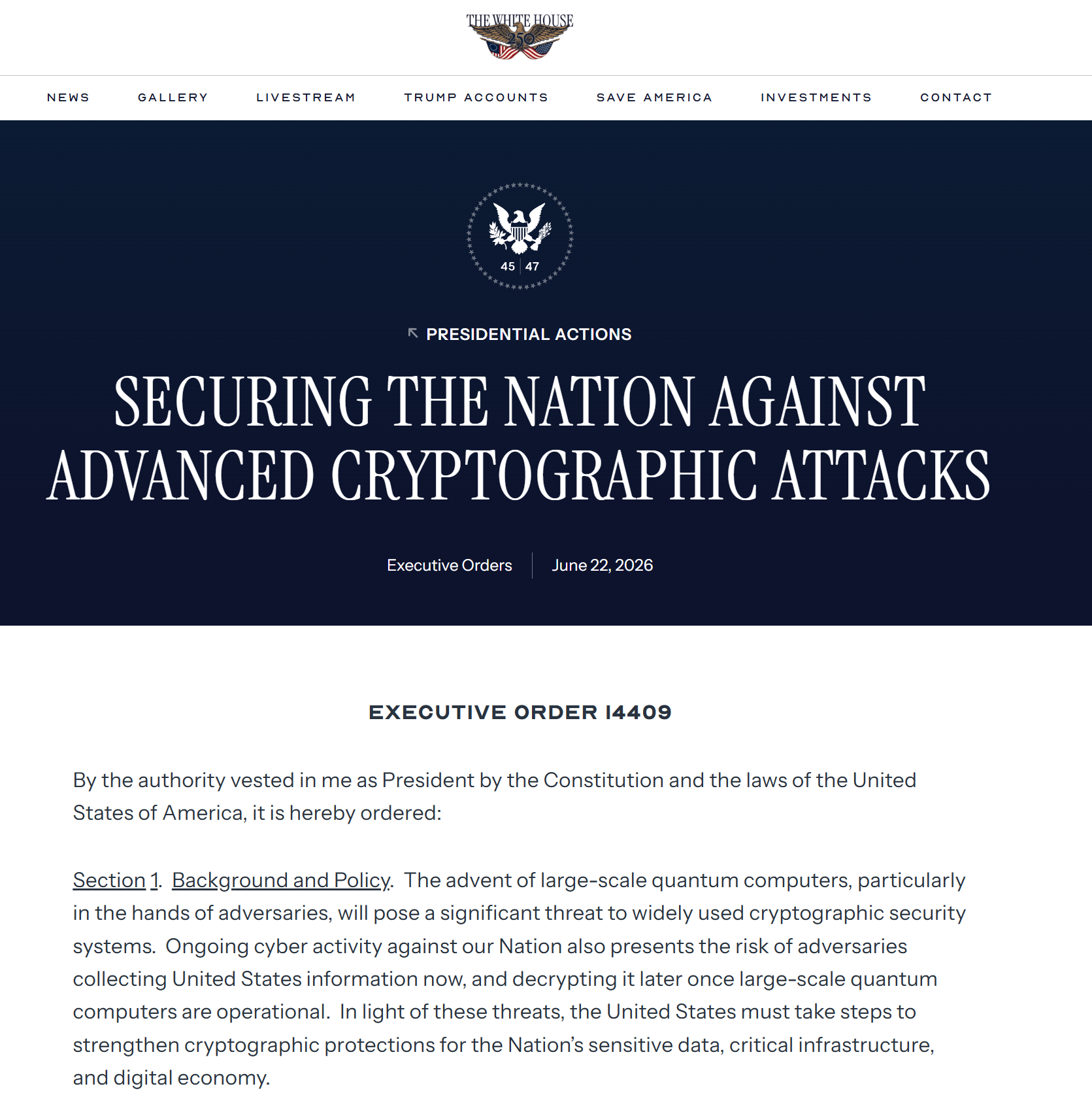
On June 22, Trump signed two executive orders in a single day. One requires all U.S. federal agencies to upgrade their cryptographic locks to a new standard by 2030 to resist the threat of quantum computing decryption; the other orders the Department of Energy to lead the construction of a "National Quantum Computer."

Quantum computing has transitioned from a technical discussion in laboratories to a mandatory national schedule.

At the beginning of 2025, tech industry titan Jensen Huang expressed pessimism about quantum computers, stating "a truly practical quantum computer might still be 15 to 30 years away." Yet, merely two months later, his attitude shifted. This year, NVIDIA released the AI-driven Ising model. Huang indicated that this would enable AI to become the control plane and operating system for quantum machines, transforming fragile qubits into scalable, highly reliable systems, and building standardized, industry-grade infrastructure for quantum computing.

Quantum computing, potentially supercharged by AI, may see its development pace accelerate significantly. The faster it progresses, the greater the daily growing threat to current system security.

The 2030 Deadline: A Hard Order for a Nationwide "Lock Change"

Once large-scale quantum computers emerge, the current cryptographic systems will be shattered. More insidiously, there's the strategy of harvest now, decrypt later—adversaries can store your encrypted data today and patiently crack it a decade later when quantum machines mature.

Hence, the U.S. government issued a hard deadline. All federal agencies must complete the migration to Post-Quantum Cryptography (PQC) for key establishment in their high-value assets and high-impact systems by December 31, 2030. Additionally, they must complete the migration for digital signatures to PQC by December 31, 2031.

Each agency must appoint a PQC Migration Lead within 30 days, reporting directly to the White House OMB and the National Cyber Director. NIST (National Institute of Standards and Technology) must initiate a PQC migration pilot for its own systems within 180 days and complete it by the end of 2027.

Furthermore, the Federal Acquisition Regulation will be revised within 180 days. All contractors supplying the U.S. government—from Microsoft and Amazon Web Services to various IT service providers—must comply with PQC standards by 2030. The Department of Homeland Security will also assist critical infrastructure like the power grid, banks, hospitals, and communication operators in developing migration plans.

The U.S. government is leveraging administrative power to forcibly drive a massive upgrade of global internet security infrastructure.

The other document signed by Trump on the same day, "Unleashing the Next Frontier in Quantum Innovation," also placed the quantum computing race squarely on the table.
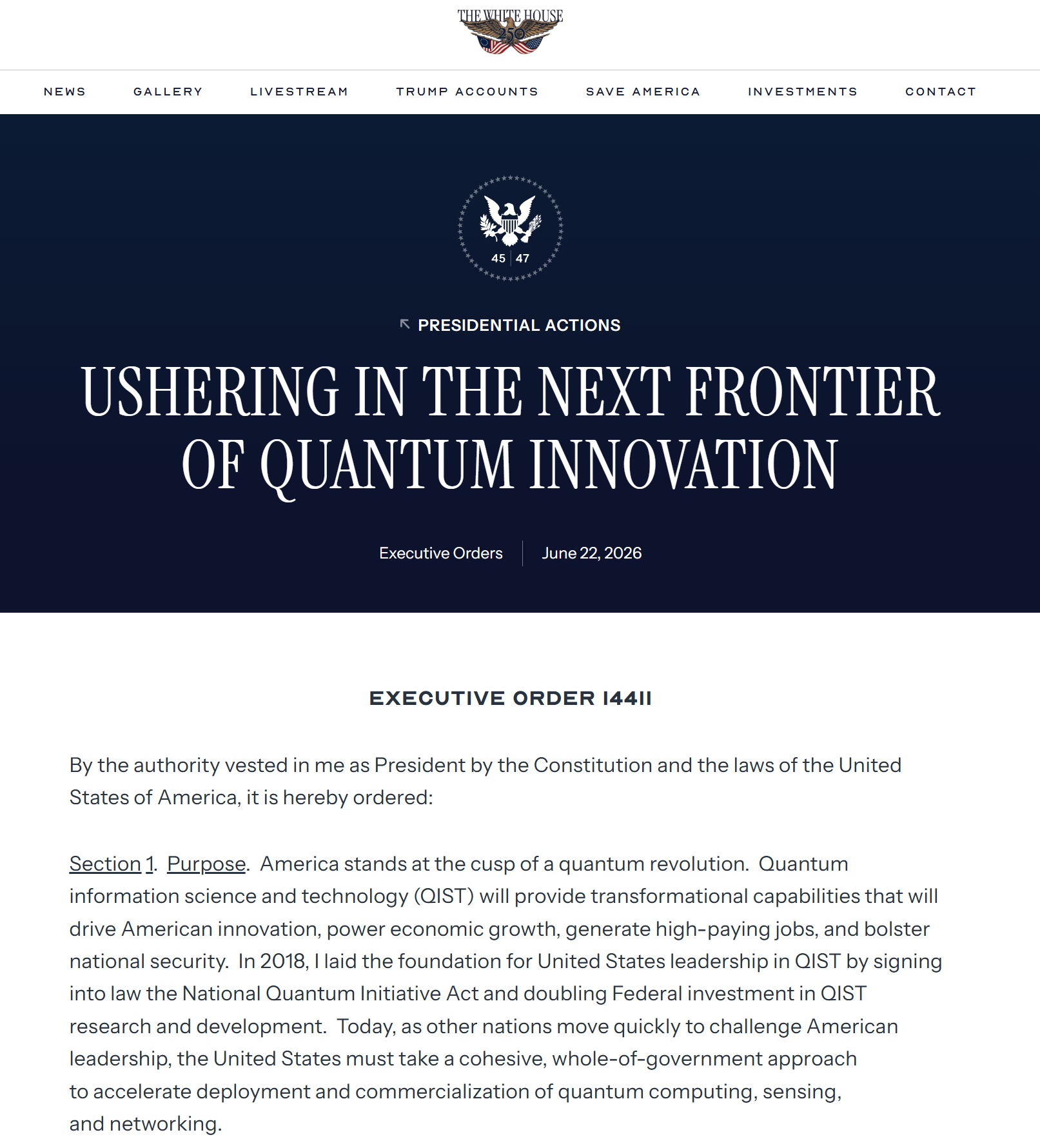

The U.S. government wants a massive machine delivered to the Department of Energy's national laboratories, one that truly solves problems classical supercomputers cannot. The White House requires the Department of Energy to publicly release technical specifications within 90 days and explore public-private partnership models within 180 days.

Perhaps this is the "Manhattan Project" moment for quantum computing. The government provides funding, policies, and orders, guiding through national will to accelerate the evolution of quantum information technology from laboratory prototypes to engineering-grade tools.

While the U.S. races to upgrade its cryptography, the cryptography underpinning the crypto industry is already fraught with peril.

The Crypto Industry Resists Quantum Computing

The foundation of Bitcoin, the ECDSA elliptic curve signature, is theoretically vulnerable to cracking by quantum computers.

According to research data released by BTQ Technologies in October 2025, approximately 6.65 million Bitcoins (worth about $745 billion at the time) have their public keys permanently exposed on the blockchain. This includes 1.9 million Bitcoins in early P2PK addresses and about 4 million Bitcoins in reused addresses.

These BTCs don't need to wait for quantum computers to actively attack transaction broadcasts—the public keys have been lying on the blockchain for over a decade. Once quantum computers mature, they can slowly reverse-engineer the private keys offline.

The Bitcoin base layer protocol has not activated a soft fork in over four years since November 2021. The BIP-360 proposal suggests some mitigation measures, but a complete solution remains distant. Historical precedent is also not optimistic. Bitcoin's SegWit upgrade took three years from proposal in December 2015 to mainstream adoption in December 2018.

In January this year, BTQ Technologies Corp. launched a testnet named Bitcoin Quantum. This testnet is fully open and permissionless, inviting miners, developers, researchers, and users to run nodes, build tools, audit cryptography, and stress-test quantum-resistant transactions before any mainnet migration.

However, achieving consensus among multiple parties for subsequent steps remains a significant challenge.

Coinbase CEO Brian Armstrong rebutted that the quantum computing threat to Bitcoin is severely exaggerated. "This isn't a problem unique to cryptocurrency; it's something the entire world needs to address. We are working directly with core developers to handle the quantum issue."

Beyond Bitcoin, other project protocols are also vigorously advancing their anti-quantum plans.

The Ethereum Foundation has established a dedicated Post-Quantum Security research team and prioritized PQC. Nico, lead of the Ethereum Foundation's privacy project Kohaku, stated that Ethereum can already begin preparing at the account level for the post-quantum era without waiting for a base-layer hard fork upgrade.

Solana has established the Falcon signature standard and announced a three-phase migration roadmap. The NEAR development team plans to add a quantum-resistant secure signature scheme to its testnet by the end of Q2 2026. Zcash expects to achieve protocol-level post-quantum privacy protection through the Tachyon upgrade by the end of 2026.

In this life-or-death race against quantum computing, the highly centralized federal agencies have already pressed the hard switch for a '5-year countdown.' For decentralized networks with concerning governance efficiency that rely on consensus, the real test is not when the quantum crisis arrives, but whether the industry can complete this anti-quantum upgrade before Satoshi Nakamoto's black box is fully deciphered.


Пов'язані питання

QWhat is the significance of the deadlines (2030 and 2031) mentioned in the executive orders for US federal agencies regarding quantum computing?

AThe deadlines set by the executive orders mandate that all US federal agencies must complete the migration of their high-value assets and high-impact systems to Post-Quantum Cryptography (PQC) for key establishment by December 31, 2030, and for digital signatures by December 31, 2031. These deadlines represent a critical and enforceable timeline for upgrading national security infrastructure to resist potential decryption by future quantum computers.

QHow does the article describe the specific threat quantum computing poses to the Bitcoin network?

AThe article describes that Bitcoin's foundational ECDSA (Elliptic Curve Digital Signature Algorithm) is theoretically vulnerable to being broken by quantum computers. Specifically, it highlights that the public keys for approximately 6.65 million Bitcoins are permanently exposed on the blockchain. Once quantum computers become powerful enough, these public keys could be used to derive the corresponding private keys offline, potentially allowing those funds to be stolen without the need to intercept a live transaction.

QWhat is the role of AI, as mentioned in the article, in accelerating the development of quantum computing?

AThe article suggests that AI is poised to significantly accelerate quantum computing development. It cites NVIDIA's release of an AI-driven Ising model, which company CEO Jensen Huang described as turning AI into the control plane and operating system for quantum machines. This integration aims to transform fragile quantum bits into scalable, highly reliable systems, thereby creating standardized, industry-grade infrastructure for quantum computing and speeding up its practical realization.

QAccording to the article, which major blockchain projects are actively working on post-quantum security upgrades, and what are some of their plans?

AThe article mentions several major blockchain projects with active post-quantum security plans: Ethereum has a dedicated research team and considers PQC a priority, noting that account-level preparations can begin without a core protocol upgrade. Solana has adopted the Falcon signature standard and published a three-phase migration roadmap. NEAR plans to add a quantum-resistant signature scheme to its testnet by the end of Q2 2026. Zcash expects to achieve protocol-level post-quantum privacy protection via its Tachyon upgrade by the end of 2026.

QWhat comparison does the article make between the US government's quantum computing initiative and a historical project, and why?

AThe article compares the US government's quantum computing initiative to the 'Manhattan Project.' This comparison is made because the initiative involves a top-down, state-driven effort with significant funding, policy support, and government procurement. The goal is to accelerate the transition of quantum information technology from laboratory prototypes to engineered, practical tools capable of solving problems beyond classical supercomputers, mirroring the concentrated national effort seen in the historical Manhattan Project.

Пов'язані матеріали

Goldman Sachs In-Depth Report: Who Will Be the Long-Term Winners in China's AI Large Model Industry?

Goldman Sachs Report: China's AI Models at an Inflection Point China's open-source/open-weight large language models (LLMs) have reached performance parity with top global proprietary models, according to a Goldman Sachs report. This is driven by architectural innovations and higher parameter efficiency, allowing Chinese models to achieve comparable capabilities at 2%-10% the parameter size and significantly lower cost. The market is evolving into a two-tiered structure: a high-end segment (e.g., GLM5.2, Qwen3.7 Max) with premium pricing and a low-end, price-sensitive segment for global SMEs and individual users. Key points: * **Cost & Performance:** Innovations like Mixture of Experts (MoE) enable high performance with smaller models. Projects like Meituan's LongCat 2.0, trained on domestic hardware, highlight progress in tech self-sufficiency. * **Open-Source Strategy:** Most Chinese players use open-source/open-weight models for flexibility and ecosystem growth. However, Goldman notes this may underreport actual deployment and revenue. A shift toward "open-weight + community license" models with revenue sharing (e.g., MiniMax) could improve monetization. * **Market Shift & Global Expansion:** Enterprise AI adoption is shifting from "token maximization" to "ROI-first." International expansion, especially in non-US markets, is a major growth driver. Chinese models are increasingly available on global platforms like AWS Bedrock and Microsoft Copilot. * **Competitive Landscape:** Using a framework based on pricing power, cost advantage, and financial strength, Goldman identifies **Zhipu AI and DeepSeek** as the strongest in foundational text models, and **ByteDance** as the leader in multimodal/video generation. The report maintains Buy ratings on MiniMax and Kuaishou. * **Market Growth:** China's AI model API and subscription revenue is projected to grow from an estimated ¥35 billion in 2026 to ¥879 billion by 2030.

marsbit9 хв тому

Goldman Sachs In-Depth Report: Who Will Be the Long-Term Winners in China's AI Large Model Industry?

marsbit9 хв тому

Goldman Sachs Deep Dive Report: Who Will Become the Long-Term Winners in China's AI Large Model Industry?

Goldman Sachs Report: Who Will Be the Long-Term Winners in China's AI Large Model Industry? China's AI large model sector is at a historic inflection point. Goldman Sachs argues that the intelligence of Chinese open-source/open-weight models is approaching top global proprietary models. Rapid adoption by domestic enterprises and global SMEs is creating a data flywheel effect that will further drive model iteration. The evolution is summarized as moving from "DeepSeek's cost-efficiency moment last year to GLM's model-intelligence moment this year." Chinese models achieve near-state-of-the-art performance at significantly lower cost, primarily due to architectural innovations like Mixture of Experts (MoE) and higher parameter efficiency. Models like DeepSeek V4 Pro (1.6T params), GLM5.2 (0.7T), and MiniMax M3 (0.4T) are much smaller than global leaders. Recent advancements in coding capability are attributed to better data curation and RLHF. Landmarks like Meituan's LongCat 2.0, trained fully on domestic AI chips, demonstrate progress in hardware stack independence. The market is forming a "two-tiered structure." The high-end tier (e.g., GLM5.2, Alibaba's Qwen3.7 Max) prices around $1 per million tokens, about 10-25% of US top models, with estimated inference gross margins of 10-20%. The low-end tier (priced as low as $0.06-$0.2 per million tokens) targets price-sensitive global SMEs and individuals. MiniMax derives 60-70% of revenue overseas. Goldman forecasts China's AI model API/subscription revenue to grow from an estimated RMB 35bn in 2026 to RMB 879bn by 2030. Most Chinese players adopt open-source/open-weight strategies for deployment flexibility and community feedback, though this limits monetization as deployments on third-party platforms (e.g., Alibaba Cloud) may not generate direct revenue. A shift towards "open-weight + community license" models with revenue-sharing agreements (like MiniMax's approach) could improve unit economics. International expansion, particularly in non-US markets, is the key growth driver. The global enterprise AI paradigm is shifting from "token maximization" to "ROI prioritization." Chinese models are already hosted on major global platforms like AWS Bedrock and are under consideration for integration into Microsoft Copilot. Using a competitive framework based on pricing power, cost advantage, and financial strength, Goldman identifies the strongest players: In foundational text models, Zhipu AI (initiated coverage) and DeepSeek lead. In multimodal/video generation, ByteDance's Seed is the frontrunner, with Kuaishou's Kling and MiniMax's Hailuo also well-positioned. Goldman maintains a Buy rating on MiniMax, citing its attractive valuation.

链捕手14 хв тому

Goldman Sachs Deep Dive Report: Who Will Become the Long-Term Winners in China's AI Large Model Industry?

链捕手14 хв тому

Is Ethereum Truly a "World Computer"?

Title: Is Ethereum Really a "World Computer"? Ethereum, envisioned as a "world computer" by its founder Vitalik Buterin, aims to be a decentralized platform for global applications. However, a recent analysis by Four Pillars raises questions about whether it is more accurately a "Western computer," based on the geographical distribution of its validators. Currently, the United States dominates with 38.19% of all validators, followed by Germany at 13.04%. Combined, these two countries account for over half of the network. In contrast, Asian representation is minimal, with Singapore holding only 3.15%. The concentration is partly due to affordable cloud hosting services like Hetzner and OVH in Europe and North America, as well as the prevalence of residential validators in the U.S., where individuals run nodes via home internet connections. When examining professionally operated validators, the distribution becomes more balanced. The U.S. share drops to 25.81%, while Asian countries like Singapore (7.28%), Hong Kong (6.44%), Japan (6.38%), and South Korea (4.59%) collectively approach the U.S. level. This shift reflects strategic deployments by institutions to meet regulatory requirements and reduce latency for local users. However, regions like South America, the Middle East, and Africa remain underrepresented. Ethereum's peer-to-peer network mechanisms, such as gossipsub, disadvantage areas with low node density, creating a feedback loop where delayed message propagation reduces validator performance and rewards. This imbalance challenges Ethereum's promises of censorship resistance and global accessibility. Despite these issues, opportunities exist for growth in underrepresented regions. As demand for localized staking infrastructure rises, early entrants in areas like the Middle East could establish dominant positions by offering compliant, low-latency solutions. The evolving validator landscape highlights both the structural challenges and the potential for Ethereum to move closer to its "world computer" ideal.

Foresight News2 год тому

Is Ethereum Truly a "World Computer"?

Foresight News2 год тому

Торгівля

Спот
活动图片