OpenAI IPO Market Sounding Meets Cold Reception, How to Convince Investors with an $850 Billion Valuation?

比推Опубліковано о 2026-03-10Востаннє оновлено о 2026-03-10

Анотація

Wall Street investment banks are conducting market soundings for a potential OpenAI IPO, but are encountering a cooler-than-expected reception from public market investors. OpenAI is currently raising funds at an $850 billion valuation, which represents a price-to-sales multiple of 28 times its projected 2026 revenue—far exceeding Nvidia's multiple of about 12. Key investor concerns include OpenAI's own projection that it will not be profitable until at least 2030, requiring continuous capital investment. Prominent investors, including Jim Chanos, question the high valuation, especially compared to profitable and dominant players like Nvidia. Additionally, the rise of well-funded competitor Anthropic, which has a lower projected cost structure and strong enterprise sales, is diverting investor attention and capital. Some investors have indicated they may short OpenAI stock upon its debut, betting that public markets will have limited patience for its long path to profitability.

Author: Dong Jing

Source: Wall Street News

Original Title: Wall Street Conducts "Market Sounding" for OpenAI IPO, Investment Institutions Unimpressed?


OpenAI may still be at least half a year away from going public, but Wall Street's预热work has quietly begun. Several investment banks are actively approaching public market investors to gauge their views on the上市prospects of the parent company of ChatGPT—and the responses received are far colder than expected.

On March 9, according to a report by tech media The Information, sources revealed that multiple investment banks competing for OpenAI's上市underwriting business have started conducting "market soundings" with public market investors. The Information interviewed 11 public market investors for this purpose, most of whom do not yet hold OpenAI equity.

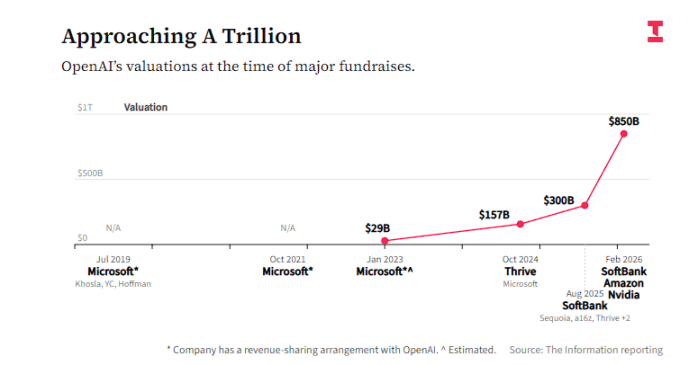
The respondents generally adopted a cautious stance towards this IPO, with core concerns集中在two points:一是unclear profit prospects—OpenAI itself predicts that it will continue to burn cash until at least 2030;二是excessive valuation—the company is currently completing a new round of financing at an $850 billion valuation, equivalent to 28 times the expected revenue for 2026, far exceeding Nvidia's price-to-sales ratio of approximately 12 times.

The report stated that the "cold" market sentiment reflects the deep-seated矛盾faced by this potential largest IPO in history: investors generally recognize OpenAI's leading position in the AI competitive landscape but remain reserved about whether it can achieve reasonable pricing in the public market. At the same time, the strong rise of competitor Anthropic is further分散investors' attention and enthusiasm.

Valuation Controversy: 28x Price-to-Sales Ratio, Where's the Premium?

OpenAI is currently completing a new round of financing at an $850 billion valuation, with participants including Nvidia, Amazon, and SoftBank. This figure has already made many public market investors hesitant, and its IPO pricing may be even higher届时.

Based on the expected revenue for 2026, $850 billion corresponds to a price-to-sales ratio of approximately 28 times. In comparison, Nvidia, regarded as a benchmark for AI investment, currently has a price-to-sales ratio of about 12 times.
The report stated that Bob Lang, founder of trading firm Explosive Options,直言:

"I do think OpenAI is an excellent company with a strong moat, but I don't think any valuation on the first day of trading is a good deal for investors."

He said he would likely not participate in public market investment in OpenAI, especially given its higher valuation multiple than Nvidia.

Lang also pointed out that the real beneficiaries of this IPO will be those early investors and hyperscale cloud computing companies that already hold shares—they will use this as an opportunity to cash out.

Well-known short-seller Jim Chanos used Nvidia as a reference point to question OpenAI's valuation logic:

"Nvidia basically has a monopoly on the market, with rapid growth, extremely high profit margins, and ample cash flow. So why would you give OpenAI a higher valuation?"

Path to Profitability: Burning Cash Until 2030, Will the Public Market Accept It?

According to the report, OpenAI itself predicts that the company will continue to incur losses until at least 2030. This timeline makes public market investors, accustomed to scrutinizing profitability, quite uneasy.

Some investors worry whether the funds raised from the IPO can support OpenAI until it reaches profitability, or whether it will still need to raise funds again届时, thereby diluting existing shareholder equity.

Mark Malek, Chief Investment Officer of Siebert Financial, stated that even if OpenAI finds it difficult to achieve significant profitability in the short term, he would still consider building a position after the IPO, but would strictly control the position size—this is the same strategy he used when investing in Palantir.

Palantir currently has a high price-to-sales ratio of 49 times, with growth far exceeding peers, but Malek believes Palantir's risk is still lower than OpenAI's because its cost structure is more flexible.

"If Palantir loses a government contract, that's bad, but they can lay people off. If you spend five years building a data center, you can't say 'forget it, don't want it anymore.' Palantir is driving a Formula One car, while OpenAI is driving a fully loaded freighter."

Analysts at J.P. Morgan noted in a report this January that OpenAI's move to introduce ads in ChatGPT helps retain users, but also observed that客户sentiment towards OpenAI was "mixed" after the company announced large-scale chip and data center spending plans.

Not everyone is观望—some investors have explicitly stated that once OpenAI goes public, they will consider shorting its stock, betting that the public market's tolerance for its long path to profitability is limited.

Chanos holds a similar position. The core logic he conveys to clients is: "You should be long the output of chips, short the places where chips are stored." The implication is that operating data centers itself is not a high-return business, and OpenAI's business model is highly dependent on large-scale computing infrastructure investment.

Chanos also pointed out that there is a severe lack of financial information about OpenAI on the market currently, making in-depth analysis difficult. But he expects that once OpenAI formally submits its IPO application, the public market will engage in fierce debate over its competitive landscape:

"Is this a winner-take-all, or is the market fragmented like cloud computing? Or like search engines, where one company becomes the standard and maintains it for a long time? For now, the various models are still constantly surpassing each other."

Anthropic's Disruption: Competitor Diverts Funds and Attention

OpenAI's path to an IPO also faces potential pressure from competitor Anthropic.

At this week's Morgan Stanley Annual Technology Conference, Anthropic CEO Dario Amodei disclosed that the company's annualized revenue run rate has doubled to $20 billion. Anthropic recently completed a new round of financing with a valuation of $380 billion, and its enterprise products like the AI programming tool Claude Code are seeing strong sales momentum.

The Information previously reported that Anthropic expects its cost expenditures on AI model training and operations in the coming years to be significantly lower than OpenAI's. Some investors are beginning to believe that,凭借success in the enterprise customer market—customers who are willing to pay a premium for AI services—Anthropic's long-term profitability may be better than OpenAI's.

As Anthropic also prepares for an上市, the IPOs of the two companies could form a competition, further分散investors' funds and enthusiasm. Investors like Chanos have explicitly stated a preference for Anthropic's relatively restrained computing power investment strategy, viewing it as a more prudent and sustainable business path.


Twitter:https://twitter.com/BitpushNewsCN

Bitpush TG Discussion Group:https://t.me/BitPushCommunity

Bitpush TG Subscription: https://t.me/bitpush

Original link:https://www.bitpush.news/articles/7618438

Пов'язані питання

QWhat are the main concerns of public market investors regarding OpenAI's potential IPO?

AInvestors are primarily concerned about two issues: OpenAI's unclear profit prospects, as the company predicts it will continue to burn cash until at least 2030, and its high valuation of $850 billion, which represents a price-to-sales ratio of 28 times its projected 2026 revenue, far exceeding Nvidia's ratio of about 12 times.

QHow does OpenAI's valuation multiple compare to Nvidia's, and why is this a point of criticism?

AOpenAI's $850 billion valuation implies a price-to-sales multiple of about 28 times its projected 2026 revenue. This is significantly higher than Nvidia's multiple of approximately 12 times. Critics, like short-seller Jim Chanos, question this valuation by pointing out that Nvidia has a near-monopoly, rapid growth, extremely high profit margins, and strong cash flow, making OpenAI's higher multiple difficult to justify.

QWhat is OpenAI's own projection for its path to profitability, and how do investors react to this timeline?

AOpenAI itself predicts that it will continue to burn cash and operate at a loss until at least 2030. This extended timeline to profitability makes public market investors, who are accustomed to scrutinizing profitability, quite uneasy. Some worry that funds raised from an IPO may not be sufficient to reach profitability, potentially requiring further financing that would dilute existing shareholders.

QWho does the article suggest would be the real beneficiaries of an OpenAI IPO?

AThe article suggests that the real beneficiaries of an OpenAI IPO would be its early investors and the large cloud computing companies that are already shareholders. These parties would use the IPO as an opportunity to cash out and realize gains on their investments.

QHow is the competitor Anthropic potentially impacting investor sentiment towards OpenAI's IPO?

AAnthropic is seen as a strong competitor that is diverting investor attention and capital. Its annualized revenue run rate has doubled to $20 billion, it has a lower projected cost structure for model training and operations, and some investors believe its long-term profitability could be superior to OpenAI's due to its success with enterprise clients. This competition could split investor interest and enthusiasm between the two companies as they both prepare for potential IPOs.

Пов'язані матеріали

The King of Blind Date Attire in Korea: How SK Hynix Made a Comeback Against Samsung?

In South Korea's dating scene, SK Hynix employees are now highly sought after, a status shift fueled by the company's astronomical profits and employee bonuses, projected to reach up to 6.1 million RMB per person by 2027. This marks a dramatic reversal for the long-time second-place player in memory semiconductors, which has now surpassed its rival Samsung in annual operating profit. The turnaround story began in 2008 when a struggling Hynix, emerging from bankruptcy restructuring, took a risky bet by agreeing to develop High Bandwidth Memory (HBM) with AMD. At the time, HBM had no clear market beyond high-end graphics cards and was a costly, complex technology. Major players like Samsung, pursuing its own HMC technology, declined. For Hynix, with only memory as its core business, it was a gamble born of necessity. The pivotal moment came in 2012 when SK Group Chairman Chey Tae-won acquired Hynix. Defying industry downturns, he invested heavily in R&D and fabrication, sustaining the HBM project through over a decade of commercial uncertainty and internal challenges. A key break occurred around 2016-2017 when Samsung faced production issues supplying HBM2 for Google's TPU, allowing SK Hynix to gain a crucial foothold in the data center market. The AI explosion post-ChatGPT in 2022 was the catalyst, turning HBM into a critical bottleneck for AI accelerators like NVIDIA's GPUs. By 2025, SK Hynix captured 62% of the global HBM market, leaving Samsung at 17%. For the first time, its annual operating profit exceeded Samsung's. Analysts point to the "innovator's dilemma" to explain Samsung's miss: its vast, successful business portfolio made it risk-averse, preventing an all-in bet on the initially niche HBM technology. In contrast, SK Hynix, as a challenger with its back against the wall, had no choice but to commit fully. The story highlights how Korea's chaebol system allows for ultra-long-term bets beyond quarterly pressures. However, SK Hynix's lead isn't guaranteed. Samsung is aggressively catching up on HBM4, and challenges like customer concentration (heavy reliance on NVIDIA) and technical hurdles in advanced packaging remain. The narrative underscores a market truth: the greatest alpha often comes from betting on uncertain, long-term directions others dismiss, much like HBM in 2008.

marsbit29 хв тому

The King of Blind Date Attire in Korea: How SK Hynix Made a Comeback Against Samsung?

marsbit29 хв тому

Understanding Hash in One Article: The "Browser Miner" on Ethereum

Hash is an Ethereum-based ERC-20 token described as a "browser-minable post-quantum token." Its key features include enabling browser-based GPU mining without specialized hardware, a fixed supply cap of 21 million tokens, immutable and permissionless smart contracts with no team allocation or pre-mining, and an emphasis on post-quantum security using Keccak256 hashing. The mining mechanism is a simplified on-chain proof-of-work where miners solve unique challenges tied to their wallet address. Key design elements prevent answer theft, with epochs resetting every 100 blocks (~20 minutes) and a per-block minting limit. Emission follows a Bitcoin-like halving schedule every 100,000 mints, starting at 100 tokens per mint. Projections suggest all tokens could be mined within approximately 294 days if a target rate of one mint per minute is sustained. Hash emphasizes "post-quantum" security by leveraging hash-based primitives like Keccak256, which are considered more resistant to quantum attacks compared to elliptic-curve cryptography. While not a fully post-quantum asset, it aligns with Ethereum's broader post-quantum research narrative. The project completed its Genesis sale at $0.03 and began trading on Uniswap, with its price reaching around $0.19. The initial circulating supply is small, with 5% sold in Genesis and 5% allocated to liquidity. The majority (47.6% of total supply) is allocated to early-stage mining, leading to a front-loaded emission schedule. This structure, combined with low initial liquidity, makes Hash a high-volatility, high-risk project dependent on sustained miner participation and market demand to absorb new supply.

marsbit43 хв тому

Understanding Hash in One Article: The "Browser Miner" on Ethereum

marsbit43 хв тому

Торгівля

Спот
Ф'ючерси
活动图片





