Source: "The Diary Of A CEO"
Compiled by: Felix, PANews
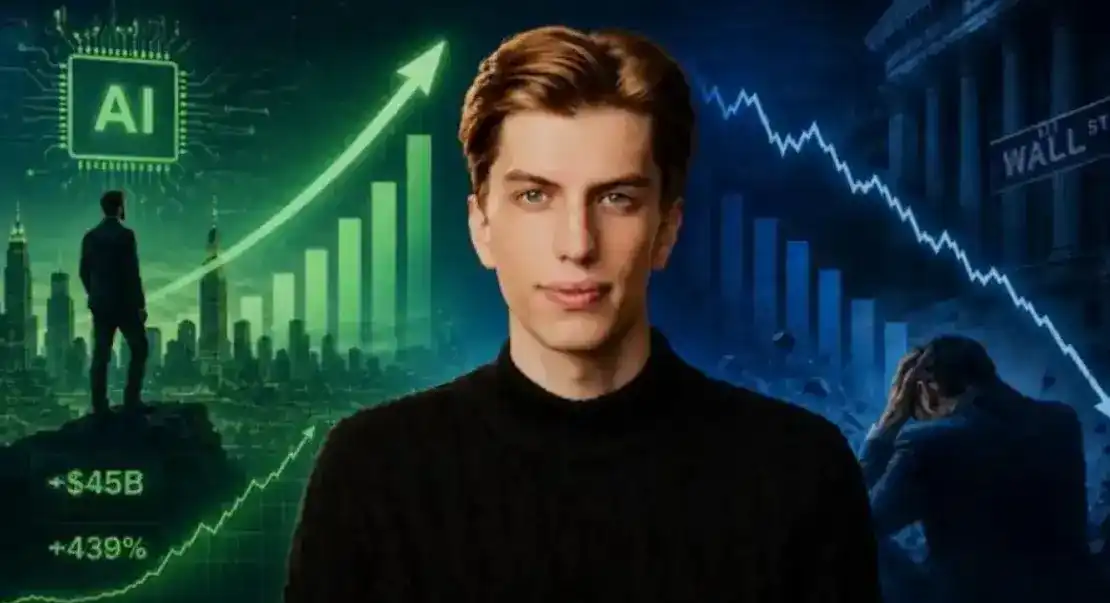
Michael Saylor, founder and executive chairman of the bitcoin treasury company Strategy, recently shared his experience of using AI for financial innovation and raising $15 billion in an interview with "The Diary Of A CEO." He used this to advise young people to learn to drive machines rather than compete with them. By comparing fiat currency with physical assets, he explained the inevitability of currency devaluation and asserted that Bitcoin is a superior long-term savings asset compared to gold and real estate.
Furthermore, Michael Saylor emphasized the importance of finding business opportunities at the "S-curve" inflection points during technological shifts. Finally, he proposed ten principles for building a solid foundation in life, encouraging people to cope with future uncertainties through continuous learning, critical thinking, and keeping promises.
PANews has compiled the highlights of the interview.

Host: Michael, you have achieved great success in the field of technology entrepreneurship. But I'd like to start with a question: I heard you raised $15 billion using AI last year, is that true?
Michael: Absolutely, this is a true story. It's because AI helped us solve a problem that no one in human history had ever encountered before. So I always advise young people: never try to outwork a robot in terms of volume of work. What you should do is guide AI to help you do something that has never been done before. If you want to achieve incredible success in today's era, you must locate that "magical opportunity."
Host: How exactly was this achieved?
Michael: In early 2025. At that time, Strategy held tens of billions of dollars worth of Bitcoin. To raise more funds to buy more Bitcoin, we had tried all traditional financing methods: we exhausted the equity market's funding limits and became the world's largest issuer of convertible bonds, even pushing the convertible bond market to its limits. In other words, if we couldn't create a new type of security or credit instrument, our growth would stall.
So, I turned to AI and began deeply exploring how to design a Bitcoin-backed preferred stock. For ordinary people, preferred stock is a hybrid security; you can give it any terms you like. You can include a put option to make it look like debt, or include a conversion right to make it look like equity.
Host: How did the Wall Street lawyers and bankers react to this?
Michael: Their responses were all the same: "No one has ever done this before, others aren't doing it, so we don't think you should." But to survive, we had to think outside the box. Our goal was to create a short-term credit instrument whose trading price would remain stable around $100 (par value), unaffected by interest rates and market fluctuations, similar to a money market instrument where investors could safely earn returns. And the only way to achieve price stability was to adjust the dividend rate monthly.
In human history, no one had ever created a preferred stock with a variable dividend rate. Was it illegal? No. It's just that no one had thought of it before, and no one had a reason to do it. We asked ChatGPT: "Can we do this?" AI gave a positive answer and designed the specific terms and path in great detail for us.
In the end, we took this design (a preferred stock named STRK) to the market, completed a $250 million IPO (the largest IPO this year), and subsequently issued an additional $8 billion. Including other instruments, we sold a total of $15 billion worth of credit assets. That's the story of using AI to create $15 billion in capital out of thin air.
Host: This is an incredibly impressive case of "intelligent arbitrage." Currently, only 2% of households have subscriptions to ChatGPT or AI. Does this mean ordinary people also have huge commercial arbitrage opportunities?
Michael: If you are an entrepreneur aspiring to create value, without a doubt, you must be proficient in using one or more AI tools. They are fundamental tools, just like computers, reading, or writing. On top of that, you need to combine specific industry expertise, using AI to completely reshape existing products or services, or to create something new.
Host: What is your core mission now? For ordinary people, what is the "essence of money" they least understand? Many ordinary people think that if they have $10,000 in the bank earning 4% interest annually, they can live comfortably.
Michael: My mission is to preach digital empowerment and Bitcoin to the world. Bitcoin is digital currency and will be the best capital asset in the long run. Its greatest feature is that: you can truly own it, and no force in the world stronger than you can take it away.
Let's look at traditional fiat currency (cash). If you try to pass through airport security with a stack of US dollars, they can directly confiscate it if they question and discover it. If you deposit money in a bank for safety, then the bank (as the counterparty) will decide whether you can keep it, whether you can withdraw it. If you try to withdraw too much cash in a short time, they will file a report with the Treasury Department, and someone might even knock on your door. Furthermore, if you want to transfer money to someone in another country, you may need approval from your bank, the recipient's bank, the central banks of both countries, and intermediary banks—potentially seven different banks. This is a "permissioned currency" strictly controlled by the state and bureaucracy.
Host: What about inflation and currency devaluation?
Michael: This is precisely what 99% of ordinary people fail to realize. About 100 years ago (1926), one acre of waterfront land on Miami Beach sold for $10,000 (I have a house there, with the original deed; two acres for $20,000, the entire house for $100,000). Today, on the same Miami Beach, that one acre of land is worth $10 million or even $20 million.
The same US dollar has increased in price by 1000 times. This means that over the past 100 years, the world's strongest, most excellent fiat currency—the US dollar—has been losing its purchasing power at a rate of about 7% per year. If you lose 7% of value each year, your wealth is roughly halved every decade. And this is the most perfect scenario! If you go to other developing countries, where fiat currencies depreciate by as much as 14% annually, they collapse completely in about 30 years (e.g., hyperinflation in Brazil, Argentina, Mexico). So, putting your wealth into cash or a bank is equivalent to losing all your savings within 10 to 30 years.
Host: So, the traditional mindset we're taught—"graduate from university, get a 9-to-5 job, save money to buy a house"—is that not a good wealth accumulation strategy? Should we buy houses?
Michael: Buying a house can only be considered a viable wealth strategy in very few regions with extremely low property taxes and good governance. In most places, due to high mortgage interest rates (up to 7%), heavy taxes, and insurance, buying a house might directly destroy you.
Take Florida as an example, which has a 2% property tax. This means that every 36 years, you pay the full cost of that house again to the government in the form of property taxes. Plus, you bear high maintenance costs. So residential property is not a good store of value. Commercial real estate is slightly better because you can pass on taxes, insurance, and maintenance costs through rent. Even if the rent itself isn't profitable, the underlying land appreciates by about 7% annually. But all this is too complicated for ordinary people. Why should you be forced to become a real estate expert, tax expert, or stock-picking master?
Host: What about gold and the S&P 500 index?
Michael: Over the past 6 years, gold has delivered annualized returns of about 12%, the S&P 500 about 15%, the Nasdaq about 18%, and Bitcoin about 33%.
Gold and the S&P 500 aren't bad choices. The S&P 500 index (via ETFs like SPY) has had an annualized return of about 10% over the past 100 years. It can help you offset the invisible 7% annual depreciation of the dollar and provide an additional 2% to 3% gain. However, the problem is that these are all privilege assets of the Western world. If you live in Turkey, Argentina, Brazil, or Africa, you simply cannot easily buy the S&P 500, QQQ index, or premium US real estate.
Therefore, Bitcoin is the world's only universal capital asset. More importantly, you shouldn't invest your family's wealth in non-capital assets, like soybeans, crude oil, or cotton, because robots and AI can produce these things infinitely. You must invest in scarce assets that AI, robots, and large factories cannot infinitely replicate or create out of thin air: like an ounce of gold, shares of the world's best 500 companies, and the globally limited 21 million Bitcoins.
Host: Elon Musk once proposed a view on the "Age of Abundance." He said that in the future, AI and robots could satisfy all human material needs. Work would become purely voluntary, driven by interest. Money, as a database for labor allocation, would rapidly decline in importance. Do you agree with this view?
Michael: He is only half right. Consumer goods, consumables, and utilitarian commodities (like clean water, electricity, basic healthcare, free entertainment, and food) will indeed become extremely cheap and abundant due to technological progress.
However, scarce, coveted, scarce assets will never become cheap and abundant. Technology can make water, chocolate, and ice cream affordable for everyone. But technology cannot give everyone a mansion in the Hamptons, a private jet, or a superyacht. Humans are inherently status-oriented animals. There will always be a hierarchical pursuit of social status, exclusivity, and affluent class.
For example, in a restaurant, water is a free, ordinary drink. But if you have money, you might spend $5 on a Coke; with more money, you order vodka, premium tequila, and finally, people are willing to spend $38 on a custom cocktail. If the state gave everyone a basic house, some would definitely want one twice as big. If everyone went skiing, people would compete for the slope with the best snow and the fewest people. Therefore, money will never disappear because human desire for exclusive scarce resources is endless.
Host: Since knowledge work will also be replaced by AI and robots in the future, if an 18-year-old young person asked you now: "What should I study in university? What should I avoid?" How would you answer?
Michael: One of the most important concepts in the history of science is the S-curve. In the early stages of the S-curve, a technology may make no progress for hundreds or thousands of years (like humans couldn't fly before 1903). But once it passes a critical point, it experiences explosive growth. In just over 60 years, humans went from 20 mph airplanes to manned rockets landing on the moon. However, by the mid-1970s, when the Boeing 737 and 747 were designed, aviation technology hit the ceiling of physics and propulsion technology. Fifty years later, today's airplanes are only about 15% more efficient than those in 1975.
The biggest mistake in school is to start learning something when its S-curve is already in its terminal phase, entering diminishing marginal returns. Once a technology enters a stagnation phase, there might be no substantial breakthrough for the next 100 years. For example, smartphones (iPhone): since the iPhone 6 or 7, its form factor, thickness, and battery technology haven't seen real qualitative changes for many years; it's also at the end of its S-curve. So, you should learn about digital intelligence and digital assets.
Host: What about traditional professions? Like doctors, lawyers, accountants?
Michael: Don't become a surgeon, don't become a lawyer, don't become an accountant, and don't become a driver. Because these jobs are essentially ones that AI can easily replace. You don't need to learn skills that AI can perform; instead, learn how to ask AI a frontier question that has never been answered in the history of civilization.
For content creators and ordinary workers, the only moat that can be built is to pursue things that are extremely difficult and scarce. For example, using AI to accurately translate and distribute content into 100 languages. In an era of technological explosion, there will always be a group of geniuses who, within the first 10 years of a technology's birth, push it to the extreme and leave their mark (like Beethoven with the piano, Zuckerberg with the internet). What you need to do is precisely locate that "0 to 1" opportunity the moment the technology just becomes commercially viable, and go all-in.
Host: The younger generation today often feels very anxious, frustrated by not getting rich quickly, and frequently changes careers. But Strategy has been operating for nearly 40 years. In today's impatient era, can long-termism still provide a competitive advantage?
Michael: Absolutely. Look at Elon Musk. All his businesses are interconnected and built upon each other: he solved rocket launch and cheap orbital costs, then gained an absolute advantage in launching Starlink satellites, then used Starlink to meet global satellite internet needs, while applying batteries and supercharging networks to Tesla.
In nature, there is a very elegant growth model called the nautilus. It grows outward along the Fibonacci spiral, each growth extending on the previous shell structure. This is the most stable and perfect growth scheme under pressure in nature.
The healthiest growth strategy is to always naturally extend and expand functionality on top of the stable foundation you already have. When your second business has no relation to your first, simply because they both belong to you, you are essentially building a tower on sand, which is highly unstable. All great companies in the world (Standard Oil, Ford, Boeing, Microsoft) were built on existing loyal customers, distribution networks, or financial assets.
Take Amazon (Amazon Prime). It withstood overwhelming external criticism of "losing money" for a full decade to build a free and ultra-fast logistics and distribution system. Once that moat was completely built, they merely issued a simple price increase notice (charging $10 more per month) and instantly created $12 billion in annual net cash flow, unleashing $250 billion in market value.
Host: I heard you have a list of "10 Golden Rules" for young people to build a strong foundation for life and career in today's society. What's the story behind this?
Michael: Yes. I was once invited to a billionaire's yacht cocktail party on the French Riviera. During it, another billionaire who had just had twins came over and said, "Michael, I'm collecting advice from the best people around me to give to my children on their 21st birthdays as a coming-of-age gift. Please write a few for me too." So I sat down and seriously condensed the following 10 principles:
Focus Your Mind: Concentrate your energy. Never blindly chase every good idea when you're young; that will dilute and destroy your core competence.
Cherish Time: Time is your most precious, non-renewable asset.
Train Your Mind: Study basic knowledge diligently, read widely, and build a deep, diverse cultural and intellectual foundation.
Strengthen Your Body: If your body is weak, you won't survive in brutal competition.
Learn to Think Independently: Everyone, media, and machines in this world are trying to brainwash you, to make you believe what they want you to believe. You must always stay alert and exercise judgment.
Choose Friends Wisely: You become who you associate with. Spend more time with positive, talented, inspiring people, and stay away from negative, pessimistic, and failing people.
Choose Your Environment Wisely: Create a work and living space filled with joy and sunshine for yourself. Don't let yourself fall into dark, ugly, and depressing situations.
Keep Promises: Break trust once, and it's hard to recover for life. People only invest resources in those who are absolutely trustworthy. Whether you keep your word often determines your life-or-death success at critical moments.
Maintain Optimism and a Constructive Attitude: No matter how bad things get, stay optimistic. Because everyone desires to work or associate with happy, constructive people.
Transform the World: Wake up with a mission to transform the world. Satoshi Nakamoto, through Bitcoin, gave 8 billion people worldwide true economic sovereignty and the perfect digital asset. That is the greatest transformation.
Host: Michael, on behalf of all viewers, let me ask the sharpest and most commented question: You once urged people to "even sell a kidney to hold Bitcoin if necessary." But just recently, you sold some Bitcoin on the market, which has shaken many believers. Why didn't you sell a kidney but sold Bitcoin instead?
Michael: This is an excellent question, and I'm happy to clarify. First, one thing must be made clear: In all of human history, aside from the inactive Satoshi Nakamoto (who holds over 1 million Bitcoins), no individual or entity holds more Bitcoin than our company. Our company holds a staggering 847,000 Bitcoins.
The reason we chose to sell a very small amount of Bitcoin a few weeks ago was to shatter a very dangerous, almost collectively delusional negative narrative in the market.
At the time, short-sellers and skeptics in the market fabricated a rumor: because Strategy holds up to 4% of the global Bitcoin supply, we are so deeply tied to the Bitcoin system that we "can never sell." They claimed that if Strategy sold any single Bitcoin, the entire Bitcoin price and Strategy's stock price would instantly plunge to zero. Based on this absurd logic, short-sellers concluded that our $55 billion Bitcoin assets were worthless, Strategy would be unable to pay preferred stock dividends, leading to a "death spiral" of debt, credit, and equity collapse.
Host: It sounds like someone was holding you hostage with credit.
Michael: Exactly. When someone firmly believes you cannot perform a "backflip" and threatens to send you to jail for it, the most effective way to counter is to perform a perfect backflip right in front of them.
Bitcoin's daily trading volume exceeds $20 billion. Even selling a tiny portion of our $55 billion assets wouldn't have any material impact on the market price. To break this "death spiral," we sold enough Bitcoin to cover the preferred stock dividends when Bitcoin was around $59,000 to $60,000. The result? Bitcoin's price didn't fall; it rose instead, instantly debunking the rumor.
This proved one point to the market and credit investors: our break-even point is approximately a 3.2% appreciation. As long as Bitcoin appreciates more than 3.2% annually, we can permanently pay dividends by selling a minimal amount of Bitcoin, without needing to issue more shares and dilute Strategy's common stock equity. This gave both our equity and debt a rational and premium trading performance, successfully protecting all shareholders and credit investors. Selling Bitcoin is by no means our primary strategy; we merely commercialized the operational mechanism of the digital credit market.
Host: So, where do you see Bitcoin's ultimate future? For a 25-year-old with only a few hundred dollars to invest, aside from buying an AI subscription, how should they face the future wealth transformation?
Michael: I predict that Bitcoin will maintain an annual appreciation rate of about 30% for the next 20 years, then slow to about 20% annually thereafter. Its performance will be 1.5 to 2 times that of the S&P 500. If you only have a little spare money, besides consistently spending $20 monthly to arm your brain with the best AI subscription, any surplus long-term funds should be firmly invested in digital capital (i.e., Bitcoin).
Host: Following our tradition, the previous guest left an anonymous question for you: "What is one thing in your life that you firmly believe in, but may have rarely spoken about publicly, and 99% of the world does not believe it?"
Michael: This is a question that deeply moves me. Looking back on my life, after completing my university education, the thing that affected me most profoundly and is ignored by 99% of people was my independent, in-depth study of two subjects as an adult:
The first is: practical "Applied Statistics." Especially the complete works by Nassim Nicholas Taleb: "Fooled by Randomness," "The Black Swan," and "Skin in the Game." These books completely taught me how to distinguish between truly meaningful data and misleading random noise. Today, this is a decision AI absolutely cannot make for you.
The second is: spending time reading Will Durant's monumental work "The Story of Civilization." The history taught in schools is mostly a fragmented, simplified version. When you, as a mentally mature adult, read these 14,000 pages covering art, culture, politics, military, and technology in a complete, synthesized way, you gain unparalleled awe and wisdom about human civilization.
You'll be astonished to find: Everything you think is great, new, and profound in this era has actually been discovered and repeated hundreds or thousands of times in civilizations as early as 15th-century Russia or even earlier. For example, people exclaim that Nixon's abandonment of the gold standard in 1971 marked the beginning of human currency devaluation. But history coldly tells you: Throughout all of human history, every country, every fiat currency, eventually moves towards endless devaluation and self-destruction.
Relearning history and mathematics as an adult completely shatters youthful arrogance, making you realize you are never the first person in human history to encounter these pains and challenges. Our predecessors have already pointed the way forward for us; that is the most powerful spiritual nourishment.
Related reading: Michael Saylor's latest long-form article: Bitcoin is not money; it's digital capital. Money will be built upon it.