Meme Coin with $60 Million Market Cap Plunges 65% in One Minute, FOMO Faces Renewed Scrutiny

marsbitОпубліковано о 2026-08-05Востаннє оновлено о 2026-08-05

Анотація

A Solana-based meme token, $CATE, which had surged from a $20M+ to over $80M market cap in about a week, experienced a dramatic 65% crash within one minute. This flash crash has intensified scrutiny on the trading app 'fomo' and highlighted the speculative nature of the current meme coin market. The crash coincided with two events: the token's X account being suspended and the fomo app experiencing downtime, preventing users from trading. While the X suspension was straightforward, the fomo outage raised significant questions. $CATE's primary narrative driver was the open endorsement by Poorgoat, a top-ranked trader on fomo with over 200,000 followers, who had turned a ~$45,000 investment into over $2M at the peak. The token itself had no novel fundamentals, being a "cat sister" to Doge, a concept already existing on Ethereum without success. The crash, triggered by less than $1.5M in selling volume despite over 60,000 holder addresses, exposed a harsh reality: purely "organic" community-driven meme tokens (excluding past successes like $SPX) may now have a market cap ceiling around $17M, as exemplified by the long-term chart of $neet. This incident has fueled existing controversies surrounding fomo. Critics have grown skeptical of the app, alleging that rankings dominated by KOLs who receive lucrative token airdrops could be manipulated to create "pump-and-dump" schemes, luring in retail users before a rug pull. The timing of the crash during fomo's outage—preventing many...

$CATE, one of the most talked-about meme coins on Solana lately, skyrocketed from a market cap of just over $2,000 to over $80 million in a little over a week, only to crash 65% in one minute early yesterday morning:
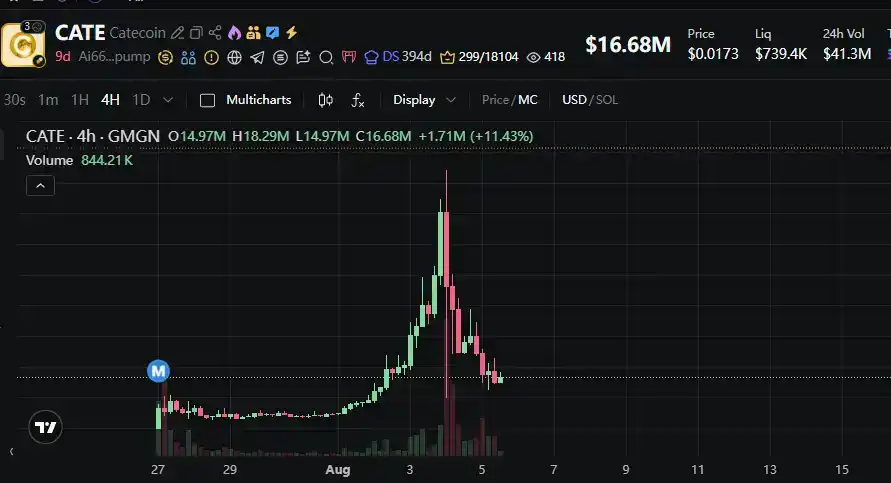
For seasoned on-chain veterans, such a price movement in a meme coin isn't surprising. However, witnessing it happen to a high-profile token like this is quite dramatic and serves as another stark reminder of some harsh realities in the current market.

Harsh Realities

Let's start by examining why this coin crashed. The community has identified several potential reasons:

- $CATE's X (Twitter) account was suddenly suspended.

- FOMO experienced downtime, preventing users from trading during the outage.

The account suspension is self-explanatory, but why would FOMO's downtime cause such a crash?

Because, much like $ANSEM rode on Ansem's clout and explicit support, $CATE's rise was largely fueled by the influence and open backing of "mini-Ansem" Poorgoat.

Poorgoat, a member of the FOMO Hall of Fame (recognized by FOMO for achieving significant profits on the platform) and currently topping FOMO's 7-day profit leaderboard while ranking 2nd on the 30-day board, entered $CATE at an average market cap of around $1.4 million, with a total investment of approximately $44,700. At the coin's peak, this single trade alone netted him over $2 million in profit.
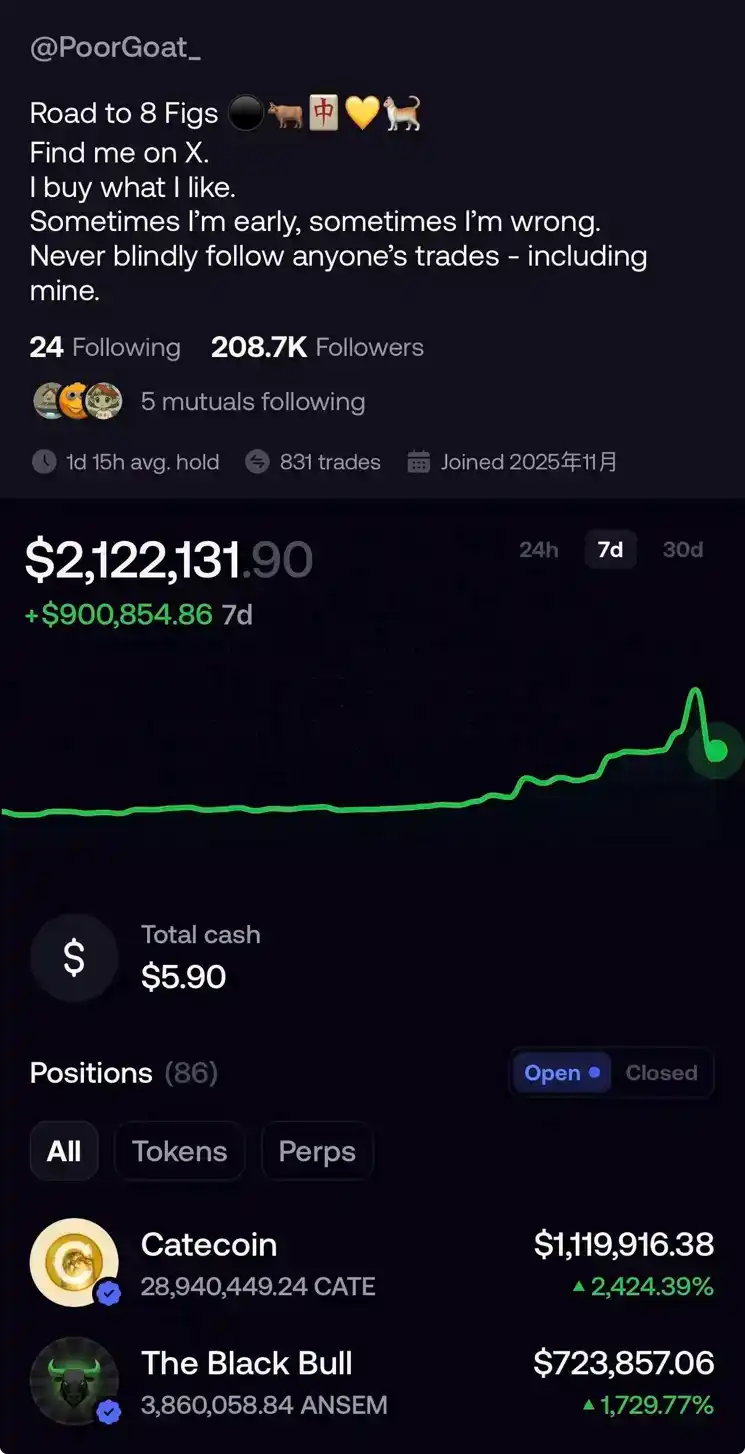
He gained fame by holding onto a $30,000 $ANSEM airdrop, which ballooned to nearly $1.75 million at its peak. Now, he has amassed over 208,000 followers on FOMO.

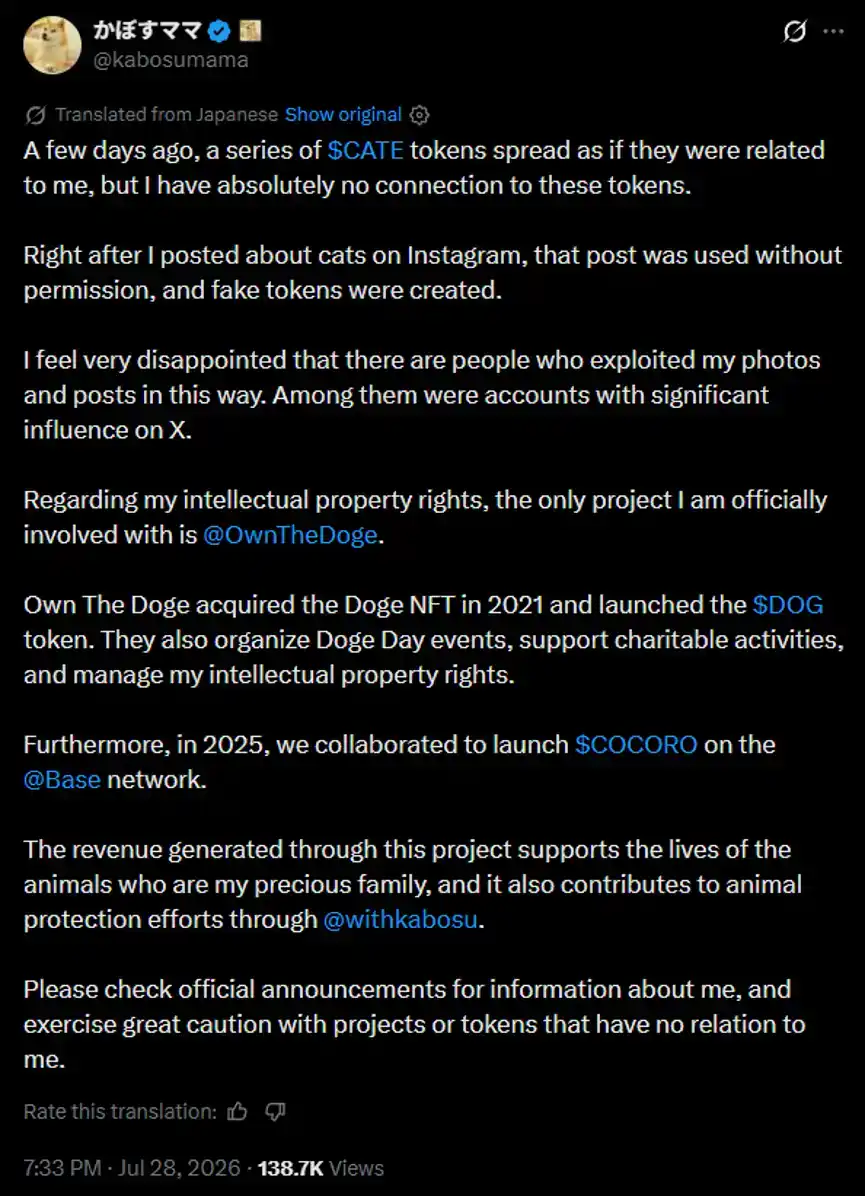
Given this context, it becomes clear why FOMO's downtime is seen as a major catalyst for the crash—fundamentally, the coin's narrative was nothing new, positioning itself as the "cat sister" to Doge. In fact, Doge's creator even publicly denied any association with the token:
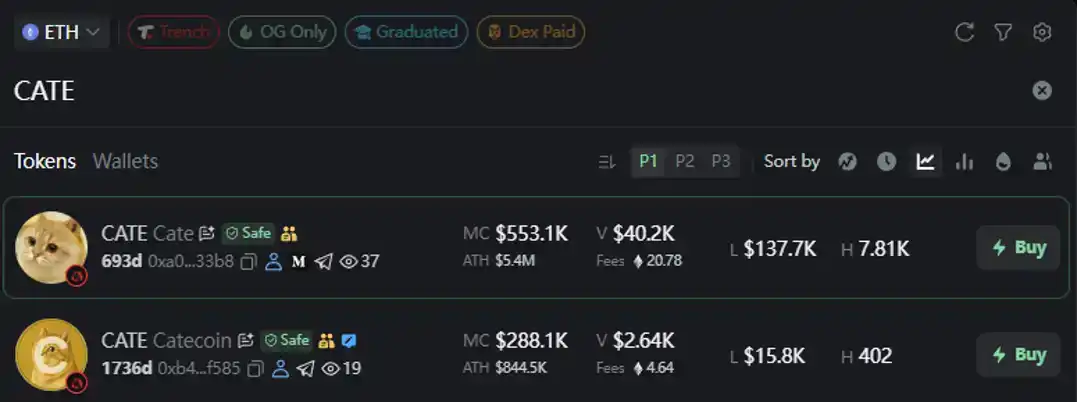
Moreover, a token with the same narrative has existed on the Ethereum mainnet for quite some time, showing no signs of revival:
Adding to the controversy surrounding this crash is the fact that Poorgoat, FOMO's current top influencer, effectively became the Chief Token Officer (CTO) for this coin, publishing a lengthy post on X arguing that the token's growth was "organic":
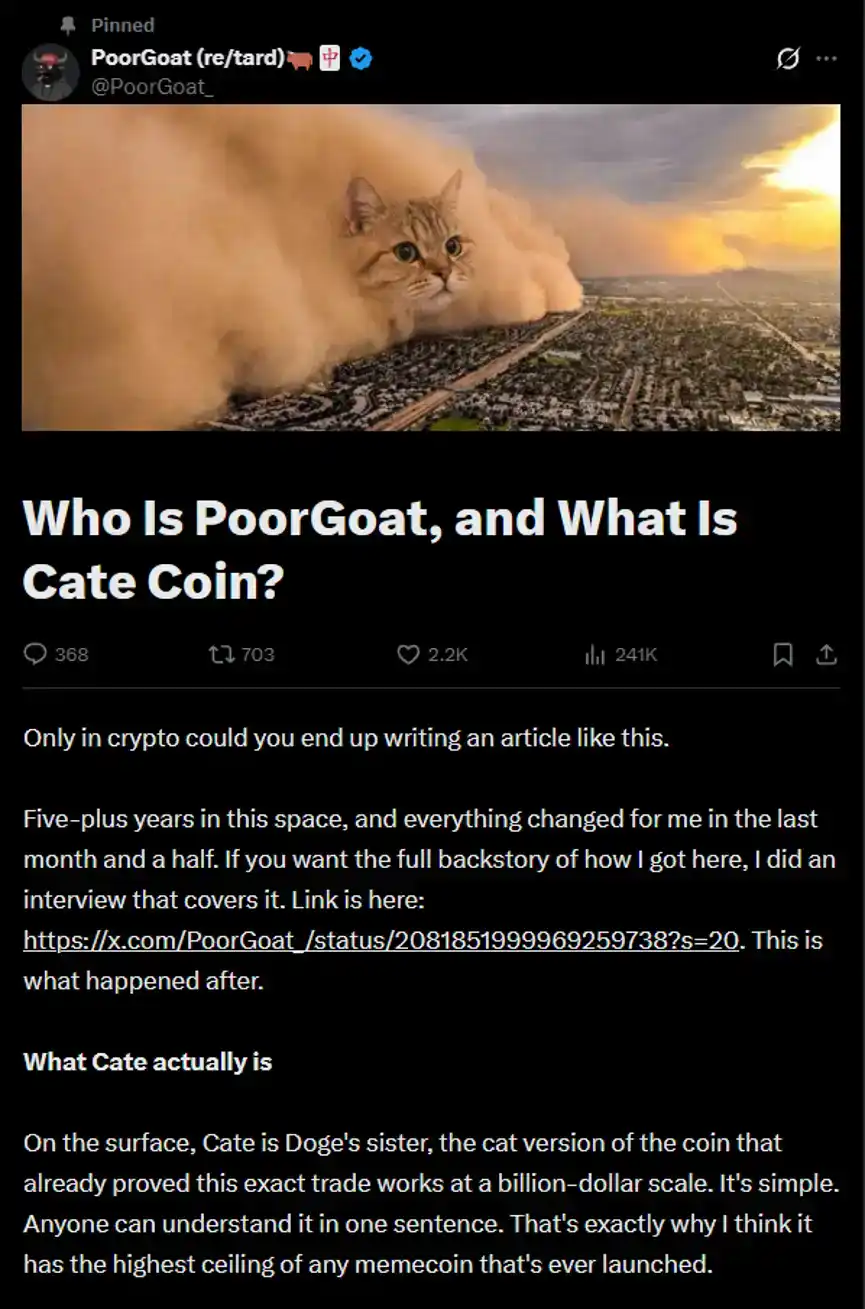
Yet, this supposedly "organic" coin, still boasting over 60,000 holder addresses, plunged more than 60% in one minute due to selling pressure of less than $1.5 million:

This brings us to the harsh reality we mentioned. In the current market, the ceiling for any token that follows the traditional "organic" community-building path (excluding past successes like $SPX, $MOG that left a strong impression) might be limited to around $17 million, similar to $neet's current market cap. We won't delve too deep into why $neet is considered organic; its price action over the past 460+ days speaks for itself:

Next, let's discuss why FOMO is facing such significant backlash this time.

Fame Brings Scrutiny

Earlier this year, when the 6000x-in-a-week "Nietzsche Penguin" $PENGUIN propelled trader logjam (now with ~138k followers on FOMO) to fame, the community largely admired and celebrated his success. At that time, logjam profited around $564,000 from $PENGUIN, and no one doubted his achievement; it was met with recognition and well-wishes.

However, controversies began to swirl around FOMO following the rise of $UNC, the pioneer of the "airdrop wealth creation" playbook later used by $ANSEM, where airdrops were distributed within a small circle to pump the price. Many recipients of these airdrops were active KOLs on FOMO. Their resulting profits, prominently displayed on FOMO's leaderboards (dominating weekly and monthly charts), essentially turned them into walking billboards for these airdropped tokens. Consequently, some users started suspecting that FOMO's data might be manipulated, suggesting collusion among KOLs to create "pump-and-dump" schemes aimed at attracting more users to the app, only to let the KOLs exit and leave others holding the bag.

Regardless of whether such insider dealings actually exist, the mere possibility fuels user resentment, a sentiment also vividly reflected in the BSC ecosystem. Moreover, the most fitting explanation found for $CATE's crash is "FOMO was down." It's not just that users felt a FOMO-related token being untradable was a major negative. The timing was simply too coincidental, leading many to believe it was a pretext to trap and liquidate users who primarily trade via FOMO.

Currently, $CATE still has over 60,000 holder addresses. FOMO's data shows over 38,400 of these holder addresses, meaning more than 60% of holders are from FOMO. If a significant portion of these addresses were mass-created by FOMO itself, it becomes hard to dismiss allegations of manipulation. If not, then the hardest hit are still the retail investors on FOMO.

Another highly contentious point is that trader MarcellxMarcell (with nearly 40k followers on FOMO) "exited at the top" when $CATE's market cap was around $45 million. Although it was still possible to trade on-chain by exporting the wallet address during FOMO's downtime, the community questions: if you publicly bought in around a $30 million market cap, showing considerable confidence, why would you consider FOMO's downtime such a massive negative catalyst?

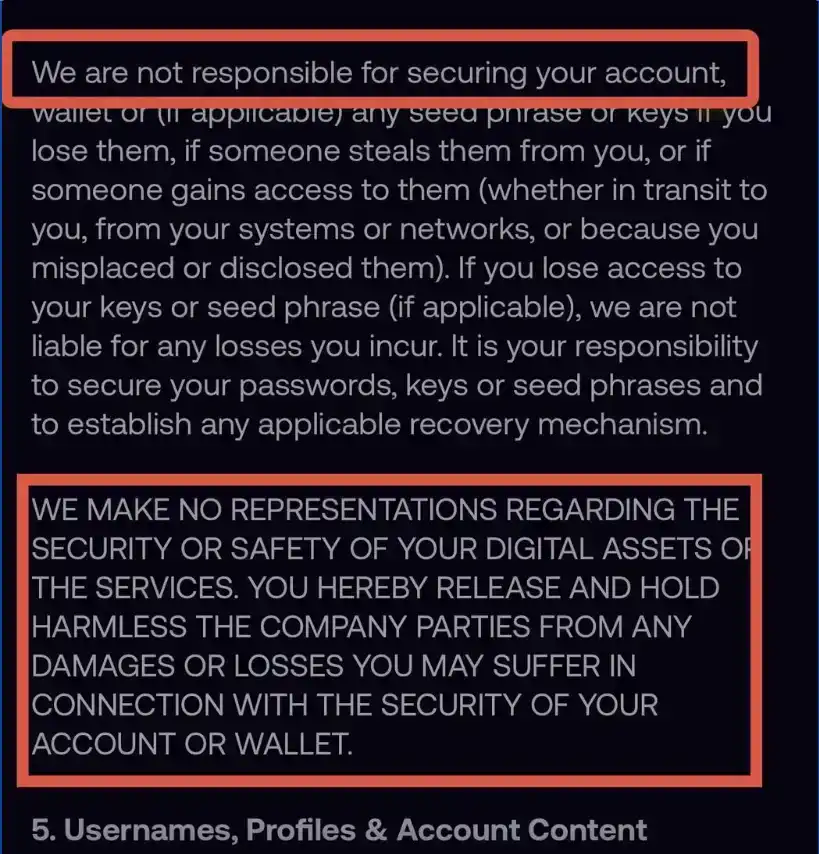
Recently, FOMO's updated terms of service explicitly state they do not guarantee the security of user assets. However, the process of exporting an address from FOMO—requiring logging into the FOMO page to obtain the private key—has also raised security concerns. Critics question whether FOMO transmits the private key to the webpage with sufficient encryption.
FOMO's official explanation points to overload due to a sudden surge in user volume, a reason many players find hard to accept. After all, the trading volume during that one-minute crash wasn't exceptionally high. "Come on, you raised $75 million in funding, and you get paralyzed by less than $5 million in volume over 5 minutes?"

Had users consistently used on-chain trading terminals like gmgn, they might have avoided this sudden, trapped liquidation.

Fame brings scrutiny, and the criticisms leveled at FOMO during its rapid growth are not entirely without merit.


Трендові криптовалюти

Пов'язані питання

QWhat is the primary reason suggested in the article for the flash crash of the $CATE meme coin?

AThe article suggests the primary reasons for the $CATE flash crash were the temporary suspension of its X account and, more critically, the fomo trading platform experiencing downtime, which prevented users from trading.

QWho is Poorgoat and what role did he play in the $CATE token?

APoorgoat is a prominent trader on the fomo platform, known as the 'little Ansem' and a member of its 'Hall of Fame.' He publicly supported and endorsed the $CATE token, acting as a key figure in its promotion and perceived legitimacy.

QAccording to the article, what is a major point of controversy surrounding the fomo platform after this incident?

AA major point of controversy is the suspicion that fomo's downtime during the crash was not coincidental. Some users believe it was a pretext to trap retail investors on the platform, allowing insiders or KOLs to sell their holdings, which fuels allegations of market manipulation.

QWhat does the article imply about the 'organic' growth narrative of certain meme coins in the current market?

AThe article implies that the current market severely limits the potential of meme coins claiming 'organic' community-driven growth. It suggests their market cap ceiling is relatively low, using $neet's ~$17 million cap as an example, compared to tokens heavily promoted by influencers on platforms like fomo.

QWhat alternative trading method does the article mention to avoid issues like those experienced with fomo's downtime?

AThe article mentions that using on-chain trading terminals like gmgn would allow users to avoid being trapped by platform-specific outages, as they enable direct blockchain transactions independent of any single app's functionality.

Пов'язані матеріали

On L1 Value Capture from Two Solana Proposals

The article, "Discussing L1 Value Capture Through Two Solana Proposals," by Max Resnick, explores how Layer 1 (L1) blockchain tokens derive their fundamental value, drawing parallels to traditional asset pricing theory. Resnick argues that L1 token value, like stock value, stems from claims on future income streams for holders, not merely from network activity or technological promise. This value is captured when fees are either burned (economically akin to a buyback) or distributed to stakers (akin to dividends). Inflationary staking rewards, by contrast, redistribute value among holders rather than creating it. The core challenge is the quality and defensibility of fee-based revenue. High-quality fees come from sustainable, recurring demand for the network's economic utility (e.g., long-term financial activity), not from transient speculation (e.g., meme coins, airdrops). The strength of a blockchain's network effects—liquidity, applications, users—can make its revenue more defensible and grant it greater pricing power than often assumed. The article proposes a foundational valuation framework for L1s, separating revenue (fees captured for token holders), costs, and total token supply. A key accounting principle is that inflationary rewards should not be counted as a cost unless the newly minted tokens are symmetrically counted as a value input; otherwise, it misrepresents profitability. Finally, Resnick discusses the economics of increasing protocol fees to boost revenue. Since revenue equals price times quantity, the net effect depends on demand elasticity. Research on Ethereum suggests transaction demand is somewhat elastic; a fee increase reduces volume. A uniform fee is a blunt instrument, as different transactions (e.g., small transfers vs. large settlements) have vastly different abilities to pay. The article suggests that transaction-value-based fees, potentially implemented via token programs, could be a more efficient way to capture value from high-willingness-to-pay activities. The discussion is framed around ongoing Solana proposals (SIMD-550, SIMD-553) but focuses on the universal principles of L1 value accrual.

marsbit1 год тому

On L1 Value Capture from Two Solana Proposals

marsbit1 год тому

Торгівля

Спот

Популярні статті

Що таке MEME 2.0

Memecoin 2.0: Поява $MEME 2.0 у світі криптовалюти Вступ У постійно змінному ландшафті криптовалюти з'явився новий претендент. Memecoin 2.0, що символізується як $MEME 2.0, підносить концепцію мем-криптовалют на захоплюючий новий рівень. Як побічний продукт оригінального Memecoin, цей проєкт привернув увагу крипто-спільноти, змістивши акцент з типової фінансової вигоди на захоплюючий і розважальний досвід. Працюючи на блокчейні Ethereum, Memecoin 2.0 сміливо переосмислює залучення спільноти у криптосфері. Що таке Memecoin 2.0, $MEME 2.0? У своїй основі, Memecoin 2.0 є криптовалютним проєктом, який надає пріоритет спільнотному духу і розвагам, пов'язаним з мем-культурою. На відміну від звичайних криптовалют, які зосереджені на практичних випадках використання та матеріальних вигодах, Memecoin 2.0 вирізняється тим, що обіймає легшу сторону цифрової валюти. Цей проєкт існує без обіцянок утиліти, структурованої дорожньої карти чи фінансових повернень, зосереджуючи увагу на створенні яскравої спільноти навколо мемів та спільних розваг. Зробивши це, він використовує зростаючу тенденцію мем-культури у онлайн-пробі, що робить його унікальним гравцем у світі цифрових активів. Творець Memecoin 2.0, $MEME 2.0 Не зважаючи на численні дослідження витоків Memecoin 2.0, чітка особистість його творця залишається невідомою. Ця анонімність не є рідкістю у крипто-спільноті, де багато проєктів очолюються особами або групами, які надають перевагу залишатися за лаштунками. Відсутність публічно доступної інформації про творця може розглядатися як стратегічний крок, що ставить в центр уваги залучення спільноти, а не індивідуальної популярності у цій сфері. Інвестори Memecoin 2.0, $MEME 2.0 Інформації щодо інвесторів або фінансової підтримки Memecoin 2.0 замало. Відсутність деталей може свідчити про те, що проєкт є самофінансованим або що його увага до спільноти, а не традиційних інвестиційних структур, привабила інший тип підтримки. Оскільки світ мем-криптовалют зазвичай передбачає більше участі низового рівня, а не інституційних інвестицій, цей підхід узгоджується з етосом проєктів, що управляються спільнотою. Як працює Memecoin 2.0, $MEME 2.0? Memecoin 2.0 повністю працює на блокчейні Ethereum, використовуючи його потужні функції безпеки та масштабованості. Використовуючи сильні сторони Ethereum, Memecoin 2.0 може запропонувати безпечне середовище для взаємодії користувачів, забезпечуючи при цьому, що транзакції є ефективними та економічними. Одна з унікальних характеристик Memecoin 2.0 полягає в його структурі, що керується спільнотою. Цінність та популярність токена $MEME 2.0 походять з активної участі його користувачів, а не з вродженої утиліти. Ця концепція підкреслює акцент проєкту на розважальному аспекті криптовалюти, натякаючи на те, що сміх та залучення спільноти є справжніми валютами, що ведуть до його успіху. Крім того, проєкт вписується в ширшу екосистему мем-криптовалют, де цінність кожної мем-криптовалюти коливається залежно від культури, тенденцій і участі спільноти, а не традиційних економічних принципів. Хронологія Memecoin 2.0, $MEME 2.0 Щоб краще зрозуміти еволюцію та віхи Memecoin 2.0, ось хронологія, що підкреслює значні події в його історії: 2024: Зародження Memecoin 2.0 вважається відгалуженням оригінального Memecoin, яке встановлює себе в процвітаючому контексті мем-криптовалют, працюючи на блокчейні Ethereum. 13 липня 2024: Memecoin 2.0 офіційно позиціонує себе як мем-криптовалюта, орієнтована на спільноту, в мережі Ethereum, підкреслюючи свій підхід, зосереджений на розвагах, який запрошує користувачів брати участь у його розвитку. Ключові моменти про Memecoin 2.0, $MEME 2.0 Кілька критичних характеристик визначають Memecoin 2.0: Спільнотно-центричний підхід: Основною метою Memecoin 2.0 є створення веселого, захоплюючого досвіду для спільноти, використовуючи колективне задоволення, що випливає з меметичної культури. Побудовано на Ethereum: Робота на блокчейні Ethereum надає проєкту важливу інфраструктуру, що забезпечує безпеку та масштабованість. Відсутність утиліти або дорожньої карти: У вражаючому відході від традиційних криптовалют, Memecoin 2.0 не обіцяє жодних утилітарних функцій або фінансових повернень, підтверджуючи свою прихильність до участі спільноти та соціального залучення. Акцент на меметичній культурі: Обіймаючи гумористичні та культурні аспекти мем-періоду, Memecoin 2.0 надає платформу для користувачів для залучення до крипти офлайн та онлайн. Додатковий контекст: Значення мем-криптовалют Мем-криптовалюти з'явилися як окрема класифікація криптовалюти, часто керуючись гумором та легким підходом до торгівлі. Ці валюти, як правило, не мають значної утиліти або розробницьких дорожніх карт, залучаючи користувачів обіцянкою розваг, взаємодії в спільноті та культурної значущості. В рамках ширшої екосистеми криптовалют, мем-криптовалюти відновлюють важливість залучення спільноти, протистоячи лише прибутковим підходам. Проєкти, такі як Memecoin 2.0, відкривають еру, в якій розваги можуть гармонізувати з фінансовими прагненнями, перетворюючи блокчейн на ігровий майданчик для творчості та соціальної взаємодії. Висновок Memecoin 2.0, або $MEME 2.0, втілює нову хвилю криптовалюти, яка надає пріоритет залученню спільноти над жорсткими фінансовими структурами. Зосереджуючись на гуморі та соціальній взаємодії, він використовує захоплення навколо мем-культури. Працюючи на блокчейні Ethereum, Memecoin 2.0 використовує можливості технології, залишаючись непохитним у своїй прихильності до розважальної цінності цифрової валюти. Коли простір навколо криптовалют продовжує еволюціонувати, Memecoin 2.0 служить доказом того, що майбутнє цифрових активів може значною мірою залежати від спільних досвідів, сміху та надійних зв'язків у спільноті. У непередбачуваному світі крипто, можливо, радість може бути такою ж цінною, як і традиційний фінансовий прибуток.

177 переглядів усьогоОпубліковано 2024.04.04Оновлено 2024.12.03

Що таке MEME 2.0

Як купити MEME

Ласкаво просимо до HTX.com! Ми зробили покупку Memeland (MEME) простою та зручною. Дотримуйтесь нашої покрокової інструкції, щоб розпочати свою криптовалютну подорож.Крок 1: Створіть обліковий запис на HTXВикористовуйте свою електронну пошту або номер телефону, щоб зареєструвати обліковий запис на HTX безплатно. Пройдіть безпроблемну реєстрацію й отримайте доступ до всіх функцій.ЗареєструватисьКрок 2: Перейдіть до розділу Купити крипту і виберіть спосіб оплатиКредитна/дебетова картка: використовуйте вашу картку Visa або Mastercard, щоб миттєво купити Memeland (MEME).Баланс: використовуйте кошти з балансу вашого рахунку HTX для безперешкодної торгівлі.Треті особи: ми додали популярні способи оплати, такі як Google Pay та Apple Pay, щоб підвищити зручність.P2P: Торгуйте безпосередньо з іншими користувачами на HTX.Позабіржова торгівля (OTC): ми пропонуємо індивідуальні послуги та конкурентні обмінні курси для трейдерів.Крок 3: Зберігайте свої Memeland (MEME)Після придбання Memeland (MEME) збережіть його у своєму обліковому записі на HTX. Крім того, ви можете відправити його в інше місце за допомогою блокчейн-переказу або використовувати його для торгівлі іншими криптовалютами.Крок 4: Торгівля Memeland (MEME)Легко торгуйте Memeland (MEME) на спотовому ринку HTX. Просто увійдіть до свого облікового запису, виберіть торгову пару, укладайте угоди та спостерігайте за ними в режимі реального часу. Ми пропонуємо зручний досвід як для початківців, так і для досвідчених трейдерів.

393 переглядів усьогоОпубліковано 2024.12.12Оновлено 2026.06.02

Як купити MEME

Обговорення

Ласкаво просимо до спільноти HTX. Тут ви можете бути в курсі останніх подій розвитку платформи та отримати доступ до професійної ринкової інформації. Нижче представлені думки користувачів щодо ціни MEME (MEME).

活动图片