Jito hits $1.75B revenue milestone, but what does this mean for its price rally?

ambcryptoОпубліковано о 2026-06-27Востаннє оновлено о 2026-06-27

Анотація

Jito has achieved a significant milestone with $1.75 billion in gross revenue, primarily driven by MEV rewards (81%), solidifying its position as a top performer in the Solana ecosystem. This revenue growth is accompanied by increased network activity, including a major rise in active addresses and a nearly 90% surge in 24-hour trading volume to $102 million, suggesting expanding user participation rather than mere speculation. On the technical front, JTO's price has broken above a multi-month bullish flag pattern, respecting an ascending trendline. The data indicates the recent price rally may reflect these strengthening fundamentals, with the breakout's sustainability hinging on continued growth in network activity.

Market activity across the Jito network has accelerated significantly of late.

The protocol has generated $1.75 billion in gross revenue, making it one of the strongest-performing projects in the Solana ecosystem. Most of that revenue—about 81%—came from MEV rewards, while staking rewards accounted for the remainder.

These metrics suggest Jito’s infrastructure is handling more economic activity as users continue to rely on the protocol for staking and MEV services. That’s not all though as that growth is also beginning to show up elsewhere.
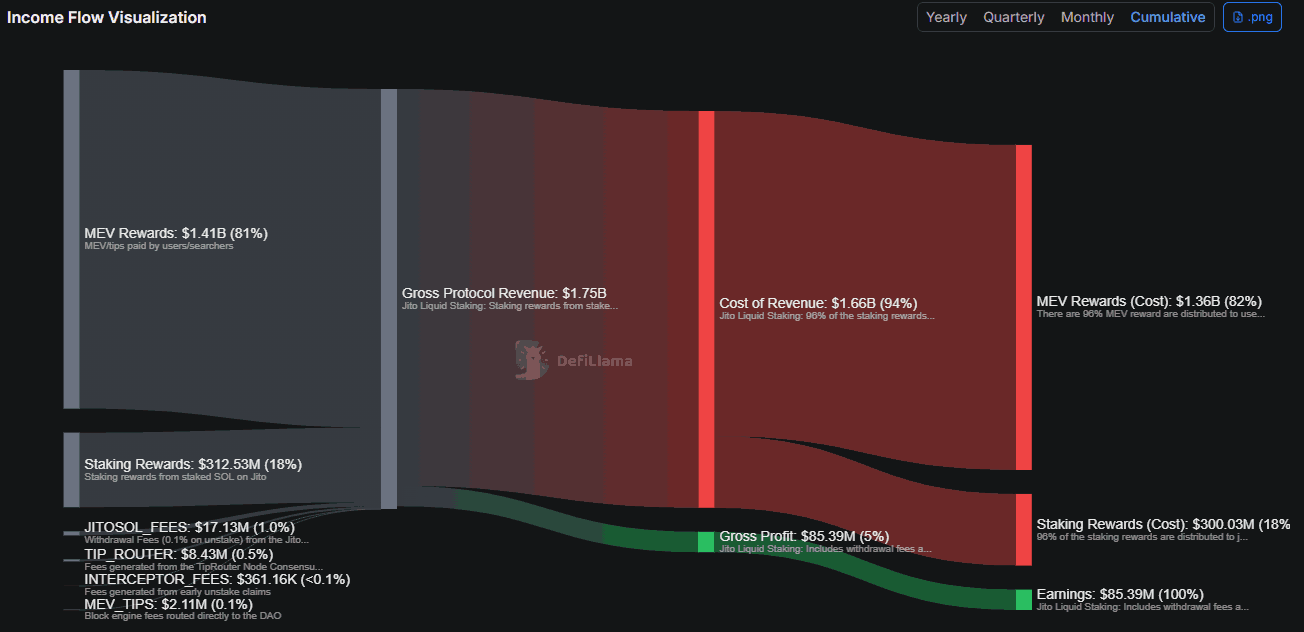
Source: DefiLlama

Is the revenue growth translating into user activity?

In fact, network participation has strengthened over the past few days too.

The number of active addresses registered a major hike, pointing to significant engagement across the ecosystem. At the same time, trading volume expanded by nearly 90% to $102 million over the last 24 hours.

These metrics often move together.

More active addresses usually indicate broader user participation, while an uptick in trading volume often means capital may be flowing back into the market. Together, they seemed to paint a picture of increasing network activity rather than a short-lived spike in speculation.

That makes the recent revenue milestone more meaningful too. It is evidence that the protocol isn’t just attracting attention—it is also generating sustained economic activity.
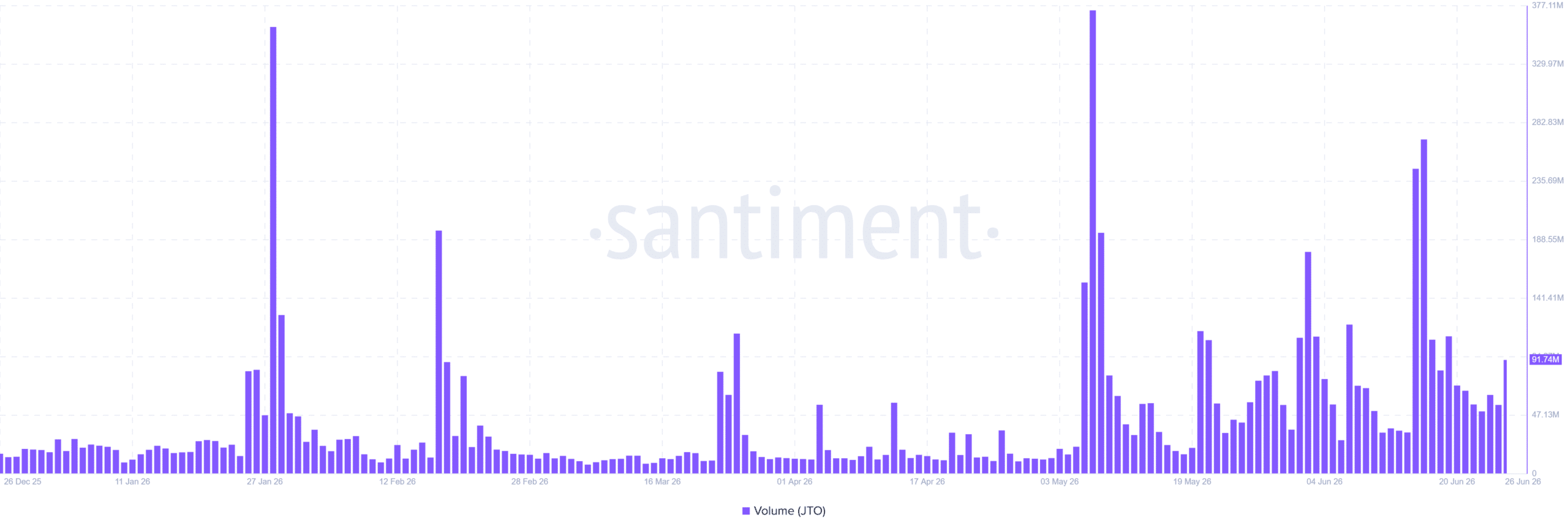
Source: Santiment

Is the market beginning to recognize that growth?

Well, the improving fundamentals are now starting to appear on the chart too.

After spending months consolidating, JTO broke above a bullish flag pattern on the daily timeframe. Since then, the price has continued to respect an ascending trendline that has produced multiple rebounds since early May.

If the momentum holds, the trendline resistance could be the next target for the token’s buyers.

In fact, the technical structure appeared to be catching up with what on-chain data has been showing for weeks. Whether the breakout develops into a larger rally will ultimately depend on whether network activity continues to expand.

At the time of writing, the latest metrics hinted at a bullish run continuation. Revenue has been growing, users are becoming more active, and trading participation registered a hike too.

In other words, the recent price breakout may simply be the market beginning to reflect those improving fundamentals.
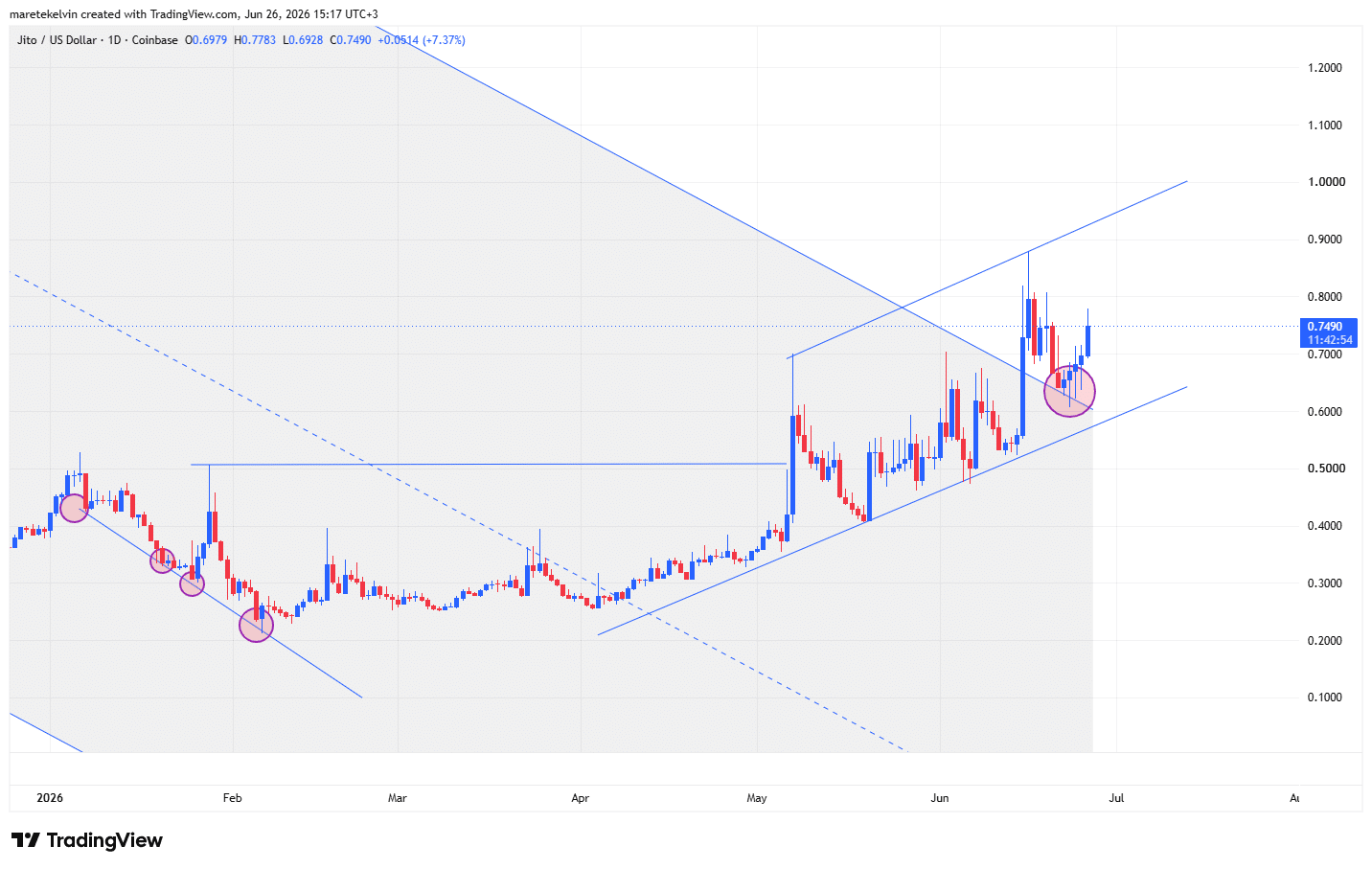
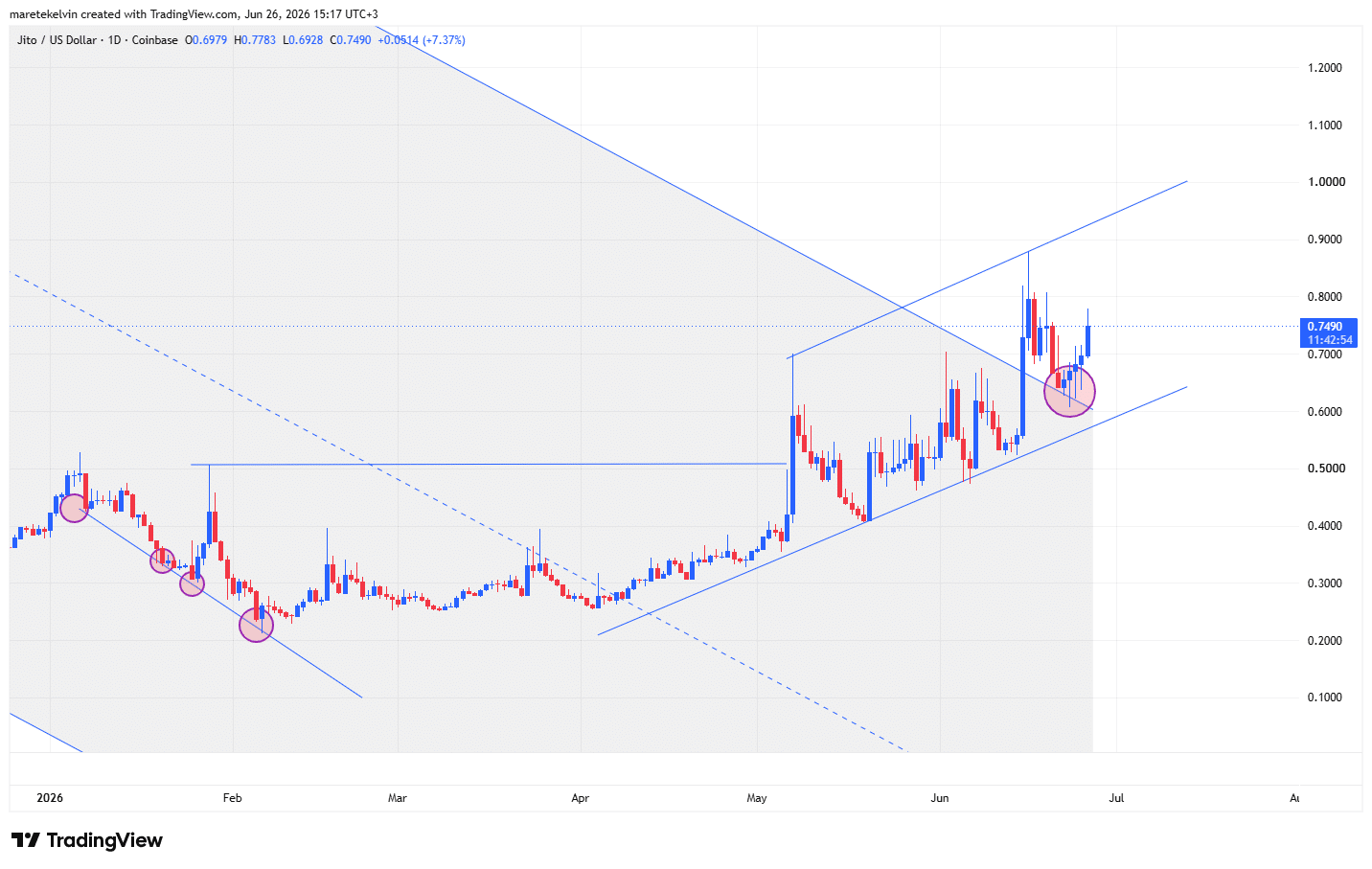
Source: TradingView

Final Summary

  • Jito generated $1.75 billion in protocol revenue, highlighting sustained network usage.
  • Hike in active addresses and a $50 million uptick in trading volume coincided with JTO’s breakout above a multi-month bullish flag.

Пов'язані питання

QWhat is the primary source of Jito's $1.75 billion in gross revenue?

AApproximately 81% of Jito's $1.75 billion in gross revenue came from MEV rewards, with the remainder coming from staking rewards.

QWhat key on-chain metrics support the idea of increasing network activity for Jito?

AKey on-chain metrics include a major hike in the number of active addresses and an expansion in trading volume by nearly 90% to $102 million over a 24-hour period, suggesting broader user participation and capital inflow.

QWhat technical pattern did the JTO token price break above on the daily timeframe, according to the article?

AThe JTO token price broke above a multi-month bullish flag pattern on the daily timeframe.

QBased on the article, what does the recent price breakout for JTO likely represent?

AThe recent price breakout is likely the market beginning to reflect Jito's improving fundamentals, such as growing revenue, increased user activity, and higher trading participation.

QWhat will ultimately determine if JTO's price breakout develops into a larger rally?

AWhether the breakout develops into a larger rally will ultimately depend on whether network activity continues to expand.

Пов'язані матеріали

BIT Research: The 2028 Halving Is Not the End, the Real Shake-Up of the Bitcoin Mining Industry Is Just Beginning

The Bitcoin mining industry is undergoing its most complex structural adjustment since inception. Despite Bitcoin's price holding near $61,000 and the network hash rate approaching a record 1 ZH/s, miner profitability is deteriorating. The industry is operating close to its breakeven point, with the 2028 halving expected to accelerate consolidation. The challenges extend beyond the halving's subsidy reduction; the industry's revenue model has yet to successfully transition towards a fee-driven structure. Increasingly, mining companies are evolving from simple Bitcoin producers into infrastructure and energy operators, including providers of AI/HPC computing power. Competition is shifting from pure hash rate expansion to business model upgrades. Economic pressure is evident. The theoretical daily mining revenue at current prices is around $78 million, yet the actual figure is only about $33 million—a 136% gap. Transaction fees remain low at roughly $220k daily, far below historical implied levels. With a current estimated industry-wide breakeven price near $65,000, mining alone is struggling to generate ideal profits. The 2028 halving is projected to push the fundamental production cost floor to approximately $93,289. This will likely accelerate a shift towards consolidation among larger, well-capitalized miners with diversified revenue streams. Competitive advantage will belong to institutionalized players with access to low-cost energy, AI/HPC hosting operations, and stronger balance sheets. In essence, Bitcoin mining is transitioning from a "mining business" to an "infrastructure business." Future profitability and resilience will depend less on block rewards and more on diversified income sources like energy management and computational infrastructure services. For investors, the key question is not the halving itself, but which miners can successfully navigate this business model transformation.

marsbit36 хв тому

BIT Research: The 2028 Halving Is Not the End, the Real Shake-Up of the Bitcoin Mining Industry Is Just Beginning

marsbit36 хв тому

This is How God Karpathy Uses Claude?

Andrej Karpathy, a prominent figure in AI, has reportedly joined Anthropic, leading to a noticeable decrease in his open-source contributions and social media activity. A document claiming to be his personal "CLAUDE.md" file—a set of instructions for the Claude AI to follow within a specific codebase—has been circulating online. While its authenticity is unverified, the content aligns closely with Karpathy's publicly shared principles on effective AI-assisted programming. The document outlines key rules for AI coding assistants, emphasizing the importance of reading existing code thoroughly before writing new code to maintain consistency. It advises against over-engineering, advocating for simple, surgical modifications that match the project's existing style. Other guidelines include clarifying assumptions upfront, writing meaningful tests, thoughtful debugging, and carefully considering dependencies. The core message is that these principles help prevent common AI coding failures, such as introducing unnecessary abstractions, style drift, or making invisible architectural decisions. The community has noted that even experts like Karpathy require detailed instructions to guide AI effectively, akin to managing a junior developer. A related GitHub repository, "andrej-karpathy-skills," which encapsulates these ideas, is reported to significantly reduce Claude's code error rate. Ultimately, the advice stresses that the best CLAUDE.md is tailored to one's own tech stack and coding practices.

marsbit36 хв тому

This is How God Karpathy Uses Claude?

marsbit36 хв тому

Торгівля

Спот
活动图片