Hunter Becomes the Hunted: The Most Profitable MEV Bot Gets Hacked

Odaily星球日报Опубліковано о 2026-06-21Востаннє оновлено о 2026-06-21

Анотація

The prominent Ethereum MEV bot address Jaredfromsubway.eth suffered a targeted on-chain attack, losing over $7.5 million. The incident was identified as a "counter-MEV honeypot attack," where the attacker deployed numerous fake token contracts and liquidity pools over several weeks, mimicking mainstream assets like WETH and USDC to create seemingly profitable arbitrage opportunities. The MEV bot, designed to automatically detect and execute such trades, interacted with the malicious setup. During the process, it granted approvals to attacker-controlled contracts, which were not promptly revoked. The attacker later exploited these persistent permissions in a single transaction, draining the bot's holdings of ETH, USDC, and USDT. Jaredfromsubway.eth is known as one of Ethereum's most active and profitable MEV bots, primarily executing "sandwich attacks" to extract value from user transactions. Its operations have been linked to a majority of such attacks on the network. This event highlights the evolving security threats in crypto, demonstrating that even sophisticated, rule-exploiting systems can become targets of carefully designed behavioral traps. Following the theft, an impersonator account on X falsely claimed to offer a bounty for the return of the funds, prompting warnings from developers.

Original | Odaily Planet Daily (@OdailyChina)

Author | Azuma (@azuma_eth)

The well-known MEV Bot address Jaredfromsubway.eth, long active on the Ethereum network, was targeted in a highly sophisticated on-chain attack on Saturday, resulting in losses exceeding $7.5 million.

According to investigations by Blockaid and several on-chain analytics firms, this incident was not a traditional phishing attack or smart contract exploit. Instead, it was a "counter-MEV honeypot attack" specifically designed to target the operational logic of MEV Bots.

Over the preceding weeks, the attacker had systematically deployed 66 counterfeit token contracts and fake liquidity pools. These assets were meticulously disguised on-chain as mainstream stablecoins like WETH, USDC, and USDT, creating seemingly legitimate arbitrage trading pathways.

The attack chain unfolded step by step — the fake liquidity pools generated signals for "arbitrageable price gaps"; the MEV bot automatically identified the arbitrage opportunity and executed trades; during the transaction, the robot granted authorization to an auxiliary contract controlled by the attacker; this authorization was not promptly revoked, leading to persistent exposure of permissions; Ultimately, in a single transaction, the attacker triggered a pre-embedded backdoor logic, directly draining the ETH, USDC, and USDT held in the MEV bot's address.

On-chain data shows that the total value of assets stolen from Jaredfromsubway.eth in this attack has exceeded $7.5 million. The attacker subsequently split and transferred portions of the funds, further dispersing the flow through mixing tools.

Who is Jaredfromsubway.eth? The Most Notorious MEV Bot Address

The reason this attack is so notable today is that the victim, Jaredfromsubway.eth, is itself one of the most active, profitable, and notorious MEV Bots on the Ethereum network (if not the most).

Essentially, "MEV attacks" are a category of on-chain arbitrage behaviors revolving around "transaction ordering rights." On the Ethereum network, transactions enter the mempool to await block inclusion before being confirmed. Block builders or searchers can extract extra profit by adjusting transaction order, inserting transactions, or rearranging transactions within a block.

The most typical attack type is the "Sandwich Attack" — the attacker inserts buy and sell operations immediately before and after a user's transaction, profiting from the price slippage within a very short time frame. Such behavior is extremely common in high-liquidity DeFi trading pairs and constitutes one of the most fundamental profit models within the MEV ecosystem.

Jaredfromsubway.eth is precisely the most representative automated executor of this mechanism. Unlike traditional "single-point arbitrage bots," this MEV Bot resembles a highly industrialized MEV execution system. It continuously monitors unconfirmed transactions in the mempool, identifies in real-time transaction paths susceptible to being sandwiched, and completes transaction construction, Gas bidding, and order insertion within an extremely short time window, systematically capturing slippage profits.

Data from Cointelegraph Research shows that from November 2024 to October 2025, approximately 60,000 to 90,000 sandwich attacks occurred monthly on the Ethereum network, with about 70% related to the strategic system of Jaredfromsubway.eth.

In May of this year, when Ethereum co-founder Vitalik Buterin exchanged 26,544 DigitalBits (XDB), his transaction was also targeted and sandwiched by Jaredfromsubway.eth.

Regarding Jaredfromsubway.eth's historical revenue, there is no official statistic, but conservative estimates suggest that the address has accumulated MEV profits reaching tens of millions of dollars during its active periods. During some peak periods, its daily earnings could reach hundreds of thousands of dollars, and it consistently ranked near the top of Ethereum's MEV leaderboards.

Crypto Security Threats Intensify: Even Top Predators Are Not Spared

While one might muse that "the eagle-hunter finally got pecked," the hacking of Jaredfromsubway.eth has also sounded another alarm regarding risks in the cryptocurrency space.

In past perceptions, MEV Bots like Jaredfromsubway.eth belonged to the "predator" side of the on-chain ecosystem — they continuously capture slippage and arbitrage opportunities within user transactions through automated strategies, positioning themselves advantageously, arguably representing one of the most iconic types of attackers in the cryptocurrency market.

But this time, it became the one that was designed, lured, and ultimately harvested. Moreover, the attacker did not choose a traditional exploit path. Instead, they constructed a long-running "behavioral trap," allowing the MEV Bot's automated system to make progressively flawed decisions while fully complying with its own rules.

It must be acknowledged that even participants like Jaredfromsubway.eth, once most adept at "gaming the system," are now exposed to a broader attack surface.

Additionally, it is worth noting that after Jaredfromsubway.eth was hacked, an unknown X account with 94,000 followers changed its name to Jaredfromsubway.eth and falsely claimed it would "offer a $1 million bounty for the full return of all funds."
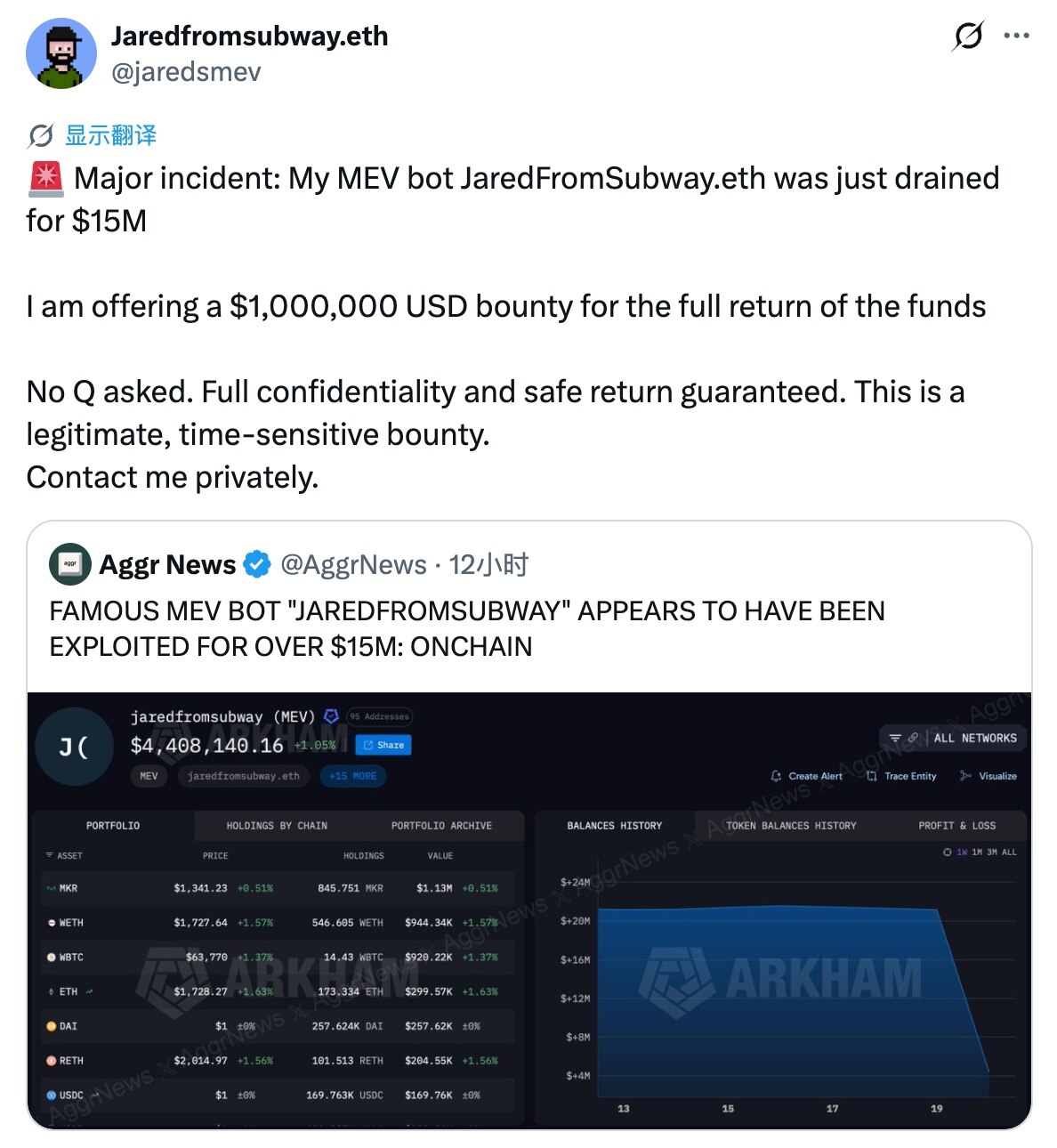
Several developers issued risk warnings, emphasizing that this account is not the official Jaredfromsubway.eth account (the MEV Bot team has no official account). They cautioned that this account might be used for scams subsequently and urged users to remain highly vigilant.


Пов'язані питання

QWhat type of attack did the MEV bot Jaredfromsubway.eth fall victim to, according to the article?

AThe article states that the MEV bot Jaredfromsubway.eth was targeted by a 'counter-MEV honeypot attack.' This was not a traditional phishing or smart contract exploit, but a sophisticated attack specifically designed to exploit the MEV bot's behavioral logic.

QWhat was the estimated total loss suffered by Jaredfromsubway.eth in this incident?

AAccording to on-chain data cited in the article, the total value of assets stolen from Jaredfromsubway.eth exceeded 7.5 million US dollars.

QAccording to the article, what is a 'Sandwich Attack' in the context of MEV?

AA 'Sandwich Attack' is described as a typical type of MEV attack. In this strategy, the attacker inserts buy and sell orders before and after a target user's transaction, respectively, to profit from the price slippage within a very short time window.

QWhat significant event involving Vitalik Buterin is mentioned in relation to Jaredfromsubway.eth?

AThe article mentions that in May of this year (presumably 2025), Ethereum co-founder Vitalik Buterin was targeted by Jaredfromsubway.eth when exchanging 26,544 DigitalBits (XDB) tokens.

QFollowing the hack, what fake action was taken by an unknown X account, and what warning was given?

AAn unknown X account with 94,000 followers changed its name to Jaredfromsubway.eth and falsely announced a '1 million US dollar bounty for the full return of all funds.' Developers issued warnings that this is not the official account (as the MEV bot team has none) and cautioned users to remain vigilant as the account might be used for scams.

Пов'язані матеріали

Fixed Supply + Institutional Frenzy, After Bitcoin's 50% Plunge, Will It Replicate Gold's 'Explosive' Run from 20 Years Ago?

"Fixed Supply & Institutional Craze: Bitcoin's Potential to Mirror Gold's 'Explosive' Price Rally of Two Decades Ago After a 50% Crash?" Despite a challenging period in 2026 where Bitcoin fell over 50% from its late 2025 peak above $126,000, analysts see potential for a turnaround, drawing parallels to gold's performance after the launch of its ETFs. Bloomberg Intelligence senior ETF analyst Eric Balchunas suggests Bitcoin ETFs could follow a "roadmap" similar to gold ETFs over the past 22 years. Since their 2004 debut, gold ETFs have seen dramatic surges, painful drawdowns, and recoveries, ultimately driving gold's market capitalization near $28 trillion. Both assets are non-yielding stores of value driven purely by investor sentiment. Spot Bitcoin ETFs, launched in early 2024, rapidly became among the fastest-growing ETFs ever, marking Bitcoin's move into mainstream finance. However, this also introduced significant volatility, with concerns about potential large-scale ETF outflows interrupting rebounds. For instance, BlackRock's IBIT, a leading Bitcoin ETF, has sold nearly 100,000 Bitcoin recently to meet redemptions, though it still holds over 733,000. The core parallel lies in fixed supply meeting surging, albeit fickle, institutional demand. Balchunas notes that both gold and Bitcoin experienced explosive price moves when demand concentrated, but such demand often comes in waves. Industry observers believe Bitcoin's "digital gold" narrative, bolstered by halving cycles and growing institutional adoption through ETFs, supports long-term bullish prospects. While the path will be volatile, if Bitcoin captures even a fraction of gold's role as a store of value, its upside potential remains substantial.

marsbit56 хв тому

Fixed Supply + Institutional Frenzy, After Bitcoin's 50% Plunge, Will It Replicate Gold's 'Explosive' Run from 20 Years Ago?

marsbit56 хв тому

Starknet Launches Privacy-First Bitcoin strkBTC, Targeting Institutional On-Chain Finance

Starknet introduces strkBTC, a privacy-focused version of Bitcoin designed for institutional on-chain finance. As digital assets face increased scrutiny, two major challenges emerge: the public visibility of all transactions and the looming threat of quantum computing to current cryptographic signatures. Bitcoin, representing over 56% of the crypto market, highlights these issues most clearly. strkBTC, built on Starknet’s STRK20 privacy framework, allows Bitcoin to be used privately on-chain while maintaining compliance. It operates in two modes: a public mode like standard ERC-20 tokens, and a shielded mode that hides balances and transactions from public view. This addresses the need for confidentiality in institutional finance, similar to traditional markets’ private trading venues. A third-party auditor, Financial Privacy Inc, holds view keys for regulatory access when necessary. Additionally, Starknet is positioned ahead in quantum resistance. Its STARK-based proof system relies on hash functions rather than elliptic-curve cryptography, making it less vulnerable to quantum attacks. Starknet’s native account abstraction also allows easier migration to quantum-resistant signatures without protocol-level forks. The team has outlined a roadmap to achieve end-to-end quantum security before “Q-day,” though dependencies on Ethereum’s own migration remain. While strkBTC currently uses a trusted bridge consortium, Starknet plans to transition toward more trustless, Bitcoin-native verification over time. The initiative underscores a shift in on-chain finance beyond yield—prioritizing privacy, compliance, and long-term security for institutional adoption.

marsbit1 год тому

Starknet Launches Privacy-First Bitcoin strkBTC, Targeting Institutional On-Chain Finance

marsbit1 год тому

Торгівля

Спот
活动图片