Starknet Launches Privacy-First Bitcoin strkBTC, Targeting Institutional On-Chain Finance

marsbitОпубліковано о 2026-07-21Востаннє оновлено о 2026-07-21

Анотація

Starknet introduces strkBTC, a privacy-focused version of Bitcoin designed for institutional on-chain finance. As digital assets face increased scrutiny, two major challenges emerge: the public visibility of all transactions and the looming threat of quantum computing to current cryptographic signatures. Bitcoin, representing over 56% of the crypto market, highlights these issues most clearly. strkBTC, built on Starknet’s STRK20 privacy framework, allows Bitcoin to be used privately on-chain while maintaining compliance. It operates in two modes: a public mode like standard ERC-20 tokens, and a shielded mode that hides balances and transactions from public view. This addresses the need for confidentiality in institutional finance, similar to traditional markets’ private trading venues. A third-party auditor, Financial Privacy Inc, holds view keys for regulatory access when necessary. Additionally, Starknet is positioned ahead in quantum resistance. Its STARK-based proof system relies on hash functions rather than elliptic-curve cryptography, making it less vulnerable to quantum attacks. Starknet’s native account abstraction also allows easier migration to quantum-resistant signatures without protocol-level forks. The team has outlined a roadmap to achieve end-to-end quantum security before “Q-day,” though dependencies on Ethereum’s own migration remain. While strkBTC currently uses a trusted bridge consortium, Starknet plans to transition toward more trustless, Bitcoin-nat...

Author: Castle Labs

Compiled by: TechFlow Deep Tides

Deep Tides Guide: As on-chain finance increasingly converges with traditional markets, two critical issues emerge: all capital flows are publicly visible, and quantum computing poses a threat to existing cryptographic signatures. Bitcoin, as the largest asset holding over 56% of the crypto market's share, serves as the clearest test case for both problems. Starknet's strkBTC solution attempts to address visibility and longevity simultaneously: enabling private Bitcoin transfers while preparing the technology for the quantum era.

As on-chain finance moves closer to traditional markets, digital assets are facing higher standards and more stringent requirements.

This new world presents two key issues: on-chain capital flows are publicly visible to everyone, and the cryptographic signatures underpinning the entire technology face a threat from quantum computing.

This is most evident with Bitcoin.

Bitcoin currently accounts for over 56% of the total crypto market capitalization, remaining the anchor of the entire crypto market, despite having almost no programmability itself.

To enhance its utility and programmability, Bitcoin is cross-chained out, entering the world of on-chain finance through wrapped tokens.

But Bitcoin in DeFi needs more than just higher yields; it needs a way to transfer large amounts without broadcasting it publicly, and a guarantee that it remains secure when tomorrow's quantum computers arrive.

The same is true for other assets in on-chain finance: assets need to be transferred, settled, and combined without exposing every position to the public, and they cannot rely on cryptographic technologies that may not survive the next decade.

We have been tracking a protocol that seems to have understood these issues earlier than most and built its solutions around these two problems.

While Starknet launched its BTCFi campaign earlier this year, it's not just about making Bitcoin usable on-chain. It's treating Bitcoin as the first clear test case for the conditions that individuals and institutions genuinely care about: private by default, disclosable when necessary, and hardened for a post-quantum future.

For context on Starknet's work in this area, we previously covered why $2 trillion worth of Bitcoin sits idle and how Starknet's roadmap charts a path to trustless BTC, as well as Starknet's new privacy framework STRK20, and why they designed the system for "privacy through ownership."

Privacy and the Quantum Countdown

A core tenet of the crypto world has always been "don't trust, verify," which is precisely what transparent blockchains have allowed us to do. Verify balances, peek at transfers, examine cash flows, monitor contract interactions. Everything is public for everyone.

You can understand how this started.

Transparency builds trust, but complete transparency harms intellectual property, strategy, personal safety, and operational privacy. This is especially true today, where AI-driven deanonymization can link public addresses to real identities with up to 90% accuracy.

Privacy is not only a human right but also critical infrastructure needed for user protection and institutional adoption on-chain.

Individuals need privacy to avoid surveillance, profiling, harassment, crime, and political exposure. Institutions need privacy to ensure the confidentiality of holdings, order flows, and other data, as well as to prevent counterparty visibility and strategy leaks. Furthermore, privacy needs to be configurable for selective disclosure to auditors, regulators, or compliance departments.

Previous attempts at on-chain privacy have repeatedly highlighted trade-offs:

Pure anonymity privacy pools like Tornado Cash faced compliance pressures, leading to OFAC sanctions, criminal charges, and prison sentences for developers, stark proof that non-compliant paths are fraught with political and legal risk.

Native privacy coins (e.g., Monero, Zcash) demonstrated that hiding transactions is possible but have struggled to integrate with the rest of the on-chain world, unable to compose with DeFi primitives at scale, pointing to a problem bigger than privacy itself: liquidity, interoperability, and compliance issues.

Private execution systems like Aztec saw early demand for private DeFi, but they often faced high costs, fragmented liquidity, and poor user experiences.

The lack of privacy leads to issues not just in the isolated on-chain world but also permeates the physical world. On-chain addresses tied to real people and publicly visible balances create higher risks of attack. CertiK reported 34 verified physical attacks against cryptocurrency holders in the first four months of 2026, a 41% increase year-over-year, representing only the documented portion of these severely underreported incidents. More specifically, in France, there were 41 crypto-related kidnappings from January to May 2026, averaging one every 2.5 days.

Privacy is not just about hiding transaction activity or protecting alpha; it's increasingly about lowering personal and operational risk.

While privacy issues are being actively addressed in the industry, another threat from quantum computing has emerged. A path that simultaneously solves visibility and longevity could propel blockchains closer to becoming next-generation financial infrastructure.

This March, a Google Quantum AI report co-authored by Justin Drake (Ethereum Foundation) and Dan Boneh (Stanford University) identified multiple attack vectors and estimated that roughly $100 billion in the Ethereum ecosystem is at risk. It also singled out Starknet as having a stronger post-quantum standing than other major L2s because its proof system is based on hash-based STARK assumptions rather than elliptic curve cryptography.
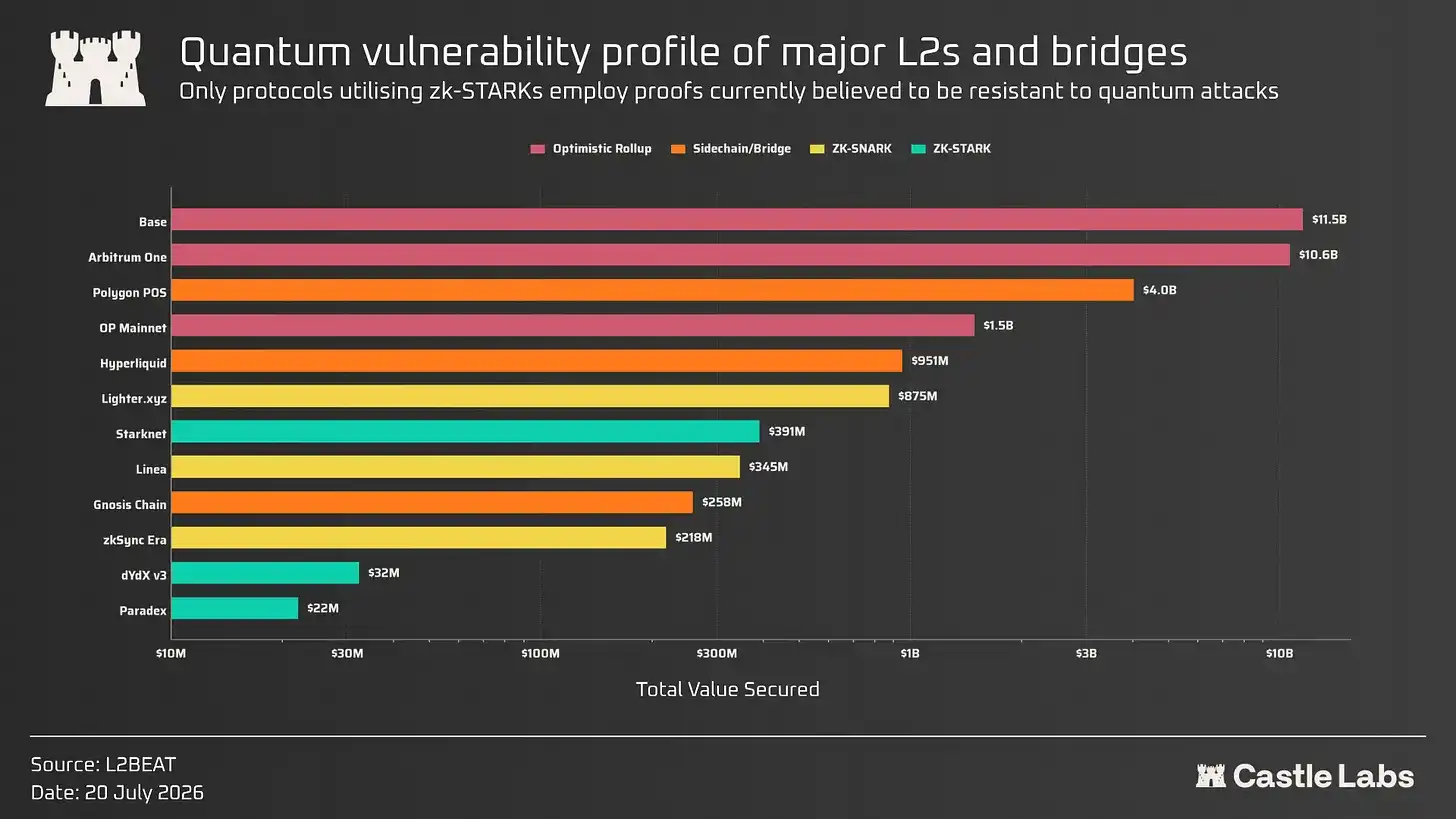
The paper focused on secp256k1 public key exposure, relevant to Bitcoin and Ethereum wallets, stating that a sufficiently powerful quantum computer could attack wallets in less than 9 minutes. Justin Drake later warned that there is "at least a 10% chance" quantum computers could recover private keys from exposed public keys by 2032.

While not a reality today, the long-term security and longevity of assets meant to be held for decades are being called into question.

Bitcoin is the world's most important digital asset, and as it increasingly serves as collateral, reserves, and assets on institutional balance sheets, its security and privacy requirements rise.

In the next section, we highlight a solution being developed around Bitcoin, the largest and clearest test case for these privacy challenges.

strkBTC: Private Bitcoin on Starknet

We've likely all used wrapped BTC tokens. They bring Bitcoin into other ecosystems and make it composable: as a tradable asset, as collateral, as liquidity.

What they don't solve is visibility.

While wrapped BTC can become productive, every move remains monitorable, inspectable, and counterparty-tradeable. Deposits, loans, trades, LP positions, repayments, withdrawals, wallet clustering, treasury flows. All public by default.

This is not how serious financial markets operate, and until this is addressed, on-chain finance will keep hitting an institutional ceiling.

In traditional finance, privacy is built into the infrastructure, whether you're a retail user or an institutional giant. In fact, a large portion of equity trading volume flows through private or over-the-counter venues like dark pools, where counterparties see what they need, regulators retain access when required, and the public sees aggregated volume, not every real-time move.

Cryptocurrency treats visibility as the standard. In reality, privacy should be the norm.

strkBTC is Starknet's attempt to let Bitcoin flow in the on-chain finance world without this limitation.

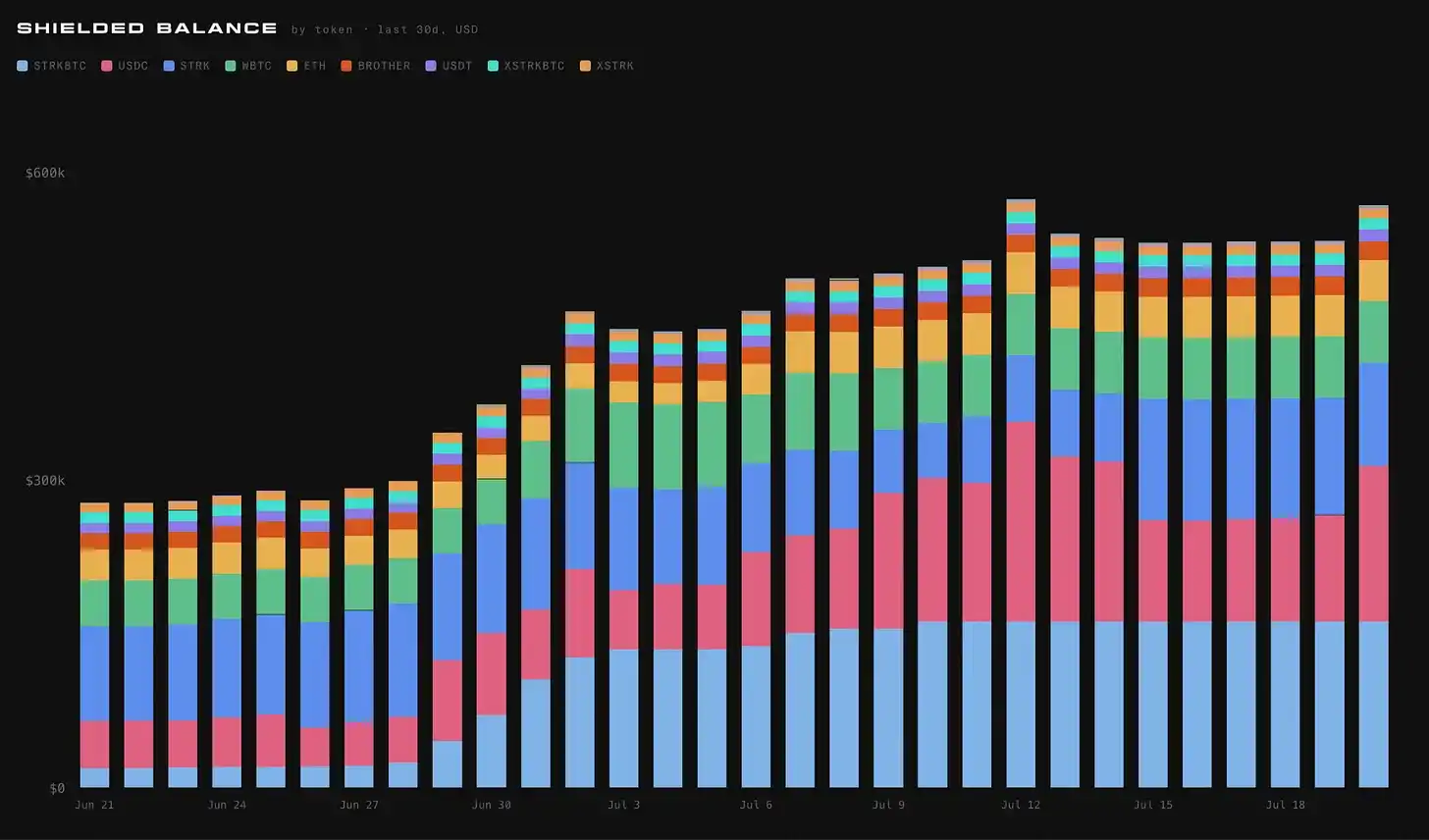
strkBTC is an ERC-20 on Starknet, backed by BTC locked on the Bitcoin network, and built on StarkWare's privacy framework STRK20 for shielded balances and private transfers.

STRK20 provides strkBTC with two modes:

In public mode, it behaves like a standard ERC-20: users can hold, transfer, supply to lending markets, provide liquidity, or use it as collateral.

In shielded mode, selected balances and transfers are hidden from public view. Users can shield, trade privately, and unshield back to public balances directly from within their wallet.
Before the Starknet v0.14.2 upgrade, which enabled STRK20, applications wanting to verify STARK proofs on Starknet had to do so within a smart contract, making it expensive and complex due to proof size. Now, transactions can directly reference off-chain proofs, with Starknet consensus handling verification natively via in-protocol proof verification.

This unlocks privacy at the protocol level, versus the historical friction of separate apps, chains, pools, or mixers, which added complexity, cost, and liquidity fragmentation. This allows applications to focus on building better products, as the underlying infrastructure has made private operations easily accessible to builders.

Compliance is a key part of the design, opening Starknet to institutions coming on-chain.

When users shield strkBTC, associated viewing keys are shared with Financial Privacy Inc. (also known as FPI), an independent third-party auditor operating the compliance infrastructure for STRK20, granting them scoped access in the event of a valid regulatory request. While this may not align with pure cypherpunk philosophy, it aligns much more closely with traditional markets. Private to the public, disclosed to regulators.

The bridge follows similar logic, operated by a trusted strkBTC consortium composed of Twinstake, NEAR Intents, Luganodes, UTXO Management, and Xverse. Currently, these independent signers support minting and burning between BTC and strkBTC. The consortium is not the final state; however, Starknet is committed to a hardening roadmap over time.

strkBTC is not meant to be just another wrapped token; it's meant to unlock the potential of a programmable, composable BTC whose moves aren't broadcast, solving the first issue: visibility.

The next issue is longevity.

The Quantum Problem for Blockchains

Every blockchain relies on public-key cryptography. When a user signs a transaction, they reveal their public key while keeping their private key hidden. This is routine on Bitcoin and most other blockchains, considered perfectly normal and secure in today's environment. But in a post-quantum world, this assumption becomes somewhat unstable.

As mentioned earlier, a sufficiently powerful quantum computer running Shor's algorithm could theoretically derive the private key from an exposed public key. This means public key exposure, the harmless part of transaction validation, could soon become a potential attack surface. This isn't unique to any single chain, as the same elliptic curve underpinnings lie beneath Bitcoin, Ethereum, and Solana.

The threat is shared, but the response capabilities are not. The most exposed chains are often the slowest to move, with Bitcoin being the clearest example.

Bitcoin isn't short on ideas for a post-quantum future. If anything, it has too many. The problem is agreeing on the trade-offs the network is willing to accept: larger signatures, higher costs, legacy coin handling, user migration, wallet support, miner policies, or battles over freezing dormant and unmigrated coins.

Clearly, Bitcoin's problem is as much social and political as it is technical.

Dan Boneh, a co-author of the Google paper, calmed everyone down in a recent interview: "Bitcoin should not panic, but it also can't ignore this. Moving too fast could be worse than waiting, because a rushed post-quantum migration could introduce catastrophic bugs before quantum is a live attack."

Bitcoin will likely solve its quantum problem, but not quickly or cleanly.

This slowness is, in some ways, a feature of sound money, but it also leaves a door open. While the base layer debates, more agile stacks can build the longevity that Bitcoin itself cannot yet commit to.

Ethereum and its extended L2s won't escape this problem. Most rollups settle to Ethereum and rely on it for data availability, thus inheriting the base layer's exposure. Ethereum is aware of this and has released its own multi-year migration plan, but until that plan arrives, every chain built on it is exposed to Ethereum's post-quantum migration problem.

This is where Starknet is ahead. While it settles to Ethereum like any other L2, Starknet's core, its proof layer, is built on foundations that don't rely on quantum-vulnerable cryptography. While the exposure inherited from Ethereum is real, everything within Starknet's own stack carries less migration debt than most major chains, and it has more in the pipeline.

Architectural Advantages

Starknet's advantageous position stems from two design choices, both made before quantum computing was a pressing concern.

The first is the proof layer, the system generating STARK proofs to secure every state transition on the network. It relies on hash functions, not the elliptic curve mathematics threatened by quantum computers, a design established since a 2018 paper co-authored by StarkWare CEO Eli Ben-Sasson. This is the critical security layer and why Google's paper listed Starknet as the only major L2 already ahead.

The second is native account abstraction. On most chains, signature schemes are fixed at the protocol level, so replacing them requires a hard fork, with every user and app having to follow. Starknet lets accounts define how to verify identity themselves, so users can migrate to quantum-resistant signatures without changing the protocol layer. According to StarkWare, a quantum-resistant wallet, S2morrow, is already deployed using Falcon-512, and OpenZeppelin is building a standardized version.

On many chains, such a change would mean coordinating a whole-protocol migration. On Starknet, much of the work can start with wallet upgrades. This doesn't mean every Starknet wallet is quantum-resistant, but this model provides an easier path for Starknet users.

StarkWare is now working to close the remaining gaps. Last week they released a roadmap to make Starknet end-to-end quantum-resistant before Q-day. Q-day refers to the point in time when quantum computers become powerful enough to break today's cryptography.

The roadmap is divided into three phases:
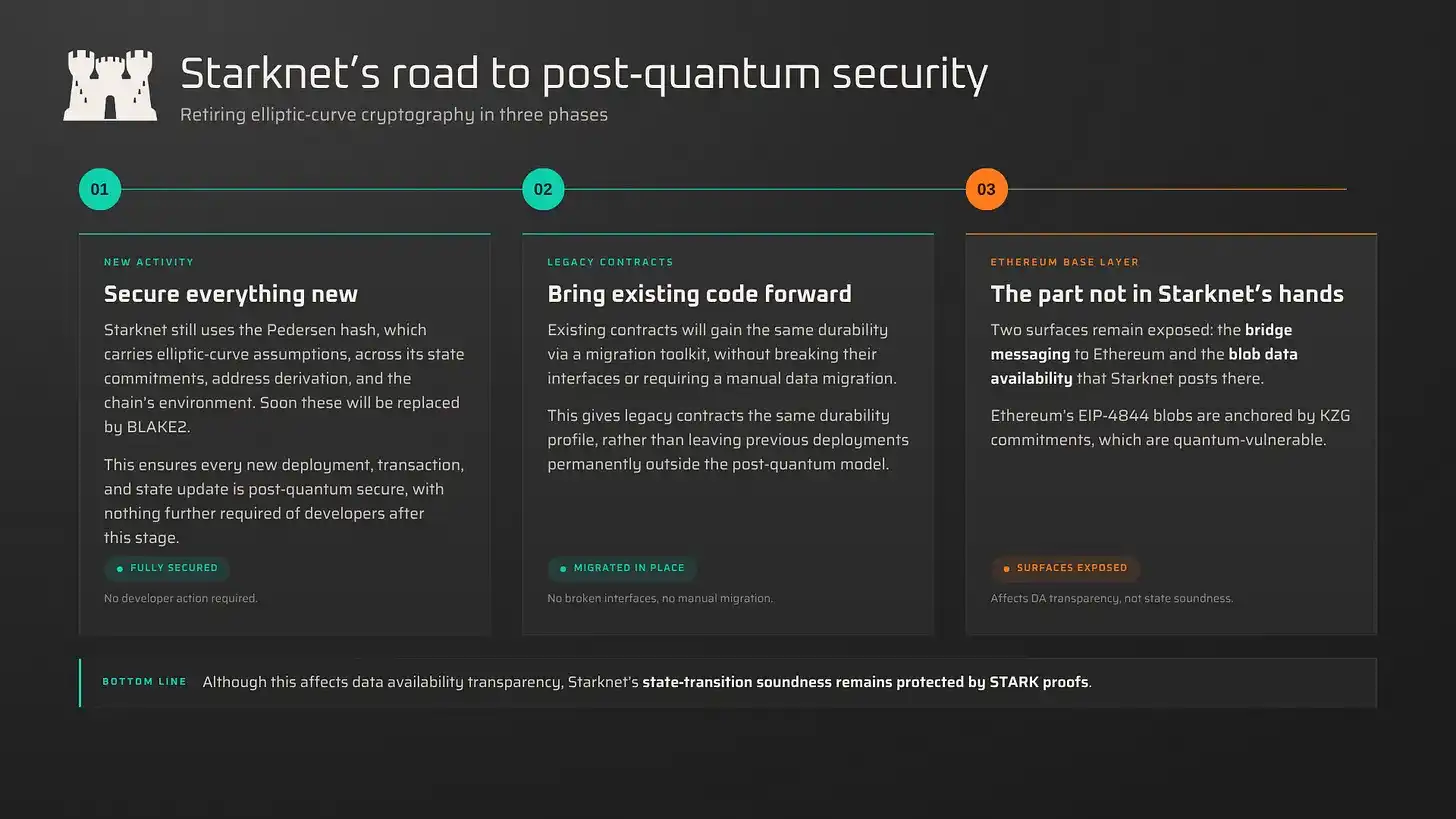
None of this means Starknet is fully quantum-resistant today, nor does the roadmap claim so.

What Still Needs Proving?

Starknet can replace Pedersen with BLAKE2, improve quantum-resistant wallet support, and provide migration paths for legacy contracts, but it cannot eliminate all problems inherited from the base layer. Bridged messages and blob data availability still depend on Ethereum's own quantum-resistant roadmap. Starknet can harden the parts it controls, but what's inherited from Ethereum will progress on Ethereum's timeline. That said, the Ethereum Foundation has outlined structured fork milestones, aiming to complete core quantum-resistant infrastructure around 2029.

strkBTC has a similar staged story. Currently, the bridge relies on a consortium to coordinate minting and burning between BTC and strkBTC. This is a trusted starting point, not the ideal trustless final state. Starknet aims to move from the consortium model to Bitcoin-native verification, then to a less-trust BitVM design, and finally, if Bitcoin enables the required opcodes in the future, to a fully trustless OP_CAT-based design.

Viewing keys are another part yet to be proven. They are Starknet's pragmatic answer to institutional privacy: publicly opaque but selectively disclosable, but they haven't been stress-tested in real scenarios, raising questions about who can request disclosure, under what conditions, and with what safeguards.

Digital assets, including Bitcoin, don't need another wrapper. They need surrounding infrastructure that can operate on-chain without compromising the two things institutions care about most: confidentiality today and longevity tomorrow.

strkBTC solves confidentiality by providing a private, selectively disclosable path for BTC into DeFi. Starknet's existing architecture and roadmap target longevity: its proof layer already avoids the elliptic curve assumptions that burden other protocols with quantum-resistant migration, and its roadmap now extends this advantage to the remaining pieces, explicitly aiming to make Starknet quantum-resistant before "Q-day."

While outcomes are still early, the direction is clear: the next institutional phase of on-chain finance needs more than just yield. It needs privacy, compliance, programmability, and longevity all integrated within the same tech stack.


Трендові криптовалюти

Пов'язані питання

QWhat are the two main challenges for on-chain finance as it approaches traditional markets, as described in the article?

AThe two main challenges are: 1) All capital flows are publicly visible, compromising operational and personal privacy. 2) The threat of quantum computing to existing cryptographic signatures, which endangers the long-term security of assets.

QWhat is strkBTC and how does it address the issue of transaction visibility on-chain?

AstrkBTC is a private version of Bitcoin on Starknet, built as an ERC-20 token backed by BTC locked on the Bitcoin network. It leverages StarkWare's STRK20 privacy framework to offer two modes: a public mode (like a standard ERC-20) and a shielded mode where selected balances and transfers are hidden from public view. This allows for private transfers, addressing the issue of default public visibility in on-chain finance.

QHow does Starknet's architecture give it a stronger position regarding the quantum computing threat compared to other major L2s?

AStarknet's proof system is based on hash-based STARK assumptions, not elliptic curve cryptography, which is vulnerable to quantum attacks. This design choice, made before quantum computing was a pressing concern, means its core proof layer is inherently more quantum-resistant. Additionally, its native account abstraction allows wallets to migrate to quantum-resistant signature schemes without requiring a protocol-level hard fork.

QWhat role does the 'viewing key' play in strkBTC's privacy and compliance model?

AWhen a user shields their strkBTC, a related viewing key is shared with an independent third-party auditor called Financial Privacy Inc. (FPI). This key grants FPI scoped access, enabling selective disclosure of transaction details to regulators or compliance bodies upon valid requests. This model provides privacy from the public while allowing for necessary regulatory oversight, aligning with traditional market practices.

QWhat are the stated future goals for the strkBTC bridge and Starknet's overall quantum resistance according to the article?

AFor the strkBTC bridge, the goal is to evolve from the current trusted consortium model to Bitcoin-native verification, then to a less-trust BitVM design, and finally to a fully trustless design based on OP_CAT if Bitcoin enables the required opcodes. For overall quantum resistance, Starknet has a roadmap aiming to make the network end-to-end quantum-secure before 'Q-day' (the point when quantum computers can break current cryptography). This involves upgrading hash functions, improving wallet support, and providing migration paths, though it acknowledges dependencies on Ethereum's own quantum migration timeline.

Пов'язані матеріали

9.42 Million Retail Investors Compete for Changxin Technology, Who Got Allotted?

Evergreen Technology's IPO subscription results are now available. On July 20, the domestic memory chip giant announced the offline preliminary allotment results and online lottery results for its IPO. A total of approximately 9.43 million retail investors participated in the online subscription, generating 770,000 winning lots with a final winning rate of about 0.4714%, setting a record for new shares on the STAR Market. After triggering a clawback mechanism from institutional to retail investors, the online retail allocation was significantly increased to 3.851 billion shares. Simultaneously, 285 institutional investors participated in the offline subscription, ultimately receiving 2.173 billion shares at an allotment rate of approximately 0.1756%. Leading insurers and public funds were among the major recipients. Notably, Liang Wenfeng, founder of the major AI model company DeepSeek, through his quantitative investment firms Ningbo Huanfang Quantitative and Zhejiang Jiuzhang Asset, secured the largest share among private funds, with a total allotment worth approximately 175 million yuan. Estimates suggest potential profits could reach 730 million yuan if Evergreen Technology's market capitalization reaches 3 trillion yuan post-listing. The company is expected to list on July 27 and could become the highest-valued tech stock on the A-share market, with various brokerages providing valuations ranging from 1 trillion to over 4 trillion yuan. However, recent significant corrections in global tech stocks may impact its post-listing performance. (Character count: 1,196)

marsbit1 год тому

9.42 Million Retail Investors Compete for Changxin Technology, Who Got Allotted?

marsbit1 год тому

3 Million-Follower Goddess Fully AI-Synthesized, Fake Orphanage, Cross-Border ‘Fake Charity’ Collapses Overnight

An Australian influencer named Lily Jay, with nearly 3 million Instagram followers, is at the centre of a major AI-fueled charity scam. Her 'Lily Jay Foundation' claimed to build orphanages, mosques, and deliver aid in places like Uganda and Gaza, using emotionally powerful videos of herself with children. However, an investigation by ABC NEWS Verify revealed these scenes—including a key video announcing an orphanage's opening—were entirely AI-generated, complete with telltale flaws like garbled text on clothing. The foundation's 'humanitarian award' was also faked using AI images. The foundation admitted in small print on its website that it is not a registered charity, avoiding financial transparency laws. While based in Kosovo, its operations and the influencer's lavish personal lifestyle raised further red flags. Following media inquiries, the foundation selectively hid donation buttons and removed fraudulent content for Australian visitors, but kept them active internationally. Experts warn this case is a textbook example of how AI can be weaponized to exploit public trust and generosity, creating believable but entirely fabricated narratives of aid. The incident highlights the growing danger of deepfakes in eroding trust within the charitable sector, urging donors to critically verify causes before giving.

marsbit1 год тому

3 Million-Follower Goddess Fully AI-Synthesized, Fake Orphanage, Cross-Border ‘Fake Charity’ Collapses Overnight

marsbit1 год тому

Торгівля

Спот

Популярні статті

Що таке BITCOIN

Розуміння HarryPotterObamaSonic10Inu (ERC-20) та його позиції у крипто-просторі Останніми роками ринок криптовалют спостерігав за зростанням популярності мем-коінів, які привертають інтерес не тільки трейдерів, але й тих, хто шукає спілкування та розважальну цінність. Серед цих унікальних токенів є HarryPotterObamaSonic10Inu (ERC-20), інтригуючий проект, що поєднує культурні посилання з тканинами криптовалюти. Ця стаття досліджує ключові аспекти HarryPotterObamaSonic10Inu, вивчаючи його механізми, спільноту та його взаємодію з ширшим крипто-ландшафтом. Що таке HarryPotterObamaSonic10Inu (ERC-20)? Як випливає з його назви, HarryPotterObamaSonic10Inu є мем-коіном, побудованим на блокчейні Ethereum, класифікованим за стандартом ERC-20. На відміну від традиційних криптовалют, які можуть підкреслювати практичну корисність або інвестиційний потенціал, цей токен процвітає завдяки розважальній цінності та силі своєї спільноти. Проект спрямований на створення середовища, де зацікавлені користувачі можуть об'єднуватися, ділитися ідеями та брати участь у заходах, натхненних різноманітними культурними явищами. Однією з примітних особливостей HarryPotterObamaSonic10Inu є нульовий податок на транзакції. Цей привабливий елемент має на меті заохочувати торгівлю та участь у спільноті, позбавлену додаткових витрат, які можуть відлякувати дрібних трейдерів. Загальна пропозиція монет становить один мільярд токенів, що позначає намір підтримувати суттєву циркуляцію в межах спільноти. Творець HarryPotterObamaSonic10Inu (ERC-20) Походження HarryPotterObamaSonic10Inu дещо окутане таємницею; деталі про творця залишаються невідомими. Розвиток цього токена позбавлений впізнаваної команди або чіткої стратегії, що не є рідкістю в секторі мем-коінів. Натомість проект виник органічно, а його розвиток значною мірою залежить від ентузіазму та участі його спільноти. Інвестори HarryPotterObamaSonic10Inu (ERC-20) Щодо зовнішніх інвестицій та підтримки, HarryPotterObamaSonic10Inu також залишається невизначеним. Токен не зазначає жодних відомих інвестиційних фондів або значної організаційної підтримки. Натомість життєва сила проекту полягає в його базовій спільноті, яка інформує про його зростання та стійкість через колективні дії та залученість у крипто-просторі. Як працює HarryPotterObamaSonic10Inu (ERC-20)? Як мем-коін, HarryPotterObamaSonic10Inu функціонує передусім поза традиційними рамками, що часто регулюють вартість активів. Є кілька відмінних аспектів, що визначають, як працює проект: Транзакції без податку: Завдяки відсутності податкових зборів на транзакції, користувачі можуть вільно купувати та продавати токен, не турбуючись про приховані витрати. Залучення спільноти: Проект процвітає завдяки взаємодії спільноти, використовуючи соціальні медіа для створення шуму та сприяння залученню. Обговорення, обмін контентом та залученість є ключовими елементами, що допомагають розширити його охоплення та зміцнити лояльність серед прихильників. Відсутність практичної корисності: Слід зазначити, що HarryPotterObamaSonic10Inu не пропонує конкретної корисності в рамках фінансової екосистеми. Натомість він класифікується як токен, що призначений в основному для розваги та спільнотних активностей. Культурне посилання: Токен кмітливо вплітає елементи популярної культури, щоб привернути інтерес, зв'язуючи з ентузіастами мемів та крипто-стежками. HarryPotterObamaSonic10Inu ілюструє, як мем-коіни функціонують інакше, ніж традиційні криптовалютні проекти, увійшовши на ринок як інноваційні соціальні конструкти, а не утилітарні активи. Хронологія HarryPotterObamaSonic10Inu (ERC-20) Історія HarryPotterObamaSonic10Inu відзначена кількома значними етапами: Створення: Токен виник з вірусного мему, захопивши уяву багатьох крипто-ентузіастів. Конкретні дати створення недоступні, що підкреслює його органічний розвиток. Лістинг на біржах: HarryPotterObamaSonic10Inu з'явився на різних біржах, дозволяючи зручніший доступ і торгівлю спільноти. Ініціативи залучення спільноти: Ведення діяльності, спрямованої на покращення взаємодії спільноти, включаючи конкурси, кампанії в соціальних мережах та створення контенту від фанатів та прихильників. Плани на майбутнє: Дорожня карта проекту включає запуск колекції NFT, мерчандайзинг та електронну комерцію, пов'язану з його культурними темами, що далі залучає спільноту та намагається додати більше вимірів до його екосистеми. Ключові моменти про HarryPotterObamaSonic10Inu (ERC-20) Спільнотний підхід: Проект надає пріоритет колективному внеску та креативності, забезпечуючи, щоб участь користувачів була в центрі його розвитку. Класифікація як мем-коін: Це є його епігенез розважальної криптовалюти, що відрізняється від традиційних інвестиційних інструментів. Жодного прямого відношення до Bitcoin: Незважаючи на схожість у назві, HarryPotterObamaSonic10Inu є відмінним і не має жодного зв’язку з Bitcoin або іншими усталеними криптовалютами. Зосередженість на співпраці: HarryPotterObamaSonic10Inu створено для того, щоб надати простір для співпраці та обміну історіями серед його власників, забезпечуючи шлях для творчості та спільного зв'язку. Перспективи на майбутнє: Амбіція розширитися за межі початкової концепції в NFT та мерчандайз відкриває шлях для проекту потенційно потрапити в більш мейнстрімні сфери цифрової культури. Оскільки мем-коіни продовжують захоплювати уяву спільноти криптовалют, HarryPotterObamaSonic10Inu (ERC-20) вирізняється своїми культурними зв'язками та орієнтованим на спільноту підходом. Хоча він може не відповідати типовій моделі утилітарного токена, його суть полягає в радощах і товариськості, що підтримуються серед його прихильників, підкреслюючи еволюційну природу криптовалют в усе більш цифрову епоху. Оскільки проект продовжує розвиватися, важливо спостерігати за тим, як динаміка спільноти вплине на його траєкторію в постійно змінюваному ландшафті технології блокчейн.

2.2k переглядів усьогоОпубліковано 2024.04.01Оновлено 2024.12.03

Що таке BITCOIN

Як купити BTC

Ласкаво просимо до HTX.com! Ми зробили покупку Bitcoin (BTC) простою та зручною. Дотримуйтесь нашої покрокової інструкції, щоб розпочати свою криптовалютну подорож.Крок 1: Створіть обліковий запис на HTXВикористовуйте свою електронну пошту або номер телефону, щоб зареєструвати обліковий запис на HTX безплатно. Пройдіть безпроблемну реєстрацію й отримайте доступ до всіх функцій.ЗареєструватисьКрок 2: Перейдіть до розділу Купити крипту і виберіть спосіб оплатиКредитна/дебетова картка: використовуйте вашу картку Visa або Mastercard, щоб миттєво купити Bitcoin (BTC).Баланс: використовуйте кошти з балансу вашого рахунку HTX для безперешкодної торгівлі.Треті особи: ми додали популярні способи оплати, такі як Google Pay та Apple Pay, щоб підвищити зручність.P2P: Торгуйте безпосередньо з іншими користувачами на HTX.Позабіржова торгівля (OTC): ми пропонуємо індивідуальні послуги та конкурентні обмінні курси для трейдерів.Крок 3: Зберігайте свої Bitcoin (BTC)Після придбання Bitcoin (BTC) збережіть його у своєму обліковому записі на HTX. Крім того, ви можете відправити його в інше місце за допомогою блокчейн-переказу або використовувати його для торгівлі іншими криптовалютами.Крок 4: Торгівля Bitcoin (BTC)Легко торгуйте Bitcoin (BTC) на спотовому ринку HTX. Просто увійдіть до свого облікового запису, виберіть торгову пару, укладайте угоди та спостерігайте за ними в режимі реального часу. Ми пропонуємо зручний досвід як для початківців, так і для досвідчених трейдерів.

5.0k переглядів усьогоОпубліковано 2024.12.12Оновлено 2026.06.02

Як купити BTC

Що таке $BITCOIN

ЦИФРОВЕ ЗОЛОТО ($BITCOIN): Комплексний аналіз Вступ до ЦИФРОВОГО ЗОЛОТА ($BITCOIN) ЦИФРОВЕ ЗОЛОТО ($BITCOIN) — це проект на основі блокчейну, що працює в мережі Solana, який має на меті поєднати характеристики традиційних дорогоцінних металів з інноваціями децентралізованих технологій. Хоча він має таку ж назву, як і Bitcoin, який часто називають “цифровим золотом” через його сприйняття як засобу збереження вартості, ЦИФРОВЕ ЗОЛОТО є окремим токеном, розробленим для створення унікальної екосистеми в ландшафті Web3. Його мета — позиціонувати себе як життєздатний альтернативний цифровий актив, хоча деталі щодо його застосувань і функціональностей все ще розробляються. Що таке ЦИФРОВЕ ЗОЛОТО ($BITCOIN)? ЦИФРОВЕ ЗОЛОТО ($BITCOIN) — це токен криптовалюти, спеціально розроблений для використання в блокчейні Solana. На відміну від Bitcoin, який виконує широко визнану роль зберігання вартості, цей токен, здається, зосереджується на більш широких застосуваннях і характеристиках. Помітні аспекти включають: Інфраструктура блокчейну: Токен побудований на блокчейні Solana, відомому своєю здатністю обробляти швидкі та низьковартісні транзакції. Динаміка постачання: ЦИФРОВЕ ЗОЛОТО має максимальне постачання, обмежене 100 квадрильйонами токенів (100P $BITCOIN), хоча деталі щодо його обігового постачання наразі не розголошуються. Утиліта: Хоча точні функціональності не викладені, є вказівки на те, що токен може бути використаний для різних застосувань, потенційно пов'язаних з децентралізованими додатками (dApps) або стратегіями токенізації активів. Хто є творцем ЦИФРОВОГО ЗОЛОТА ($BITCOIN)? На даний момент особа творців і команди розробників, що стоять за ЦИФРОВИМ ЗОЛОТОМ ($BITCOIN), залишається невідомою. Ця ситуація є типовою для багатьох інноваційних проектів у сфері блокчейну, особливо тих, що пов'язані з децентралізованими фінансами та феноменом мем-коінів. Хоча така анонімність може сприяти культурі, орієнтованій на спільноту, вона посилює занепокоєння щодо управління та підзвітності. Хто є інвесторами ЦИФРОВОГО ЗОЛОТА ($BITCOIN)? Доступна інформація вказує на те, що ЦИФРОВЕ ЗОЛОТО ($BITCOIN) не має жодних відомих інституційних спонсорів або помітних венчурних капіталовкладень. Проект, здається, працює за моделлю “рівний до рівного”, зосереджуючись на підтримці та прийнятті спільноти, а не на традиційних шляхах фінансування. Його активність і ліквідність переважно розташовані на децентралізованих біржах (DEX), таких як PumpSwap, а не на встановлених централізованих торгових платформах, що ще більше підкреслює його підхід знизу вгору. Як працює ЦИФРОВЕ ЗОЛОТО ($BITCOIN) Операційні механізми ЦИФРОВОГО ЗОЛОТА ($BITCOIN) можна детальніше розглянути на основі його дизайну блокчейну та характеристик мережі: Механізм консенсусу: Використовуючи унікальний proof-of-history (PoH) Solana в поєднанні з моделлю proof-of-stake (PoS), проект забезпечує ефективну валідацію транзакцій, що сприяє високій продуктивності мережі. Токеноміка: Хоча конкретні дефляційні механізми не були детально описані, велике максимальне постачання токенів вказує на те, що воно може задовольняти мікротранзакції або нішеві випадки використання, які ще потрібно визначити. Інтероперабельність: Існує потенціал для інтеграції з більш широкою екосистемою Solana, включаючи різні платформи децентралізованих фінансів (DeFi). Однак деталі щодо конкретних інтеграцій залишаються невизначеними. Хронологія ключових подій Ось хронологія, яка підкреслює значні віхи, пов'язані з ЦИФРОВИМ ЗОЛОТОМ ($BITCOIN): 2023: Початкове розгортання токена відбувається на блокчейні Solana, позначене його адресою контракту. 2024: ЦИФРОВЕ ЗОЛОТО набуває видимості, оскільки стає доступним для торгівлі на децентралізованих біржах, таких як PumpSwap, що дозволяє користувачам торгувати ним проти SOL. 2025: Проект спостерігає спорадичну торгову активність і потенційний інтерес до ініціатив, очолюваних спільнотою, хоча на даний момент не зафіксовано жодних значних партнерств або технічних досягнень. Критичний аналіз Сильні сторони Масштабованість: Основна інфраструктура Solana підтримує високі обсяги транзакцій, що може підвищити утиліту $BITCOIN у різних сценаріях транзакцій. Доступність: Потенційно низька торгова ціна за токен може привабити роздрібних інвесторів, сприяючи більш широкій участі завдяки можливостям дробового володіння. Ризики Відсутність прозорості: Відсутність публічно відомих спонсорів, розробників або процесу аудиту може викликати скептицизм щодо стійкості та надійності проекту. Волатильність ринку: Торгова активність сильно залежить від спекулятивної поведінки, що може призвести до значної волатильності цін і невизначеності для інвесторів. Висновок ЦИФРОВЕ ЗОЛОТО ($BITCOIN) постає як цікавій, але неоднозначний проект у швидко розвиваючійся екосистемі Solana. Хоча він намагається використати наратив “цифрового золота”, його відхід від встановленої ролі Bitcoin як засобу збереження вартості підкреслює необхідність чіткішого розмежування його передбачуваної утиліти та структури управління. Майбутнє прийняття та адаптація, ймовірно, залежатиме від вирішення поточної непрозорості та більш чіткого визначення його операційних та економічних стратегій. Примітка: Цей звіт охоплює синтезовану інформацію, доступну станом на жовтень 2023 року, і можуть відбутися події, що виходять за межі дослідницького періоду.

158 переглядів усьогоОпубліковано 2025.05.13Оновлено 2025.05.13

Що таке $BITCOIN

Обговорення

Ласкаво просимо до спільноти HTX. Тут ви можете бути в курсі останніх подій розвитку платформи та отримати доступ до професійної ринкової інформації. Нижче представлені думки користувачів щодо ціни BTC (BTC).

活动图片