Hoskinson Says Cardano Faces A Make-Or-Break Web3 Problem

bitcoinistОпубліковано о 2026-04-24Востаннє оновлено о 2026-04-24

Анотація

Charles Hoskinson argues that Cardano's next phase must address a critical Web3 weakness: the industry's reliance on centralized off-chain infrastructure, which contradicts decentralization ideals. Citing Moxie Marlinspike's essay, he acknowledges Cardano faces the same problem, where user experience often depends on centralized services. Hoskinson proposes that Midnight's cryptographic tools and BlockFrost's transformation into a decentralized infrastructure network are key solutions. He connects this vision to current treasury proposals, emphasizing the need to build scalable, decentralized off-chain systems instead of recreating Web2 centralization.

Charles Hoskinson used his latest livestream to argue that Cardano’s next phase should focus less on abstract decentralization rhetoric and more on fixing a structural weakness he says still defines crypto: the reliance on centralized off-chain infrastructure. In the process, he tied that critique directly to Cardano’s treasury debates around BlockFrost, Midnight, partner chains and the broader direction of the network.

Speaking from Wyoming in a late-night broadcast recorded on April 23, Hoskinson framed the discussion around “My First Impressions of Web3,” a January 2022 essay by Signal co-founder Moxie Marlinspike. He described the piece as one of the texts that convinced him to acquire BlockFrost, saying Moxie had identified “the uncomfortable hidden truths” behind the industry’s decentralization claims.

Cardano Can Succeed Where Web3 Fell Back

Hoskinson spent much of the stream reading and unpacking Marlinspike’s central argument: that users do not want to run their own servers, protocols move slowly, and most supposedly decentralized applications still depend on centralized companies for the actual user experience. One of the essay’s most important passages, in Hoskinson’s telling, was this: “Once a distributed ecosystem centralizes around a platform for convenience, it becomes the worst of both worlds. Centralized control but still distributed enough to become mired in time.”

That line became the throughline of Hoskinson’s own case for Cardano. He acknowledged that the problem is not unique to Ethereum, even though Marlinspike’s original examples focused on Infura, Alchemy, MetaMask and OpenSea. “So, we’ll stop for a moment and we’ll ask is Cardano any different?” Hoskinson said. “The answer is no. That’s the uncomfortable hidden truth that Moxy’s talking about.”

From there, he shifted from diagnosis to strategy. Hoskinson argued that Midnight had to come first because it brings the cryptographic building blocks needed for a more coherent trust model, citing multi-party computation, zero-knowledge cryptography and trusted execution environments. But, he said, privacy and cryptography alone are not enough if the infrastructure layer remains dependent on centralized service providers.

That is where BlockFrost entered the picture. Hoskinson said the company’s long-term role should be to become “a decentralized infrastructure network,” effectively a decentralized alternative to the developer platforms that now sit between users and blockchains. “BlockFrost destiny, should we fund it, is to become the decentralized infra Alchemy that we all wish we would have had,” he said, “and something that Moxy could write about as the proper good alternative, the thing that actually is philosophically consistent.”

He bolstered that point with the economics of crypto infrastructure. Citing a February 2022 funding round, Hoskinson noted that Alchemy reached a $10 billion valuation after raising $200 million, up sharply from a prior $3.5 billion valuation. For Hoskinson, those numbers were not just venture-market trivia. They were evidence that the real control points in crypto often live outside the chain itself, in the companies that host, index and shape the interfaces through which users interact with the network.

Hoskinson also used the stream to connect this thesis to Cardano’s treasury voting process. He said the proposals now in front of the ecosystem are not random funding asks, but part of an end-to-end push to decentralize the application layer, improve scalability, connect Cardano to other systems and build off-chain infrastructure that does not simply recreate Web2 chokepoints.

“There’s always going to be a part that’s offchain,” he said. “It bothered me deeply to say that we are these web three people, but we’ve created an incentive system for companies to accelerate and grow and basically take the off-chain component and define and sculpt the user experience.”

At press time, ADA traded at $0.25.
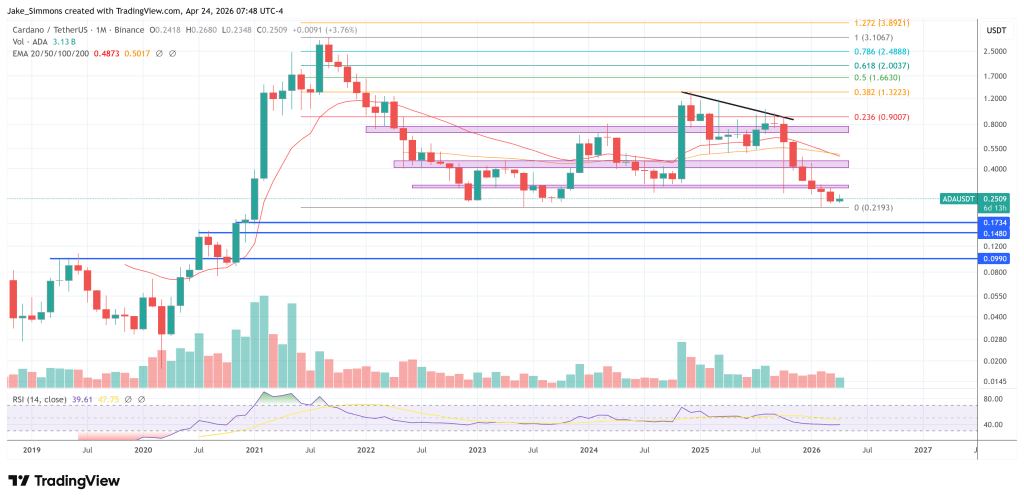
ADA remains below key resistance, 1-monthly chart | Source: ADAUSDT on TradingView.com

Трендові криптовалюти

Пов'язані питання

QWhat is the main problem Charles Hoskinson identified for Cardano and the broader Web3 ecosystem?

AThe main problem is the reliance on centralized off-chain infrastructure, which contradicts the decentralization claims of the industry and creates centralized control points.

QWhich essay by Moxie Marlinspike did Hoskinson reference, and what was its key argument?

AHoskinson referenced the January 2022 essay 'My First Impressions of Web3.' Its key argument was that users don't want to run their own servers, protocols move slowly, and most decentralized applications still depend on centralized companies for the user experience.

QWhat is the proposed long-term role for BlockFrost within the Cardano ecosystem according to Hoskinson?

AHoskinson stated that BlockFrost's long-term role should be to become 'a decentralized infrastructure network,' serving as a decentralized alternative to centralized developer platforms like Alchemy.

QHow did Hoskinson connect the infrastructure problem to Cardano's treasury voting process?

AHe stated that the current treasury proposals are not random funding requests but are part of a strategic, end-to-end push to decentralize the application layer and build off-chain infrastructure that avoids recreating Web2 centralization chokepoints.

QWhat technologies did Hoskinson cite as the cryptographic building blocks that Midnight will bring to Cardano?

AHe cited multi-party computation, zero-knowledge cryptography, and trusted execution environments as the key cryptographic building blocks that Midnight will provide.

Пов'язані матеріали

The Changing Landscape: What Are Crypto VCs Experiencing?

Title: The Shifting Landscape of Crypto Venture Capital The era of dedicated crypto venture capital funds is undergoing a significant transformation. Once essential for navigating the sector's complexity and high risk, these specialized funds are now facing an identity crisis as the market matures. This shift mirrors historical patterns in other specialized investment classes like cleantech and SPACs, where initial information advantages dissipate as technologies become mainstream and integrated into existing industry frameworks. The article argues that crypto is reaching a critical inflection point, transitioning from a "building phase" to an "integration phase." Major players like Stripe, BlackRock, and Visa now engage with crypto not for its novel mechanics but as a foundational financial infrastructure. Their needs—regulatory compliance, banking partnerships, distribution channels—align with traditional fintech, a domain easily understood by large, generalist funds like Sequoia and Founders Fund. This evolution creates a "barbell effect" within the VC landscape. On one end are massive, diversified platforms that can incorporate crypto as one vertical among many. On the other are small, nimble funds focused on niche, experimental projects. The middle ground—medium-sized dedicated crypto funds—is being squeezed out. Their typical fund size makes it impossible to generate sufficient returns solely from early-stage crypto bets, yet they cannot compete with giants for later-stage deals. Consequently, leading crypto-native firms like Paradigm and Framework Ventures are expanding into AI, robotics, and other sectors, driven partly by LP pressure for better returns amid a broader VC DPI crisis. Others, like Dragonfly and a16z, have narrowed their crypto focus predominantly to financial infrastructure like stablecoins, reframing the sector's core narrative. For crypto entrepreneurs, this consolidation presents challenges. While generalist funds offer larger checks and broader resources, crypto projects now compete fiercely with AI for attention and capital within these firms. Furthermore, the long-term, non-commercial foundational work that built the ecosystem—funded by dedicated crypto VCs—is less likely to attract generalist capital focused on direct returns. The conclusion is that "crypto investor" as a standalone category is becoming obsolete, akin to "internet investor." Crypto is becoming a baseline infrastructure layer. The future will see a barbell structure: large-scale growth financing handled by generalist funds, while pioneering, speculative projects are funded by small, specialized vehicles. The dedicated crypto funds of the 2017-2021 boom, which incubated core infrastructure, are giving way to this new, bifurcated reality.

Foresight News13 хв тому

The Changing Landscape: What Are Crypto VCs Experiencing?

Foresight News13 хв тому

As Consensus Accelerates, What Are Young Investors Betting On?

Title: As Consensus Forms Faster, What Are Young Investors Betting On? In the rapid evolution of tech investment, a new generation of young investors is navigating a landscape where AI, robotics, commercial aerospace, and quantum computing are advancing simultaneously. Traditional investment logic based on financial models is giving way to a need for deep technical understanding and the ability to act before industry consensus forms. An analysis of trends from the "WAIC FUTURE TECH" list of young investment leaders reveals key shifts in focus. The first major trend is the movement of AI from the digital screen into the physical world. Investment is shifting from large language models and chatbots towards embodied AI, robotics, AI hardware, and edge computing. While demonstrations generate excitement, the real challenge lies in achieving scalable, reliable, and cost-effective delivery in complex real-world environments like factories and logistics. Success depends not just on algorithms but on the integration of sensors, actuators, and control systems. Second, the competitive focus for large models is moving beyond raw capability toward building an "intelligence flywheel." The goal is to create self-reinforcing systems where user interaction generates data, improving the model, which in turn enhances the user experience and attracts more engagement. Companies that successfully embed AI into workflows to create these closed-loop systems can build lasting value that isn't easily erased by the next model upgrade. Third, facing a potential bottleneck in high-quality human-generated data, investors are looking at new underlying technologies. Reinforcement learning and self-play, as demonstrated by AlphaGo Zero, offer paths for AI to generate its own experience. Scientific foundation models, which aim to build general AI capabilities for fields like life sciences and materials discovery, represent a non-consensus direction that could unlock new frontiers of knowledge and data. Finally, in deep-tech areas like quantum computing, commercial aerospace, and space-based infrastructure, patient capital is essential. These fields have long, uncertain development and validation cycles involving complex engineering, supply chains, and regulations. Investment here requires a long-term view, focusing on foundational team capabilities and the eventual emergence of market demand, even if commercial returns are distant. Collectively, these trends illustrate how young investors are adapting to a new era. They are learning to make earlier, technically-informed judgments, balance hype with real-world viability, and provide the patient capital needed to build the deep-tech foundations of the future.

marsbit41 хв тому

As Consensus Accelerates, What Are Young Investors Betting On?

marsbit41 хв тому

Can Japan Buy Growth with AI? Will the Bond Market Believe It?

Japan's cabinet has introduced the 2026 Basic Policy on Economic and Fiscal Management and Reform, shifting its primary fiscal target. The new framework moves away from the traditional annual primary balance goal and instead prioritizes a stable reduction of the debt-to-GDP ratio. This change is tied to a strategy of increased "responsible proactive fiscal" spending, aiming to boost long-term growth through investments in strategic sectors like AI, semiconductors, energy, and robotics. The government estimates total public and private investment in 62 key technologies could exceed 370 trillion yen by 2040. The market reaction has been mixed and cautious. While equity markets may respond to policy signals, bond markets are focused on fiscal credibility. Concerns center on whether the weakening of the clear primary balance anchor could lead to looser fiscal discipline. If investors doubt that these strategic investments will generate sufficient productivity gains, tax revenue, and nominal growth to outpace rising interest costs, they may demand higher yields on Japanese Government Bonds (JGBs). Recent volatility in the yen and JGB yields, with the 10-year yield briefly reaching 2.9%, reflects this skepticism. The success of this new framework hinges on two factors: whether Japan can achieve a nominal growth rate consistently higher than its long-term interest rates, and whether future budgets demonstrate disciplined control over bond issuance. The government's narrative is that strategic investment is essential to break Japan's cycle of low growth, aging, and labor shortages. However, the bond market will continuously assess the credibility of this plan, pricing the risk that it may represent fiscal expansion rather than a viable growth strategy.

marsbit1 год тому

Can Japan Buy Growth with AI? Will the Bond Market Believe It?

marsbit1 год тому

Торгівля

Спот

Популярні статті

Як купити ADA

Ласкаво просимо до HTX.com! Ми зробили покупку Cardano (ADA) простою та зручною. Дотримуйтесь нашої покрокової інструкції, щоб розпочати свою криптовалютну подорож.Крок 1: Створіть обліковий запис на HTXВикористовуйте свою електронну пошту або номер телефону, щоб зареєструвати обліковий запис на HTX безплатно. Пройдіть безпроблемну реєстрацію й отримайте доступ до всіх функцій.ЗареєструватисьКрок 2: Перейдіть до розділу Купити крипту і виберіть спосіб оплатиКредитна/дебетова картка: використовуйте вашу картку Visa або Mastercard, щоб миттєво купити Cardano (ADA).Баланс: використовуйте кошти з балансу вашого рахунку HTX для безперешкодної торгівлі.Треті особи: ми додали популярні способи оплати, такі як Google Pay та Apple Pay, щоб підвищити зручність.P2P: Торгуйте безпосередньо з іншими користувачами на HTX.Позабіржова торгівля (OTC): ми пропонуємо індивідуальні послуги та конкурентні обмінні курси для трейдерів.Крок 3: Зберігайте свої Cardano (ADA)Після придбання Cardano (ADA) збережіть його у своєму обліковому записі на HTX. Крім того, ви можете відправити його в інше місце за допомогою блокчейн-переказу або використовувати його для торгівлі іншими криптовалютами.Крок 4: Торгівля Cardano (ADA)Легко торгуйте Cardano (ADA) на спотовому ринку HTX. Просто увійдіть до свого облікового запису, виберіть торгову пару, укладайте угоди та спостерігайте за ними в режимі реального часу. Ми пропонуємо зручний досвід як для початківців, так і для досвідчених трейдерів.

1.0k переглядів усьогоОпубліковано 2024.12.10Оновлено 2026.06.02

Як купити ADA

Обговорення

Ласкаво просимо до спільноти HTX. Тут ви можете бути в курсі останніх подій розвитку платформи та отримати доступ до професійної ринкової інформації. Нижче представлені думки користувачів щодо ціни ADA (ADA).

活动图片













