Unlocking $100 Million in Liquidity? Pump.fun's New Policy Tests the 5-Minute Pump Technique

Foresight NewsОпубліковано о 2026-07-22Востаннє оновлено о 2026-07-22

Анотація

Foresight News, July 21 – Pump.fun has launched its new "BOOST" mode as the standard launch mechanism for new tokens. The core of BOOST is to address the issue of "dead liquidity." Historically, when a token migrates from its bonding curve to a liquidity pool, roughly 20% of its liquidity becomes permanently locked and unusable, a problem the platform estimates costs over $100 million annually. The new mechanism redirects this 20% of funds, which would have been locked, to instead be used for a 5-minute Time-Weighted Average Price (TWAP) buyback of the token immediately after migration. The purchased tokens are then permanently burned. For example, this means reserving 17.6 SOL for SOL pairs or about $2516 for USDC pairs at migration. This creates a short-term buying pressure and reduces the token's supply. The goal is to improve the immediate post-launch performance of memecoins, potentially increasing trader retention and transaction volume on the platform. However, critics warn this could lower the bar for token launches, encouraging low-quality projects, and that the brief 5-minute buy pressure might lead to sharper price crashes once it ends if followed by large sell-offs.


Author: Ma He, Foresight News


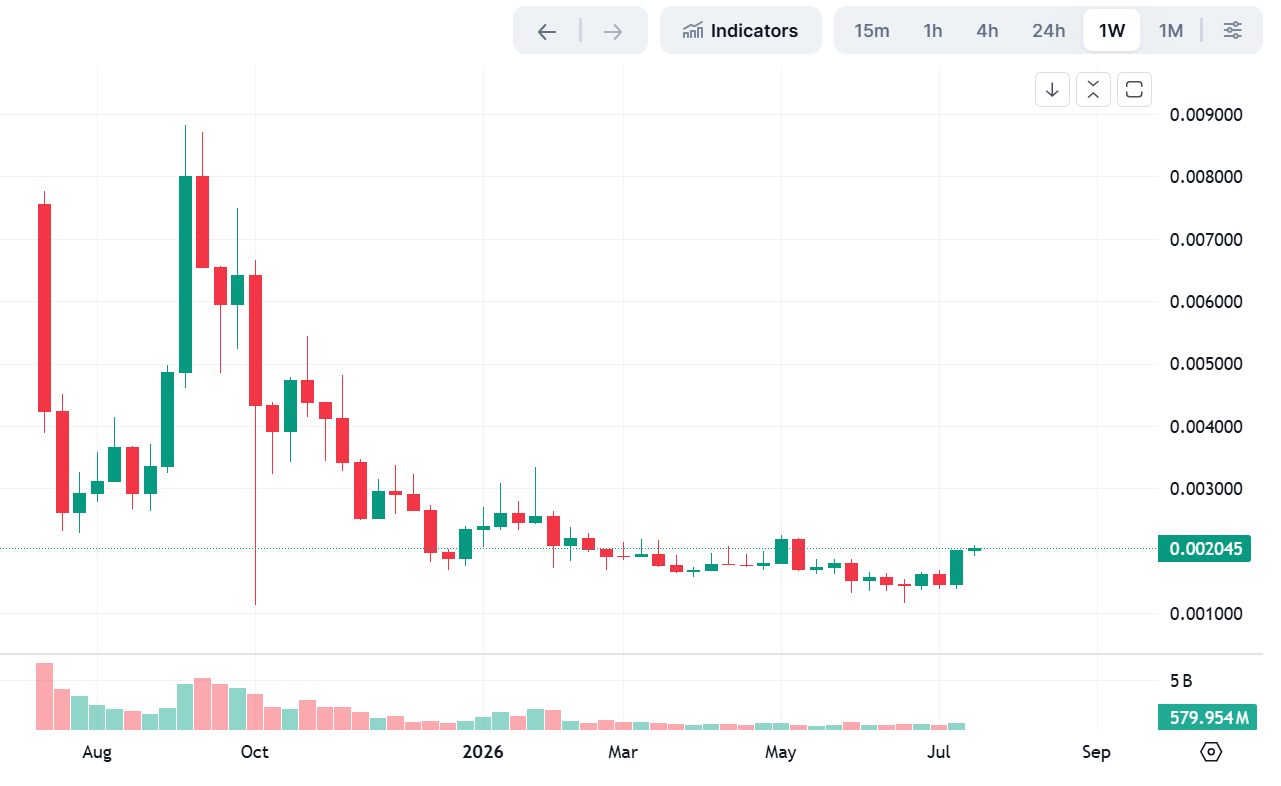
On July 21, Pump.fun officially announced the launch of BOOST mode, setting it as the new standard default launch mechanism for tokens. After the announcement, PUMP's price continued to fluctuate around $0.002.


According to official explanations, historical data shows that whenever a token graduates from the bonding curve and migrates to a liquidity pool, approximately 20% of the liquidity becomes "dead liquidity." Even if all holders sell, these funds remain permanently locked in the LP, becoming unusable. The platform estimates this mechanism causes over $100 million in liquidity to be permanently lost annually.
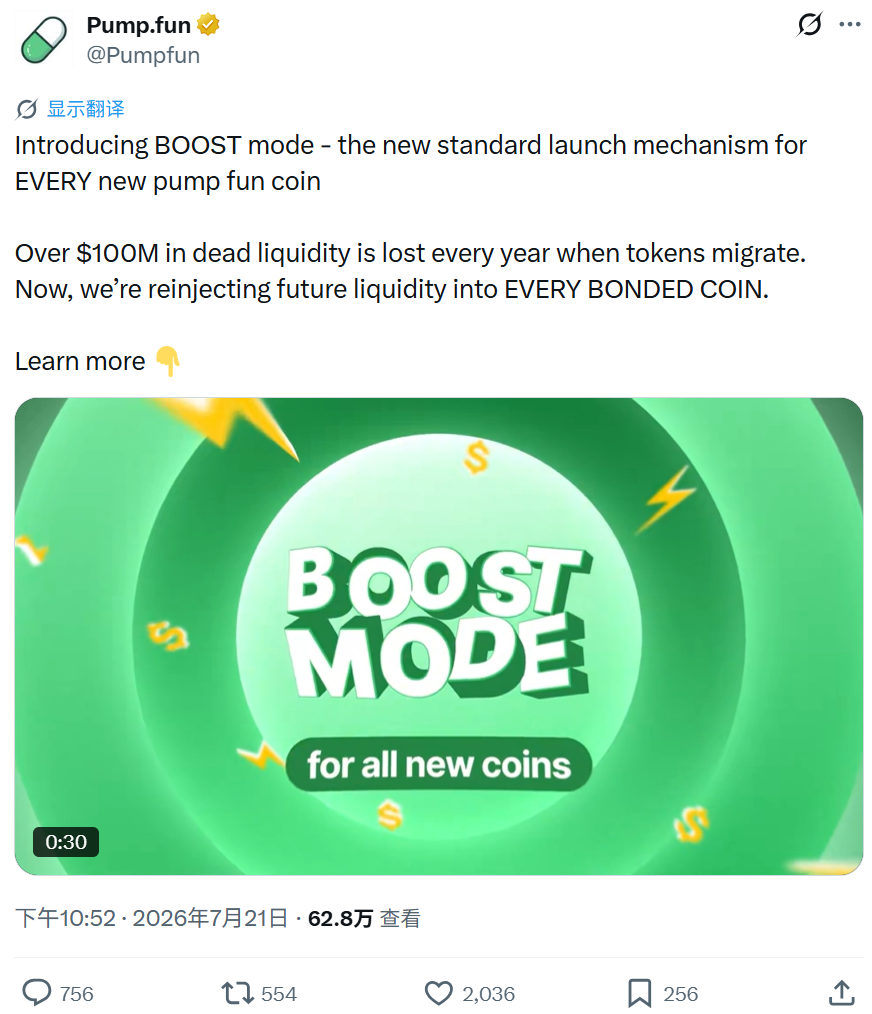


The core action of BOOST mode is straightforward: use these funds, which would otherwise be wasted, to continuously buy the token via TWAP (Time Weighted Average Price) during the first 5 minutes after migration, and immediately burn all purchased tokens. When a token graduates, Pump.fun will forcibly withhold about 20% of the funds. Calculated based on fixed migration rules, this amounts to withholding 17.6 SOL for SOL pairs and about $2516 for USDC pairs.


These funds entirely come from the "sacrificed" portion of liquidity during previous migrations, not from new platform subsidies. After the purchase is completed, the corresponding tokens are directly burned, creating short-term buying pressure while permanently reducing circulating supply.


Using Reserve Funds to Provide a 5-Minute Buy Pressure for Tokens


Pump.fun's classic process is: users create a token with one click, then trade on the bonding curve. When the token reaches a certain market cap threshold, it automatically migrates to the PumpSwap liquidity pool. During migration, the platform locks a portion of the liquidity into the LP at a set ratio to ensure subsequent trading depth.


The problem lies in the high proportion of these locked funds. Even if the token's price later goes to zero and everyone sells out, a sum of "dead money" remains in the LP. This money can neither be withdrawn nor redeployed to other active assets, resulting in systemic capital waste. The official estimate is "over $100 million annually."


BOOST mode does not change the bonding curve trading experience or adjust the graduation threshold itself. It does not arbitrarily add or release any external liquidity. Its essence is to extract the 20% of settlement funds originally intended for the LP and use them to buy and directly burn tokens on the secondary market via TWAP over 5 minutes.


The official explicitly stated that tokens migrated after 22:23 (Beijing Time) on July 21 automatically have BOOST enabled. Tokens migrated before this time, as well as those launched via the Mayhem (AI Agent Lab) mode, do not benefit from this mechanism.


A 5-Minute Fireworks Show


As of July 22, Pump.fun's current annualized revenue is approximately $342.54 million, with total token buyback value around $411.27 million. However, its token price remains far from its all-time high of $0.008. Relying solely on large-scale buybacks can hardly effectively boost price expectations anymore.


The essence of BOOST is not to add another round of buybacks for PUMP, but to attempt to solve the product issues of the launchpad itself.


The logic behind this might be: if meme coins after graduation have slightly thicker order books and better short-term performance, trader retention and repeat purchase intentions would be higher. Most PVP (Player vs. Player) players don't care about a meme coin's fate three days later; they care about whether it can "pump" at the moment of graduation. The Pump.fun team likely sees through this. Instead of locking 20% of funds defensively in the LP pool, it's better to turn that money into a 5-minute "fireworks show."


The platform's real moat isn't "high token launch volume," but "a certain proportion of launched tokens can continuously generate trading volume." Only when the latter stabilizes can protocol revenue truly be sustainable. Stable or growing revenue provides continuous ammunition for buybacks, rather than appearing like "using存量 revenue to barely support the price."


Of course, many traders are concerned that the additional buying pressure could lower the actual difficulty of project launches, potentially making more low-quality tokens appear "successful," thereby encouraging more aggressive launch behavior. Others point out that the 5-minute TWAP buying window is still short. Once buying stops after 5 minutes and faces large sell orders, the token price could crash with even more exaggerated slippage than before. This essentially trades extremely high post-pump dump risk for a 5-minute pumping illusion.


Трендові криптовалюти

Пов'язані питання

QWhat is the core mechanism of Pump.fun's new BOOST mode, and what problem does it aim to solve?

AThe core mechanism of the BOOST mode is to use the approximately 20% of liquidity that would normally be permanently locked as 'dead liquidity' when a token graduates to a liquidity pool. Instead of locking it, this capital is used to buy the token via TWAP (Time-Weighted Average Price) over the first 5 minutes after graduation and then immediately burn the purchased tokens. It aims to solve the problem of systemic capital waste, estimated by the platform to be over $100 million annually, where funds become unusable even if a token's price goes to zero.

QAccording to the article, what are the potential benefits of the BOOST mechanism for the Pump.fun platform?

AThe potential benefits are: 1) Creating a short-term buying pressure and a 'fireworks' effect in the first 5 minutes after a token's graduation, which could improve trader retention and repurchase intention. 2) Permanently reducing the token's circulating supply through burning, potentially supporting its price. 3) Strengthening the platform's moat by increasing the proportion of launched tokens that generate sustained trading volume, which is crucial for sustainable protocol revenue and, consequently, for funding ongoing token buybacks.

QWhat are the main concerns or criticisms raised about the BOOST mechanism in the article?

AThe main concerns are: 1) It might lower the actual difficulty for a project to launch successfully, making it easier for low-quality tokens to create an illusion of success and encouraging more aggressive token launches. 2) The 5-minute TWAP buying window is short. Once it stops and if faced with large sell-offs, the token price could crash with even worse slippage than before. This essentially trades a high risk of a post-buyback crash for a 5-minute pump illusion.

QWhat is the estimated annual value of 'dead liquidity' that the BOOST mode seeks to repurpose, and where does this capital come from?

AThe platform estimates that over $100 million worth of liquidity is permanently lost ('dead') each year. This capital comes from the portion of funds (about 20%) that is automatically locked into the liquidity pool (LP) when a token graduates from the bonding curve. It is not new platform subsidy but repurposed existing capital that would otherwise be trapped forever.

QWhich tokens on Pump.fun are eligible for the new BOOST mechanism, and which are not?

ATokens that graduate (migrate from bonding curve to liquidity pool) after 22:23 Beijing Time on July 21st automatically have the BOOST configuration enabled. Tokens that migrated before this time, as well as tokens launched through the Mayhem (AI Agent Lab) mode, are not eligible for this mechanism.

Пов'язані матеріали

7 Months After the Collapse of Huiwang, Southeast Asia's Escrow Platforms Undergo a Major Reshuffle

Following the collapse of Huione Pay—dubbed the "Alipay of Southeast Asia"—seven months ago, the region's underground financial guarantee platform sector is undergoing a significant reshuffle. This power vacuum has been swiftly filled by emerging platforms such as XinBi, Tiger/Navigator, JinBei (renamed JinBo), Dali/Tiancheng, and FullyLight. These platforms, operating largely via Telegram and offering services like escrow for illicit transactions, have absorbed the vast user base and markets left behind by Huione. While positioning themselves as "trust intermediaries," their primary clientele consists of networks involved in online scams, money laundering, illegal gambling, and even human trafficking. For instance, the Tiger/Navigator platform explicitly provides "escrow" services for kidnapping-for-ransom operations ("强押车交易"). Data underscores the immense scale: Huione alone processed over $103 billion in cryptocurrency payments and facilitated over $31 billion through its escrow market before its downfall, linking it to Cambodia's notorious Prince Group. Since its collapse, competitors have seen explosive growth. For example, the XinBi platform has accumulated over $1.6 billion in total USDT revenue, while platforms like NewPay, OkPay (under Dali), and FullyLight Wallet collectively processed over $4.8 billion in USDT in a single year. This ecosystem thrives in regions like Cambodia and Myanmar, where regulatory gaps allow these platforms to act as critical financial infrastructure for sprawling cybercrime industries, from scam compounds to online casinos. The article concludes that the moniker "Southeast Asian Alipay" is a misnomer, obscuring the platforms' fundamental role in enabling serious criminal enterprises rather than representing legitimate financial innovation.

Odaily星球日报4 хв тому

7 Months After the Collapse of Huiwang, Southeast Asia's Escrow Platforms Undergo a Major Reshuffle

Odaily星球日报4 хв тому

The Changing Landscape: What Are Crypto VCs Experiencing?

Title: The Shifting Landscape of Crypto Venture Capital The era of dedicated crypto venture capital funds is undergoing a significant transformation. Once essential for navigating the sector's complexity and high risk, these specialized funds are now facing an identity crisis as the market matures. This shift mirrors historical patterns in other specialized investment classes like cleantech and SPACs, where initial information advantages dissipate as technologies become mainstream and integrated into existing industry frameworks. The article argues that crypto is reaching a critical inflection point, transitioning from a "building phase" to an "integration phase." Major players like Stripe, BlackRock, and Visa now engage with crypto not for its novel mechanics but as a foundational financial infrastructure. Their needs—regulatory compliance, banking partnerships, distribution channels—align with traditional fintech, a domain easily understood by large, generalist funds like Sequoia and Founders Fund. This evolution creates a "barbell effect" within the VC landscape. On one end are massive, diversified platforms that can incorporate crypto as one vertical among many. On the other are small, nimble funds focused on niche, experimental projects. The middle ground—medium-sized dedicated crypto funds—is being squeezed out. Their typical fund size makes it impossible to generate sufficient returns solely from early-stage crypto bets, yet they cannot compete with giants for later-stage deals. Consequently, leading crypto-native firms like Paradigm and Framework Ventures are expanding into AI, robotics, and other sectors, driven partly by LP pressure for better returns amid a broader VC DPI crisis. Others, like Dragonfly and a16z, have narrowed their crypto focus predominantly to financial infrastructure like stablecoins, reframing the sector's core narrative. For crypto entrepreneurs, this consolidation presents challenges. While generalist funds offer larger checks and broader resources, crypto projects now compete fiercely with AI for attention and capital within these firms. Furthermore, the long-term, non-commercial foundational work that built the ecosystem—funded by dedicated crypto VCs—is less likely to attract generalist capital focused on direct returns. The conclusion is that "crypto investor" as a standalone category is becoming obsolete, akin to "internet investor." Crypto is becoming a baseline infrastructure layer. The future will see a barbell structure: large-scale growth financing handled by generalist funds, while pioneering, speculative projects are funded by small, specialized vehicles. The dedicated crypto funds of the 2017-2021 boom, which incubated core infrastructure, are giving way to this new, bifurcated reality.

Foresight News21 хв тому

The Changing Landscape: What Are Crypto VCs Experiencing?

Foresight News21 хв тому

As Consensus Accelerates, What Are Young Investors Betting On?

Title: As Consensus Forms Faster, What Are Young Investors Betting On? In the rapid evolution of tech investment, a new generation of young investors is navigating a landscape where AI, robotics, commercial aerospace, and quantum computing are advancing simultaneously. Traditional investment logic based on financial models is giving way to a need for deep technical understanding and the ability to act before industry consensus forms. An analysis of trends from the "WAIC FUTURE TECH" list of young investment leaders reveals key shifts in focus. The first major trend is the movement of AI from the digital screen into the physical world. Investment is shifting from large language models and chatbots towards embodied AI, robotics, AI hardware, and edge computing. While demonstrations generate excitement, the real challenge lies in achieving scalable, reliable, and cost-effective delivery in complex real-world environments like factories and logistics. Success depends not just on algorithms but on the integration of sensors, actuators, and control systems. Second, the competitive focus for large models is moving beyond raw capability toward building an "intelligence flywheel." The goal is to create self-reinforcing systems where user interaction generates data, improving the model, which in turn enhances the user experience and attracts more engagement. Companies that successfully embed AI into workflows to create these closed-loop systems can build lasting value that isn't easily erased by the next model upgrade. Third, facing a potential bottleneck in high-quality human-generated data, investors are looking at new underlying technologies. Reinforcement learning and self-play, as demonstrated by AlphaGo Zero, offer paths for AI to generate its own experience. Scientific foundation models, which aim to build general AI capabilities for fields like life sciences and materials discovery, represent a non-consensus direction that could unlock new frontiers of knowledge and data. Finally, in deep-tech areas like quantum computing, commercial aerospace, and space-based infrastructure, patient capital is essential. These fields have long, uncertain development and validation cycles involving complex engineering, supply chains, and regulations. Investment here requires a long-term view, focusing on foundational team capabilities and the eventual emergence of market demand, even if commercial returns are distant. Collectively, these trends illustrate how young investors are adapting to a new era. They are learning to make earlier, technically-informed judgments, balance hype with real-world viability, and provide the patient capital needed to build the deep-tech foundations of the future.

marsbit49 хв тому

As Consensus Accelerates, What Are Young Investors Betting On?

marsbit49 хв тому

Can Japan Buy Growth with AI? Will the Bond Market Believe It?

Japan's cabinet has introduced the 2026 Basic Policy on Economic and Fiscal Management and Reform, shifting its primary fiscal target. The new framework moves away from the traditional annual primary balance goal and instead prioritizes a stable reduction of the debt-to-GDP ratio. This change is tied to a strategy of increased "responsible proactive fiscal" spending, aiming to boost long-term growth through investments in strategic sectors like AI, semiconductors, energy, and robotics. The government estimates total public and private investment in 62 key technologies could exceed 370 trillion yen by 2040. The market reaction has been mixed and cautious. While equity markets may respond to policy signals, bond markets are focused on fiscal credibility. Concerns center on whether the weakening of the clear primary balance anchor could lead to looser fiscal discipline. If investors doubt that these strategic investments will generate sufficient productivity gains, tax revenue, and nominal growth to outpace rising interest costs, they may demand higher yields on Japanese Government Bonds (JGBs). Recent volatility in the yen and JGB yields, with the 10-year yield briefly reaching 2.9%, reflects this skepticism. The success of this new framework hinges on two factors: whether Japan can achieve a nominal growth rate consistently higher than its long-term interest rates, and whether future budgets demonstrate disciplined control over bond issuance. The government's narrative is that strategic investment is essential to break Japan's cycle of low growth, aging, and labor shortages. However, the bond market will continuously assess the credibility of this plan, pricing the risk that it may represent fiscal expansion rather than a viable growth strategy.

marsbit1 год тому

Can Japan Buy Growth with AI? Will the Bond Market Believe It?

marsbit1 год тому

Торгівля

Спот

Популярні статті

Як купити PUMP

Ласкаво просимо до HTX.com! Ми зробили покупку Big Pump (PUMP) простою та зручною. Дотримуйтесь нашої покрокової інструкції, щоб розпочати свою криптовалютну подорож.Крок 1: Створіть обліковий запис на HTXВикористовуйте свою електронну пошту або номер телефону, щоб зареєструвати обліковий запис на HTX безплатно. Пройдіть безпроблемну реєстрацію й отримайте доступ до всіх функцій.ЗареєструватисьКрок 2: Перейдіть до розділу Купити крипту і виберіть спосіб оплатиКредитна/дебетова картка: використовуйте вашу картку Visa або Mastercard, щоб миттєво купити Big Pump (PUMP).Баланс: використовуйте кошти з балансу вашого рахунку HTX для безперешкодної торгівлі.Треті особи: ми додали популярні способи оплати, такі як Google Pay та Apple Pay, щоб підвищити зручність.P2P: Торгуйте безпосередньо з іншими користувачами на HTX.Позабіржова торгівля (OTC): ми пропонуємо індивідуальні послуги та конкурентні обмінні курси для трейдерів.Крок 3: Зберігайте свої Big Pump (PUMP)Після придбання Big Pump (PUMP) збережіть його у своєму обліковому записі на HTX. Крім того, ви можете відправити його в інше місце за допомогою блокчейн-переказу або використовувати його для торгівлі іншими криптовалютами.Крок 4: Торгівля Big Pump (PUMP)Легко торгуйте Big Pump (PUMP) на спотовому ринку HTX. Просто увійдіть до свого облікового запису, виберіть торгову пару, укладайте угоди та спостерігайте за ними в режимі реального часу. Ми пропонуємо зручний досвід як для початківців, так і для досвідчених трейдерів.

353 переглядів усьогоОпубліковано 2024.12.12Оновлено 2026.06.02

Як купити PUMP

Обговорення

Ласкаво просимо до спільноти HTX. Тут ви можете бути в курсі останніх подій розвитку платформи та отримати доступ до професійної ринкової інформації. Нижче представлені думки користувачів щодо ціни PUMP (PUMP).

活动图片












