Ex-Ripple Director Shares 4 Crypto And Blockchain Predictions For 2026

bitcoinistОпубліковано о 2025-12-24Востаннє оновлено о 2025-12-24

Анотація

Former Ripple director and current Evernorth CEO Asheesh Birla predicts that by 2026, institutional adoption will move beyond speculation and become embedded in everyday financial infrastructure. His four key forecasts include: 1) Corporate treasuries will become programmable through DeFi and AI, reducing manual processes and middlemen. 2) Local stablecoins will proliferate and challenge the traditional $9.6 trillion FX market via on-chain exchanges. 3) Stablecoins will achieve mainstream use in corporate and bank settlements for real-time liquidity analytics and faster transactions, potentially growing from $300 billion to $100 trillion in market cap. 4) NFTs will rebrand as digital access tokens for membership, combining ticketing, loyalty, and collectibles. Birla emphasizes a shift toward practical, institutional use cases for blockchain and crypto.

Asheesh Birla, a former Ripple board member who now runs Evernorth, an XRP-focused digital asset treasury, is out with a tidy set of 2026 predictions that basically boil down to one thing: institutions finally stop circling and start using this stuff in production.

In a short video shared to social media, Birla frames next year as the moment crypto infrastructure slips into the background and starts doing the boring work it always promised to do.

“My theme this year is really around how institutions, financial and corporate institutions, are going to start adopting blockchain technology at scale,” he said. “It’s going to be part of everyday financial infrastructure in 2026. It’s going to quietly power how money moves.”

4 Crypto Predictions For 2026 By Ex-Ripple Exec Birla

Prediction No. 1 is corporate treasury operations getting “programmable,” in his words, as DeFi tooling collides with AI-driven automation. The pitch is straightforward: back offices are still messy, manual, and full of middlemen. If you can turn parts of treasury management into code — and then let AI help run the workflows — you compress cost, time, and operational friction.

“It’s just a more efficient way to manage their operations, which today are manual and have a lot of middlemen,” the ex-Ripple director said. “Using DeFi and AI, I think you’re going to see a lot of those efficiency gains start to come to fruition and you’re going to see fewer middlemen and a better experience for moving money and managing your global operations in 2026.”

His second call is a twist on the stablecoin trade: not just more dollar coins, but “local stablecoins” proliferating across regions, then meeting on-chain in FX venues.

“You’re going to see these challenge the 9.6 trillion dollar FX market,” he said, arguing that on-chain DEX liquidity becomes the base layer for a new kind of spot FX market that competes with legacy rails.

Prediction No. 3 is stablecoins going fully mainstream inside corporate and bank plumbing — less as a crypto product, more as settlement tech. Birla claims the upside is obvious to finance teams: “real-time analytics into your liquidity positions around the world,” faster movement, cleaner reconciliation.

He also throws out the big-number trajectory that’s become common in these forecasts, saying stablecoins could grow “from 300 billion to 100 trillion dollars in market cap” based on “industry projections.”

And then there’s the NFT comeback, which he’s careful to describe as a rebrand and a reframing, not a rerun of 2021. Forget JPEG roulette, he says. Think access.

“They’re going to be about membership access,” the ex-Ripple director said in his prediction no. 4. “So it’s going to allow you to combine ticketing, loyalty, and digital collectibles into one digital access token.”

The subtext here matters: Birla’s now building Evernorth around XRP exposure and institutional participation, with the firm positioning itself as a purpose-built XRP treasury.

So his “bigger story” is also a bit of a sales thesis, crypto moving beyond speculation by embedding into how money moves, how treasuries run, and how brands manage customer relationships.

At press time, XRP traded at $1.8577.
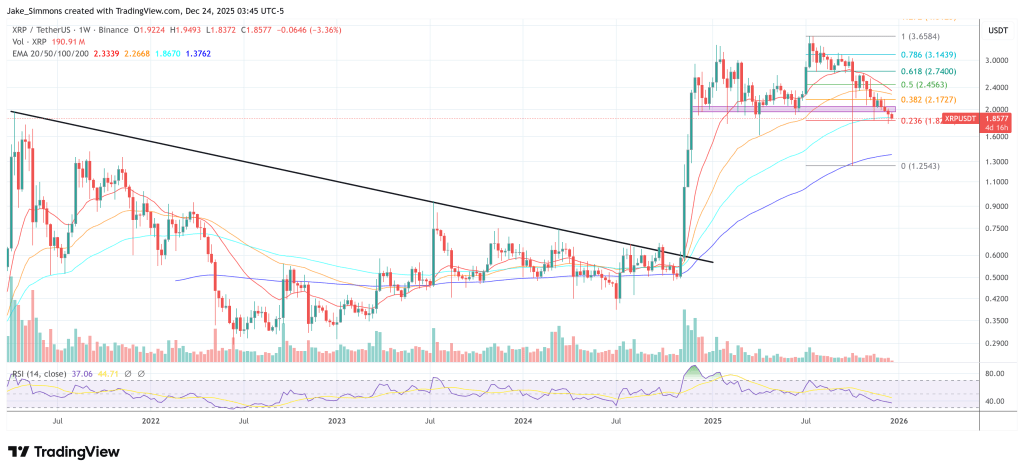
XRP falls below key support, 1-week chart | Source: XRPUSDT on TradingView.com

Пов'язані питання

QWhat is the main theme of Asheesh Birla's 2026 predictions for blockchain and crypto?

AThe main theme is how financial and corporate institutions will start adopting blockchain technology at scale, making it part of everyday financial infrastructure that quietly powers how money moves.

QAccording to Birla, what will be the primary use case for NFTs in 2026, moving beyond the 2021 speculation?

ANFTs will be rebranded and reframed to focus on membership access, combining ticketing, loyalty programs, and digital collectibles into one digital access token.

QHow does Birla predict stablecoins will evolve in the crypto market by 2026?

ABirla predicts stablecoins will go fully mainstream as settlement technology within corporate and bank systems, potentially growing from a $300 billion to a $100 trillion market cap, and will include the proliferation of 'local stablecoins' that challenge the traditional FX market.

QWhat specific efficiency gains does Birla foresee from combining DeFi tooling with AI-driven automation in corporate treasury operations?

AHe foresees that turning parts of treasury management into code and using AI to run workflows will compress cost, time, and operational friction by reducing manual processes and middlemen, leading to a more efficient way to manage global operations and move money.

QWhat role does Birla's company, Evernorth, play in the context of these predictions?

AEvernorth is a digital asset treasury focused on XRP, positioning itself to facilitate institutional participation and exposure to XRP as crypto moves beyond speculation and embeds into money movement, treasury management, and customer relationship management.

Пов'язані матеріали

Jensen Huang's CMU Speech: In the AI Era, Don't Just Watch, Build

Jensen Huang, CEO of NVIDIA and a first-generation immigrant, delivered the commencement address to Carnegie Mellon University's class of 2026. He shared his personal journey from a humble background to founding NVIDIA, emphasizing resilience, learning from failure, and the responsibility that comes with leadership. Huang framed the present moment as the dawn of the AI revolution, a shift he believes is more profound than previous computing waves. He described AI as fundamentally resetting computing—moving from human-written software to machines that understand, reason, and use tools. This will create a new industry for generating intelligence and transform every sector. While acknowledging AI's potential to automate tasks and displace some jobs, Huang distinguished between the *tasks* of a job and its core *purpose*. He argued AI will augment human capability, not replace humans. The real risk, he stated, is not AI itself, but people being left behind by those who effectively use AI. He presented AI as a generational opportunity for massive infrastructure investment—in chip factories, data centers, energy grids, and advanced manufacturing—that could re-industrialize nations like the U.S. and bridge the digital divide by making computing and intelligent tools accessible to all. Huang called for a balanced approach: advancing AI safely and responsibly, establishing prudent policies, ensuring broad access, and encouraging universal participation. He urged the graduates not to fear the future but to engage with optimism and ambition, reminding them of CMU's motto, "My heart is in the work." His core message was clear: this is their moment to actively build and shape the AI-powered future, not merely observe it.

marsbit42 хв тому

Jensen Huang's CMU Speech: In the AI Era, Don't Just Watch, Build

marsbit42 хв тому

The Era Has Arrived Where Human Writers Must Prove They Are Not Machines

The article describes an era where AI-generated content is flooding the market, forcing human authors to prove they are not machines. It begins with the example of dozens of AI-written, error-ridden biographies of Henry Kissinger appearing on Amazon within hours of his death, a pattern repeated for other deceased celebrities and even living experts who find fraudulent books under their names. This spam content has exploded, with monthly new book releases on platforms like Amazon reaching 300,000 by late 2025. The issue spans genres, from suspiciously high proportions of AI-written teen romance and self-help books to dangerous, AI-generated foraging guides containing lethal advice. The platforms' automated review systems, designed to catch plagiarism and banned words, are ill-equipped to detect AI-generated text that avoids these pitfalls while being nonsensical or fraudulent. The problem has infiltrated traditional publishing. A major publisher, Hachette, had to recall a bestselling horror novel after AI detection tools suggested 78% of its content was machine-generated. An acclaimed European philosophy book was later revealed to be entirely written by AI under a fake author persona. In response, authors are fighting back. At the 2026 London Book Fair, 10,000 writers published a blank book titled "Don't Steal This Book" containing only their signatures—using emptiness as a protest weapon in an age of AI overproduction. Initiatives like the "Human Author Certification" program have emerged, ironically placing the burden on humans to prove their work is not machine-made. The article warns of a vicious cycle: AI-generated low-quality books pollute the data used to train future AI models, leading to "model collapse" and an ever-worsening flood of digital waste, eroding trust in publishing and devaluing human creativity.

marsbit1 год тому

The Era Has Arrived Where Human Writers Must Prove They Are Not Machines

marsbit1 год тому

Торгівля

Спот
Ф'ючерси
活动图片





