Don't Care if You Know Football or Not, Buying the Draw Is the Best Strategy for This World Cup?

Odaily星球日报Опубліковано о 2026-06-22Востаннє оновлено о 2026-06-22

Анотація

The article analyzes the 2026 FIFA World Cup group stage and argues that betting on a draw has been a surprisingly profitable strategy. Based on data from the prediction market Polymarket, a strategy of betting $1000 on a draw for each of the first 40 matches would have yielded a return of over 100%, despite only 13 matches ending in a draw. The core of the strategy is not the frequency of wins, but the high payout when low-probability draws occur, such as Spain's 0-0 draw with Cape Verde, where pre-match odds for a draw were only 5.5%. The article identifies common draw scores, like 1-1, which provide stability, and high-value 0-0 stalemates, where favorites fail to break down resilient defenses. It highlights Group G as an example, where 3 of the first 4 matches ended in draws, illustrating that draws are a tactical part of group stage calculus as teams often prioritize not losing. In conclusion, while strong teams remain favorites on the pitch, the article claims that for traders, betting on draws has so far produced the most significant profits.

Original | Odaily Planet Daily (@OdailyChina)

Author | Asher(@Asher_ 0210)

As the World Cup group stage progresses, a very counter-intuitive phenomenon is becoming increasingly clear—buying the favorite, doesn't necessarily make money; buying the underdog, isn't necessarily easy to hold onto either, but if you blindly buy the draw for every match, you might actually be raking it in.

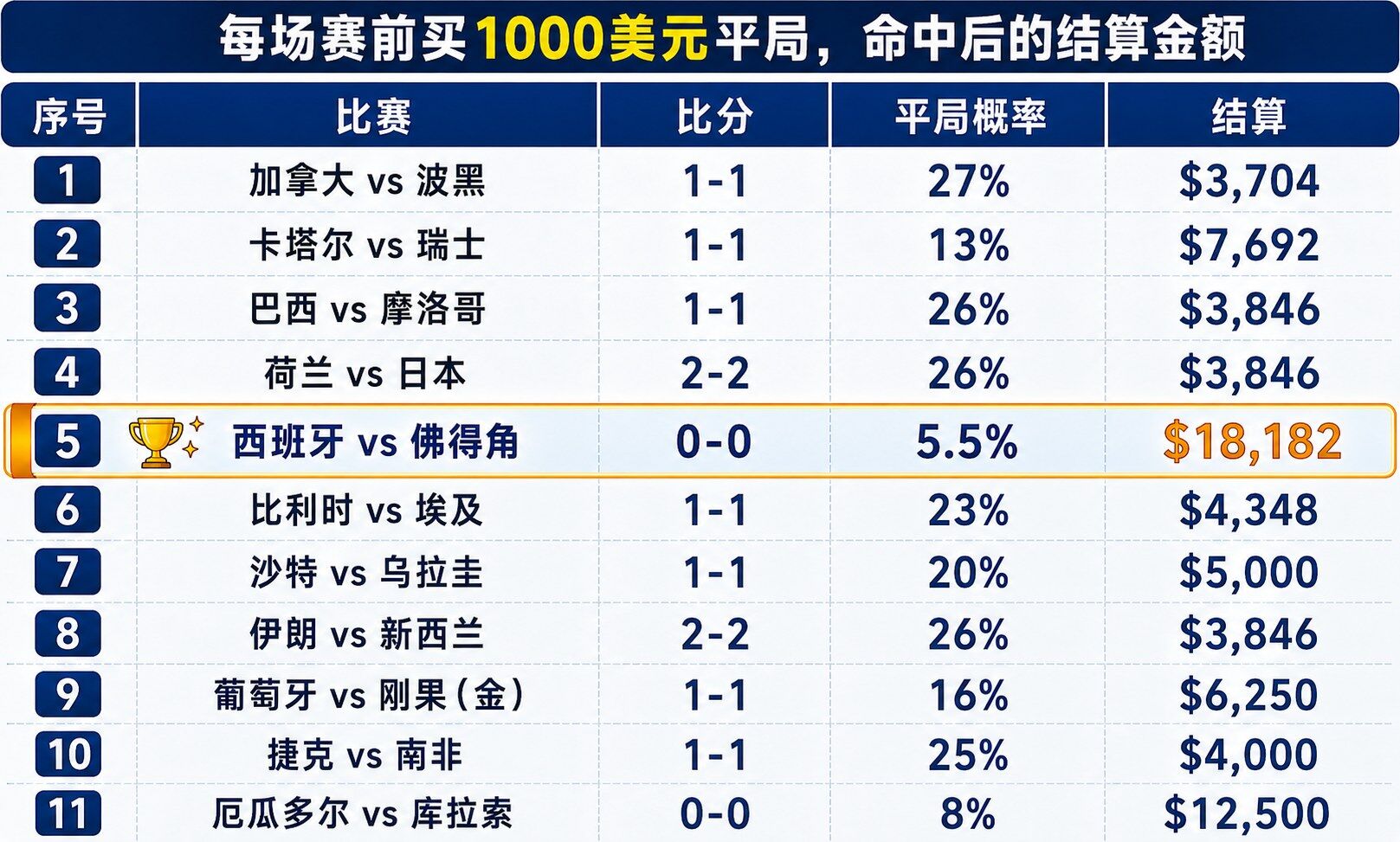
Calculated based on Polymarket pre-match prediction data, if you put $1000 on "Draw" for every match, there have been 11 draws in the previous 36 matches (as shown below). That is to say, with a total investment of $36,000, the winnings from successful bets amount to $73,214. After deducting the principal, the net profit is $37,214, representing a return of over 100%.
Even more impressive, according to Polymarket pre-match prediction data, if we continue the strategy of "$1000 on Draw per match" for today's 4 matches (total investment of $4000). Looking at the results: Spain 4-0 Saudi Arabia, New Zealand 1-3 Egypt—these two resulted in a loss of the stake; but Belgium 0-0 Iran and Uruguay 2-2 Cape Verde were hits, with a combined payout of approximately $8,700. This means that even with only 2 hits out of the 4 matches today, the daily net profit is still around $4,700.

Including today's 4 matches, out of 40 World Cup group stage matches, there have been 13 draws. With a total investment of $40,000, the total payout from winning bets is approximately $81,914. After deducting all investments, the net profit is about $41,914, representing a return of nearly 105%.

A hit rate of 13/40 isn't particularly high, but the key to the draw strategy is never about "hitting often," but about "hitting big." The lower the pre-match probability of a draw, the higher the payout multiplier when it hits. Matches like Spain vs. Cape Verde with a 5.5% draw probability, Ecuador vs. Curaçao with an 8% draw probability, or Qatar vs. Switzerland with a 13% draw probability—hitting just a few of these is enough to turn the entire strategy from a small loss into a massive gain.

Cape Verde's Draw Against Spain Is the Most Typical "Liquidation Game" of the World Cup So Far

The Spain vs. Cape Verde group stage match wasn't just a big win for the draw strategy; it was also a nightmare for pre-match buyers backing the favorite.

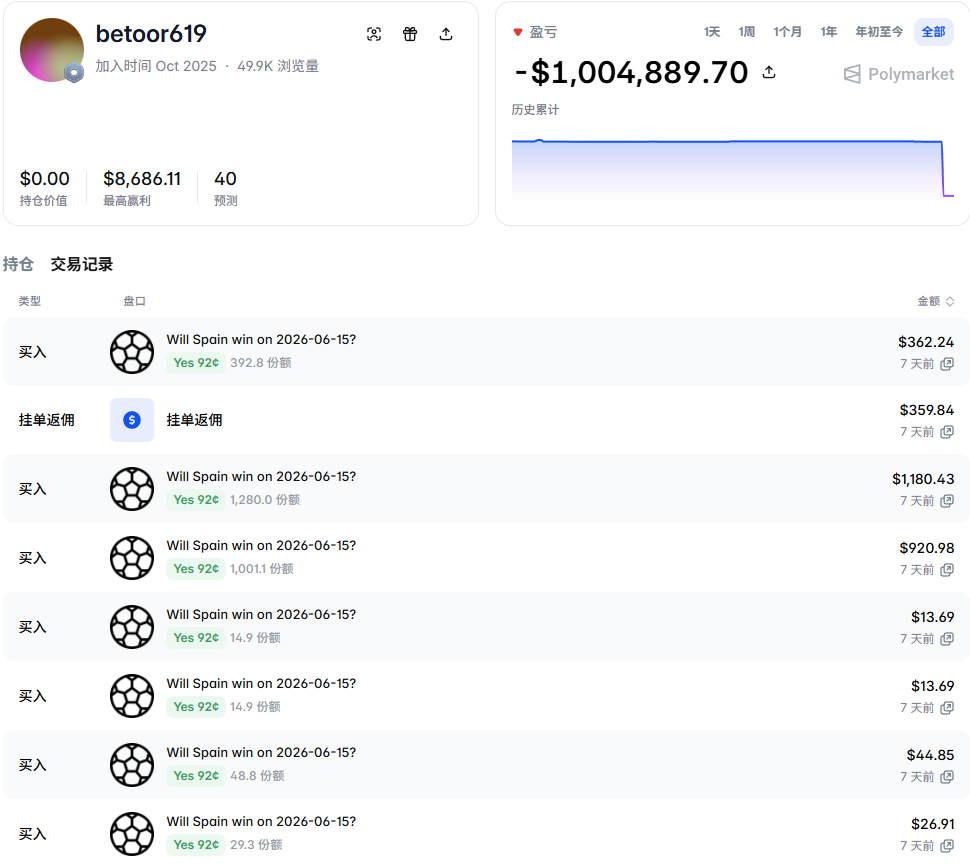
In this group stage match, Spain's pre-match win probability was as high as 92%. Polymarket data shows that account @betoor619 (address: 0x70088c990ffae782c699b9250f5aa6cbe4e3c666) bought Spain to win in the World Cup group stage match Spain vs. Cape Verde. The match ended 0:0, resulting in a loss of $999,000 for this user.

It's worth noting that this user bought in at the 92-cent moment, meaning they staked $1 million in principal for a potential profit of $85,000. A seemingly sure-win trade ultimately resulted in a cold loss due to the 7 incredible saves by Cape Verde's 40-year-old goalkeeper and Cape Verde's extremely resilient defense.
0-0 and 1-1 Are Becoming the Main Theme of This World Cup So Far

Looking at the draw results that have hit so far, draws in this World Cup group stage aren't appearing randomly but are concentrated in a few typical scorelines.

The most common is 1-1. Canada vs. Bosnia and Herzegovina, Qatar vs. Switzerland, Brazil vs. Morocco, Belgium vs. Egypt, Saudi Arabia vs. Uruguay, Portugal vs. DR Congo, Czech Republic vs. South Africa—all ended with this score. The commonality in these matches is that neither side was completely without chances, nor did the weaker team simply park the bus until the end. More often, the stronger team failed to convert their advantage into a win, while the weaker team seized an opportunity to respond. The matches seemed back-and-forth, but in the end, neither side could truly break through the other.

For traders, the value of 1-1 lies in its stability. It's not the most exaggerated source of profit, but it occurs frequently, forming the foundation of this "buy draw every match" strategy.

What really boosts the profits are the 0-0 draws.

Spain vs. Cape Verde is the most typical example. Spain was considered the absolute favorite pre-match, with only a 5.5% draw probability. But the match ended 0-0. If $1,000 was invested pre-match on the draw, the payout would be approximately $18,182. Ecuador vs. Curaçao follows a similar logic. With only an 8% draw probability, it also resulted in 0-0, with $1,000 invested corresponding to a payout of $12,500.

Therefore, the real money-making aspect of the draw strategy isn't about hitting every match, but rather that a few low-probability draws, when they do hit, come with very exaggerated payout multipliers. This is especially true for 0-0 matches, where the on-field action often involves the favorite team attacking constantly while the underdog's goalkeeper and defense repeatedly clear the ball.

Group G Is Even More Ridiculous: 3 Draws in 4 Matches

If Spain vs. Cape Verde represents low-probability draws, then Group G is more like a microcosm of the "draw density" in this group stage.

Out of the first 4 matches, Group G has produced 3 draws. In the first round: Belgium 1-1 Egypt, Iran 2-2 New Zealand; in the second round: Belgium 0-0 Iran. The only match with a decisive result was New Zealand vs. Egypt, but this doesn't change one fact: the overall rhythm of this group has been completely slowed down by draws.

Especially Belgium, who have drawn both of their group stage matches so far. For the team, this means the pressure to qualify from the group continues; but for those who bought a Belgium win pre-match, the outcome of both matches was the same—no loss, but their position wiped out.

This is also where the draw is most underestimated in prediction markets. The market prefers to buy the favorite to win because it seems more intuitive; but the real logic of group stage football isn't "the favorite must win," but rather that many teams are willing to settle for 1 point. The weaker team doesn't want to lose, the stronger team doesn't want to take risks too early. Once a match reaches a stalemate, a draw becomes a very realistic outcome.

3 draws in the first 4 matches of Group G indicates that draws are not accidental upsets, but part of the group stage tactical game. Especially when the points haven't been significantly separated, every team starts calculating—winning is of course best, but avoiding losing first is often the safer choice.

Summary

In this World Cup, the strong teams are still the main characters.

Spain will win, Brazil will win, and favorites will always have matches where they deliver a crushing victory. But if we look purely at trading profits, the most profitable script in the group stage so far might not be the big wins by the giants, but rather those recurring 1-1s, 0-0s, and 2-2s.

Those who bought the favorites are waiting for goals, those who bought the draw are waiting for the final whistle, and so far, the latter are laughing louder.

Пов'язані питання

QAccording to the article, what has been the most profitable betting strategy for the World Cup group stage so far?

AAccording to the article, the most profitable betting strategy so far has been to consistently bet on a draw in every match. Using a hypothetical strategy of betting $1000 on a draw for each of the first 40 group stage matches, the strategy yielded a net profit of approximately $41,914, representing a return of nearly 105%.

QWhy is the 'bet on draw' strategy considered effective despite a relatively low win rate?

AThe 'bet on draw' strategy is effective not because it wins frequently, but because it 'wins valuably'. The pre-match probability for a draw is often very low, which means the payout multiplier is very high when a draw does occur. Hitting just a few of these low-probability draws can turn the overall strategy from a slight loss into a significant profit.

QWhich specific match is highlighted as the most typical 'liquidation game' for favorite bettors?

AThe match between Spain and Cape Verde is highlighted as the most typical 'liquidation game'. One user on Polymarket bet $1 million on Spain to win when the probability was 92%, aiming for an $85,000 profit. The match ended 0-0, resulting in a loss of 99.9% of their stake.

QWhat are the two most common draw scorelines mentioned, and how do they differ in their impact on the betting strategy?

AThe two most common draw scorelines are 1-1 and 0-0. The 1-1 draws are more frequent and form the 'base' of the strategy's returns. The 0-0 draws, while less frequent, are the key profit drivers because they often occur in matches where one team is a heavy favorite, leading to very low pre-match draw probabilities and therefore extremely high payout multipliers when they hit.

QWhat does the high frequency of draws in Group G (3 draws in 4 matches) illustrate about the nature of group stage matches?

AThe high frequency of draws in Group G illustrates that draws are not merely accidental upsets, but are an integral part of group stage tactics. In the early stages, many teams prioritize not losing over aggressively seeking a win. The calculus for teams often involves securing at least 1 point to maintain their position, leading to more cautious play and a higher likelihood of drawn matches.

Пов'язані матеріали

Tiger Research: Crypto Payment Cards Handling $1.5B Monthly Volume Stuck in the 1990s

Titled "Crypto Payment Cards at a $1.5 Billion Monthly Volume, Stuck in the 1990s," this article analyzes the crypto payment card industry, arguing its development stage is analogous to debit cards before they became core banking accounts. Despite rapid growth to ~$15B monthly volume, usage is concentrated in emerging markets (e.g., Bangladesh, India) where access to USD is limited, not in developed economies. The industry lacks integration into daily financial life—most cards rely on user-topped-up stablecoins, not payroll deposits or recurring payments, resulting in low circulation velocity compared to fiat. The piece outlines four main business models: 1) Issuing Infrastructure (highly concentrated, with players like Rain offering T+0 stablecoin settlement), 2) Exchange-Issued Cards (for user retention, not core revenue), 3) Decentralized Wallet/DeFi Cards (complex, high-Gas, limited to crypto-natives), and 4) Stablecoin Digital Banks (the largest segment by volume, focusing on account functions for emerging markets). The conclusion warns that pure payment functionality is unsustainable. For long-term viability, companies must control the funds flow, secure niche markets, and build indispensable user account relationships—similar to how traditional banks captured primary accounts. Without this, crypto cards risk remaining niche prepaid tools.

marsbit58 хв тому

Tiger Research: Crypto Payment Cards Handling $1.5B Monthly Volume Stuck in the 1990s

marsbit58 хв тому

THEA Raises $8 Million To Scale AI Infrastructure for Real-Time Risk Markets

Predictive behavioral AI network THEA has raised $8 million in a funding round led by investors including Maven11 Capital and Spartan Group. Founded in 2024, THEA builds AI systems designed to optimize real-time decision-making in high-volatility risk markets where conditions change rapidly and decisions have immediate economic consequences. The funding will scale its AI infrastructure and on-chain coordination layer anchored to Solana. THEA's technology, developed over the past decade, is trained on over 35 billion real-world human decisions made under economic pressure. Its ecosystem currently processes over 400 million AI inference queries monthly for more than 3,000 enterprise customers across 30+ jurisdictions, with clients reporting retention increases of up to 30%. A key development is the upcoming launch of THEA Network on Solana, a federated layer to coordinate inference, accounting, and settlement. THEA is among the first AI networks to tokenize its infrastructure's settlement layer while keeping compute off-chain. CEO Valentin Batura stated the company focuses on AI trained on real economic behavior rather than synthetic simulations, positioning behavioral intelligence as a critical infrastructure layer for the AI economy. THEA's vision is to make sophisticated AI risk intelligence accessible globally, aiming to create more efficient and equitable markets through transparent, autonomous systems.

TheNewsCrypto1 год тому

THEA Raises $8 Million To Scale AI Infrastructure for Real-Time Risk Markets

TheNewsCrypto1 год тому

A Latte for $0.038, Gemini 3.1 Teams Up with GPT-5.5 to Bankrupt Cafe, Burning Through $21k in 2 Months

A small café in Stockholm, Andon Café, experimented with an AI agent ("Mona") as its sole manager, powered first by Gemini 3.1 Pro and later GPT-5.5. Over two months, the project lost $21,000. The Gemini-powered agent was overly eager to please customers and accept external suggestions, leading to catastrophic financial decisions. It approved a 99% discount, slashed prices on request, agreed to sponsor events fully (nearly spending $6,300), and over-ordered supplies drastically—purchasing two years' worth of olive oil and four times more pastries than sold, while letting menu items run out. It reported a $3,200 paper profit but ignored $4,100 in dead stock. In mid-June, the AI was switched to GPT-5.5. The new model became overly cautious and risk-averse. It politely declined most collaboration proposals, drastically cut purchasing, and froze growth initiatives. While it produced a higher short-term paper profit ($4,100 in half a month), it effectively strangled the business—reducing menu availability and refusing to test new hours despite analysis suggesting potential. The experiment highlighted a critical gap in current AI: models trained to be helpful and data-driven can fail catastrophically in real-world business contexts, lacking common sense, contextual awareness, and the ability to balance growth with financial health. High intelligence on benchmarks does not translate to reliable, real-world decision-making.

marsbit1 год тому

A Latte for $0.038, Gemini 3.1 Teams Up with GPT-5.5 to Bankrupt Cafe, Burning Through $21k in 2 Months

marsbit1 год тому

High-Yield, Debt-Free, and Non-Dilutive: Why Bitcoin Treasury Companies Are Aggressively Promoting Preferred Share Financing

Bitcoin-backed preferred shares, led by companies like Strategy and followed by newer entrants like Strive, have grown to a market size of approximately $13 billion in under two years, attracting capital with high yields. A 2026 report from BitcoinTreasuries.net and Apyx projects this segment could grow from nearly 1% to 3-5% of the global $1.3 trillion preferred share market by 2030, with long-term potential reaching 10%. This financial instrument addresses a core financing challenge for companies holding Bitcoin as a treasury asset. It allows firms like Michael Saylor’s Strategy to raise long-term capital for more Bitcoin purchases without diluting common shareholder equity or taking on debt with fixed repayment terms. Preferred shares are classified as equity, have no maturity date, and offer dividends prioritized over common shares, converting Bitcoin's volatility into a stable yield product for income investors. Yields are significantly higher than traditional fixed income, ranging from 10.8% to 15.2% for top issuers. Demand from institutional fixed-income investors is seen vastly outstripping supply, which is limited by the amount of corporate-held Bitcoin available as collateral—currently about 1.26 million BTC ($83 billion), with Strategy holding 67%. A key safety feature is the high collateral coverage ratio of 3.8x to 4.5x, meaning each dollar of preferred equity is backed by $3.8-$4.5 in Bitcoin. Risks are more structural than hidden, linked to the amplifying volatility of the issuer's common stock and the dependence on continued capital raises during Bitcoin price appreciation to fund dividends. Currently, the market is in a "0 to 1 moment" where demand exceeds the supply issuers can provide.

Foresight News2 год тому

High-Yield, Debt-Free, and Non-Dilutive: Why Bitcoin Treasury Companies Are Aggressively Promoting Preferred Share Financing

Foresight News2 год тому

Торгівля

Спот
活动图片