Diversification Beyond Digital Assets

insights.glassnodeОпубліковано о 2026-06-29Востаннє оновлено о 2026-06-29

Анотація

The article describes a major wealth transfer in the crypto market from late 2025 into 2026, where long-term Bitcoin holders sold to a new wave of institutional and traditional wealth buyers. This "cohort handover" occurred as capital rotated within crypto, moving into stablecoins rather than exiting during corrections. For private banks, this presents an opportunity but also an operational challenge: onboarding crypto-native high-net-worth individuals (HNIs) requires clear visibility into the provenance of their on-chain wealth. The compliance bottleneck hinders these clients from diversifying into traditional finance and blocks banks from accessing new capital. Cense, a Glassnode spin-out, addresses this by providing bank-ready, auditable documentation of digital wealth histories. This bridges the gap, allowing crypto wealth to enter the banking system for diversification and liquidity management, while enabling banks to onboard new clients and assets. The future points toward convergence, where seamless movement between crypto and traditional assets defines wealth management, with infrastructure like Cense's resolving the key compliance hurdle.

The current phase of the digital asset market is being defined by a clear on-chain signal. As Bitcoin advanced into the cycle peak in late 2025, Long-Term Holders began distributing into strength – a measurable redistribution of supply from seasoned holders to newer market participants. Active Supply rose to 37% of BTC in Q4 2025, while long-dormant supply declined modestly.

Through the Q1 2026 correction, the picture sharpened further: total crypto market capitalization excluding stablecoins fell by roughly 18%, yet stablecoin supply grew from $308B to $318B. Capital was not leaving crypto markets – it was rotating into cash-like instruments while awaiting clearer signals.
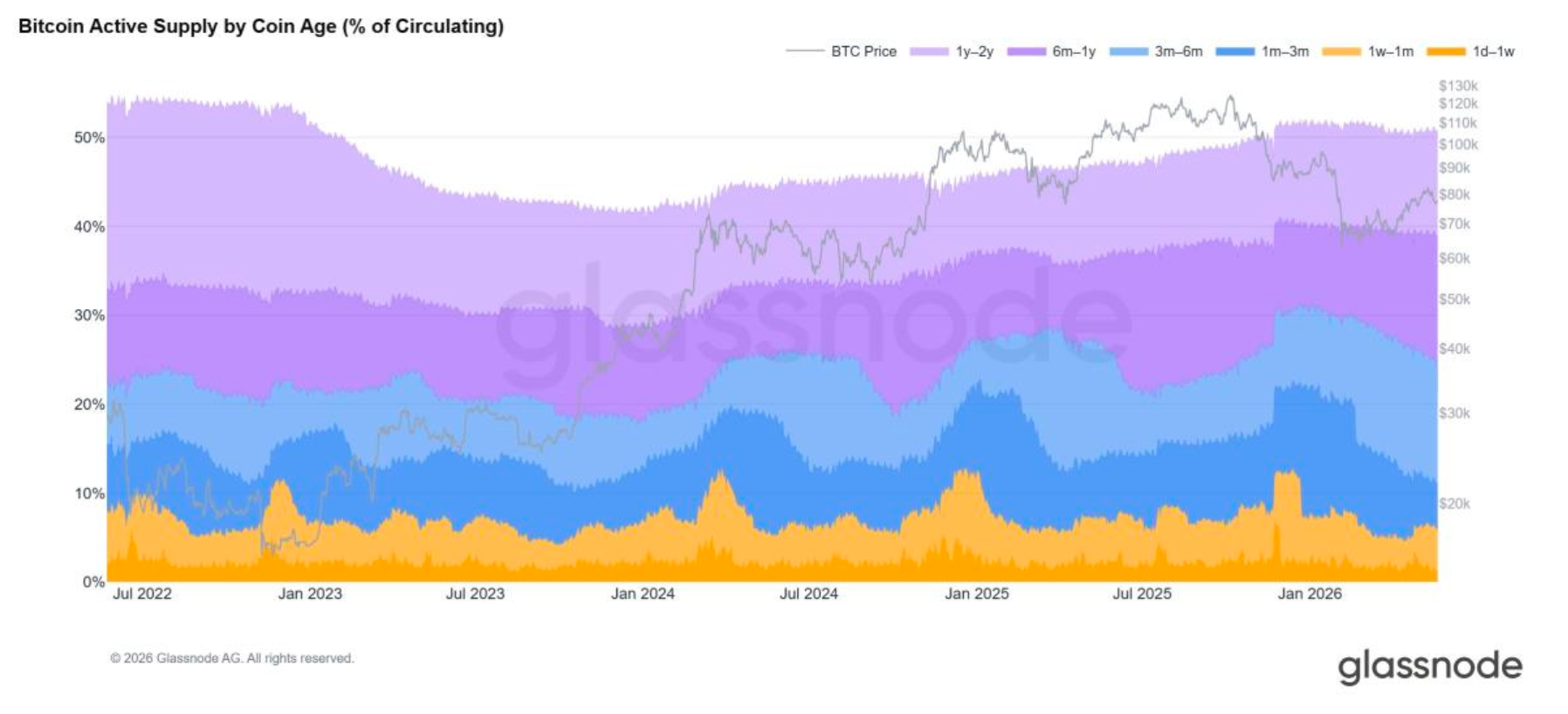
Bitcoin Active Supply by Coin Age (% of Circulating). The expansion of younger cohorts through late 2025 and into 2026 illustrates the redistribution from seasoned holders to newer participants. Source: Glassnode.

This is what wealth-cycle maturation looks like in the data. Early accumulators are realizing significant capital. New cohorts of buyers - institutional, corporate, and increasingly traditional wealth - are stepping into that supply. The result is the most concrete handover of crypto wealth between cohorts the asset class has ever seen, and it is happening at the same moment that private banking infrastructure is finally beginning to engage with digital assets seriously.
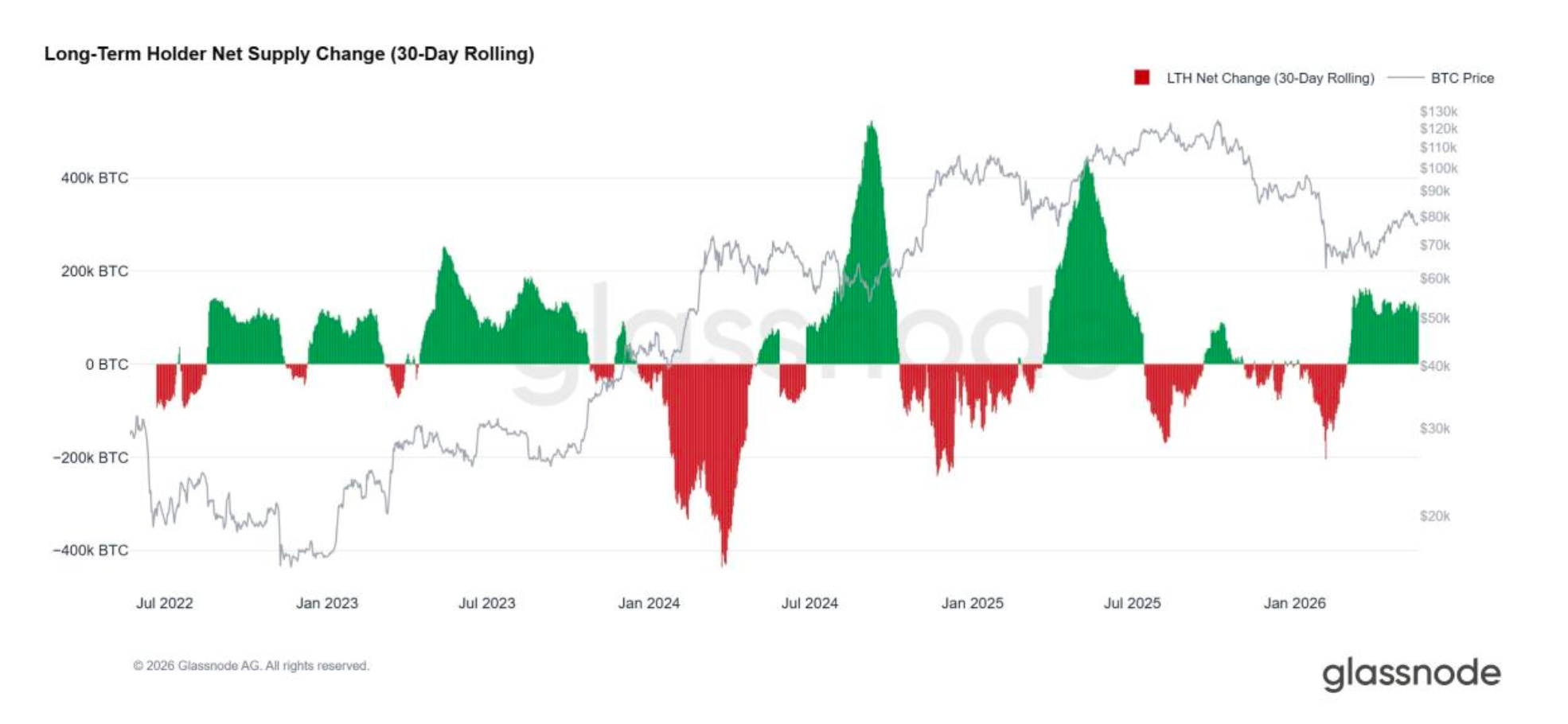
Long-Term Holder Net Supply Change (30-Day Rolling). Green bars indicate accumulation; red bars indicate distribution. The 2025 distribution waves represent the largest cohort handover in Bitcoin's history. Source: Glassnode

For private banks and wealth managers, this represents a structural opportunity. The HNIs realizing profit are not exiting the asset class - they are looking to diversify, manage liquidity, and access the full wealth-management stack: equities, fixed income, private markets, lending, succession planning. The dynamic also moves in the other direction. As banks become more open to crypto-native clients, they bring new capital and new buyers into digital assets, deepening the institutional demand base that has already absorbed a record share of Long-Term Holder distributions. The flow runs both ways.

The constraint, however, is operational. Effective movement of wealth between digital assets and the banking system depends on one thing: transparent, auditable wealth provenance.

Compliance is the Operational Layer

Private banks were not originally built for clients whose wealth histories sit primarily on a public ledger. Even sophisticated, fully legitimate crypto-native HNIs routinely encounter onboarding friction, repeated information requests, or extended delays as institutions seek clear visibility into the origin and legitimacy of digital assets. To address this - and to allow value to move in both directions between crypto wealth and traditional finance – Glassnode spun out Cense in 2023.

According to Michiel Hoogenboom, Chief Commercial Officer at Cense, the issue is structural rather than procedural. “This goes beyond compliance inconvenience - it is a wealth management issue. When crypto wealth cannot enter the banking system cleanly, the client remains concentrated in a single asset class and unable to deploy capital as efficiently as the overall wealth profile should allow. The same friction also blocks the reverse flow - banking clients who want to allocate into digital assets cannot do so through their trusted institutions.”

Cense leverages the same on-chain analytics foundations that power Glassnode's institutional market intelligence, applied at the client level. Translated into a wealth-management context, that rigor produces auditable, bank-ready documentation of digital wealth histories, a cleaner entry point into private banking and a credible pathway for traditional capital to move the other way.

Benefits Flow in Both Directions

Once crypto wealth becomes bankable, the advantages compound on both sides.

HNIs gain the ability to diversify beyond digital assets, access broader investment opportunities, manage liquidity across traditional and crypto portfolios, and unlock the operational dimensions of private wealth - lending, structured solutions, succession. Private banks, in turn, gain access to a compliant, high-quality deposit base and a durable channel for long-term AUM growth.
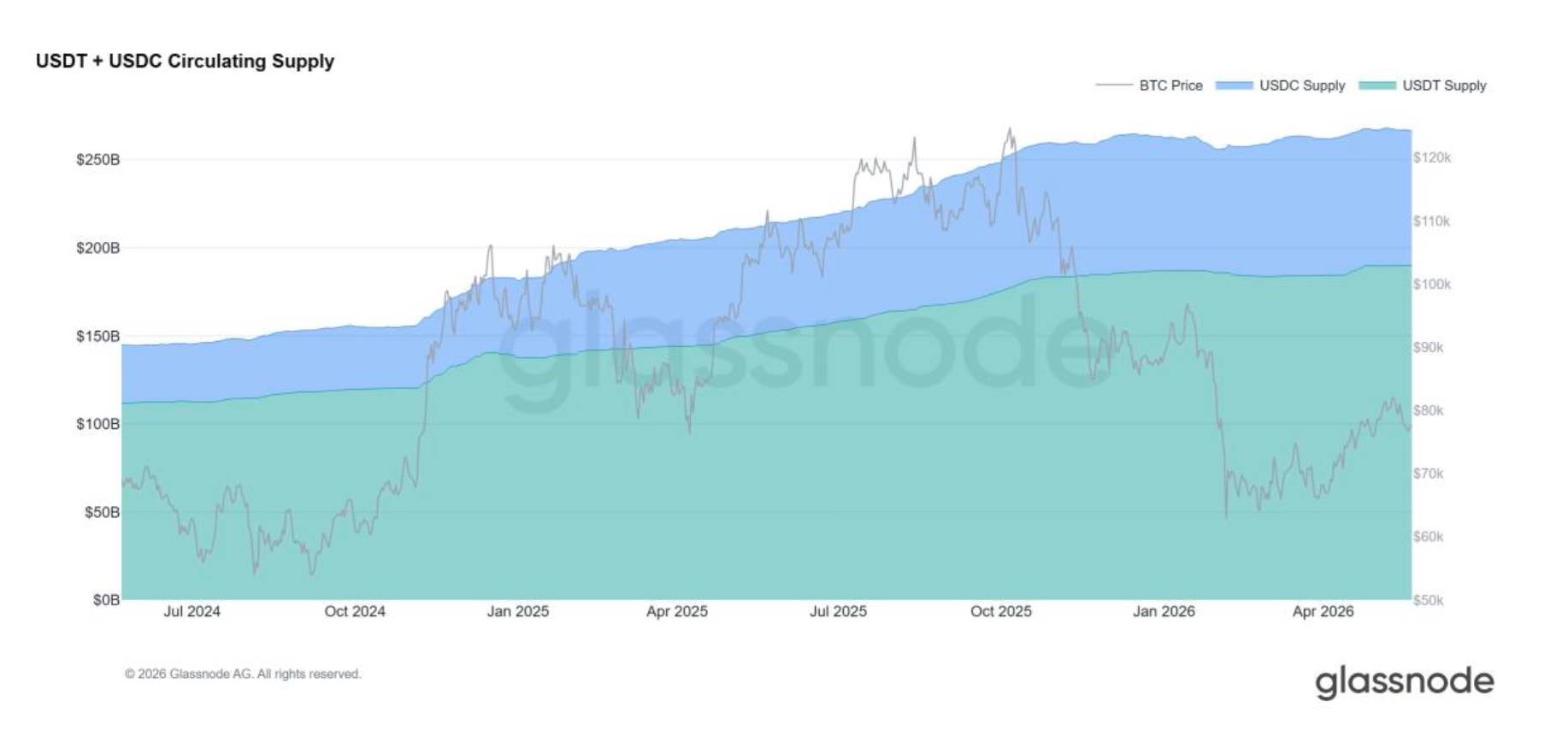
USDT + USDC Circulating Supply. Aggregate stablecoin supply continued to expand through the Q1 2026 correction, evidence that capital was rotating within crypto markets rather than exiting. Source: Glassnode.

The institutional backdrop reinforces the logic. Digital asset markets entered 2026 on firmer footing after last year's deleveraging, with Bitcoin retaining structural leadership. Q2 2026 added nuance: 82% of surveyed institutions now place the market in a bear or late-bear phase, up from 31% in December - yet the rotation into stablecoins and the recovery in BTC derivatives open interest, particularly in perpetuals, point to a rebuilding of risk appetite within the asset class. Institutional allocators are repositioning, not withdrawing.

“Crypto wealth becomes significantly more valuable when it is fully bankable. Once a client has a clean route into private banking, they can diversify beyond crypto, access broader investment opportunities, and manage liquidity across digital and traditional assets. And once banks have a clean route to onboard crypto-native wealth, capital starts moving the other way too.”
- Michiel Hoogenboom, Cense

Looking Ahead: Convergent Wealth

The coming years are likely to be defined less by “crypto versus traditional finance” and more by the convergence of the two - a wealth landscape where HNIs hold a mix of crypto, equities, fixed income, private markets, and cash, and where institutions are equipped to move capital fluidly between them.

The on-chain signal is consistent with this view. The redistribution of supply from Long-Term Holders to new participants through 2025 and into 2026 is, in effect, the largest cohort handover in Bitcoin's history. The capital absorbing it is increasingly institutional. The infrastructure connecting it back to the broader wealth-management stack is where the bottleneck still sits.

“Markets will continue to fluctuate,” Hoogenboom concludes, “but the structural advantages of proactive preparation remain. Investors and institutions who invest the time now to build transparent crypto readiness will be best positioned when conditions accelerate again. Some of Europe's most forward-looking banks - including Van Lanschot Kempen, a leading Dutch private bank - are already on this path. That is a vote of confidence not just in Cense, but in the entire crypto ecosystem's transition into mainstream wealth management.”


About Cense

Cense is a Swiss crypto intelligence specialist, founded in 2023 as a spinout of Glassnode. Its first design partner was a Swiss crypto-native financial institution, where the most complex use cases surfaced early. Today, Cense operates as an independent crypto-intelligence partner between digital asset holders and leading retail and private banks, with a focus on compliance, onboarding, and risk intelligence.

Start a conversation with the experts at Cense.

Book your demo

Disclaimer: This report is for informational and educational purposes only. The analysis represents a limited case study with significant constraints and should not be interpreted as investment advice or definitive trading signals. Past performance patterns do not guarantee future results. Always conduct thorough due diligence and consider multiple factors before making investment decisions.


Пов'язані питання

QWhat is the main on-chain signal defining the current phase of the digital asset market according to the article?

AThe main on-chain signal is the distribution of Bitcoin by Long-Term Holders into strength as it approached its cycle peak in late 2025. This led to a measurable redistribution of supply from seasoned holders to newer market participants, with Active Supply rising to 37% of BTC in Q4 2025.

QWhat does the growth in stablecoin supply during the Q1 2026 correction indicate about capital movement?

AThe growth in stablecoin supply from $308B to $318B during the Q1 2026 correction indicates that capital was not leaving crypto markets. Instead, it was rotating into cash-like instruments (stablecoins) within the crypto ecosystem while investors awaited clearer market signals.

QWhat is identified as the key operational constraint for moving wealth between digital assets and the banking system?

AThe key operational constraint is the need for transparent, auditable wealth provenance. Private banks require clear visibility into the origin and legitimacy of digital assets to onboard clients smoothly, which is often lacking for crypto-native high-net-worth individuals.

QWhat are the main benefits for High-Net-Worth Individuals (HNIs) once their crypto wealth becomes 'bankable'?

AOnce crypto wealth becomes bankable, HNIs gain the ability to diversify beyond digital assets, access broader traditional investment opportunities (equities, fixed income, private markets), manage liquidity across both portfolios, and unlock services like lending, structured solutions, and succession planning.

QAccording to the article, what is Cense's role and how does it address the operational bottleneck?

ACense, spun out from Glassnode in 2023, acts as a crypto intelligence specialist. It leverages on-chain analytics to provide private banks with auditable, bank-ready documentation of a client's digital wealth history. This addresses the bottleneck by creating a cleaner, compliant entry point for crypto wealth into banking and a credible pathway for traditional capital to flow into digital assets.

Пов'язані матеріали

Deforming the Transformer, LLMs Become Smarter

A new research paper proposes "Tapered Language Models (TLMs)," a method that improves large language model performance without adding any parameters. It challenges the standard Transformer design where each layer has the same number of parameters ("feed-forward network" width). Building on evidence that layers are not equally important—earlier layers handle foundational information like grammar, while later layers often reinforce existing judgments—the researchers suggest reallocating model capacity from later to earlier layers. The core idea is to make the layer width taper off monotonically from start to end, keeping total parameters and compute constant. Experiments compared linear, cosine, and sigmoid tapering curves on a 440M parameter model. The cosine curve (e.g., starting width 1.5x baseline, ending 0.5x) achieved the best result, reducing perplexity by 1.84 points compared to the uniform baseline—a significant gain at zero cost. This finding proved robust across four different model architectures (including gated attention and memory-augmented models) and at larger scales (760M and 1.3B parameters), consistently improving performance on commonsense reasoning and language modeling tasks without harming long-context retrieval ability. The work highlights a long-overlooked design dimension: optimal parameter allocation across depth. It offers a "free lever" for efficiency, potentially applicable beyond language models to vision Transformers and diffusion models. The study was conducted by researchers from Mila, Cornell University, and the University of Montreal.

marsbit6 хв тому

Deforming the Transformer, LLMs Become Smarter

marsbit6 хв тому

From SpaceX to Galaxy Digital: A Detailed Look at 37 New AI Companies and 7 Crypto Dark Horses Added to the Russell Indexes

On June 26th, following its annual reconstitution, the Russell US Indexes finalized their new components, with changes taking effect for market trading on June 29th. The Russell 3000 Index, representing approximately 98% of the investable US equity market, saw significant turnover. A record $334 billion was traded during Nasdaq's closing cross on reconstitution day, highlighting the massive passive fund flows tied to these benchmarks. Companies newly added to the index are set to benefit from mandatory buying by these funds. The reconstitution raised the market cap threshold between the large-cap Russell 1000 and small-cap Russell 2000 by 24% to $5.7 billion. Overall, 224 new companies entered the Russell 3000. Of these, 19 joined the Russell 1000, and 205 joined the Russell 2000, while 118 firms were removed. Notably, among the newcomers, approximately 37 are companies operating in the AI and semiconductor ecosystem, accounting for roughly 17% of new additions. The most prominent is SpaceX, which, following its recent IPO and soaring valuation, was fast-tracked directly into the Russell 1000 and Top 200 indexes. Additionally, about 7 cryptocurrency-related companies were newly included, representing about 3% of new entrants. These include Galaxy Digital, Bitmine, and Tron, among others. The inclusion of several Decentralized Autonomous Trust (DAT) entities signals the model's sustained market presence. For these smaller AI and crypto firms, index inclusion boosts visibility, potentially attracting further institutional investment and supporting their stock performance.

Odaily星球日报9 хв тому

From SpaceX to Galaxy Digital: A Detailed Look at 37 New AI Companies and 7 Crypto Dark Horses Added to the Russell Indexes

Odaily星球日报9 хв тому

Token Uneconomical

"Token Inefficiency" explores the rising economic burden of AI model token usage in enterprises, where escalating costs often fail to match tangible productivity gains. Major companies like Microsoft, Uber, and Meta are facing "token inefficiency"—characterized by budget overruns for tools like Claude Code with unclear returns. This inefficiency stems from supply-side factors like strategic model price hikes by leaders (e.g., Anthropic) and price increases in budget-friendly models, alongside technical waste in Agent systems through context traps, tokenizer inflation, redundant skill calls, and multi-Agent coordination overhead. A deeper demand-side challenge limits token value: their primary utility remains confined to highly digitalized domains like programming, which benefits from automatic, low-cost feedback loops. Extending tokens to physical world tasks or less digitalized industries faces the "Sim-to-Real Gap," where real-world validation is costly and slow, unlike in code compilation. The article warns that this inefficiency concentrates financial risk in mid-tier model developers, potentially fueling circular financing schemes and shadow credit bubbles. It also highlights societal externalities, as data center expansion strains local power grids and inflates utility costs for residents. To achieve a positive net token economy, the path forward requires dual efforts: technical optimizations (context compression, skill reduction, model routing, budget constraints) and business-side discipline (governance, cost attribution, ROI focus). The ultimate goal is shifting from showcasing AI capabilities to maximizing value per token, finding scalable commercial applications that justify the investment and bridge the digital-physical divide.

marsbit28 хв тому

Token Uneconomical

marsbit28 хв тому

Stock Price Halved in 45 Days, Is Circle Actually the "DeFi Barometer"?

Over a 45-day period, Circle's stock price plummeted by approximately 50% to around $63, coinciding with a significant $70 billion decline in the circulation of its USDC stablecoin from its peak. In contrast, Tether's USDT saw a much smaller reduction. Analyst Ed Engel posits that Circle acts as a barometer for DeFi activity, as a high correlation exists between USDC supply and ETH price movements. The vast majority of USDC is concentrated within crypto exchanges and DeFi protocols for yield generation, rather than for widespread daily use in payments or commerce, unlike USDT which has stronger real-world adoption in various regions. The recent contraction in DeFi Total Value Locked (TVL), following security incidents like the Kelp DAO attack, appears to mirror Circle's declining stock performance. While Circle is actively promoting USDC's use as a settlement asset on platforms like Hyperliquid and in institutional payment corridors—where its organic transfer volume surpasses USDT's—these efforts have not sufficiently driven growth in USDC's overall supply. The company's revenue remains heavily tied to DeFi's expansion. For Circle's investment narrative to change, it must either significantly reduce its reliance on the volatile DeFi sector or demonstrably prove that real-world adoption can substantially and sustainably increase USDC circulation. In the near term, market confidence hinges on DeFi addressing its inherent risk-reward imbalances.

marsbit1 год тому

Stock Price Halved in 45 Days, Is Circle Actually the "DeFi Barometer"?

marsbit1 год тому

Торгівля

Спот
活动图片