CryptoQuant Founder: The Cost to Double BTC Has Increased by 20,000 Times, Where Will the $100 Billion Buying Power Come From?

marsbitОпубліковано о 2026-07-07Востаннє оновлено о 2026-07-07

Анотація

CryptoQuant founder Ki Young Ju analyzes Bitcoin's current capital challenge. He notes that the cryptocurrency market has grown too large for retail-driven momentum alone to generate massive price increases as in past cycles. His calculations show that in 2011, approximately $2.7 million in capital inflow could push BTC's price up by 550x, whereas the current cycle requires an estimated $101 billion in new capital just for a 100% price increase. This shift underscores that sustaining a bull run now depends on attracting large-scale, long-term institutional capital rather than short-term speculative trading. Recent outflows from US spot Bitcoin ETFs, totaling nearly $10 billion since May, highlight the fragility of current demand and challenge the narrative of deep institutional support. While surveys indicate continued institutional interest, these entities prioritize regulated products, risk management, and portfolio integration over speculative gains. For the next significant bull market, Bitcoin must transition to being a core macro asset. The key drivers are no longer just more buyers, but capital allocation from larger, slower-moving entities like wealth advisors, corporate treasuries, banks, and sovereign wealth funds. This new phase pits Bitcoin against other major asset classes like AI for a share of institutional capital, making its growth trajectory dependent on sustained, high-quality inflows from diversified financial balance sheets.

Author: CryptoSlate

Compiled by: Deep Tide TechFlow

Deep Tide Introduction: ETF outflows, institutional wait-and-see, AI capturing investor attention... Bitcoin has grown too large to be moved by retail investors alone. CryptoQuant founder Ki Young Ju did the math: In 2011, $2.7 million could push BTC up 550 times; now, it takes $101 billion to double it. Whether the next bull market arrives depends on whether wealth advisors, corporate treasuries, banks, and sovereign funds are willing to treat BTC as a long-term allocation rather than a short-term trade.

Bitcoin's next major rally may no longer depend on whether investors believe in the asset, but on how much major capital is willing to participate with real money.

The latest analysis from CryptoQuant CEO Ki Young Ju shows that the world's largest cryptocurrency has matured into a market too large to be easily propelled as it was in early cycles. According to him, each bull cycle requires more capital to produce smaller percentage gains, a shift that raises the threshold for another parabolic rally.

This is particularly relevant now as BTC is in a prolonged bear market, having fallen to around $63,000, down 50% from the peak above $126,000 recorded last October.

This pullback tests the institutional adoption that helped push the asset into mainstream portfolios. The core question now is whether Bitcoin can attract enough persistent capital to offset its declining price sensitivity.

A Larger Market Changes the Cycle Math

Bitcoin's early rallies were built on a much smaller base, allowing small amounts of new money to produce massive price changes. This relationship has diminished as the asset has matured.

Ju's analysis compares the growth in Bitcoin's realized capitalization across several bull cycles with the subsequent price gains. Realized capitalization calculates coins at their last on-chain move price, making it a common proxy for the amount of capital absorbed by the network.

Ju said that in the 2011 cycle, roughly $27 million in net capital inflow was associated with a roughly 55,000% price gain.

The current cycle has absorbed about $697 billion, producing about a 689% gain, highlighting how much more capital is needed to generate smaller gains as the asset scales.
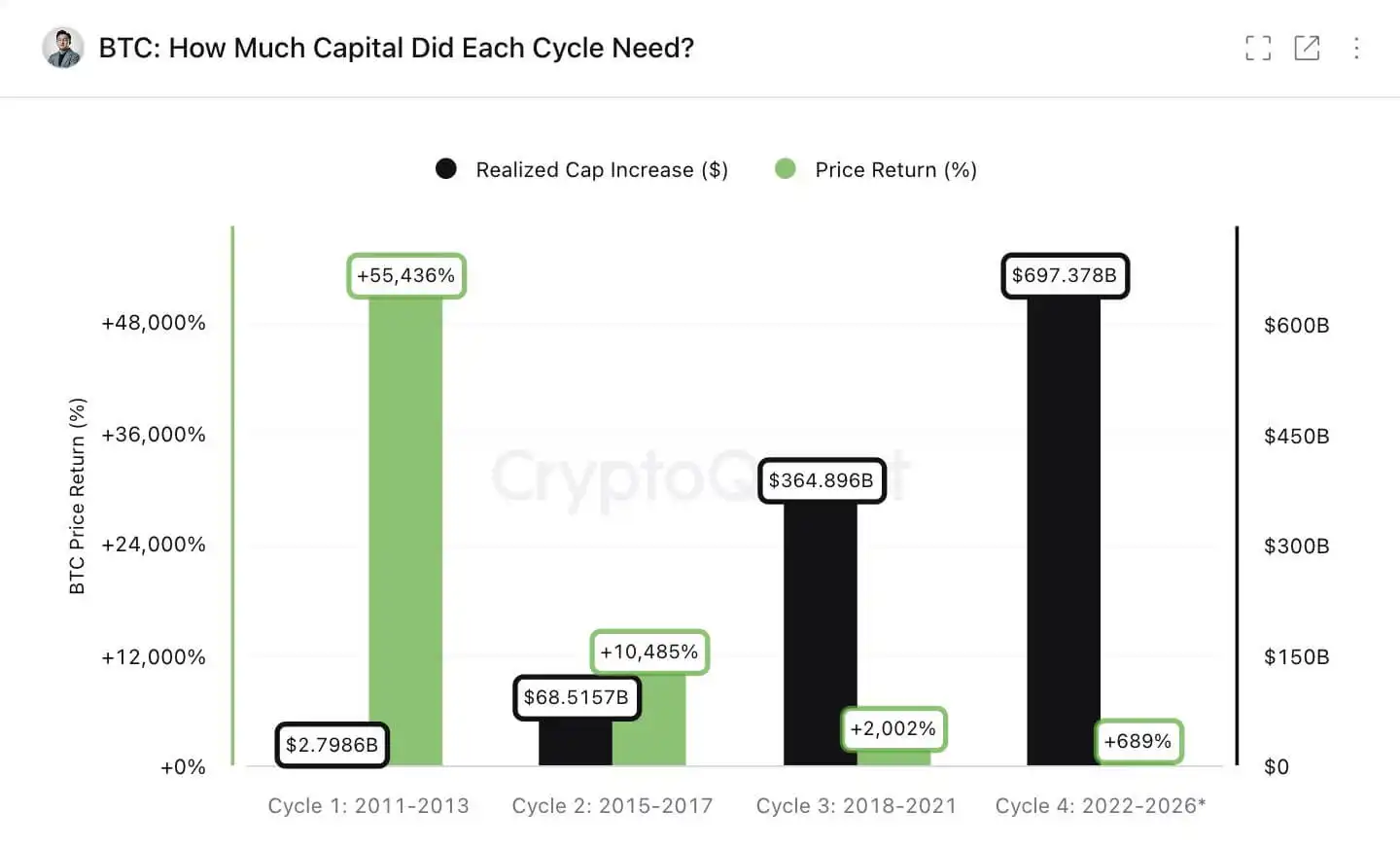
Figure: Bitcoin Price Returns vs Realized Cap Gains

Source: CryptoQuant

The same pattern appears in smaller increments. Ju said that around $5 million in new money was enough to double the Bitcoin price in 2011. In the current cycle, that figure is around $101 billion.

While this doesn't end the bullish thesis around BTC, it changes the type of demand needed to sustain it.

Ju argues another major rally is still possible if Bitcoin becomes a deeper macro allocation. "Bitcoin needs to become a core macro asset," he wrote, adding that the market can no longer rely solely on retail-dominated ETF trading.

This perspective frames Bitcoin's next cycle as a test of financial market integration. Supply shocks from halvings still reduce new issuance, but the growth trajectory increasingly depends on whether capital allocators treat Bitcoin as a recurring portfolio position rather than a tactical trade.

ETF Outflows Weaken the Near-Term Setup

This test arrives as the market's most visible institutional vehicle hits a rough patch.

U.S. spot Bitcoin ETFs helped broaden access following their 2024 launch, offering advisors, hedge funds, and traditional investors a regulated path to the asset. But recent flows have turned negative, undercutting the argument that institutional demand is already deep enough to support another major rally.

Data from Santiment shows nearly $10 billion in outflows from Bitcoin ETFs since early May, with the 12 products currently on an eight-week streak of outflows.

Addressing these numbers, the BTC-focused analytics platform Ecoinometrics said:

"The pattern since May has been very one-sided. Every attempt to rebuild buying momentum almost immediately stalls. Bitcoin ETFs have failed to achieve more than a single day of inflows, while outflow streaks repeatedly last for days, culminating in the longest outflow streak since the ETFs launched."
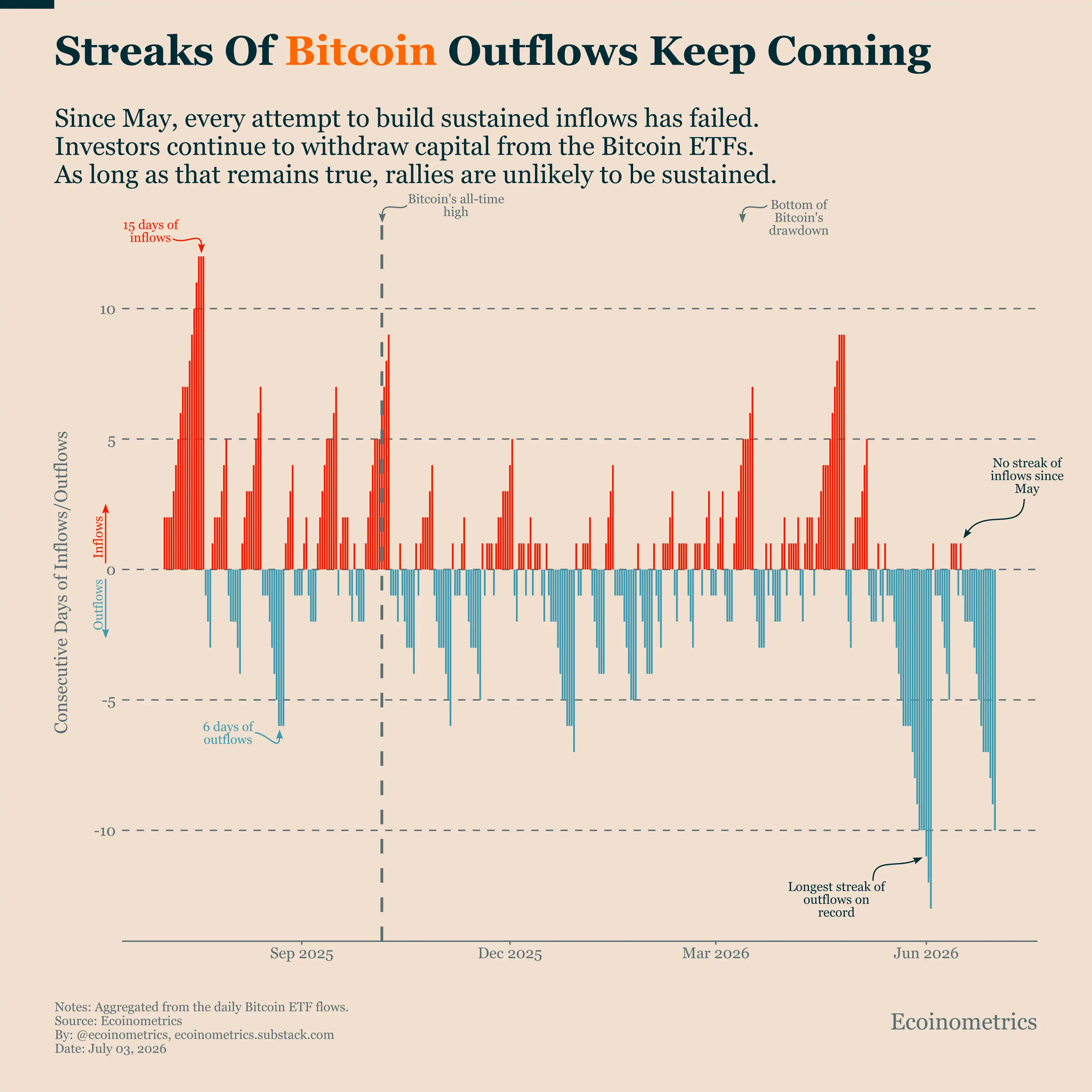
Figure: Bitcoin ETF Outflows

Source: Ecoinometrics

These outflows complicate a rapid return to highs. Bitcoin's October record came during a period when investors were still rewarding ETF access and treating the asset as a beneficiary of friendlier policies, institutional participation, and broader links to global markets.

Now, the ETF weakness suggests access alone is insufficient. The next phase of adoption requires steadier allocations across wealth platforms, model portfolios, corporate balance sheets, and other capital pools that move more slowly than retail traders but can deploy at larger scale.

For Bitcoin, this creates a demand landscape that is higher quality but harder to win. Institutions may bring bigger checks, but they also require liquidity, risk controls, custody standards, portfolio mandates, and compliance approval before allocations become durable.

Institutions Are Still Engaging, But With Stricter Standards

Despite these substantial outflows, survey data from Coinbase suggests institutional interest hasn't vanished.

A January 2026 survey of 351 institutional decision-makers by Coinbase and EY-Parthenon found nearly three-quarters plan to increase crypto allocations, while 74% expect crypto prices to rise in the next 12 months.

The same survey found 49% are placing more emphasis on risk management, liquidity, and position sizing.

This combination matters for Bitcoin's capital problem. Institutions don't approach crypto with the same behaviors that defined early retail-led cycles.

They are more likely to demand regulated products, clear governance, operational resilience, and defined exposure limits.

The survey found 66% of respondents already have exposure through spot crypto ETFs or exchange-traded products, while 81% prefer spot exposure through registered vehicles.

These findings support the view that regulated wrapper products remain central to the next adoption phase.

However, they also show why the recent ETF outflows are a pressure point. If ETFs are the primary institutional on-ramp, sustained weakness in these products could slow the broader allocation process.

Thus, Bitcoin's capital-efficiency problem cuts both ways. Its larger scale may make the asset more acceptable to traditional finance.

But that scale also means marginal buyers must be larger, more consistent, and less speculative than those driving early cycles.

Bitcoin's Next Buyers Must Compete With the Rest of Wall Street

This makes Bitcoin's next cycle dependent on a broader set of investors than the retail traders and crypto-native funds that powered early rallies.

Michael Saylor, executive chairman of MicroStrategy, argues Bitcoin's next decade will be less driven by miner issuance and more by capital flows across financial markets. MicroStrategy is the largest corporate holder of Bitcoin, making Saylor one of the most visible advocates for treating the asset as a balance-sheet tool rather than a speculative trade.

According to him:

"Over the next decade, Bitcoin's trajectory will be less driven by miner issuance and more by capital flows. ETF flows. Corporate treasury flows. Sovereign reserve flows. Banking credit flows. Derivative flows. Insurance flows. Collateral flows. Structured credit flows. Global savings flows. Halvings tighten supply. Capital flows set the growth trajectory. This is the next phase of Bitcoin adoption: not just more buyers, but more balance sheets."

The emphasis is that Bitcoin's supply story is no longer novel. Its issuance schedule is known, halving cycles are understood, and the asset already trades at a scale that requires larger pools of capital to move it meaningfully.

Therefore, any new repricing must come from demand channels capable of absorbing a market valued over $1 trillion.

This means ETF demand is only part of the shift. A stronger cycle may require advisors adding Bitcoin to model portfolios, companies using it more aggressively on balance sheets, banks building credit products around it, insurers and asset managers viewing it as a macro allocation, and sovereign entities considering exposure over time.

This shift may be slower than retail momentum cycles. It will also expose Bitcoin more to rate expectations, regulatory delays, liquidity shocks, and competition with other markets chasing the same institutional capital.

Notably, artificial intelligence has emerged as one of those competitors. AI-related assets and infrastructure have absorbed a significant portion of investor attention this year, with spending and investment forecasts reaching trillions.

In earlier crypto cycles, looser speculative capital might have flowed more easily into Bitcoin. In today's market, Bitcoin must compete for the same pool of institutional capital against AI stocks, private infrastructure deals, credit products, commodities, and other macro trades.

That competition is now at the center of the Bitcoin cycle debate. The asset is large enough to enter mainstream allocation conversations, but that also means it gets compared against every other major capital use.

The views expressed in this article are those of the author alone and do not represent the views of CryptoSlate. Nothing you read on CryptoSlate should be taken as investment advice, nor does CryptoSlate endorse any projects mentioned or linked in this article. Buying and trading cryptocurrencies should be considered a high-risk activity. Please conduct your own due diligence before taking any action related to the content of this article. Finally, CryptoSlate assumes no liability for any losses incurred while trading cryptocurrencies. Please refer to our company disclaimer for more information.


Трендові криптовалюти

Пов'язані питання

QAccording to the CryptoQuant founder, how has the capital required to double Bitcoin's price changed from 2011 to the current cycle?

AIn 2011, approximately $5 million in new capital was enough to double Bitcoin's price. In the current cycle, that number has risen to about $101 billion, representing a roughly 20,000-fold increase in the capital efficiency cost for generating the same percentage gain.

QWhat does the article suggest is the new key factor for Bitcoin's next major bull run, as opposed to earlier cycles?

AThe article suggests that Bitcoin's next major bull run depends less on investor belief and more on whether large, institutional capital (like wealth advisors, corporate treasuries, banks, and sovereign funds) is willing to make Bitcoin a long-term portfolio allocation, rather than engaging in short-term trading.

QWhat recent trend in U.S. Bitcoin ETFs complicates the argument for immediate institutional-driven price appreciation?

ASince early May, U.S. spot Bitcoin ETFs have experienced nearly $10 billion in net outflows, marking their longest streak of consecutive weekly outflows since launch. This sustained weakness suggests that mere access to regulated products is insufficient and that deeper, more stable institutional allocations are needed.

QAccording to Michael Saylor, what will drive Bitcoin's trajectory in the next decade, replacing the previous dominant factor?

AMichael Saylor states that Bitcoin's trajectory in the next decade will be less driven by miner issuance and more driven by capital flows from various sources, including ETF flows, corporate treasury flows, sovereign reserve flows, bank credit flows, and global savings flows.

QWhat new competitive challenge does Bitcoin face in attracting institutional capital, as mentioned in the article?

ABitcoin now faces significant competition for institutional capital from other major sectors, particularly Artificial Intelligence (AI). AI-related assets and infrastructure are absorbing a large portion of investor attention and capital, forcing Bitcoin to compete for the same pool of institutional funds.

Пов'язані матеріали

Blood Loss of $55 Million Selling 3,588 BTC, Strategy Becomes a Literal Scumbag

On July 6th, Strategy (formerly MicroStrategy) disclosed in an SEC filing that it sold 3,588 Bitcoin (BTC) between June 29th and July 5th for approximately $216 million, at an average price of ~$60,200. This marked the company's largest net sale since initiating its Bitcoin strategy in 2020 and its first institutionalized reduction of its core holding. The sale resulted in a realized loss of about $54.8 million, as the selling price was below its average cost basis of ~$75,476 per BTC. The proceeds were used to pay preferred stock dividends and replenish USD reserves. This move follows a new "Digital Credit Capital Framework" approved on June 29th, authorizing the sale of up to $1.25 billion in Bitcoin. The sale consumes roughly 17% of this authorized amount in its first week. Strategy's foundational narrative, built by founder Michael Saylor, was a commitment to "never sell" Bitcoin. The recent institutionalized selling framework and these substantial sales represent a significant shift from that original promise. While the amount sold is only 0.4% of Strategy's total holdings of 843,775 BTC, the action challenges the premium at which its stock (MSTR) trades relative to its Bitcoin holdings. Investors had priced in the "never sell" narrative. The company now faces a contradiction: it sells Bitcoin at a loss to pay dividends on the preferred stock it issued to fund Bitcoin purchases. Saylor has framed selling as a tool for future strategic purchases, but each sale erodes the credibility of the original commitment, potentially threatening the premium valuation of MSTR shares.

Foresight News7 хв тому

Blood Loss of $55 Million Selling 3,588 BTC, Strategy Becomes a Literal Scumbag

Foresight News7 хв тому

JP Morgan Tokenized Fund Surges 250% in TVL in One Month, Institutional Funds Are Treating Ethereum as the Default Underlying Layer

JPMorgan's tokenized money market fund, JLTXX, has seen its on-chain total value locked (TVL) surge approximately 250% in a month, reaching nearly $700 million from an initial $200 million since its launch seven weeks ago. The fund, which invests in short-term U.S. Treasuries and repos, operates exclusively on the public Ethereum mainnet, signaling growing institutional acceptance of Ethereum as a foundational layer for compliant financial products. A key driver of this growth is its inclusion as reserve assets for stablecoins like USDG, meeting requirements under U.S. stablecoin legislation. Simultaneously, despite a significant price decline—ETH has fallen over 50% from its 2025 high—institutional accumulation continues. BitMine Immersion Technologies, led by Tom Lee, purchased an additional $73 million worth of ETH last week, bringing its holdings to roughly 4.8% of Ethereum's circulating supply. The article highlights a divergence: while the tokenization of real-world assets and stablecoin reserves is driving long-term institutional adoption of Ethereum's infrastructure, short-term price action remains pressured by market sentiment and ETF outflows. This suggests that institutional on-chain activity, though a positive fundamental development, may not serve as a reliable signal for near-term price bottoms.

marsbit11 хв тому

JP Morgan Tokenized Fund Surges 250% in TVL in One Month, Institutional Funds Are Treating Ethereum as the Default Underlying Layer

marsbit11 хв тому

Dialogue with Yihui Capital, SoundAI Technology, Ling Universe, and Zhongbo Jili: Opportunities and Challenges in the AI Smart Hardware Track

On June 28, 2026, an event titled "New Opportunities in AI Hardware: The Battle for Interactive Entry Points Begins" was held in Beijing. It featured a report from ITJuzi and discussions with experts from SoundAI, Ling Universe, One Reed Capital, and Zhongbo Juli on the opportunities and challenges in China's AI hardware sector. Key report findings highlight the sector's intense activity: 327 out of 431 startups founded post-2023 have secured funding, with 179 investments in H1 2026 alone. The landscape is dominated by embodied intelligent robots, while wearable tech like smart rings and AI glasses shows rapid growth. Geographically, Shenzhen leads, leveraging its superior hardware supply chain, followed by Beijing and Shanghai. The overarching trend is for companies to focus on micro-innovations within specific scenarios rather than reinventing foundational technology. Industry leaders shared several critical insights: 1. **Balancing Innovation & Market Readiness**: Entrepreneurs face the "hammer looking for a nail" dilemma. Success requires balancing technical capability with user acceptance, cost control, and incremental design improvements rather than chasing disruptive innovation. 2. **Competitive Landscape**: The future interactive entry point may not be a single super-device but a mix of universal terminals and specialized, scenario-specific hardware. While large companies have ecosystem advantages, startups can win by deeply targeting vertical markets and specific user groups. 3. **Core Challenges & Business Models**: Key hurdles include deep understanding of AI models and navigating non-transparent hardware supply chains. Viable business models may involve selling hardware at cost and generating revenue through software subscriptions, but this requires tight control over both hardware BOM and model inference costs. 4. **The Road to Commercialization**: The ultimate test is market validation—achieving sales growth and sustainable cash flow. Companies must find the right application scenario, use edge computing effectively, and close the loop from technology to commercial success. 5. **The Future of Interaction**: Proactive, context-aware interaction is the next frontier, though it's currently limited by issues like model hallucinations and environmental perception. The near-term focus should be on identifying target users and creating a coherent experience in specific domains, such as health wearables. In summary, to succeed in the competitive AI hardware arena, companies must strategically choose their niche, build a team with the right geographical advantages (e.g., leveraging Shenzhen's supply chain), and most importantly, execute a flawless commercialization strategy that translates technology into market-accepted products and sustainable business growth.

marsbit1 год тому

Dialogue with Yihui Capital, SoundAI Technology, Ling Universe, and Zhongbo Jili: Opportunities and Challenges in the AI Smart Hardware Track

marsbit1 год тому

Торгівля

Спот

Популярні статті

Що таке BITCOIN

Розуміння HarryPotterObamaSonic10Inu (ERC-20) та його позиції у крипто-просторі Останніми роками ринок криптовалют спостерігав за зростанням популярності мем-коінів, які привертають інтерес не тільки трейдерів, але й тих, хто шукає спілкування та розважальну цінність. Серед цих унікальних токенів є HarryPotterObamaSonic10Inu (ERC-20), інтригуючий проект, що поєднує культурні посилання з тканинами криптовалюти. Ця стаття досліджує ключові аспекти HarryPotterObamaSonic10Inu, вивчаючи його механізми, спільноту та його взаємодію з ширшим крипто-ландшафтом. Що таке HarryPotterObamaSonic10Inu (ERC-20)? Як випливає з його назви, HarryPotterObamaSonic10Inu є мем-коіном, побудованим на блокчейні Ethereum, класифікованим за стандартом ERC-20. На відміну від традиційних криптовалют, які можуть підкреслювати практичну корисність або інвестиційний потенціал, цей токен процвітає завдяки розважальній цінності та силі своєї спільноти. Проект спрямований на створення середовища, де зацікавлені користувачі можуть об'єднуватися, ділитися ідеями та брати участь у заходах, натхненних різноманітними культурними явищами. Однією з примітних особливостей HarryPotterObamaSonic10Inu є нульовий податок на транзакції. Цей привабливий елемент має на меті заохочувати торгівлю та участь у спільноті, позбавлену додаткових витрат, які можуть відлякувати дрібних трейдерів. Загальна пропозиція монет становить один мільярд токенів, що позначає намір підтримувати суттєву циркуляцію в межах спільноти. Творець HarryPotterObamaSonic10Inu (ERC-20) Походження HarryPotterObamaSonic10Inu дещо окутане таємницею; деталі про творця залишаються невідомими. Розвиток цього токена позбавлений впізнаваної команди або чіткої стратегії, що не є рідкістю в секторі мем-коінів. Натомість проект виник органічно, а його розвиток значною мірою залежить від ентузіазму та участі його спільноти. Інвестори HarryPotterObamaSonic10Inu (ERC-20) Щодо зовнішніх інвестицій та підтримки, HarryPotterObamaSonic10Inu також залишається невизначеним. Токен не зазначає жодних відомих інвестиційних фондів або значної організаційної підтримки. Натомість життєва сила проекту полягає в його базовій спільноті, яка інформує про його зростання та стійкість через колективні дії та залученість у крипто-просторі. Як працює HarryPotterObamaSonic10Inu (ERC-20)? Як мем-коін, HarryPotterObamaSonic10Inu функціонує передусім поза традиційними рамками, що часто регулюють вартість активів. Є кілька відмінних аспектів, що визначають, як працює проект: Транзакції без податку: Завдяки відсутності податкових зборів на транзакції, користувачі можуть вільно купувати та продавати токен, не турбуючись про приховані витрати. Залучення спільноти: Проект процвітає завдяки взаємодії спільноти, використовуючи соціальні медіа для створення шуму та сприяння залученню. Обговорення, обмін контентом та залученість є ключовими елементами, що допомагають розширити його охоплення та зміцнити лояльність серед прихильників. Відсутність практичної корисності: Слід зазначити, що HarryPotterObamaSonic10Inu не пропонує конкретної корисності в рамках фінансової екосистеми. Натомість він класифікується як токен, що призначений в основному для розваги та спільнотних активностей. Культурне посилання: Токен кмітливо вплітає елементи популярної культури, щоб привернути інтерес, зв'язуючи з ентузіастами мемів та крипто-стежками. HarryPotterObamaSonic10Inu ілюструє, як мем-коіни функціонують інакше, ніж традиційні криптовалютні проекти, увійшовши на ринок як інноваційні соціальні конструкти, а не утилітарні активи. Хронологія HarryPotterObamaSonic10Inu (ERC-20) Історія HarryPotterObamaSonic10Inu відзначена кількома значними етапами: Створення: Токен виник з вірусного мему, захопивши уяву багатьох крипто-ентузіастів. Конкретні дати створення недоступні, що підкреслює його органічний розвиток. Лістинг на біржах: HarryPotterObamaSonic10Inu з'явився на різних біржах, дозволяючи зручніший доступ і торгівлю спільноти. Ініціативи залучення спільноти: Ведення діяльності, спрямованої на покращення взаємодії спільноти, включаючи конкурси, кампанії в соціальних мережах та створення контенту від фанатів та прихильників. Плани на майбутнє: Дорожня карта проекту включає запуск колекції NFT, мерчандайзинг та електронну комерцію, пов'язану з його культурними темами, що далі залучає спільноту та намагається додати більше вимірів до його екосистеми. Ключові моменти про HarryPotterObamaSonic10Inu (ERC-20) Спільнотний підхід: Проект надає пріоритет колективному внеску та креативності, забезпечуючи, щоб участь користувачів була в центрі його розвитку. Класифікація як мем-коін: Це є його епігенез розважальної криптовалюти, що відрізняється від традиційних інвестиційних інструментів. Жодного прямого відношення до Bitcoin: Незважаючи на схожість у назві, HarryPotterObamaSonic10Inu є відмінним і не має жодного зв’язку з Bitcoin або іншими усталеними криптовалютами. Зосередженість на співпраці: HarryPotterObamaSonic10Inu створено для того, щоб надати простір для співпраці та обміну історіями серед його власників, забезпечуючи шлях для творчості та спільного зв'язку. Перспективи на майбутнє: Амбіція розширитися за межі початкової концепції в NFT та мерчандайз відкриває шлях для проекту потенційно потрапити в більш мейнстрімні сфери цифрової культури. Оскільки мем-коіни продовжують захоплювати уяву спільноти криптовалют, HarryPotterObamaSonic10Inu (ERC-20) вирізняється своїми культурними зв'язками та орієнтованим на спільноту підходом. Хоча він може не відповідати типовій моделі утилітарного токена, його суть полягає в радощах і товариськості, що підтримуються серед його прихильників, підкреслюючи еволюційну природу криптовалют в усе більш цифрову епоху. Оскільки проект продовжує розвиватися, важливо спостерігати за тим, як динаміка спільноти вплине на його траєкторію в постійно змінюваному ландшафті технології блокчейн.

2.1k переглядів усьогоОпубліковано 2024.04.01Оновлено 2024.12.03

Що таке BITCOIN

Як купити BTC

Ласкаво просимо до HTX.com! Ми зробили покупку Bitcoin (BTC) простою та зручною. Дотримуйтесь нашої покрокової інструкції, щоб розпочати свою криптовалютну подорож.Крок 1: Створіть обліковий запис на HTXВикористовуйте свою електронну пошту або номер телефону, щоб зареєструвати обліковий запис на HTX безплатно. Пройдіть безпроблемну реєстрацію й отримайте доступ до всіх функцій.ЗареєструватисьКрок 2: Перейдіть до розділу Купити крипту і виберіть спосіб оплатиКредитна/дебетова картка: використовуйте вашу картку Visa або Mastercard, щоб миттєво купити Bitcoin (BTC).Баланс: використовуйте кошти з балансу вашого рахунку HTX для безперешкодної торгівлі.Треті особи: ми додали популярні способи оплати, такі як Google Pay та Apple Pay, щоб підвищити зручність.P2P: Торгуйте безпосередньо з іншими користувачами на HTX.Позабіржова торгівля (OTC): ми пропонуємо індивідуальні послуги та конкурентні обмінні курси для трейдерів.Крок 3: Зберігайте свої Bitcoin (BTC)Після придбання Bitcoin (BTC) збережіть його у своєму обліковому записі на HTX. Крім того, ви можете відправити його в інше місце за допомогою блокчейн-переказу або використовувати його для торгівлі іншими криптовалютами.Крок 4: Торгівля Bitcoin (BTC)Легко торгуйте Bitcoin (BTC) на спотовому ринку HTX. Просто увійдіть до свого облікового запису, виберіть торгову пару, укладайте угоди та спостерігайте за ними в режимі реального часу. Ми пропонуємо зручний досвід як для початківців, так і для досвідчених трейдерів.

4.9k переглядів усьогоОпубліковано 2024.12.12Оновлено 2026.06.02

Як купити BTC

Що таке $BITCOIN

ЦИФРОВЕ ЗОЛОТО ($BITCOIN): Комплексний аналіз Вступ до ЦИФРОВОГО ЗОЛОТА ($BITCOIN) ЦИФРОВЕ ЗОЛОТО ($BITCOIN) — це проект на основі блокчейну, що працює в мережі Solana, який має на меті поєднати характеристики традиційних дорогоцінних металів з інноваціями децентралізованих технологій. Хоча він має таку ж назву, як і Bitcoin, який часто називають “цифровим золотом” через його сприйняття як засобу збереження вартості, ЦИФРОВЕ ЗОЛОТО є окремим токеном, розробленим для створення унікальної екосистеми в ландшафті Web3. Його мета — позиціонувати себе як життєздатний альтернативний цифровий актив, хоча деталі щодо його застосувань і функціональностей все ще розробляються. Що таке ЦИФРОВЕ ЗОЛОТО ($BITCOIN)? ЦИФРОВЕ ЗОЛОТО ($BITCOIN) — це токен криптовалюти, спеціально розроблений для використання в блокчейні Solana. На відміну від Bitcoin, який виконує широко визнану роль зберігання вартості, цей токен, здається, зосереджується на більш широких застосуваннях і характеристиках. Помітні аспекти включають: Інфраструктура блокчейну: Токен побудований на блокчейні Solana, відомому своєю здатністю обробляти швидкі та низьковартісні транзакції. Динаміка постачання: ЦИФРОВЕ ЗОЛОТО має максимальне постачання, обмежене 100 квадрильйонами токенів (100P $BITCOIN), хоча деталі щодо його обігового постачання наразі не розголошуються. Утиліта: Хоча точні функціональності не викладені, є вказівки на те, що токен може бути використаний для різних застосувань, потенційно пов'язаних з децентралізованими додатками (dApps) або стратегіями токенізації активів. Хто є творцем ЦИФРОВОГО ЗОЛОТА ($BITCOIN)? На даний момент особа творців і команди розробників, що стоять за ЦИФРОВИМ ЗОЛОТОМ ($BITCOIN), залишається невідомою. Ця ситуація є типовою для багатьох інноваційних проектів у сфері блокчейну, особливо тих, що пов'язані з децентралізованими фінансами та феноменом мем-коінів. Хоча така анонімність може сприяти культурі, орієнтованій на спільноту, вона посилює занепокоєння щодо управління та підзвітності. Хто є інвесторами ЦИФРОВОГО ЗОЛОТА ($BITCOIN)? Доступна інформація вказує на те, що ЦИФРОВЕ ЗОЛОТО ($BITCOIN) не має жодних відомих інституційних спонсорів або помітних венчурних капіталовкладень. Проект, здається, працює за моделлю “рівний до рівного”, зосереджуючись на підтримці та прийнятті спільноти, а не на традиційних шляхах фінансування. Його активність і ліквідність переважно розташовані на децентралізованих біржах (DEX), таких як PumpSwap, а не на встановлених централізованих торгових платформах, що ще більше підкреслює його підхід знизу вгору. Як працює ЦИФРОВЕ ЗОЛОТО ($BITCOIN) Операційні механізми ЦИФРОВОГО ЗОЛОТА ($BITCOIN) можна детальніше розглянути на основі його дизайну блокчейну та характеристик мережі: Механізм консенсусу: Використовуючи унікальний proof-of-history (PoH) Solana в поєднанні з моделлю proof-of-stake (PoS), проект забезпечує ефективну валідацію транзакцій, що сприяє високій продуктивності мережі. Токеноміка: Хоча конкретні дефляційні механізми не були детально описані, велике максимальне постачання токенів вказує на те, що воно може задовольняти мікротранзакції або нішеві випадки використання, які ще потрібно визначити. Інтероперабельність: Існує потенціал для інтеграції з більш широкою екосистемою Solana, включаючи різні платформи децентралізованих фінансів (DeFi). Однак деталі щодо конкретних інтеграцій залишаються невизначеними. Хронологія ключових подій Ось хронологія, яка підкреслює значні віхи, пов'язані з ЦИФРОВИМ ЗОЛОТОМ ($BITCOIN): 2023: Початкове розгортання токена відбувається на блокчейні Solana, позначене його адресою контракту. 2024: ЦИФРОВЕ ЗОЛОТО набуває видимості, оскільки стає доступним для торгівлі на децентралізованих біржах, таких як PumpSwap, що дозволяє користувачам торгувати ним проти SOL. 2025: Проект спостерігає спорадичну торгову активність і потенційний інтерес до ініціатив, очолюваних спільнотою, хоча на даний момент не зафіксовано жодних значних партнерств або технічних досягнень. Критичний аналіз Сильні сторони Масштабованість: Основна інфраструктура Solana підтримує високі обсяги транзакцій, що може підвищити утиліту $BITCOIN у різних сценаріях транзакцій. Доступність: Потенційно низька торгова ціна за токен може привабити роздрібних інвесторів, сприяючи більш широкій участі завдяки можливостям дробового володіння. Ризики Відсутність прозорості: Відсутність публічно відомих спонсорів, розробників або процесу аудиту може викликати скептицизм щодо стійкості та надійності проекту. Волатильність ринку: Торгова активність сильно залежить від спекулятивної поведінки, що може призвести до значної волатильності цін і невизначеності для інвесторів. Висновок ЦИФРОВЕ ЗОЛОТО ($BITCOIN) постає як цікавій, але неоднозначний проект у швидко розвиваючійся екосистемі Solana. Хоча він намагається використати наратив “цифрового золота”, його відхід від встановленої ролі Bitcoin як засобу збереження вартості підкреслює необхідність чіткішого розмежування його передбачуваної утиліти та структури управління. Майбутнє прийняття та адаптація, ймовірно, залежатиме від вирішення поточної непрозорості та більш чіткого визначення його операційних та економічних стратегій. Примітка: Цей звіт охоплює синтезовану інформацію, доступну станом на жовтень 2023 року, і можуть відбутися події, що виходять за межі дослідницького періоду.

136 переглядів усьогоОпубліковано 2025.05.13Оновлено 2025.05.13

Що таке $BITCOIN

Обговорення

Ласкаво просимо до спільноти HTX. Тут ви можете бути в курсі останніх подій розвитку платформи та отримати доступ до професійної ринкової інформації. Нижче представлені думки користувачів щодо ціни BTC (BTC).

活动图片