The sharp recovery in bitcoin's price has increased the likelihood that Geoffrey Kendrick's year-end forecast of $100,000 could prove too conservative, wrote the Standard Chartered analyst in research published early on August 21. Kendrick is the global head of digital assets research at Standard Chartered Bank. He said the rising prices forced traders to close bearish positions while also stimulating renewed demand from long-term investors.
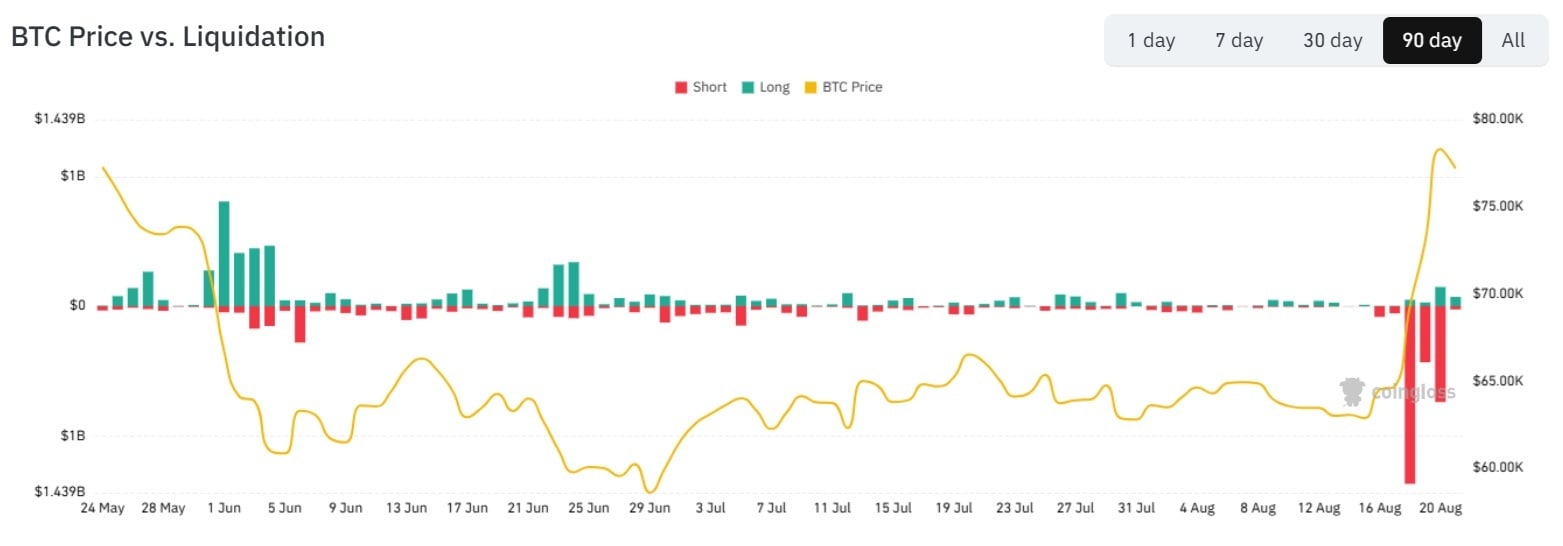
The scale of the market turnaround led Kendrick to characterize the past week as the largest short-squeeze event in bitcoin's recorded history. An attached 90-day chart from Coinglass shows short liquidations for $BTC approached $1.44 billion during the August 19–21 rally, the largest daily figure for that period. Kendrick noted that, according to Coinglass data covering the period since June 2021, this event was the largest $BTC short-squeeze in the dataset.
Standard Chartered's digital assets research head linked the record short squeeze to a growing risk of overshooting his year-end forecast, stating:
"For the first time this year, there is a risk that my year-end forecast ($100,000) might be too low."
This upside risk partly reflects how forced position closures can accelerate an already rising market. Short liquidations occur when exchanges automatically close leveraged bearish positions after price increases reduce their margin below maintenance requirements. These forced buys can amplify gains by adding demand to an already rising market. A liquidation cascade can develop when one wave of forced buying pushes bitcoin toward another cluster of liquidation levels, triggering new position closures and further purchases.
ETF Inflows Boost Demand Beyond "Short Squeeze"
Institutional demand also intensified as U.S. exchange-traded funds (ETFs) holding spot bitcoin returned to net inflows during the rally. Kendrick estimated these funds had attracted roughly $1.5 billion by early August 21. Updated data for U.S. spot bitcoin ETFs showed $1.61 billion in inflows over the first four trading sessions of the week. During the latest session on August 21, inflows were approximately $307.5 million, bringing the total five-day figure to about $1.92 billion.
The most active session during this period was August 20, when the funds attracted $606.29 million. BlackRock's IBIT accounted for $502.99 million, or roughly 83% of the daily volume. August 19 brought $517.19 million after smaller gains on August 17 and 18.
Spot bitcoin ETFs hold bitcoin through regulated fund structures, allowing investors to gain exposure to price changes through brokerage accounts without directly owning or securing the asset. The creation and redemption of shares link fund demand to purchases and sales of the underlying bitcoin. Sustained inflows can require the funds or their authorized participants to acquire bitcoin, while share redemptions can trigger sales.
The Standard Chartered analyst characterized bitcoin as a "Giffen good" for long-term investors, explaining that "people want to buy more when the price rises." He linked this trend to the resumption of ETF inflows and expects the price increase to draw more attention and capital to the asset.
What Sparked Bitcoin's Three-Day Surge
The rally accelerated after the U.S. Treasury Department expanded its planned buybacks of longer-dated government securities to support liquidity. In the Treasury's August 19 announcement, the maximum purchase amount was doubled from $2 billion to at least $4 billion per operation, starting September 9 and running through November 4 inclusive.
President Donald Trump became the second catalyst on August 19, gathering leaders from crypto companies, financial markets, and federal regulators for a cryptocurrency event at the White House. Brian Armstrong, CEO of cryptocurrency exchange Coinbase (Nasdaq: COIN), urged senators at the meeting to advance the CLARITY Act bill. The President directly pressured lawmakers, telling attendees: "We need Congress to take the next step by passing the CLARITY law." On the same day, bitcoin broke through $70,000 and climbed to $71,834 – the first time it had risen above that level since early June.
Kendrick characterized this intervention as favorable for bitcoin's position as a store of value, arguing that the asset allows investors to hold wealth outside central control. On August 21, bitcoin reached $79,500 – its highest level since May, while traders betting on its decline lost $3 billion in just 24 hours, the largest short squeeze since 2021.
The charted figure of $1.44 billion covers bitcoin positions exclusively, not the broader cryptocurrency derivatives market. Short liquidations across cryptocurrency markets exceeded $1.22 billion for a separate 24-hour period, and Coinglass data cited on August 21 showed bitcoin short liquidations over 24 hours at $764 million.
What Bitcoin Needs to Reach $126,000
Bitcoin set its all-time high on October 6, 2025, and has not returned to that level since. In his analysis, Kendrick concluded:
"Once investors remember how quickly prices can accelerate to the upside, and we pass the October 6 date (12 months after the all-time high), exceeding the all-time high level ($126,000) by year-end becomes possible."
Besides the potential price overshoot, Kendrick also pointed to the relatively low level of open interest in futures, which measures the number of outstanding derivative contracts. He said crypto markets had lagged the artificial intelligence investment theme earlier in the year, leaving room for renewed participation as prices rise. A higher level of open interest would indicate more activity in the derivatives market but would not determine the price direction.
Standard Chartered lowered its year-end target from $150,000 to $100,000 in February; Kendrick linked that reduction to macroeconomic weakness and expected fund selling. At the time, he wrote that ETF holders "are more likely sellers than buyers on the dip for now," contradicting the buyer behavior model he now describes. According to the bank's long-term forecast, the bitcoin price will grow from $100,000 this year to $500,000 by 2030, while the price of ether over the same period will reach $40,000.
end-content