Crypto Markets Catch A Breather As Outflows Begin To Slow: Analysts

bitcoinistОпубліковано о 2026-02-10Востаннє оновлено о 2026-02-10

Анотація

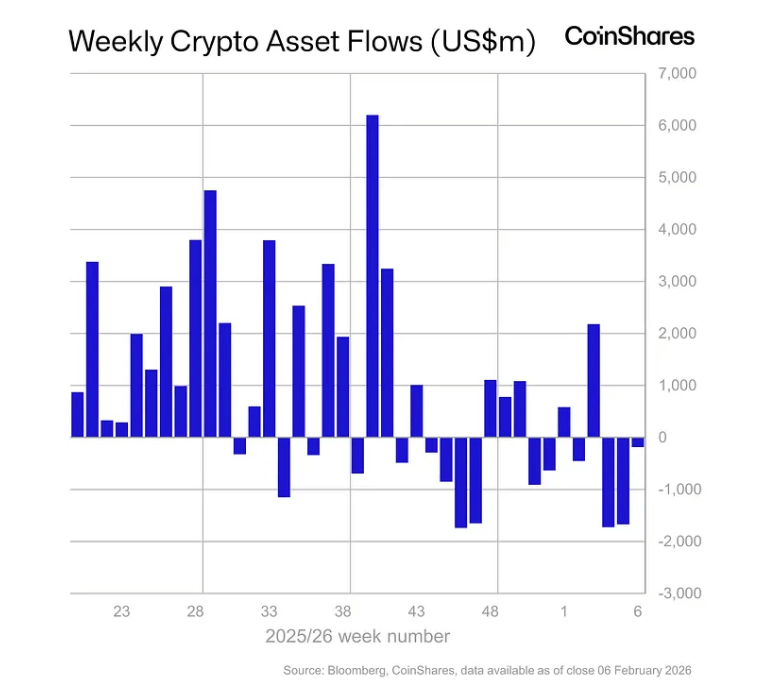
Crypto investment products experienced another week of net outflows, though the pace of withdrawals slowed significantly as prices stabilized. Trading activity reached a record high, with volumes exceeding $63 billion. Bitcoin-focused funds bore the brunt of the outflows, with approximately $264 million withdrawn. Meanwhile, some altcoins like XRP attracted fresh capital, suggesting a partial rotation by investors. Global crypto ETP assets declined to around $130 billion, the lowest since March 2025. Despite the downturn, new product filings, such as 21Shares' ETF application for Ondo, indicate continued industry development amid ongoing political and regulatory influences.

Crypto investment products saw another week of net withdrawals, but the rush out the door slowed sharply as prices found firmer footing. Trading activity stayed heavy, and a handful of altcoins drew fresh interest even while Bitcoin-focused funds lost ground.

Record Trading Activity

According to CoinShares, exchange-traded products logged a record week of trading, with volumes topping $63 billion. That was higher than the prior high set last October.

High turnover was mixed with net selling. James Butterfill, head of research at CoinShares, said a change in the speed of withdrawals can be more revealing than the raw outflows themselves.

Market watchers took that as a hint that investor mood might be shifting after several rough weeks.

Source: CoinShares
Bitcoin Takes The Brunt

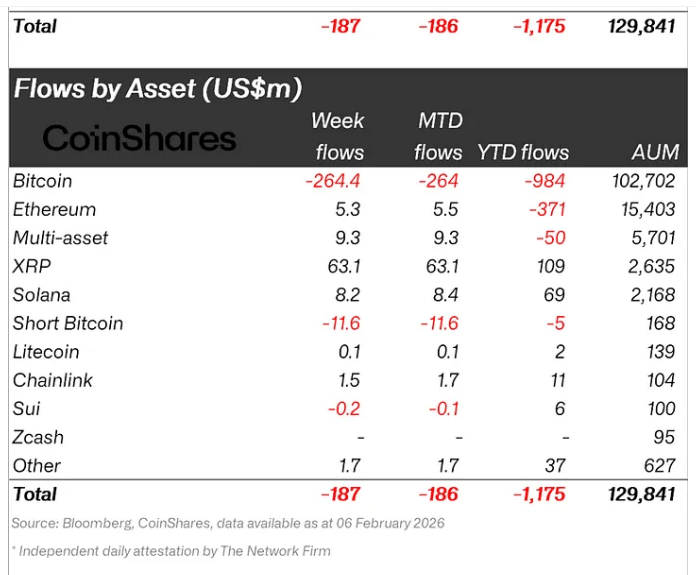
Bitcoin-linked ETPs were the main source of outflows. Reports say Bitcoin funds saw withdrawals around $264 million while spot Bitcoin ETFs accounted for about $318 million of that move, based on SoSoValue data.

The token’s price briefly touched $60,000 last Thursday on Coinbase, marking its lowest point since November 2024. That drop clearly weighed on funds tied directly to Bitcoin exposure.
Source: CoinShares

Altcoins Attract Some Fresh Capital

XRP led the inflows, drawing $63 million. Ether and Solana-linked products picked up smaller amounts, attracting $5.3 million and $8.2 million, respectively.

The flow mix suggests some investors are trimming big Bitcoin positions and shifting small slices into other tokens. That behavior was visible even as overall assets under management slid.

BTCUSD trading at $69,061 on the 24-hour chart: TradingView

Crypto AUM And Year-To-Date Flows

Global crypto ETP assets fell to close to $130 billion by week’s end, the lowest since March 2025. Bitcoin ETP AUM stood at about $102.7 billion, while ETF totals fell below $90 billion.

After three consecutive weeks of withdrawals, crypto ETPs have shed roughly $1.2 billion year-to-date, compared with almost $2 billion pulled from Bitcoin ETFs over the same span.

Industry Moves Continue

Beyond flows and prices, the market kept adding new product filings. Reports note that 21Shares filed with the US Securities and Exchange Commission for an ETF tied to Ondo. That kind of filing shows issuers still see demand for more varied crypto tools even in a cooling period.

Political signals have also been part of the backdrop. Markets remain sensitive to comments from US political figures, including US President Donald Trump, and to US regulatory talk that can shape investor appetite.

Featured image from TalkShop, chart from TradingView

Пов'язані питання

QWhat was the main reason analysts suggested a potential shift in investor sentiment despite continued outflows from crypto investment products?

AAnalysts pointed to the sharp slowdown in the speed of withdrawals as a more revealing indicator than the raw outflow numbers, hinting that investor mood might be shifting after several rough weeks as prices found firmer footing.

QWhich cryptocurrency's investment products were the primary source of outflows, and what was the approximate amount withdrawn from its ETFs according to SoSoValue data?

ABitcoin-linked ETPs were the main source of outflows. Spot Bitcoin ETFs accounted for approximately $318 million in withdrawals.

QWhich altcoin led the inflows for the week, and how much capital did it attract?

AXRP led the inflows for the week, attracting $63 million in fresh capital.

QWhat was the total value of assets under management (AUM) for global crypto ETPs by the end of the week, and what was significant about this level?

AGlobal crypto ETP assets fell to close to $130 billion by week’s end, which was the lowest level since March 2025.

QBeyond market flows, what action did 21Shares take that indicates continued issuer interest in new crypto products?

A21Shares filed with the US Securities and Exchange Commission for an ETF tied to Ondo, showing that issuers still see demand for more varied crypto tools even during a cooling period.

Пов'язані матеріали

Jensen Huang's CMU Speech: In the AI Era, Don't Just Watch, Build

Jensen Huang, CEO of NVIDIA and a first-generation immigrant, delivered the commencement address to Carnegie Mellon University's class of 2026. He shared his personal journey from a humble background to founding NVIDIA, emphasizing resilience, learning from failure, and the responsibility that comes with leadership. Huang framed the present moment as the dawn of the AI revolution, a shift he believes is more profound than previous computing waves. He described AI as fundamentally resetting computing—moving from human-written software to machines that understand, reason, and use tools. This will create a new industry for generating intelligence and transform every sector. While acknowledging AI's potential to automate tasks and displace some jobs, Huang distinguished between the *tasks* of a job and its core *purpose*. He argued AI will augment human capability, not replace humans. The real risk, he stated, is not AI itself, but people being left behind by those who effectively use AI. He presented AI as a generational opportunity for massive infrastructure investment—in chip factories, data centers, energy grids, and advanced manufacturing—that could re-industrialize nations like the U.S. and bridge the digital divide by making computing and intelligent tools accessible to all. Huang called for a balanced approach: advancing AI safely and responsibly, establishing prudent policies, ensuring broad access, and encouraging universal participation. He urged the graduates not to fear the future but to engage with optimism and ambition, reminding them of CMU's motto, "My heart is in the work." His core message was clear: this is their moment to actively build and shape the AI-powered future, not merely observe it.

marsbit48 хв тому

Jensen Huang's CMU Speech: In the AI Era, Don't Just Watch, Build

marsbit48 хв тому

The Era Has Arrived Where Human Writers Must Prove They Are Not Machines

The article describes an era where AI-generated content is flooding the market, forcing human authors to prove they are not machines. It begins with the example of dozens of AI-written, error-ridden biographies of Henry Kissinger appearing on Amazon within hours of his death, a pattern repeated for other deceased celebrities and even living experts who find fraudulent books under their names. This spam content has exploded, with monthly new book releases on platforms like Amazon reaching 300,000 by late 2025. The issue spans genres, from suspiciously high proportions of AI-written teen romance and self-help books to dangerous, AI-generated foraging guides containing lethal advice. The platforms' automated review systems, designed to catch plagiarism and banned words, are ill-equipped to detect AI-generated text that avoids these pitfalls while being nonsensical or fraudulent. The problem has infiltrated traditional publishing. A major publisher, Hachette, had to recall a bestselling horror novel after AI detection tools suggested 78% of its content was machine-generated. An acclaimed European philosophy book was later revealed to be entirely written by AI under a fake author persona. In response, authors are fighting back. At the 2026 London Book Fair, 10,000 writers published a blank book titled "Don't Steal This Book" containing only their signatures—using emptiness as a protest weapon in an age of AI overproduction. Initiatives like the "Human Author Certification" program have emerged, ironically placing the burden on humans to prove their work is not machine-made. The article warns of a vicious cycle: AI-generated low-quality books pollute the data used to train future AI models, leading to "model collapse" and an ever-worsening flood of digital waste, eroding trust in publishing and devaluing human creativity.

marsbit1 год тому

The Era Has Arrived Where Human Writers Must Prove They Are Not Machines

marsbit1 год тому

Торгівля

Спот
Ф'ючерси
活动图片





