Crypto CLARITY Act set for Senate markup in January, says Sacks

cointelegraphОпубліковано о 2025-12-18Востаннє оновлено о 2025-12-18

Анотація

The long-awaited Crypto CLARITY Act is set for a Senate markup in January, according to White House AI and crypto czar David Sacks. Senate Banking Committee Chair Tim Scott and Agriculture Committee Chair John Boozman confirmed the bipartisan bill will advance next month. The legislation aims to define crypto securities and commodities, clarify regulatory roles between the SEC and CFTC, and reduce uncertainty for crypto firms. Supporters say it will establish clearer compliance pathways, encourage innovation, and strengthen investor protections. Work on the bill continued during the recent government shutdown, with regulators meeting executives from major crypto companies and venture firms.

The long-awaited Digital Asset Market Clarity Act, or CLARITY Act, is moving closer to passage, with a Senate markup expected in January, says White House artificial intelligence and crypto czar David Sacks.

Sacks posted to X on Thursday that Senate Banking Committee Chair Tim Scott and Agriculture Committee Chair John Boozman had confirmed that the bipartisan crypto bill will reach the Senate next month.

”We are closer than ever to passing the landmark crypto market structure legislation that President Trump has called for. We look forward to finishing the job in January!”
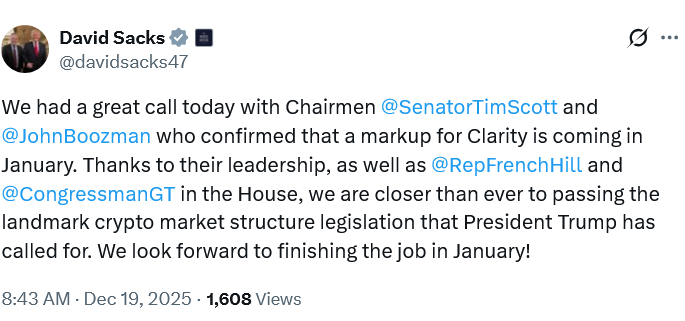
Source: David Sacks

The CLARITY Act would define crypto securities and commodities and clarify the roles of the Securities and Exchange Commission, the Commodity Futures Trading Commission, and other financial regulators.

Backers of the bill say it will reduce regulatory uncertainty for crypto firms by establishing clearer compliance pathways and encourage innovation while strengthening investor protections.

Related: Bitcoin institutional buys flip new supply for the first time in 6 weeks

US regulators continued to work on the CLARITY Act during the record 43-day government shutdown across October and November, meeting with executives from the likes of Coinbase, Ripple, Kraken, Circle, and tech-focused venture capital firms a16z and Paradigm.

Magazine: Quantum attacking Bitcoin would be a waste of time: Kevin O’Leary

Пов'язані питання

QWhat is the name of the crypto bill expected to be marked up in the Senate in January?

AThe Digital Asset Market Clarity Act, or CLARITY Act.

QWho announced that the CLARITY Act will reach the Senate next month?

AWhite House artificial intelligence and crypto czar David Sacks.

QWhich two Senate committee chairs confirmed the upcoming markup for the crypto bill?

ASenate Banking Committee Chair Tim Scott and Agriculture Committee Chair John Boozman.

QWhat is the main purpose of the CLARITY Act according to its backers?

ATo define crypto securities and commodities, clarify the roles of financial regulators like the SEC and CFTC, reduce regulatory uncertainty, establish clearer compliance pathways, encourage innovation, and strengthen investor protections.

QWhich major crypto and tech firms did US regulators meet with to work on the CLARITY Act during the government shutdown?

AExecutives from Coinbase, Ripple, Kraken, Circle, and tech-focused venture capital firms a16z and Paradigm.

Пов'язані матеріали

Jensen Huang's CMU Speech: In the AI Era, Don't Just Watch, Build

Jensen Huang, CEO of NVIDIA and a first-generation immigrant, delivered the commencement address to Carnegie Mellon University's class of 2026. He shared his personal journey from a humble background to founding NVIDIA, emphasizing resilience, learning from failure, and the responsibility that comes with leadership. Huang framed the present moment as the dawn of the AI revolution, a shift he believes is more profound than previous computing waves. He described AI as fundamentally resetting computing—moving from human-written software to machines that understand, reason, and use tools. This will create a new industry for generating intelligence and transform every sector. While acknowledging AI's potential to automate tasks and displace some jobs, Huang distinguished between the *tasks* of a job and its core *purpose*. He argued AI will augment human capability, not replace humans. The real risk, he stated, is not AI itself, but people being left behind by those who effectively use AI. He presented AI as a generational opportunity for massive infrastructure investment—in chip factories, data centers, energy grids, and advanced manufacturing—that could re-industrialize nations like the U.S. and bridge the digital divide by making computing and intelligent tools accessible to all. Huang called for a balanced approach: advancing AI safely and responsibly, establishing prudent policies, ensuring broad access, and encouraging universal participation. He urged the graduates not to fear the future but to engage with optimism and ambition, reminding them of CMU's motto, "My heart is in the work." His core message was clear: this is their moment to actively build and shape the AI-powered future, not merely observe it.

marsbit22 хв тому

Jensen Huang's CMU Speech: In the AI Era, Don't Just Watch, Build

marsbit22 хв тому

The Era Has Arrived Where Human Writers Must Prove They Are Not Machines

The article describes an era where AI-generated content is flooding the market, forcing human authors to prove they are not machines. It begins with the example of dozens of AI-written, error-ridden biographies of Henry Kissinger appearing on Amazon within hours of his death, a pattern repeated for other deceased celebrities and even living experts who find fraudulent books under their names. This spam content has exploded, with monthly new book releases on platforms like Amazon reaching 300,000 by late 2025. The issue spans genres, from suspiciously high proportions of AI-written teen romance and self-help books to dangerous, AI-generated foraging guides containing lethal advice. The platforms' automated review systems, designed to catch plagiarism and banned words, are ill-equipped to detect AI-generated text that avoids these pitfalls while being nonsensical or fraudulent. The problem has infiltrated traditional publishing. A major publisher, Hachette, had to recall a bestselling horror novel after AI detection tools suggested 78% of its content was machine-generated. An acclaimed European philosophy book was later revealed to be entirely written by AI under a fake author persona. In response, authors are fighting back. At the 2026 London Book Fair, 10,000 writers published a blank book titled "Don't Steal This Book" containing only their signatures—using emptiness as a protest weapon in an age of AI overproduction. Initiatives like the "Human Author Certification" program have emerged, ironically placing the burden on humans to prove their work is not machine-made. The article warns of a vicious cycle: AI-generated low-quality books pollute the data used to train future AI models, leading to "model collapse" and an ever-worsening flood of digital waste, eroding trust in publishing and devaluing human creativity.

marsbit47 хв тому

The Era Has Arrived Where Human Writers Must Prove They Are Not Machines

marsbit47 хв тому

Торгівля

Спот
Ф'ючерси
活动图片





