Crypto Bear Market Startup Guide Part 1: Pre-Market Price Spread Market for Tokenized Stocks

Odaily星球日报Опубліковано о 2026-03-16Востаннє оновлено о 2026-03-16

Анотація

The article "Crypto Bear Market Startup Guide Part 1: Pre-IPO Stock Price Difference Market" discusses entrepreneurial opportunities during a crypto bear market, focusing on the emerging niche of pre-IPO stock price difference markets. It begins by challenging the notion that bear markets are beneficial for building, citing data showing over 80% of crypto startups from the 2022 bear market are still active, suggesting that focused development and survival skills can thrive in downturns. The core analysis highlights the significant price discrepancies for pre-IPO stocks of companies like Kalshi, Polymarket, and SpaceX(xAI) across different crypto-based trading platforms such as PreStocks, Jarsy, and Tessera. For instance, Kalshi's pre-IPO price shows a $148 (37%) difference between PreStocks ($397) and Jarsy ($545). Polymarket's price gap is $94 (over 50%), and SpaceX has a $75 (12.7%) difference. The author argues this demonstrates a clear market need for a unified platform that bridges these price gaps across traditional and crypto pre-IPO markets, acting as a liquidity bridge. The proposed business model for such a "pre-IPO price difference market" would likely generate revenue through trading fees, LP fees, and arbitrage on the platform's own capital. The piece positions this as a promising venture for the anticipated 2026 IPO boom.

Original|Odaily Planet Daily(@OdailyChina)

Author|Wenser(@wenser 2010)

Not long ago, Mysten Labs CEO evan.sui shared his views on the "bear market." He mentioned that he does not agree with the notion that "the bear market is great, just keep building." In fact, the bear market is not "great"; packaging it as good for everyone overlooks the real costs (such as discouraging builders and users). Many retail investors and excellent teams will face cash flow problems and be forced to exit, ultimately harming the long-term development of the crypto industry.

However, data evidence does not align with this view. A report released by Lattice VC in October 2024 showed that over 80% of crypto startups that announced seed round funding during the 2022 bear market were still building at that time. In other words, if project teams can ensure relatively stable personnel and funding, the bear market may indeed be more conducive to project development and growth. The reasons might be that during a bear market, project teams focus more on product development and experience optimization; or perhaps the bear market hones the project teams' abilities to survive through various means. In any case, being in a crypto bear market, determined startup teams might find opportunities in adversity and carve out their own path to development.

In light of this, we will use a series of articles titled "Crypto Bear Market Startup Guide" to explore potential entrepreneurial tracks and project directions with our readers during this cycle. If any crypto projects are born or grow rapidly as a result in the future, Odaily Planet Daily also welcomes project teams to discuss cooperation.

Today, let's first discuss one of the hottest potential entrepreneurial directions besides prediction markets—the pre-market price spread market for tokenized stocks.

The Real Demand for Tokenized Stock Pre-Market: Platform Differentiation and Liquidity Bridge

As an intermediate bridge connecting the crypto market with the traditional financial market, tokenized stock trading platforms have not only garnered high attention and active participation from crypto project teams but have also seen involvement from global leading securities platforms including Nasdaq and the New York Stock Exchange, aiming to capture incremental markets while further activating liquidity in traditional financial markets.

Furthermore, not only have listed cryptocurrency concept stocks undergone tokenization and on-chain contract transformation, but many pre-IPO hot concept stocks have also received enthusiastic追捧 from both crypto and traditional financial markets, giving rise to several pre-market stock tokenization trading platforms.

Considering that the capital market is about to welcome a wave of U.S. stock listings this year from companies including OpenAI, Anthropic, SpaceX(xAI), Kalshi, Polymarket, OKX, Kraken, and a series of AI model companies, commercial aerospace companies, prediction market platforms, and crypto exchanges, there is no doubt that 2026 is destined to be a "big year for IPOs."

Against the backdrop of a fluctuating and occasionally rebounding crypto market and a consistently rising stock market, the热度 of the pre-market stock trading market further supports the above view—there is strong demand from both crypto and traditional financial markets for pre-market trading of hot concept stocks.

This is the main reason for the emergence of pre-market stock trading platforms such as PreStocks, Jarsy, Tessera, and others. Moreover, compared to traditional financial market pre-market trading markets like Hiive and Nasdaq Private Market, crypto pre-market trading markets offer more flexible trading methods, purchase limits, and entry barriers, with relatively higher premiums, which is why many users enthusiastically participate.

However, just as the same token can have different price differences on different exchanges, before mechanisms类似 oracles are introduced into the pre-market stock market, regardless of the reason, we can clearly see that different platforms have certain price differences for the same underlying stock mentioned above.

Based on the above information, we can make a somewhat bold judgment—the crypto market still lacks one or more "bridge platforms between pre-market stock trading markets."

This might be a necessary step forward in advancing the tokenization of stocks and the tokenization of pre-market stock markets—a unified comprehensive platform covering pre-market trading in both traditional financial markets and crypto markets.

Below, we will use the two leading prediction market platforms, Kalshi and Polymarket, which are recently seeking $20 billion in funding, and SpaceX(xAI), valued at $1.25 trillion, as examples to explore the feasibility and real demand of this "entrepreneurial direction."

Comparing Pre-Market Price Spreads on PreStocks, Jarsy, Tessera 3 Major Platforms: Maximum Spread Rate Exceeds 50%, Price Difference Up to Nearly $150

Kalshi Pre-Market Spread: Up to $148, Spread Rate About 37%

Taking the Kalshi pre-market as an example, its prices on different platforms are as follows—

On the PreStocks platform, the pre-market price of the stock token is around $397; (Compared to the $369 we mentioned one month ago in the article "Kalshi Trading Volume Continues to Hit New Highs, What Is a Reasonable Pre-IPO Stock Price?", it has increased by nearly $30, a rise of 7.6%)
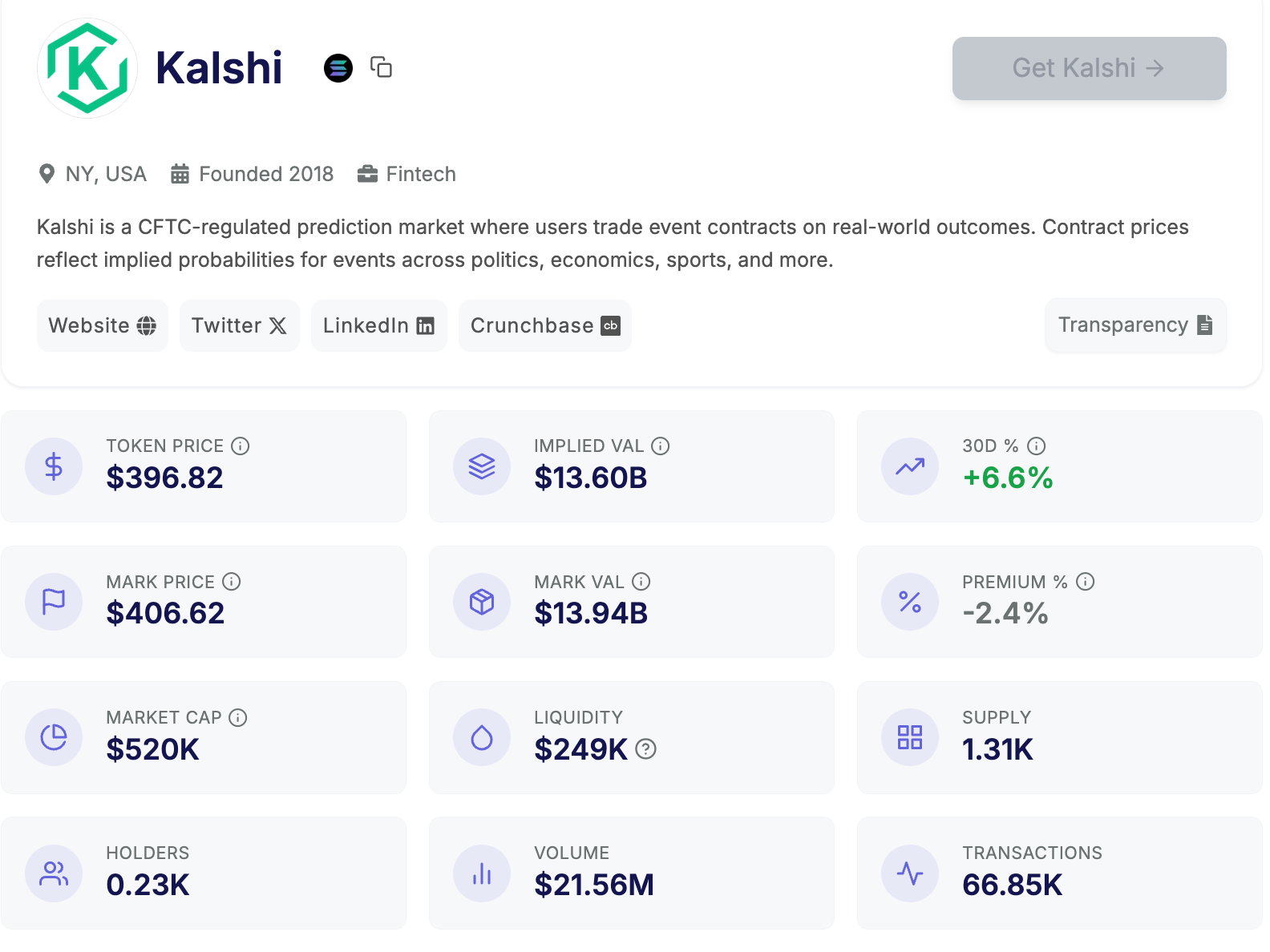
On the Jarsy platform, the pre-market price is quoted at around $545. (Compared to the $504 we mentioned one month ago in the article "Kalshi Trading Volume Continues to Hit New Highs, What Is a Reasonable Pre-IPO Stock Price?", it has increased by over $40, a rise of 8.1%)

In other words, the price difference for Kalshi's pre-market stock on the two major trading platforms is as high as $148 (Odaily Planet Daily Note: Considering the two platforms use order book trading mechanisms and on-chain liquidity token trading mechanisms respectively, we are only making a abstract comparison here,暂时 not involving specific asset settlement forms, same below). If calculated based on the $360 price on the traditional financial market pre-market trading platform Hiive, the pre-market price difference甚至 reaches $185.

Polymarket Pre-Market Spread: Up to $94, Spread Rate Over 50%

Taking the Polymarket pre-market as an example, its prices on different platforms are as follows—

On the PreStocks platform, the pre-market price of the stock token is around $186 (Odaily Planet Daily Note: up 23% in the past 30 days);
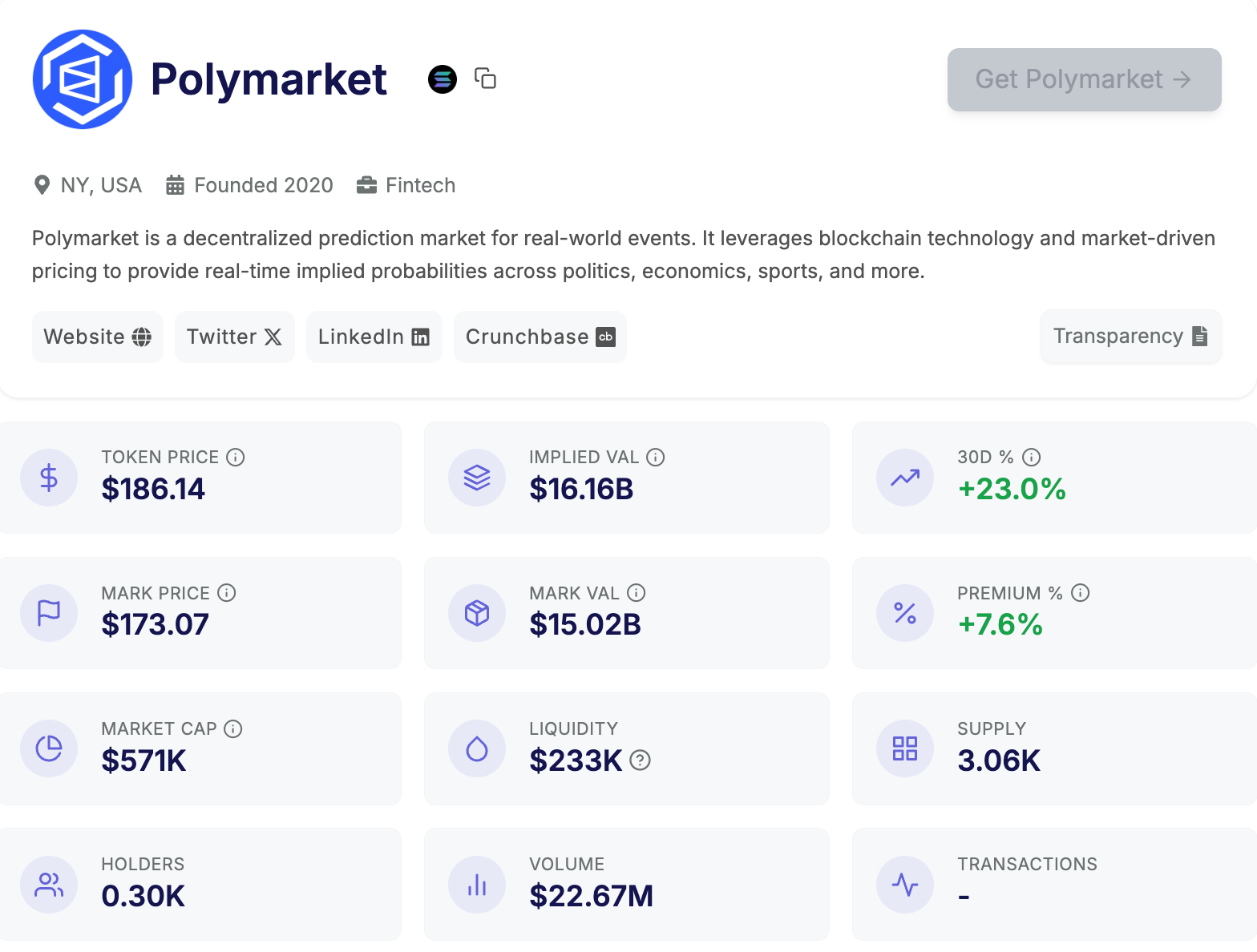
On the Jarsy platform, the pre-market price is quoted at around $280.

In other words, the price difference for Polymarket's pre-market stock on the 2 major platforms is about $94, with a spread rate of approximately 50.5%.

SpaceX(xAI) Pre-Market Spread: About $75, Spread Rate 12.7%

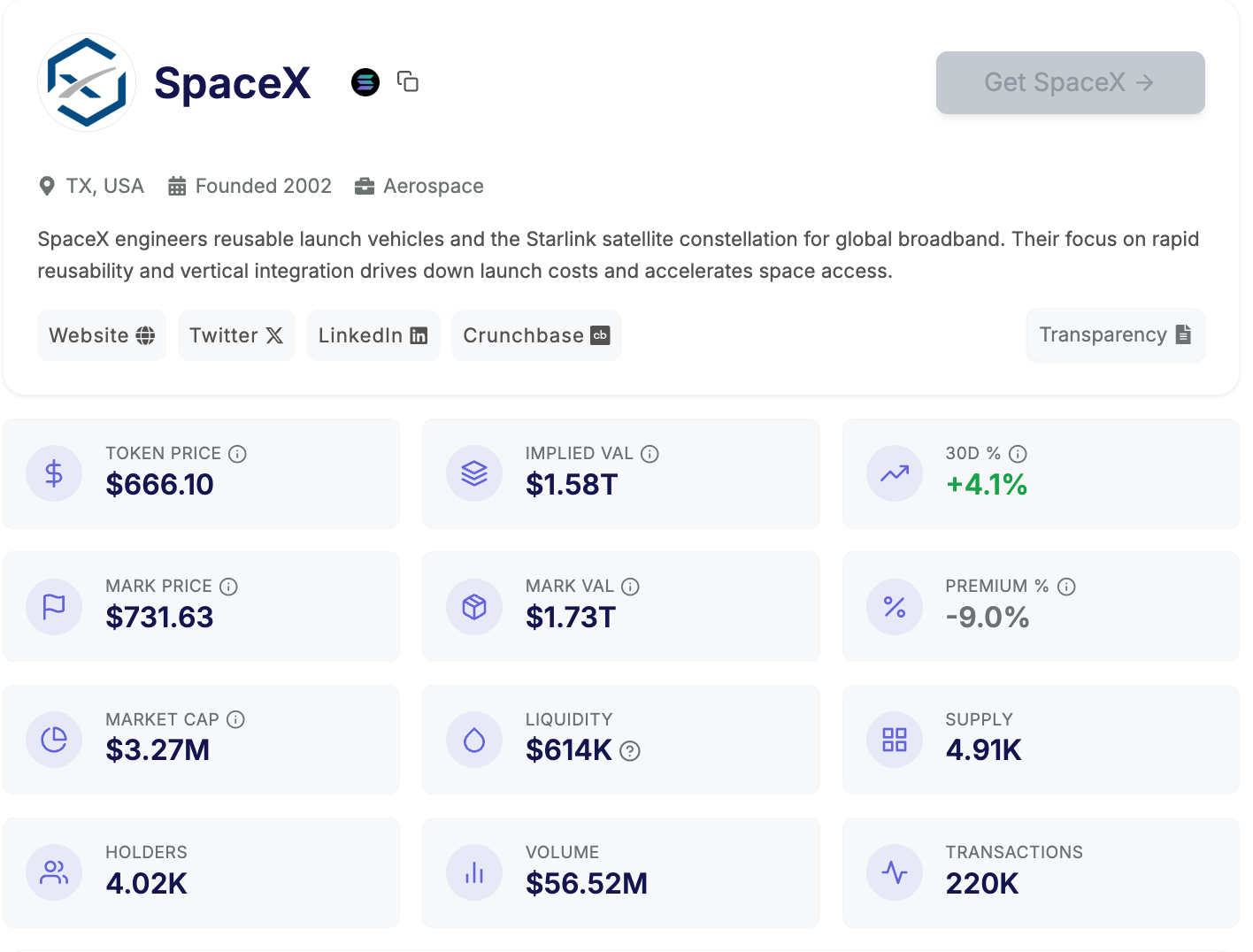
Taking SpaceX(xAI) as an example, its prices on different platforms are as follows—

On the PreStocks platform, the pre-market price of the stock token is around $666 (Odaily Planet Daily Note: up 4.1% in the past 30 days);
On the Tessera platform, the pre-market price of the stock token is temporarily reported at around $591 (Odaily Planet Daily Note: up about 14.5% in the past 30 days).
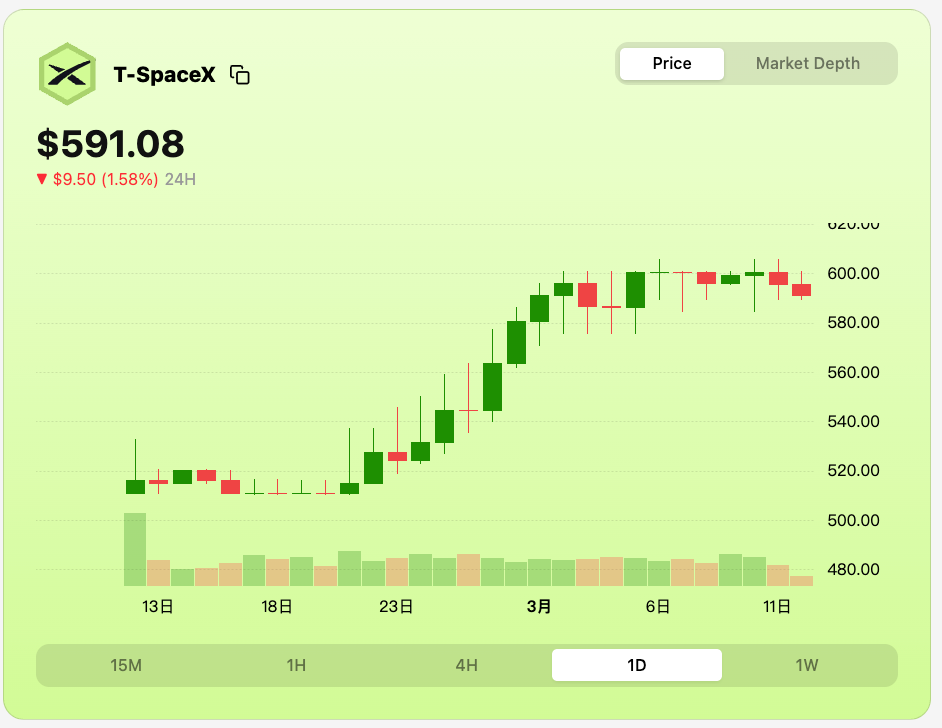
In other words, the price difference for SpaceX's pre-market stock on the 2 major platforms is about $75, with a spread rate of approximately 12.7%.

In summary, based on existing pre-market trading platforms, it might be possible to build a pre-market price spread market for tokenized stocks to meet market trading and speculation demands, once sufficient pre-market tokens or pre-market equity capital is available.

Of course, considering that the current market liquidity remains within the million-dollar level, the main business model of this platform may revolve around transaction fees, LP fees, and realizing price differences from the platform's own investment allocations, among others.


Пов'язані питання

QWhat is the main argument presented by Mysten Labs CEO evan.sui regarding the 'bear market' in crypto?

AMysten Labs CEO evan.sui argues that bear markets are not 'great' and that the narrative that they are good for everyone ignores the real costs, such as driving away builders and users, causing cash flow problems for retail investors and excellent teams, and ultimately harming the long-term development of the crypto industry.

QAccording to the Lattice VC report from October 2024, what percentage of crypto startups that announced seed funding during the 2022 bear market are still building?

AAccording to the Lattice VC report from October 2024, over 80% of crypto startups that announced seed funding during the 2022 bear market are still building.

QWhat is the proposed new business opportunity discussed in the article for the bear market?

AThe proposed new business opportunity is creating a 'pre-market price difference market for tokenized stocks' or a bridge platform that connects different pre-market stock trading platforms to capitalize on the price discrepancies between them.

QWhat was the approximate price difference (in USD) and the difference rate for Kalshi stock between the PreStocks and Jarsy platforms?

AThe price difference for Kalshi stock between the PreStocks ($397) and Jarsy ($545) platforms was approximately $148, with a difference rate of about 37%.

QWhat potential business model is suggested for a platform that capitalizes on pre-market stock price differences?

AThe potential business models suggested are transaction fees, liquidity provider (LP) fees, and profiting from the price differences of the platform's own investment allocations.

Пов'язані матеріали

Who Will Define the Rules of the AI Era? Anthropic Discusses the 2028 US-China AI Landscape

This article, based on Anthropic's analysis, outlines the intensifying systemic competition between the U.S./allies and China for AI leadership by 2028. It argues that access to advanced computing power ("compute") is the critical bottleneck, where the U.S. currently holds a significant advantage through chip export controls and allied innovation. However, China's AI labs remain competitive by exploiting policy loopholes—via chip smuggling, overseas data center access, and "model distillation" attacks to copy U.S. model capabilities—keeping them close to the frontier. The piece presents two contrasting scenarios for 2028. In the first, decisive U.S. action to tighten compute controls and curb distillation locks in a 12-24 month AI capability lead, cementing democratic influence over global AI norms, security, and economic infrastructure. In the second, policy inaction allows China to achieve near-parity through continued access to U.S. technology, enabling Beijing to promote its AI stack globally and integrate advanced AI into its military and governance systems, altering the strategic balance. Anthropic contends that maintaining a decisive U.S. lead is essential for shaping safe AI development and governance. The core recommendation is for U.S. policymakers to urgently close compute and model access loopholes while promoting global adoption of the U.S. AI technology stack to secure a lasting strategic advantage.

marsbit1 год тому

Who Will Define the Rules of the AI Era? Anthropic Discusses the 2028 US-China AI Landscape

marsbit1 год тому

“Why Didn’t You Buy 2x Long SK Hynix?”

The article discusses the immense popularity of the "2x Long SK Hynix ETF" (07709.HK) in Hong Kong, which became the world's largest single-stock leveraged ETF by May 2026. Launched in October 2025, the ETF's net value soared over 1000% in seven months, significantly outperforming the 324% gain of SK Hynix's underlying stock, driven by the AI boom and a critical shift in industry demand from computing power to memory. It highlights the mechanics and risks of daily-rebalanced leveraged ETFs. In a smooth bullish market, they generate amplified returns, but during volatile periods—exemplified by market swings during geopolitical tensions in the Strait of Hormuz in March-April 2026—they suffer severe "volatility decay," where choppy price action can cause losses far exceeding twice the drop of the underlying asset. The piece frames SK Hynix, as NVIDIA's primary HBM supplier, within the classic cycle of the memory chip industry—a commoditized sector prone to boom-and-bust cycles of shortage, price hikes, overcapacity, and crashes. While current AI-driven demand and high margins (Q1 2026毛利率~79%) create a "super cycle," the article questions its sustainability. It warns that extreme profits will inevitably tempt competitors like Samsung and Micron to ramp up HBM production, potentially eroding scarcity. Furthermore, the entire narrative remains tethered to the massive AI capital expenditure of tech giants. In conclusion, the ETF's trajectory symbolizes the accelerated, all-in nature of the current AI revolution, where timeframes are compressed and market moves are extreme. However, it also underscores that while industry trends define ultimate returns, macro-geopolitical risks dictate the volatile and uncertain path to get there.

marsbit1 год тому

“Why Didn’t You Buy 2x Long SK Hynix?”

marsbit1 год тому

a16z Crypto: A Guide to the CLARITY Act for Crypto Entrepreneurs

The CLARITY Act, a bipartisan crypto market structure bill, has advanced through the Senate Banking Committee, marking a potential historic shift in U.S. digital asset regulation. For years, a lack of clear rules has stifled innovation, pushed development overseas, and exposed consumers to risk. This bill aims to establish a comprehensive framework, providing long-needed regulatory clarity for blockchain networks and digital assets. It builds upon previous legislative efforts like FIT21 and the House version of CLARITY, which gained strong bipartisan support. CLARITY is crucial because it recognizes that blockchain networks are fundamentally different from traditional companies. Networks operate through decentralized, shared rules rather than centralized control. Applying corporate legal frameworks to networks forces them into a centralized model, concentrating power and value. In contrast, decentralized blockchain networks can function as user-owned public infrastructure, distributing value more equitably among participants. The bill seeks to enable the safe launch of networks in the U.S., clarify regulatory jurisdiction between the SEC and CFTC, oversee crypto exchanges, and enhance consumer protections. Its passage would align U.S. law with the nature of decentralized technology, allowing builders to operate transparently and fund projects domestically without structural compromises due to regulatory uncertainty. Similar to the positive impact seen after the stablecoin-focused GENIUS Act, CLARITY could unlock a new wave of innovation, helping the U.S. reclaim leadership in the crypto space while combating fraud and abuse.

链捕手1 год тому

a16z Crypto: A Guide to the CLARITY Act for Crypto Entrepreneurs

链捕手1 год тому

Торгівля

Спот
Ф'ючерси
活动图片




