Cardano’s whale growth is positive, but will it be enough for demand to catch up?

ambcryptoОпубліковано о 2026-04-08Востаннє оновлено о 2026-04-08

Анотація

Cardano's ADA price has moved sideways amid a weak altcoin market, but whale accumulation has increased significantly. Wallets holding at least 10 million ADA reached a 4-month high, rising 5.2% over nine weeks, suggesting growing confidence among large holders. However, this accumulation has not translated into strong price momentum, with ADA gaining only about 11% since February's low. The price remains range-bound between $0.24–$0.25, facing selling pressure near $0.27 and $0.31. Weak demand, limited capital inflow, and competition from other narratives like AI and RWA have capped ADA's upside. While whale growth is positive, a sustained breakout depends on broader altcoin strength and stronger market demand.

Cardano’s [ADA] price has continued to move sideways within a broader altcoin market that lacks strong directional momentum.

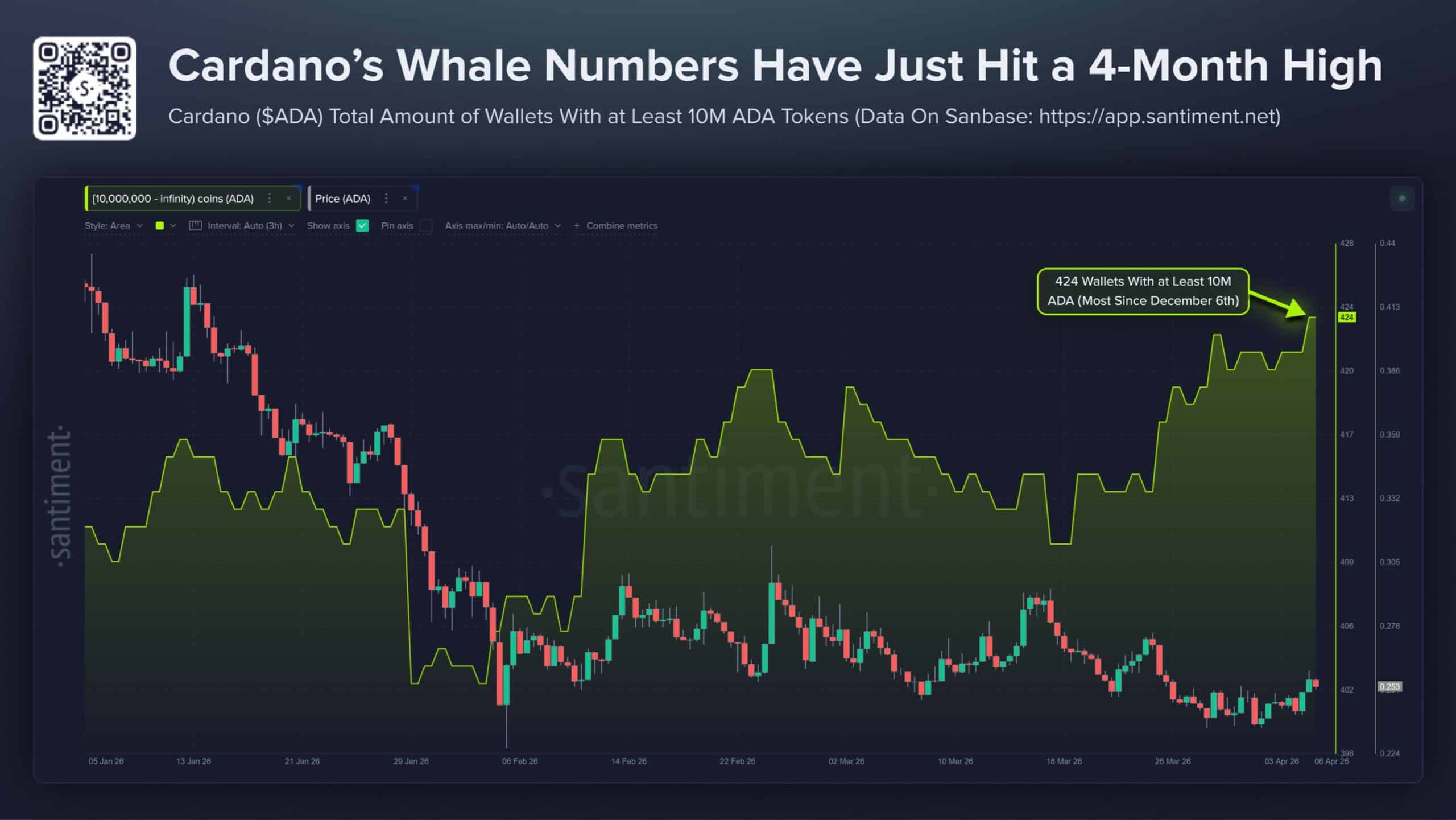
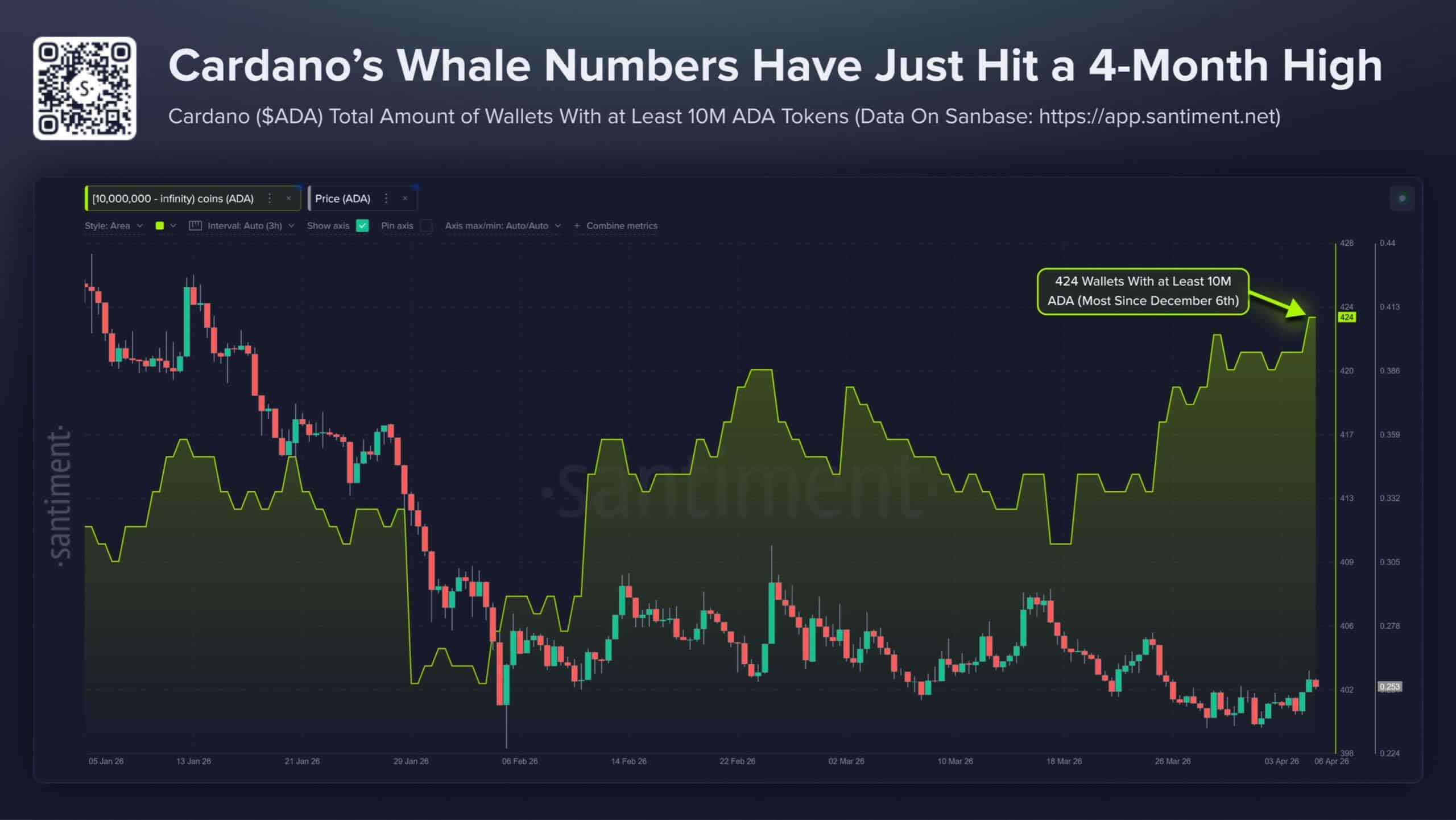
However, ownership dynamics tell us a different story as large holders quietly increase their exposure. In fact, wallets holding at least 10 million ADA have climbed to 424 – A 4-month high, with figures for the same rising by 5.2% over nine weeks.
Source: Santiment

Meanwhile, the price has only gained about 11% since 05 February’s low, showing limited follow-through. As whale numbers trend higher, the price has remained constrained – A sign that accumulation may be absorbing available supply.

This dynamic may be evidence of growing confidence among large holders, but it also suggested that demand might not have fully translated into momentum. If accumulation persists, it may support future upside, although near-term price action could remain range-bound.

A price compression on the charts

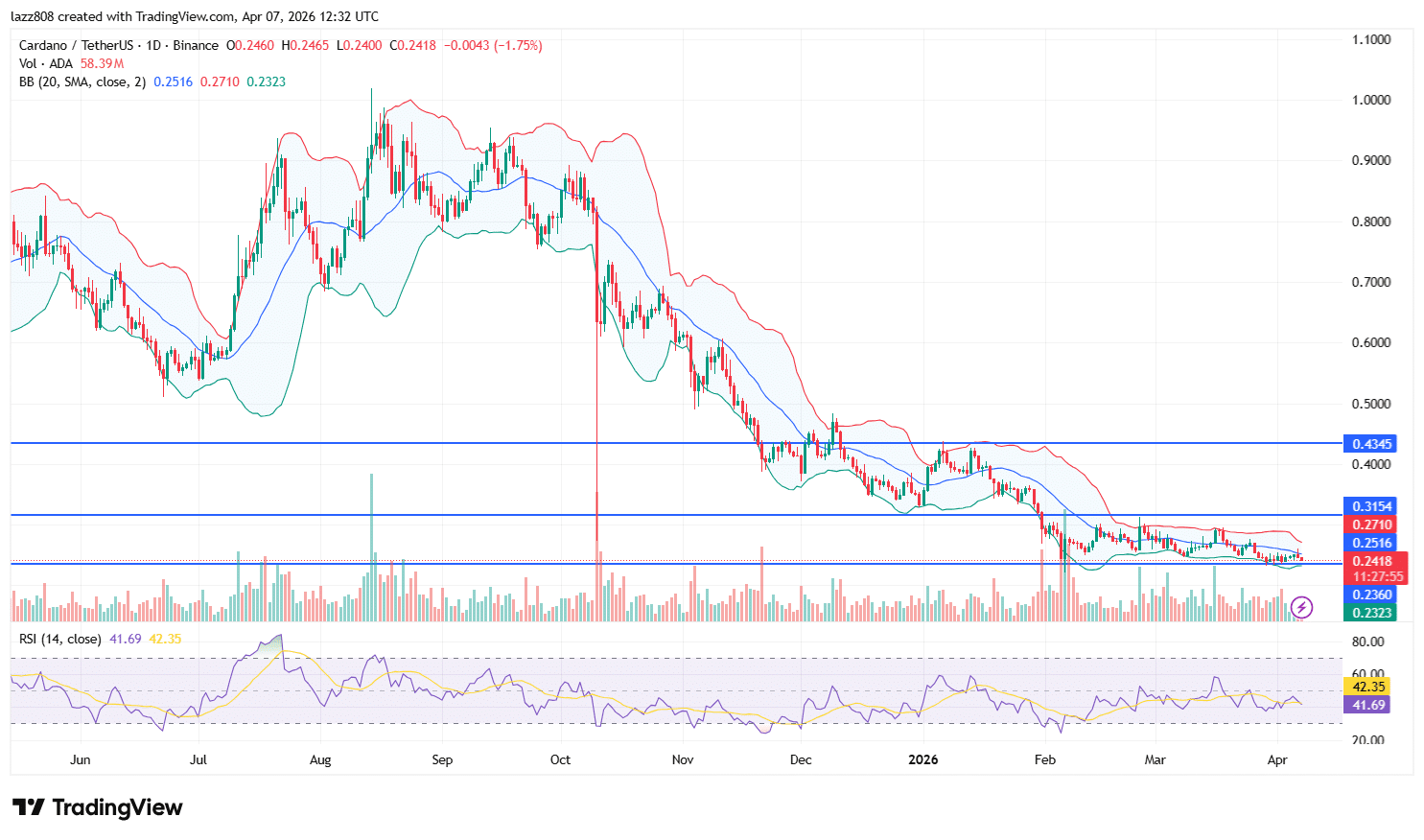
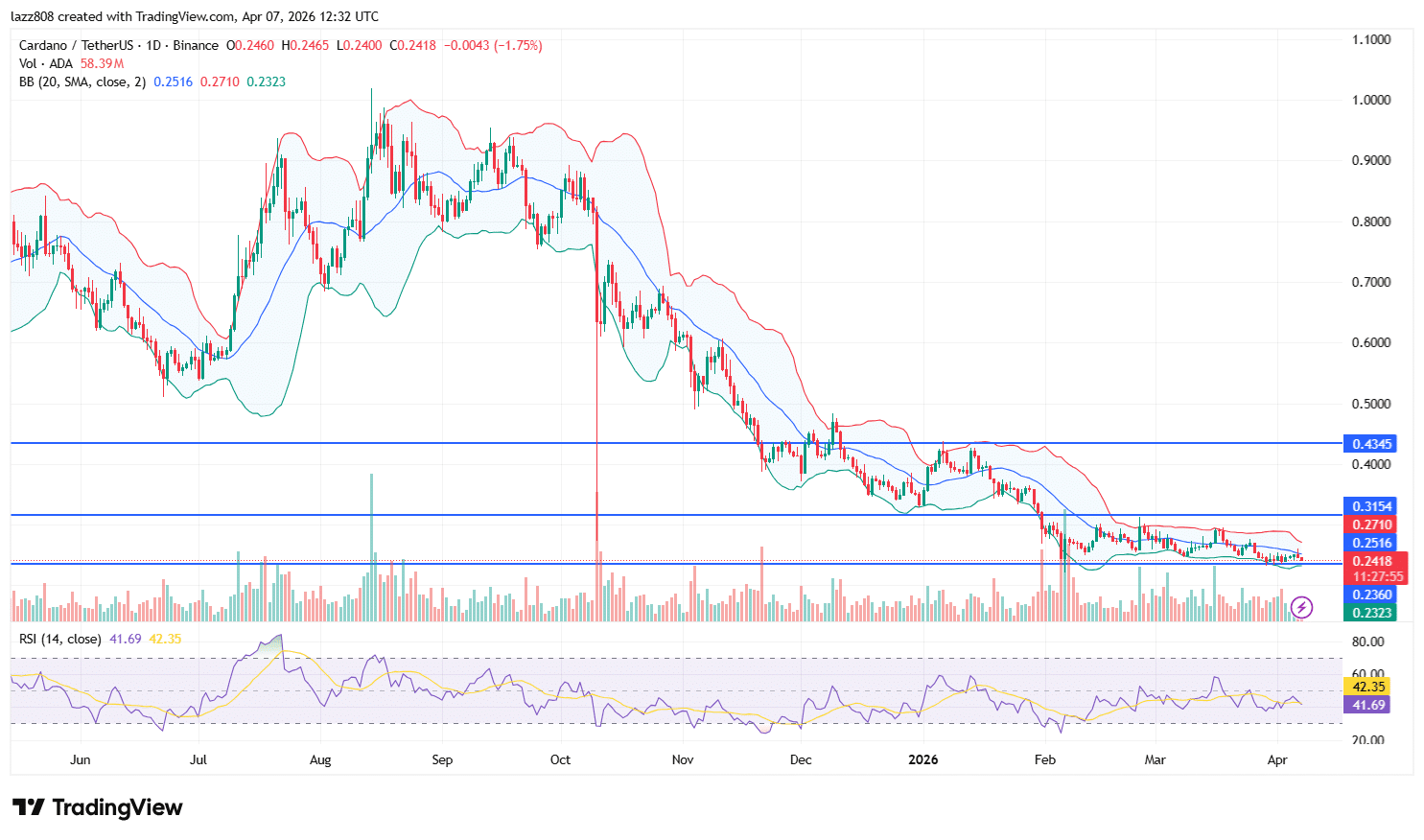
The gap between rising whale accumulation and muted price action appeared to be more evident across ADA’s structure. After failing to hold above $0.43, the price trended lower and later stabilized around $0.24–$0.25.

As rallies approach $0.27 and $0.31, prior holders could move to exit near breakeven. This could keep upside capped. Meanwhile, Bollinger Bands seemed to tighten sharply too, signaling volatility compression and a market waiting for direction.
Source: ADA/USDT on TradingView

At press time, the price was tracking the lower band, reflecting persistent selling pressure. The RSI near 42 supported this subdued sentiment too.

This dynamic suggested that accumulation may be ongoing. However, weak capital rotation has delayed some momentum, leaving ADA range-bound until stronger demand emerges.

Weak demand caps ADA’s breakout potential

Sustained price compression could point to a deeper issue, one where accumulation alone fails to drive expansion. While the price may be holding near $0.24–$0.25, new demand has been limited, keeping rallies from extending themselves.

As capital rotates into narratives like AI, RWAs, and high-beta L2s, ADA has received less attention, weakening its momentum. At press time, its DeFi activity reflected this, with the TVL near $132 million – Far below competing ecosystems.

Worth noting, however, that Cardano’s rising whale accumulation is evidence of growing long-term confidence. And yet, weak price performance and limited demand could delay any meaningful breakout or sustained momentum.

This would leave ADA reliant on broader altcoin strength, with its positioning reflecting early accumulation rather than confirmed recovery or independent upside expansion.


Final Summary

  • Weak demand and overhead supply have kept Cardano’s price price range-bound, delaying breakout.
  • Cardano remains tied to broader altcoin momentum, especially as limited capital rotation continues to cap upside.


Трендові криптовалюти

Пов'язані питання

QWhat has been the trend in Cardano (ADA) whale accumulation recently, and what does it indicate?

AWallets holding at least 10 million ADA have increased to 424, a 4-month high, representing a 5.2% rise over nine weeks. This indicates growing long-term confidence among large holders and suggests that accumulation is absorbing available supply.

QHow has the price of ADA performed in relation to the increase in whale holdings?

ADespite the growth in whale accumulation, the price of ADA has only gained about 11% since its low on February 5th and has remained range-bound, primarily between $0.24 and $0.25. This shows a disconnect, where the increased holdings have not yet translated into significant price momentum.

QWhat technical indicators suggest that ADA is experiencing selling pressure and subdued sentiment?

AThe price was tracking the lower Bollinger Band, which reflects persistent selling pressure. Additionally, the Relative Strength Index (RSI) was near 42, further supporting the view of subdued market sentiment.

QAccording to the article, what is a key factor capping the upside potential for ADA's price?

AWeak demand and limited new capital rotation into ADA are key factors capping its upside potential. Capital is instead flowing into other narratives like AI, Real-World Assets (RWAs), and high-beta Layer 2 solutions, leaving ADA with less attention and momentum.

QWhat is the current state of Cardano's DeFi ecosystem, as measured by Total Value Locked (TVL)?

ACardano's DeFi activity is weak, with a Total Value Locked (TVL) of around $132 million at the time of writing. This is far below the TVL of competing ecosystems.

Пов'язані матеріали

Upbit is Anxious: A Hasty Counterattack Aimed at Regaining Stablecoin Market Share

Title: Upbit's Rushed Counterattack to Reclaim Stablecoin Market Share Facing a dramatic shift in South Korea's stablecoin market, leading exchange Upbit launched a promotional campaign from July 26 to August 9, waiving the 0.05% trading fee for stablecoins paired with the Korean Won (KRW) and rapidly listing new stablecoins like RLUSD and USDG. This move is a direct response to its plummeting market share in this sector. Historically a duopoly with Bithumb, the market has been reshaped since October 2025 when Coinone permanently removed fees for USDC trading. By June 2026, Coinone led with 34.8% of stablecoin volume, followed by Bithumb (31.1%) and Upbit (30.1%). This contrasts sharply with the overall crypto market, where Upbit commands 60%. The data shows stablecoin demand is highly sensitive to fees, as users primarily buy them to transfer capital overseas for derivatives trading or forex arbitrage. South Korean exchanges have seen a net outflow of stablecoins for 18 consecutive months, totaling approximately 14.9 trillion KRW, underscoring their role as a cross-border capital conduit. Upbit's limited-time promotion initially boosted its daily stablecoin volume by 162%, but the surge was almost entirely in USDT (98.1% of volume). The newly listed stablecoins saw negligible, fleeting interest. Furthermore, the promotional effect quickly waned in the second week, with volume dropping 33% on weekdays. A concurrent weakening of the KRW also contributed to the trading spike, independent of the fee waiver. The analysis suggests that once the promotion ends, Upbit is unlikely to retain its temporary gains unless it matches Coinone's permanent zero-fee policy, forcing a choice between market share and fee revenue. Upbit's strategic push may be less about immediate profit and more about preparing for future regulatory shifts. With South Korea's *Digital Asset Basic Act* on the horizon, which will regulate KRW-backed stablecoins, and following Dunamu's (Upbit's parent) integration into Naver Financial to build a payment ecosystem, securing a dominant position in the dollar stablecoin distribution channel holds long-term strategic value. However, potential regulatory conflicts could prevent Upbit from listing a future Naver-issued KRW stablecoin, making the current fight for dollar stablecoin flow even more critical.

marsbit49 хв тому

Upbit is Anxious: A Hasty Counterattack Aimed at Regaining Stablecoin Market Share

marsbit49 хв тому

Michael Saylor Compares Bitcoin and Gold!

Michael Saylor, founder of MicroStrategy, argues that Bitcoin fundamentally changes how wealth is stored and transferred by transforming digital scarcity into economic value. He describes Bitcoin as the first digital monetary network, combining computers, digital networks, and cryptography. It digitizes monetary assets, allowing their supply to be controlled by public protocols rather than institutions, thus converting economic value into information transmissible over global networks. Comparing Bitcoin to gold, Saylor states that while increasing Bitcoin's supply is harder, its integration with software and transfer is easier. He highlights Bitcoin's proof-of-work mechanism, which ties it to the physical world by consuming real energy to secure the ledger, making past transactions immutable. This creates a shared security system involving miners, energy companies, and investors. Saylor suggests "digital monetary energy" is a more accurate term than "digital gold." He emphasizes that the Bitcoin network is an adaptive ecosystem of miners, nodes, developers, and users. Its core design is intentionally simple, focused on maintaining a secure ledger for scarce digital assets, with complex functionalities built in higher-layer applications. This architecture allows Bitcoin to serve as a foundation for transmitting value and fostering innovation in payments and financial services. Saylor notes Bitcoin's deeper impact lies in creating digital sovereignty, where private keys give individuals permissionless control over their economic power, with ownership verified mathematically, not by institutions. He concludes that while gold's physical scarcity makes it money, Bitcoin's digital scarcity does the same, characterizing Bitcoin as the monetary energy of the digital age.

cryptonews.ru1 год тому

Michael Saylor Compares Bitcoin and Gold!

cryptonews.ru1 год тому

Торгівля

Спот

Популярні статті

Як купити ADA

Ласкаво просимо до HTX.com! Ми зробили покупку Cardano (ADA) простою та зручною. Дотримуйтесь нашої покрокової інструкції, щоб розпочати свою криптовалютну подорож.Крок 1: Створіть обліковий запис на HTXВикористовуйте свою електронну пошту або номер телефону, щоб зареєструвати обліковий запис на HTX безплатно. Пройдіть безпроблемну реєстрацію й отримайте доступ до всіх функцій.ЗареєструватисьКрок 2: Перейдіть до розділу Купити крипту і виберіть спосіб оплатиКредитна/дебетова картка: використовуйте вашу картку Visa або Mastercard, щоб миттєво купити Cardano (ADA).Баланс: використовуйте кошти з балансу вашого рахунку HTX для безперешкодної торгівлі.Треті особи: ми додали популярні способи оплати, такі як Google Pay та Apple Pay, щоб підвищити зручність.P2P: Торгуйте безпосередньо з іншими користувачами на HTX.Позабіржова торгівля (OTC): ми пропонуємо індивідуальні послуги та конкурентні обмінні курси для трейдерів.Крок 3: Зберігайте свої Cardano (ADA)Після придбання Cardano (ADA) збережіть його у своєму обліковому записі на HTX. Крім того, ви можете відправити його в інше місце за допомогою блокчейн-переказу або використовувати його для торгівлі іншими криптовалютами.Крок 4: Торгівля Cardano (ADA)Легко торгуйте Cardano (ADA) на спотовому ринку HTX. Просто увійдіть до свого облікового запису, виберіть торгову пару, укладайте угоди та спостерігайте за ними в режимі реального часу. Ми пропонуємо зручний досвід як для початківців, так і для досвідчених трейдерів.

1.2k переглядів усьогоОпубліковано 2024.12.10Оновлено 2026.06.02

Як купити ADA

Обговорення

Ласкаво просимо до спільноти HTX. Тут ви можете бути в курсі останніх подій розвитку платформи та отримати доступ до професійної ринкової інформації. Нижче представлені думки користувачів щодо ціни ADA (ADA).

活动图片











