Cardano Price Forecast Turns Bearish as ADA Loses ETF Ground and $0.29 Support Weakens

bitcoinistОпубліковано о 2026-02-06Востаннє оновлено о 2026-02-06

Анотація

The Cardano (ADA) price outlook is turning increasingly bearish as it faces multiple headwinds. A weakening market structure, fading optimism around ETF inclusion, and a broader crypto risk-off sentiment are pressuring the token. ADA is struggling to maintain support at the critical $0.29 level, a zone that has been tested repeatedly and is now showing signs of weakness. The loss of momentum is exacerbated by a shift in institutional focus, evidenced by Grayscale removing ADA from its CoinDesk Crypto 5 ETF in favor of more liquid assets like BNB. This has left Cardano with diminished support and a thinner order book, making it more vulnerable to downside moves. Technical analysis indicates that a sustained break below $0.29 could lead to a deeper correction, with limited support until much lower price levels. Broader on-chain and derivatives data across the crypto market signal caution, with reduced buying activity. For ADA to stabilize, a significant improvement in overall market sentiment or a new demand catalyst is needed. Until then, the forecast remains bearish.

The Cardano price outlook is tilting further to the downside as weakening market structure, fading ETF optimism, and broader crypto risk-off sentiment weigh on ADA.

While much of the recent attention has been on sharp declines in large-cap tokens like XRP, the same forces are quietly pressuring Cardano, pushing it closer to a key technical inflection point around the $0.29 level.

ADA has struggled to attract sustained demand since the start of the year, with rallies repeatedly stalling as liquidity thins across the altcoin market. The token’s inability to hold above short-term support zones now raises the risk of a deeper correction.
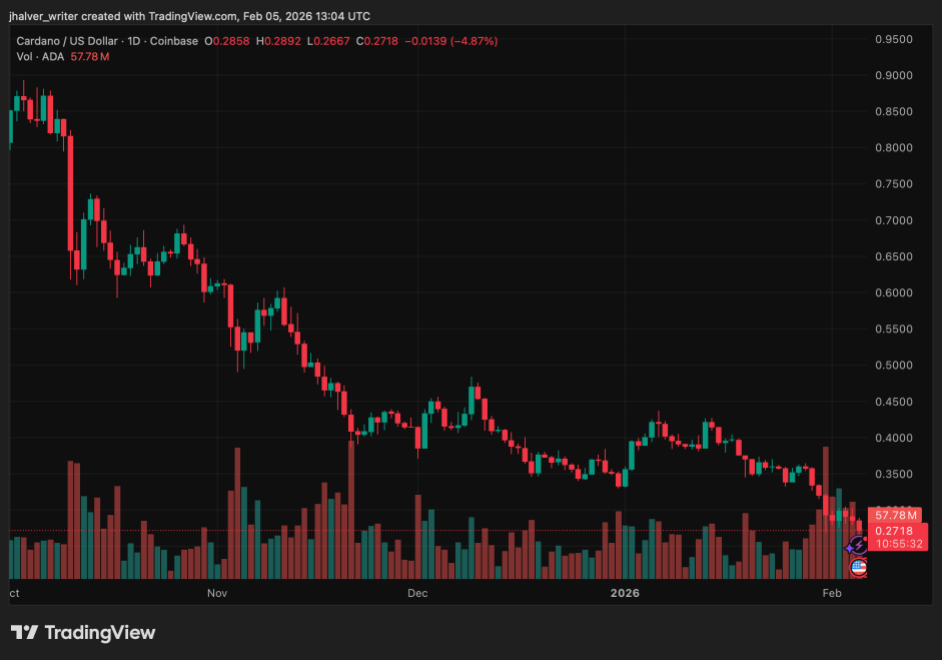
ADA's price trends to the downside on the daily chart. Source: ADAUSD on Tradingview

ETF Momentum Fades as Market Focus Narrows

One factor weighing on the Cardano price is the loss of relative ETF momentum. As institutional attention concentrates on assets with clearer regulatory narratives or active derivatives demand, ADA has slipped out of the spotlight.

Capital flows are rotating toward more liquid large-cap plays, leaving Cardano with diminished support during market stress. This dynamic is evident in Grayscale’s decision to drop Cardano from its CoinDesk Crypto 5 ETF in favor of BNB.

This shift mirrors patterns seen elsewhere in the market. XRP, for instance, has experienced heavy selling despite ETF-related products remaining active, highlighting that ETF presence alone is no longer enough to offset broader bearish sentiment.

For Cardano, which lacks the same level of derivatives activity or headline-driven catalysts, the impact is more pronounced. The result is a thinner order book and weaker follow-through on rebounds, making ADA more vulnerable to downside moves if risk appetite continues to deteriorate.

$0.29 Cardano Price Support Under Pressure

From a technical perspective, the $0.29 level has emerged as a critical zone for the Cardano price. This area has acted as a demand floor in recent months, but repeated tests have reduced its strength. Price action around this level shows buyers stepping in with less conviction, while sellers remain active on minor rallies.

If $0.29 fails to hold on a sustained basis, chart structure points to limited support until lower historical consolidation zones. Momentum indicators have also softened, aligning with the broader downtrend across altcoins as Bitcoin’s weakness drags sentiment lower.

Broader Market Signals Remain Cautious

On-chain and derivatives data across the crypto market continue to signal caution. Falling open interest, reduced spot buying, and muted activity from large holders suggest investors are prioritizing capital preservation over accumulation.

This environment leaves assets like Cardano exposed, particularly when bullish narratives fade.

For ADA to stabilize, the market would likely need a broader improvement in risk sentiment or a clear catalyst that draws fresh demand. Until then, the Cardano price forecast remains bearish, with traders watching closely to see whether the $0.29 support can hold or give way to another leg lower.

Cover image from ChatGPT, ADAUSD chart from Tradingview

Пов'язані питання

QWhat are the main factors contributing to the bearish Cardano (ADA) price outlook mentioned in the article?

AThe main factors are weakening market structure, fading ETF optimism, and broader crypto risk-off sentiment.

QWhy has Cardano (ADA) lost ETF momentum according to the article?

AInstitutional attention has concentrated on assets with clearer regulatory narratives or active derivatives demand, causing capital to rotate toward more liquid large-cap plays and leaving ADA with diminished support.

QWhat is the critical technical support level for the Cardano price, and why is it significant?

AThe critical technical support level is $0.29. It has acted as a demand floor, but repeated tests have weakened it, and a sustained break below could lead to a deeper correction with limited support until lower historical consolidation zones.

QHow did Grayscale's decision impact Cardano (ADA)?

AGrayscale dropped Cardano from its CoinDesk Crypto 5 ETF in favor of BNB, which is cited as an example of the diminishing institutional support and ETF momentum for ADA.

QWhat broader market signals suggest a cautious environment for cryptocurrencies like Cardano?

ABroader market signals include falling open interest, reduced spot buying, and muted activity from large holders, indicating that investors are prioritizing capital preservation over accumulation.

Пов'язані матеріали

Google TPU Shipments Revised Up by 50%

Recent industry research indicates a significant upward revision in the shipments of Google's TPU (Tensor Processing Unit) chips. Previous expectations for 2027 were set at around 10 million units, but new estimates now point to 15 million units, a 50% increase. This substantial boost directly translates to higher demand across the entire supporting supply chain. Google's TPU clusters utilize a standardized all-optical interconnect architecture. Consequently, key hardware components are deeply integrated and scaled in fixed ratios with the chips. The 15 million TPU target will drive corresponding demand increases for NPO optical engines (roughly a 1:1 match), 1.6T optical modules, OCS optical switches, high-end server power supplies, fiber optics & MPO connectors, and liquid cooling solutions. Among these, liquid cooling is highlighted as the sector experiencing the most significant transformation and offering the most stable potential for excess returns. As next-generation TPU chips reach power levels where traditional air cooling is insufficient, liquid cooling becomes essential. 2026 is forecasted as the first year of substantial adoption for Google's liquid cooling solutions. This shift, coupled with delivery and capacity bottlenecks faced by incumbent overseas manufacturers, is creating a prime window for domestic Chinese suppliers to enter and secure Google's core supply chain. The market size for Google-specific liquid cooling is projected to potentially triple from a baseline of hundreds of billions to around 300 billion units by 2028. The logic for the fiber optic sector is also being rewritten. Once considered a cyclical commodity tied to telecom operator procurement, fiber is now a strategic and scarce resource for AI Data Centers (AIDC). A severe supply-demand imbalance, driven by the long lead time for preform production (18-24 months) and surging demand from cloud giants, is supporting strong performance. Chinese fiber manufacturers are well-positioned to capture a significant share of global AIDC demand, with exports potentially reaching 200-300 million core kilometers in 2026. Overall, the investment focus within the AI computing industry is shifting from pure "chip performance speculation" towards the more certain incremental growth in computing infrastructure and its supporting ecosystem. The upward revision in Google TPU shipments, along with the potential for further doubling by 2028, is seen as solidifying performance visibility for the entire supporting supply chain over the next two years.

marsbit32 хв тому

Google TPU Shipments Revised Up by 50%

marsbit32 хв тому

What Wall Street Really Wants After the Crypto Story Recedes

The tide of speculative crypto narratives has receded, revealing Wall Street's true objective: building a controlled, yield-generating, and compliant financial pipeline on distributed ledgers. They are migrating core functions onto blockchains, not for decentralization, but for efficiency and new revenue streams. Key developments include BlackRock's BUIDL fund, a tokenized treasury fund acting as a foundational reserve asset, and the rise of Securitize, which is going public and partnering with the NYSE to build a 24/7 digital securities trading and settlement system. This signals a major shift of securities clearing to blockchain technology. To make volatile assets like Bitcoin palatable for institutional investors, firms like BlackRock and Goldman Sachs are creating "covered call" ETFs (e.g., BITA). These products systematically sell options on Bitcoin holdings, transforming price volatility into stable monthly income, effectively repackaging crypto as a yield-bearing asset. Stablecoins are being positioned not as speculative tools but as efficient payment rails. Companies like Stripe and Mastercard are integrating them for instant, low-cost merchant settlements and cross-border card payments, respectively. Critically, new legislation like the GENIUS Act shapes them as non-interest-bearing, heavily regulated extensions of the US dollar system. In summary, Wall Street is quietly constructing a parallel, blockchain-based financial infrastructure featuring tokenized traditional assets, structured crypto yields, and programmable dollar pipelines—all under its control and fully integrated with existing regulatory and credit frameworks.

marsbit49 хв тому

What Wall Street Really Wants After the Crypto Story Recedes

marsbit49 хв тому

Tying Itself to SpaceX: Cursor's $60 Billion Rise

This article recounts the rapid rise of AI-powered coding startup Cursor and its 25-year-old MIT graduate CEO, Michael Truell. Launched in 2023, Cursor achieved explosive growth, reaching over 10 billion USD in revenue by late 2025. However, its journey highlights a central dilemma for AI application companies: dependence on foundational model providers. Cursor initially relied heavily on Anthropic's models but faced an existential threat when Anthropic launched its own competing coding tool, Claude Code. In response, Cursor declared an internal emergency in early 2026 and accelerated development of its own model, Composer. To secure the immense computing power needed, Truell struck a pivotal deal with Elon Musk's SpaceX in April 2026. The collaboration grants Cursor access to SpaceX's supercomputing resources for Composer, while SpaceX's Grok model benefits from Cursor's programming data. The agreement includes a potential 600 billion USD acquisition of Cursor by SpaceX later in the year, though a substantial termination fee is in place if the deal falls through. The story explores Cursor's intense, sometimes controversial hiring practices involving lengthy unpaid "work trials," its complex partnership-turned-rivalry with Anthropic, and its high-stakes gamble to ensure independence through the SpaceX alliance. The core question remains: will Cursor evolve into a defining, independent "generational" software company, or become a key piece in a tech giant's AI arsenal?

marsbit53 хв тому

Tying Itself to SpaceX: Cursor's $60 Billion Rise

marsbit53 хв тому

Warsh's Debut: Will the FED Chair Who Knows Crypto Best Bring Surprises or Shocks to the Market?

Kevin Warsh, the new Federal Reserve Chairman, prepares for his inaugural press conference amidst a challenging macroeconomic landscape: resurgent inflation, a bond market sell-off, and political pressure from President Trump for rate cuts. Uniquely, Warsh holds indirect investments in over 20 crypto and Web3 entities (e.g., Solana, dYdX), making him the first Fed Chair with disclosed crypto exposure. His stance may combine a hawkish, inflation-focused monetary policy with a crypto-friendly regulatory philosophy that shifts from Powell’s “same risk, same rule” approach toward a framework acknowledging blockchain’s productivity value. Warsh’s leadership could impact crypto markets across three dimensions: a paradigm shift in regulation (potentially accelerating pro-innovation legislation and stable币 rules), a re-pricing of risk premiums based on clearer communication and his view of AI as a structural disinflationary force, and a long-term reallocation of global institutional capital driven by increased legitimacy. Two potential scenarios for the press conference are outlined. A “positive surprise” would involve a dovish-leaning tone on rates coupled with signals of regulatory openness, potentially boosting crypto asset valuations. Conversely, a “negative shock” would see a more hawkish-than-expected stance on inflation and rates, triggering a broad risk-asset selloff that crypto markets would not escape. While ethics rules required Warsh to divest his crypto holdings upon confirmation, his deep understanding of the technology may fundamentally lower policy uncertainty and build a more receptive long-term foundation for digital assets’ integration into the mainstream financial system.

marsbit11 год тому

Warsh's Debut: Will the FED Chair Who Knows Crypto Best Bring Surprises or Shocks to the Market?

marsbit11 год тому

Торгівля

Спот
Ф'ючерси

Популярні статті

Як купити ADA

Ласкаво просимо до HTX.com! Ми зробили покупку Cardano (ADA) простою та зручною. Дотримуйтесь нашої покрокової інструкції, щоб розпочати свою криптовалютну подорож.Крок 1: Створіть обліковий запис на HTXВикористовуйте свою електронну пошту або номер телефону, щоб зареєструвати обліковий запис на HTX безплатно. Пройдіть безпроблемну реєстрацію й отримайте доступ до всіх функцій.ЗареєструватисьКрок 2: Перейдіть до розділу Купити крипту і виберіть спосіб оплатиКредитна/дебетова картка: використовуйте вашу картку Visa або Mastercard, щоб миттєво купити Cardano (ADA).Баланс: використовуйте кошти з балансу вашого рахунку HTX для безперешкодної торгівлі.Треті особи: ми додали популярні способи оплати, такі як Google Pay та Apple Pay, щоб підвищити зручність.P2P: Торгуйте безпосередньо з іншими користувачами на HTX.Позабіржова торгівля (OTC): ми пропонуємо індивідуальні послуги та конкурентні обмінні курси для трейдерів.Крок 3: Зберігайте свої Cardano (ADA)Після придбання Cardano (ADA) збережіть його у своєму обліковому записі на HTX. Крім того, ви можете відправити його в інше місце за допомогою блокчейн-переказу або використовувати його для торгівлі іншими криптовалютами.Крок 4: Торгівля Cardano (ADA)Легко торгуйте Cardano (ADA) на спотовому ринку HTX. Просто увійдіть до свого облікового запису, виберіть торгову пару, укладайте угоди та спостерігайте за ними в режимі реального часу. Ми пропонуємо зручний досвід як для початківців, так і для досвідчених трейдерів.

994 переглядів усьогоОпубліковано 2024.12.10Оновлено 2026.06.02

Як купити ADA

Обговорення

Ласкаво просимо до спільноти HTX. Тут ви можете бути в курсі останніх подій розвитку платформи та отримати доступ до професійної ринкової інформації. Нижче представлені думки користувачів щодо ціни ADA (ADA).

活动图片