BP Price Soars 300% in 2 Weeks: What Is Backpack Betting On?

Foresight NewsОпубліковано о 2026-06-15Востаннє оновлено о 2026-06-15

Анотація

"BP, the native token of the Backpack exchange, surged over 300% in two weeks to $0.475, driven by the launch of its new regulated stock brokerage and asset tokenization arm, Backpack Securities. The platform enables users to trade U.S. stocks and tokenize them on Solana, with the SpaceX tokenized stock (SPCX) generating significant on-chain volume. This expansion into bridging traditional finance with DeFi aligns with the RWA narrative. BP's unique tokenomics, where 25% was airdropped at TGE with zero allocation to the team, and a staking mechanism allowing conversion to equity upon a company IPO, underpins its value proposition. Over 66% of the circulating supply is currently staked."


Author: Ma He, Foresight News


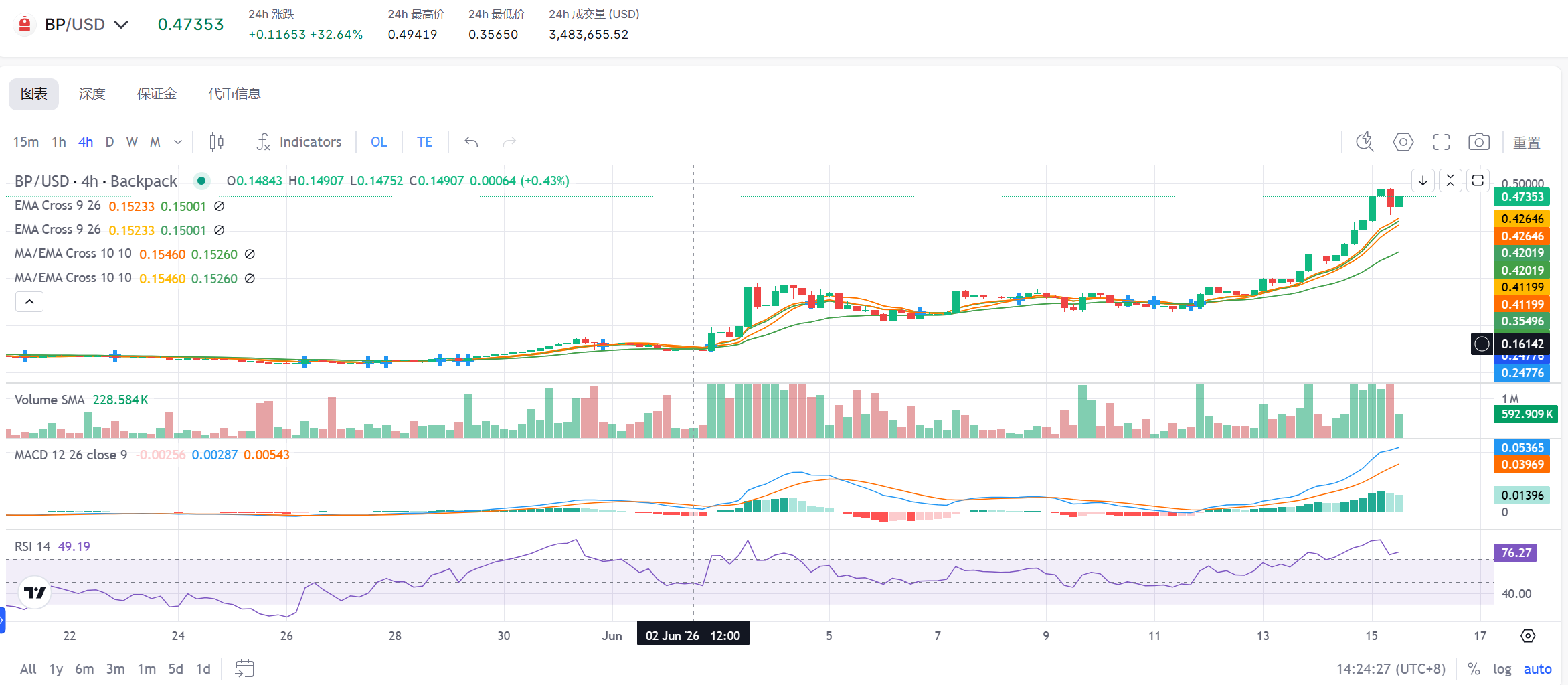
On June 15, the exchange token of Backpack, BP, surged over 30% again within 24 hours, currently quoted at $0.475, with a market cap of $118.48 million and an FDV of $473.94 million. BP has skyrocketed significantly from around $0.16 in early June this year, peaking above $0.48.


The immediate driving force behind this rally comes from the platform's latest breakthrough in traditional U.S. stock brokerage and asset tokenization services.


Entering U.S. Stock Brokerage and Tokenization Business


In March 2026, BP completed its TGE on Solana, with a total supply of 1 billion tokens and an initial circulating supply of 250 million. After listing, the price briefly hit a high before quickly retracing, with a single-day maximum drop exceeding 40%, filling the market with profit-taking pressure. For several weeks thereafter, the price consolidated at lower levels until the turn-around in early June.


On June 2, Backpack announced the launch of the Backpack Securities platform, which will offer regulated U.S. stock brokerage services while also supporting the tokenization of traditional stocks for circulation on the blockchain, enabling seamless conversion between traditional securities and on-chain assets. The brokerage services are planned for a gradual rollout in June, with initial tokenized products launched on the Solana ecosystem through a partnership with Sunrise. BP surged over 80% in a single day, rapidly climbing from the $0.14-0.15 range to around $0.27, with its market cap approaching $70 million at one point.


On June 12, the same day SpaceX listed on NASDAQ, its tokenized product SPCX went live on Solana. BP subsequently rose approximately 27% within the next 24 hours, reaching above $0.347. This token is pegged 1:1 to real SpaceX shares, supports 24/7 on-chain trading, and can be redeemed to a traditional securities account via Backpack's brokerage account, achieving interoperability between on-chain and off-chain assets. On its first day, the product generated approximately $35-38 million in on-chain trading volume across DEXs like Jupiter and Raydium. According to the latest official data, the total on-chain trading volume for SPCX exceeded $86 million.
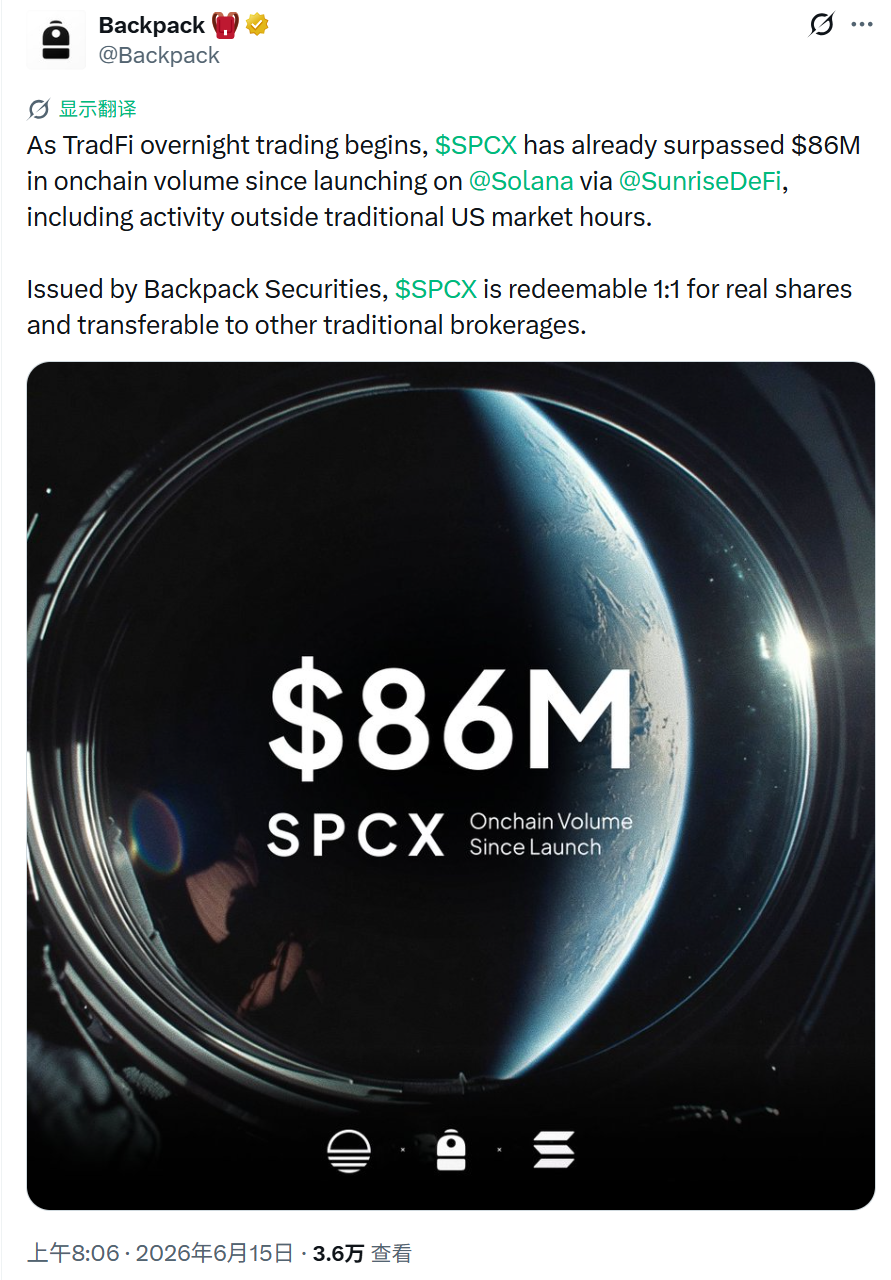


Backpack is building a bridge between traditional U.S. stocks and Solana DeFi. Users can not only trade crypto assets on the platform but also access real stocks through the same account, and tokenize some of those assets for on-chain use, trading, or composability. This path aligns well with the current RWA narrative and has also provided the BP token with clearer use cases and demand support.
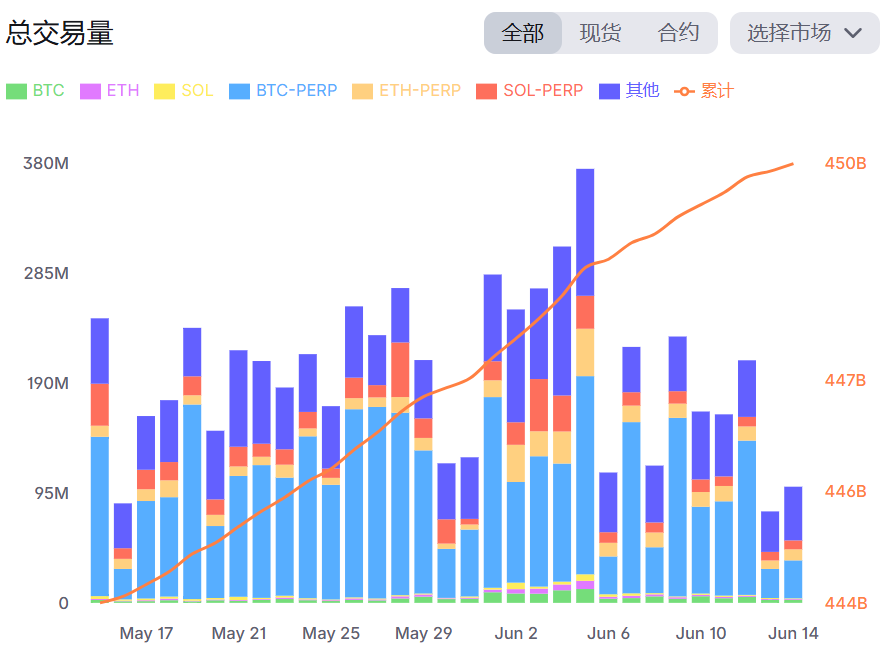


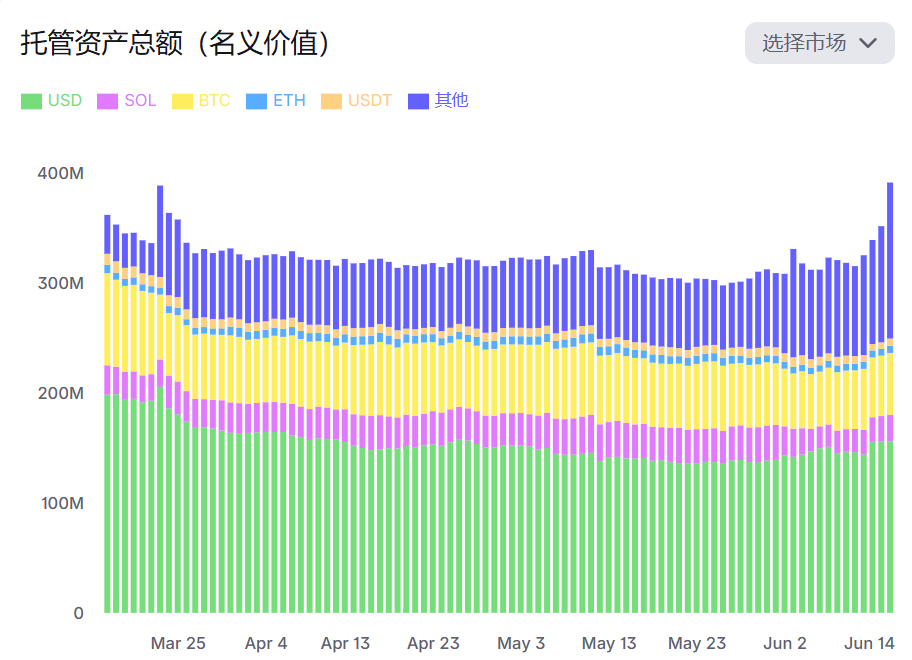
BP's rise this round stems more from the substantial expansion of the platform's business rather than short-term hype. Currently, its official website shows that Backpack's Total Custodied Assets (nominal value) has rebounded to $390 million.

Team Receives Zero Tokens Unless the Company Goes Public


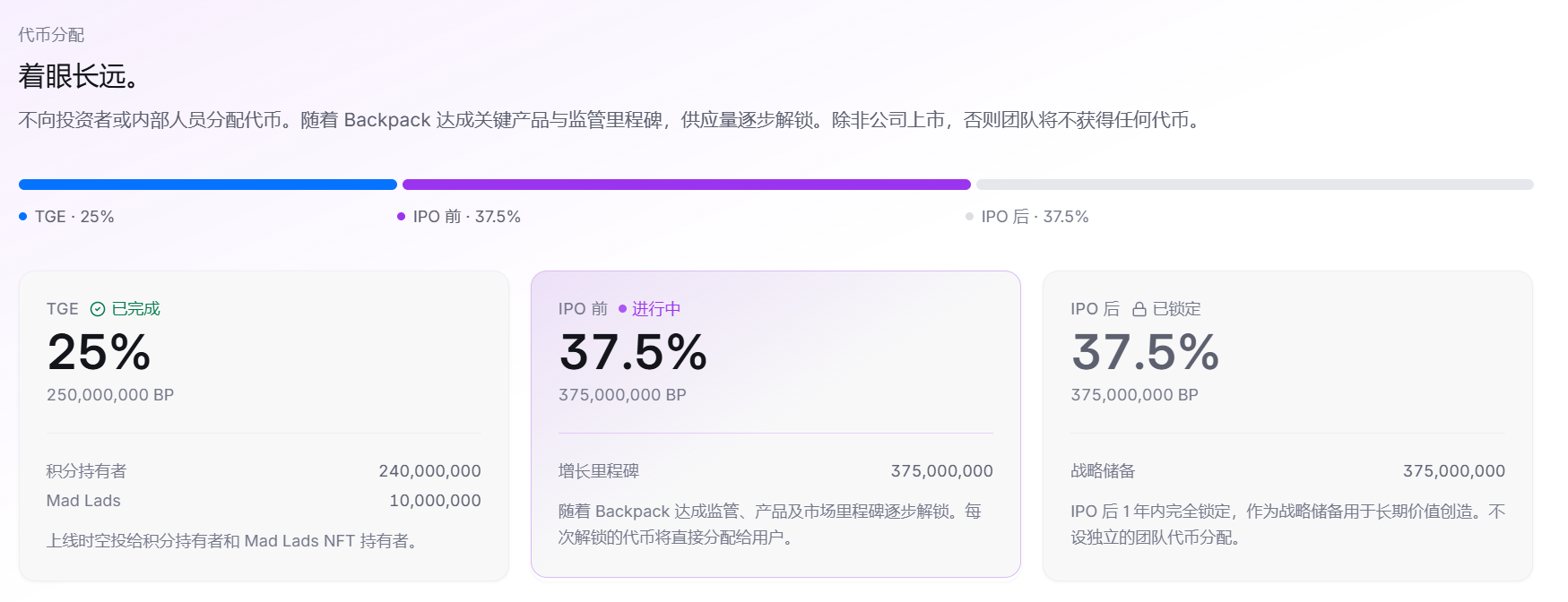
Supporting the development of the above business is the BP token and its unique economic structure launched by Backpack as early as March. The total supply of 1 billion tokens is divided into three phases: The TGE phase allocates 25% (250 million tokens) entirely to community users via airdrop, with approximately 240 million given to Points Program participants and 10 million to Mad Lads NFT holders. At launch, the team, founders, and investors received zero token allocation; The Pre-IPO phase allocates 37.5%, tied to growth triggers like regulatory milestones and product launches, and continues distribution to users upon unlocking; The Post-IPO phase allocates 37.5% to the company treasury, locked for at least one year post-IPO, with the team benefiting only through equity, not directly from tokens.


The most notable mechanism is the equity conversion design: Users staking BP for at least 1 year gain the right to convert their tokens into company equity upon an IPO or acquisition, with the base unlock bonus increasing with holding time up to the 4th year.


Additionally, staking grants benefits such as tiered trading fee discounts, extra yield on USD collateral, free wire transfers, and priority access to the Backpack Card. Currently, about 66% (approximately 165 million tokens) of the circulating supply is staked.


Although the airdrop process was technically smooth, it sparked community discussion. Supporters argued that the "no insider TGE allocation" model was quite radical, and the points system genuinely rewarded trading and ecosystem participation; criticism centered on the relatively strict Sybil filtering mechanism, which led to some long-term users having their points invalidated and receiving less than expected, as well as noticeable profit-taking during the post-listing price correction. CEO Armani Ferrante publicly denied allegations related to team OTC selling.


These controversies affected market sentiment in the short term, but as real products like Backpack Securities land, the focus is gradually shifting from distribution details to the platform's long-term growth and the token's actual utility. Against the backdrop of the platform's expansion into U.S. stock brokerage and tokenization services, the long-term alignment value of BP's staking and equity mechanisms is being re-examined.


Пов'язані питання

QWhat is the primary driver behind the recent surge in Backpack Exchange's BP token price?

AThe primary driver behind the recent surge in BP token price is the platform's expansion into traditional U.S. stock brokerage and asset tokenization services, particularly the launch of Backpack Securities and the tokenization of SpaceX shares (SPCX).

QWhat key feature of the BP token's economic structure aims to align long-term user and platform interests?

AA key feature is the equity conversion design: users who stake BP for at least one year gain the right to convert their tokens into company equity during an IPO or acquisition, with the conversion bonus increasing up to the fourth year of staking.

QWhat was a significant immediate market reaction following the launch of the tokenized SpaceX (SPCX) product?

AA significant immediate market reaction was that BP's price rose approximately 27% within 24 hours after the SPCX tokenized product launched on Solana on June 12, coinciding with SpaceX's Nasdaq IPO.

QAccording to the article, what portion of the initially circulating BP token supply was allocated to the team, founders, and investors at TGE (Token Generation Event)?

AAccording to the article, 0% of the BP tokens were allocated to the team, founders, and investors at the TGE. The entire initial circulating supply of 250 million tokens (25% of total supply) was airdropped to the community.

QWhat is the total supply of BP tokens and what percentage is designated for the 'Post-IPO' stage to be held in the company treasury?

AThe total supply of BP tokens is 1 billion. 37.5% of the total supply is designated for the 'Post-IPO' stage and will enter the company treasury, locked for at least one year after an IPO.

Пов'язані матеріали

Now the Greatest Regret Is to My Family: Crypto Experts Took a Stumble in the Stock Market

Summary: This article examines the significant losses recently suffered by cryptocurrency traders and influencers who ventured into the stock market, specifically by heavily investing in AI-related and semiconductor storage stocks. The narrative centers on the dramatic reversal in the Korean and US equity markets in late July, with stocks like SK Hynix and related leveraged ETFs experiencing historic plunges, erasing massive gains. The analysis highlights several key factors behind the "flip." Traders, accustomed to crypto's high volatility and frustrated by a stagnant market, chased the apparent momentum in AI-themed equities. Many made fatal mistakes: applying high-leverage strategies common in crypto (e.g., 2x ETFs, on-chain perpetual contracts) to stocks, and failing to understand the distinct rules of different stock markets (like Korean pre-market trading). This led to widespread liquidations, especially when a thin Korean pre-market trade triggered a cascading flash crash on a decentralized exchange. Post-crash reflections from prominent figures reveal deep regret and self-criticism. They acknowledge misjudging their expertise, overestimating their edge against sophisticated institutional players, and the dangers of leverage. The article concludes that while such setbacks are part of trading, surviving long-term requires recognizing one's limitations and the inherent risks of cross-market strategies.

marsbit19 хв тому

Now the Greatest Regret Is to My Family: Crypto Experts Took a Stumble in the Stock Market

marsbit19 хв тому

US Senate Makes Important Amendments to "Conflict of Interest" Section of Cryptocurrency Bill

The U.S. Senate has taken a key step regarding the CLARITY Act, which could shape the future of the U.S. crypto market. On July 29, Senators Tom Tillis and Ruben Gallego finalized amendments to the bill's "conflict of interest" rules, one of its most contentious aspects. The bipartisan bill aims to tighten restrictions on high-level federal officials' ties to digital assets. The new text, crafted as an alternative to a White House-endorsed ethics code, is expected to impose stricter rules limiting officials' ability to issue or directly participate in digital asset projects. However, with Congress entering an August recess and the revised text not yet reviewed by much of the Senate, the bill's timeline is uncertain. Senate Majority Leader John Thune indicated a procedural vote could occur between July 29 and August 1 but expressed doubt the full bill could pass before the break. The House-approved CLARITY Act, passed in July 2025, has been under Senate negotiation for over a year. Key goals of the CLARITY Act include clarifying jurisdictional boundaries between the SEC and CFTC, setting rules for digital commodity spot markets, and addressing topics like stablecoin yields, DeFi, and illicit financing. The stablecoin yield provisions could significantly impact U.S.-based DeFi protocols, exchanges, and issuers, affecting their global competitiveness. The outcome is being closely watched by both the U.S. and global digital asset markets.

cryptonews.ru1 год тому

US Senate Makes Important Amendments to "Conflict of Interest" Section of Cryptocurrency Bill

cryptonews.ru1 год тому

Pavel Durov Designated as a Terrorist in Russia. What Does This Mean for Telegram Users?

Pavel Durov, the founder of Telegram, has been added to Russia's list of terrorists and extremists by Rosfinmonitoring, as published on July 30. The entry includes his name and date of birth. The designation follows an announcement by the Russian Federal Security Service (FSB) on July 29, which charged Durov with aiding terrorist activity. The FSB alleges that a Telegram dating bot named "DaiVinchik" was used to recruit 46 individuals for attacks on police and arson, orchestrated by Ukrainian special services. The FSB also accuses Telegram's administration of failing to remove channels and bots used by Ukrainian intelligence and extremist groups. Durov is reportedly subject to an international arrest warrant. Inclusion on the Rosfinmonitoring list leads to significant restrictions: the freezing of Durov's bank accounts and assets, severe limitations on financial transactions, and a ban on election participation, media interaction, and event organization. Transfers to his accounts may be considered terrorism financing. For ordinary Russian Telegram users, purchasing Telegram Premium is not classified as financing terrorism, according to an IT expert. General use of the messenger—messaging, managing channels—does not automatically make a user a participant in extremist activity. There has been no official decision to ban Telegram itself. It is noted that French authorities are also investigating Durov over allegations of inadequate measures against criminal activity on the platform and insufficient cooperation with law enforcement. Durov denies all charges.

cryptonews.ru1 год тому

Pavel Durov Designated as a Terrorist in Russia. What Does This Mean for Telegram Users?

cryptonews.ru1 год тому

Торгівля

Спот
活动图片