Now the Greatest Regret Is to My Family: Crypto Experts Took a Stumble in the Stock Market

marsbitОпубліковано о 2026-07-30Востаннє оновлено о 2026-07-30

Анотація

Summary: This article examines the significant losses recently suffered by cryptocurrency traders and influencers who ventured into the stock market, specifically by heavily investing in AI-related and semiconductor storage stocks. The narrative centers on the dramatic reversal in the Korean and US equity markets in late July, with stocks like SK Hynix and related leveraged ETFs experiencing historic plunges, erasing massive gains. The analysis highlights several key factors behind the "flip." Traders, accustomed to crypto's high volatility and frustrated by a stagnant market, chased the apparent momentum in AI-themed equities. Many made fatal mistakes: applying high-leverage strategies common in crypto (e.g., 2x ETFs, on-chain perpetual contracts) to stocks, and failing to understand the distinct rules of different stock markets (like Korean pre-market trading). This led to widespread liquidations, especially when a thin Korean pre-market trade triggered a cascading flash crash on a decentralized exchange. Post-crash reflections from prominent figures reveal deep regret and self-criticism. They acknowledge misjudging their expertise, overestimating their edge against sophisticated institutional players, and the dangers of leverage. The article concludes that while such setbacks are part of trading, surviving long-term requires recognizing one's limitations and the inherent risks of cross-market strategies.

"Now, the greatest regret is to my family."

Lately, the frequency of hearing this phrase is no less than that of "Do you believe in the light?" and "You should stand in the light, not let the light stand there" from two months ago.

These two short sentences encapsulate a 180-degree reversal in the market and a landscape of shattered hearts.

According to public data, South Korean stock SK Hynix has halved from its June high, erasing over 1,000 trillion won (approximately $800 billion) in market capitalization. The KOSPI index has retreated about 30% from its peak and has experienced 9 trading halts this year.

On July 28th, SK Hynix fell over 10%. U.S. memory stocks also plunged collectively, with SanDisk, Western Digital, Seagate, and Micron dropping 8% to 13% in a single day.

On July 29th, SK Hynix fell sharply again, dropping nearly 20% intraday, while a 2x long Hynix ETF plummeted over 30%, both setting their largest single-day declines in history.
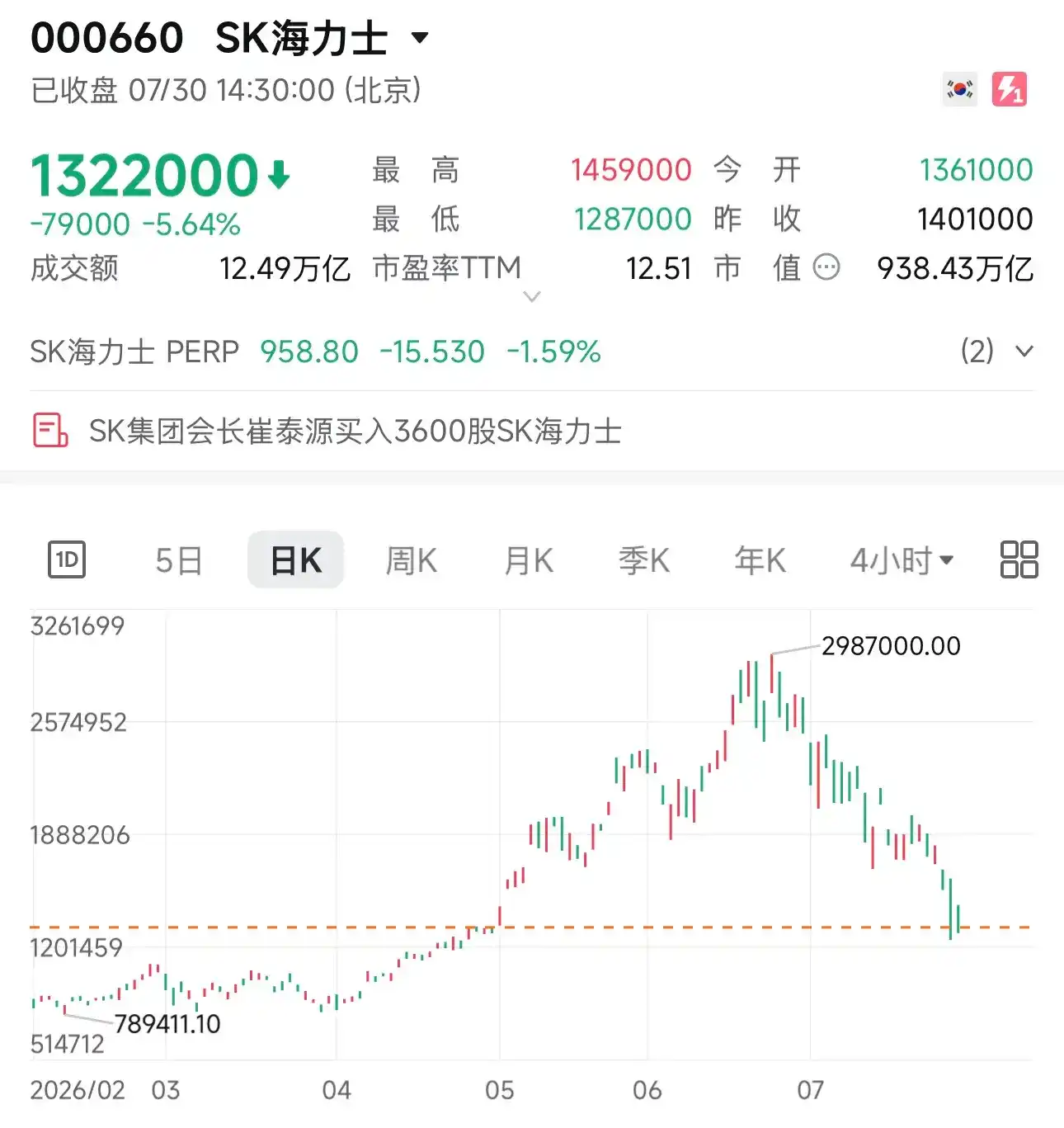
A cross-market bloodbath thus unfolded. The extreme volatility flushed out numerous big V's and traders from the crypto circle. Among them were those who had earned their first pot of gold in the crypto market and those who had already achieved financial freedom. Now, all that's left are reflections and declarations of leaving the scene.
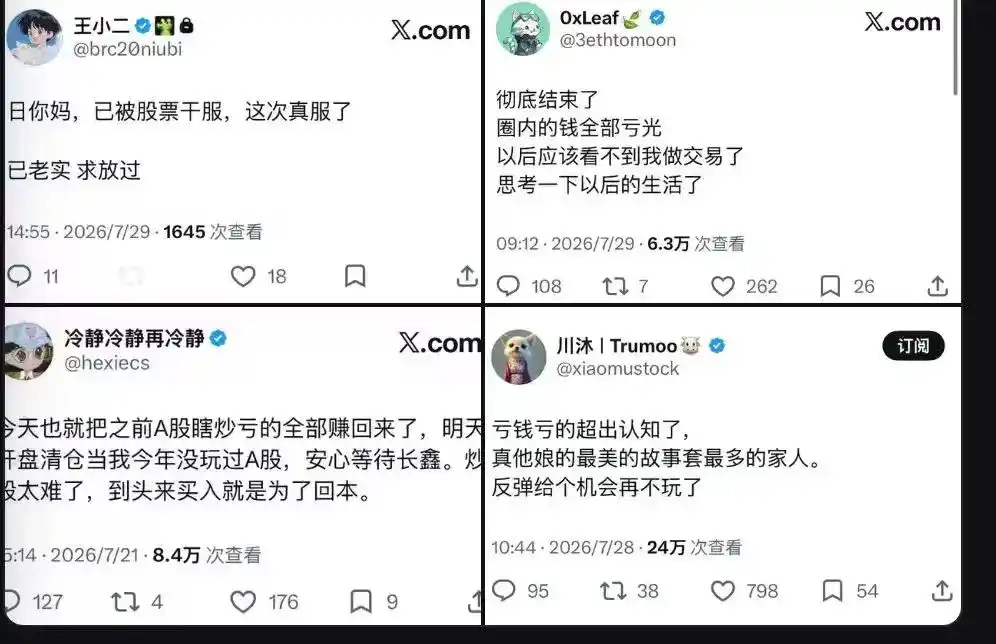
Half Market Conditions, Half Human Nature

Perhaps because the crypto market had been too quiet for too long, memory stocks became the best destination for active capital.

Dp Dapeng (@Dp520888) posted that from the end of last year to the first half of this year, the crypto market was in a constant downtrend. Bitcoin barely caught its breath around $60,000, while South Korean and U.S. stock markets soared on the AI narrative during the same period. Major exchanges, in their efforts to expand markets, had also opened up stock trading access.

He noted that he saw many crypto peers painfully cut losses on their crypto assets and go all-in on Micron and SanDisk at highs, only to lose over 30% subsequently. Had this money stayed in crypto, they could have at least held on until Bitcoin fell to $40,000.

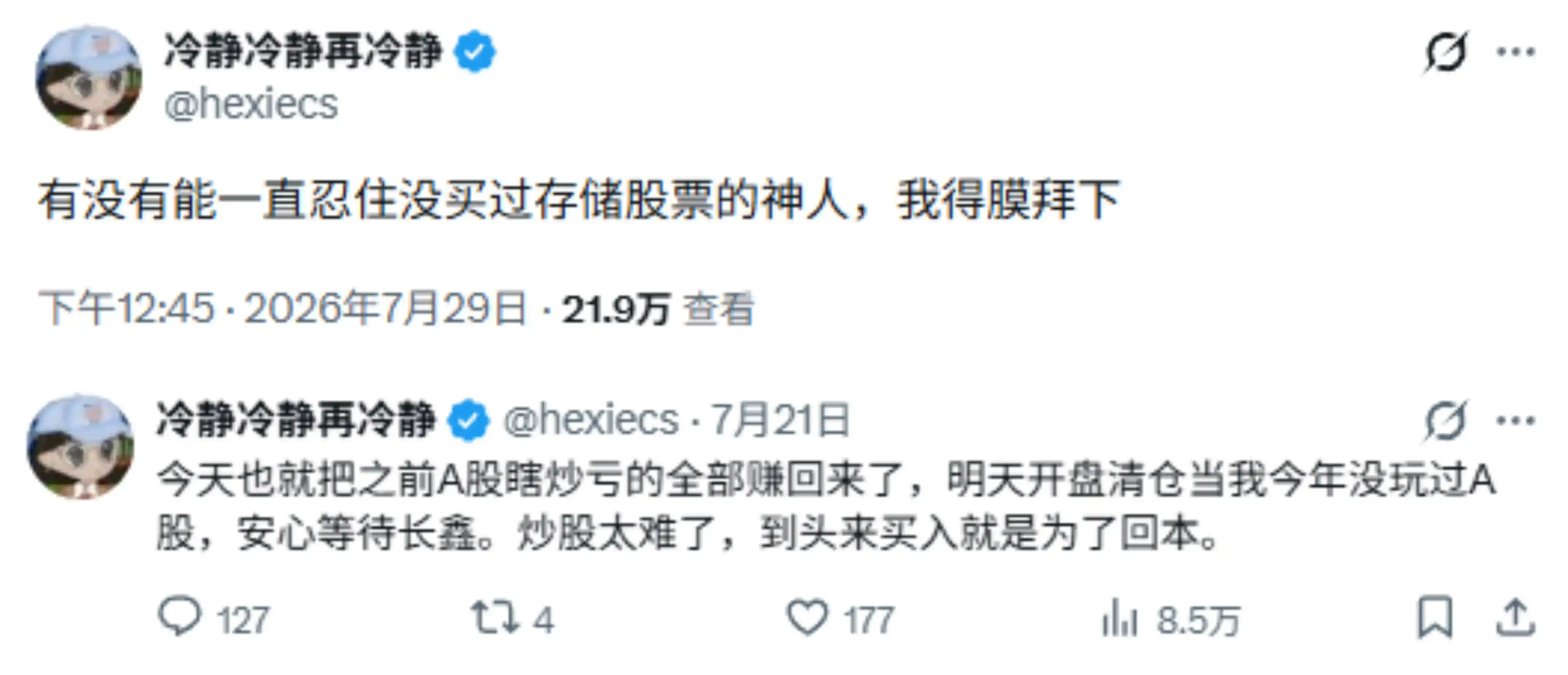
People accustomed to high volatility and tormented by the lack of profit-making opportunities for over half a year found it hard to resist chasing the market that seemed more lucrative. As @hexiecs posted, "Is there any god who has always resisted buying memory stocks? I need to worship them."
However, narratives like AI, GPU, and storage come and go quickly in capital markets. Nvidia's stock price peaked in May and has already wiped out this year's gains, with its total market cap recently overtaken again by Apple. Now it's just storage's turn.

So, the starting point of this crash is half market conditions, half human nature.

Why the Crash This Time?

People transitioning from the crypto circle to the stock market are prone to culture shock.

On one hand, it's the leverage habit. Many start with 2x long positions or add even higher leverage via on-chain perpetual contracts. The same bearish candle that represents a mere pullback in a spot account becomes a liquidation event in a leveraged account.

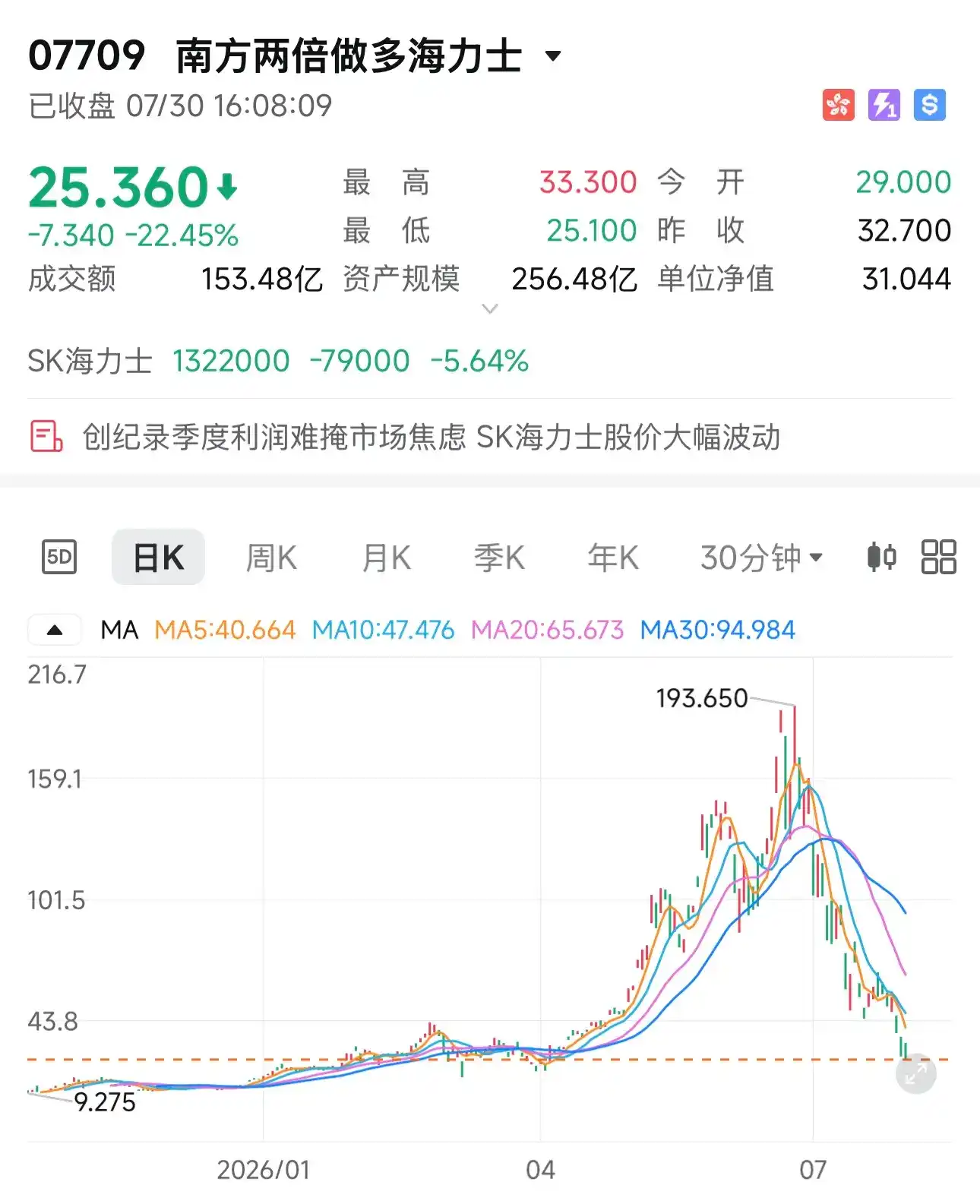
How severe the damage to leveraged products was this round can be seen by looking at the South Korean 2x Long Hynix ETF. This fund was once the world's largest single-stock leveraged product, with peak assets around 130 billion HKD. Its cumulative decline since July has exceeded 80%, with assets now down to 25.6 billion HKD. Another 2x Long Samsung Electronics ETF also fell about 70% this month.
According to Hyperliquid data, on July 29th, the combined 24-hour trading volume for Hynix-related contracts SKHX and SKHY on the platform reached $1.765 billion, becoming the most actively traded asset on the platform, with heat and volume even surpassing BTC.

On the other hand, it's the rule differences. The stock market itself has several sets of rules: U.S. stocks have after-hours trading, South Korean stocks have NXT pre-market, A-shares have price limits, Hong Kong stocks have another set, each with its own trading hours, price bands, and settlement rhythms.

When these underlying assets are packaged into on-chain perpetual contracts, the extreme rules of other markets are bundled in as well. The wick on Hyperliquid on July 28th is a living example.

It is reported that on that day, only one lot of SK Hynix traded in the South Korean pre-market at around $868, about 30% lower than the previous close, right near the lower limit of the price band. This less than $900 real transaction was fed into the chain via the oracle, causing the SKHX perpetual contract to flash crash about 18% in one minute.

According to on-chain data, approximately $80 million was liquidated in the subsequent four hours, with open interest evaporating about $150 million.
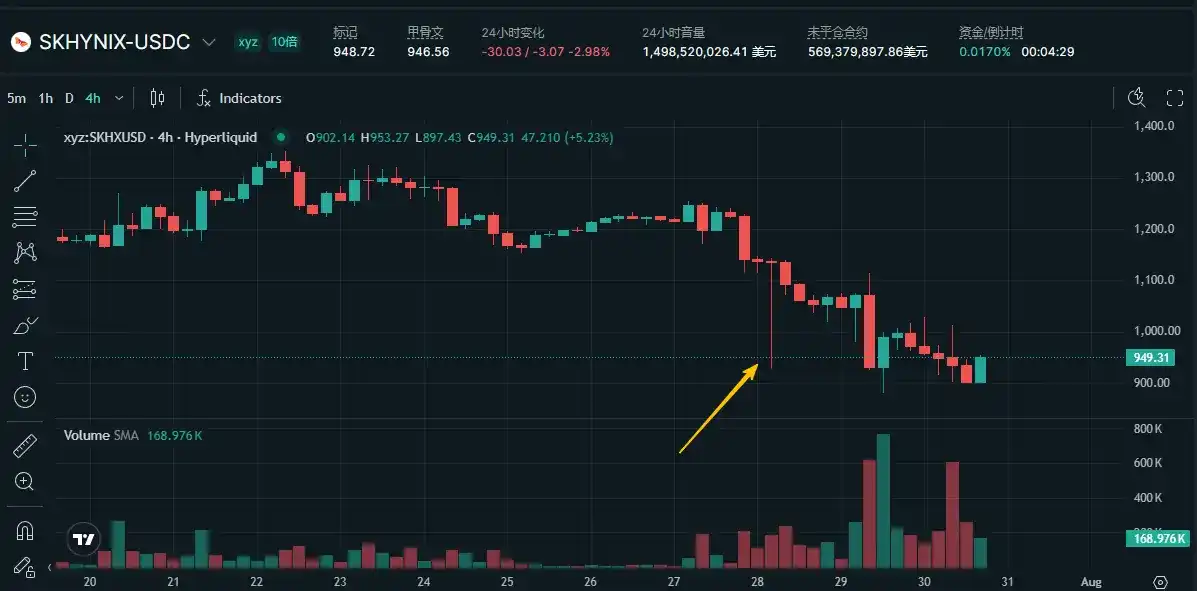
Trade.xyz announced that this price was synchronized from that real transaction in the South Korean pre-market, with the oracle operating according to specifications and no technical error. Although Trade.xyz decided to fully compensate for the liquidation losses this time, it specifically stated this does not constitute a guarantee for similar situations in the future.

Reflections After the Bloodbath

After this bloodbath, many big V's on X began to reflect. Their review focus largely fell on whether the methods they had relied on to make money over the years were still effective after switching markets.

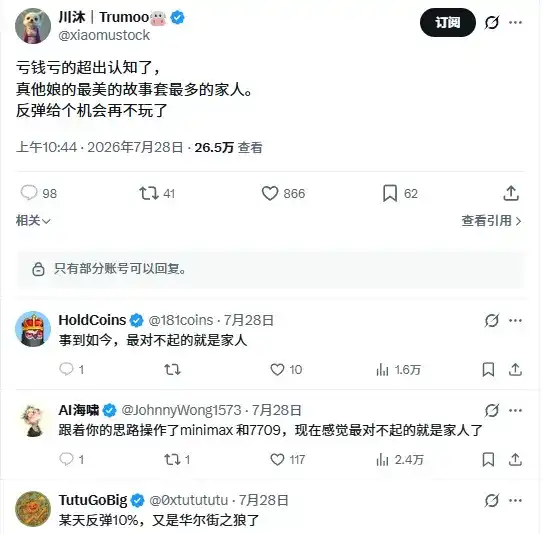
Chuanmu (@xiaomustock) stated that he made and lost money on storage stocks this year. The reason Buffett has survived in the capital market for so long is inseparable from his style of avoiding leverage, not going all-in, and always holding significant idle cash. Ordinary people either lose sleep from anxiety over using leverage to get rich quickly, or continue using leverage after making money, anxious in both profit and loss.
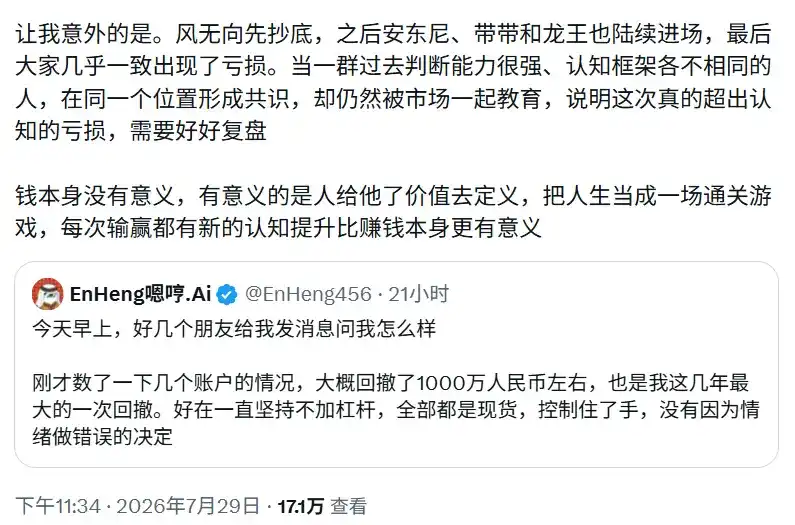
KOL En Heng (@EnHeng456) recounted his three major losses since entering the industry, with this storage wave being the heaviest, resulting in a combined drawdown of over ten million across several accounts, but fortunately, it was all spot trading with no leverage.

He also pointed out that multiple traders with consistently strong judgment and different cognitive frameworks successively entered the market, yet almost all ended up losing. When such a group forms a consensus at the same position but is collectively taught a lesson by the market, it indicates that this loss indeed exceeded their original understanding.
Zishi (@silverfang888), who claimed to have been liquidated for $20 million in semiconductors, also said his biggest regret was moving from crypto to trading stocks. In his view, he is merely a crypto player with limited insight, sitting across from people in the U.S. stock market arena whose cognition and capital far surpass his own.

After being liquidated, many fell into intense self-negation, attributing the losses of these months to their own shallow insight and low cognition. The concentrated outbreak of such emotions also serves as a reminder to everyone using leverage as an amplifier: what the market takes is never just the principal.

Some offered comfort, saying whose trading career hasn't experienced a few such drawdowns? Money lost can be treated as tuition paid. As long as one is still here with spirit intact, there will always be another journey ahead.

In truth, there are very few who can consistently win in the market. Those who can journey a bit further are often those who can still see their own boundaries at different stages.


Трендові криптовалюти

Пов'язані питання

QAccording to the article, what is the main reason behind the significant losses of crypto traders in the stock market?

AThe main reasons are a combination of market conditions and human nature. Crypto traders, accustomed to high volatility, moved to the AI-driven stock market for better returns. However, they faced issues like improper use of leverage and unfamiliarity with the different trading rules of stock markets (like pre-market sessions and price bands), which led to severe losses when the storage sector crashed.

QHow did the specific event on Hyperliquid on July 28th cause major liquidations?

AOn July 28th, a single SK Hynix share traded for around $868 in the Korean pre-market, about 30% lower than the previous close. This price, fed into the chain via an oracle, caused the SKHX perpetual contract on Hyperliquid to flash-crash by about 18% in one minute. This led to approximately $80 million in liquidations and a $150 million drop in open interest over the next four hours.

QWhat is one key trading habit from the crypto world that proved detrimental in the stock market?

AOne key detrimental habit was the immediate use of high leverage. Many traders started with 2x leveraged ETFs or even higher leverage on perpetual contracts. This meant that a price decline that would be a simple drawdown in a spot account resulted in margin calls and liquidations in leveraged positions.

QWhat major reflection did trader '川沐' (@xiaomustock) share after the losses?

ATrader '川沐' reflected that his gains and losses this year both came from the storage sector. He noted that Warren Buffett's longevity in the market is tied to his style of avoiding leverage, not going all-in, and always keeping a large amount of cash on hand. In contrast, ordinary people either lose sleep over leverage-driven anxiety to get rich or continue using leverage after profits, leading to anxiety in both winning and losing.

QWhat was the final attitude or lesson some traders expressed after the market crash?

AAfter the crash, some traders expressed a lesson in humility and recognizing one's boundaries. They acknowledged that moving from the crypto circle to the stock market meant competing against players with far superior knowledge and capital. While some fell into self-doubt, others offered comfort, stating that such drawdowns are part of a trading career, and as long as one's spirit remains, there will always be another opportunity.

Пов'язані матеріали

In Conversation with Ray Dalio: We Are Currently in an AI Bubble, with 1% of My Portfolio in Bitcoin

Ray Dalio, founder of Bridgewater Associates, warns in an interview that the current AI boom shows classic bubble characteristics, which could lead to significant economic downturns as seen in past cycles like 1929 or 2000. He explains that speculative enthusiasm, fueled by debt and overvaluation, often precedes a crash when rising rates or taxation force asset sales, causing widespread losses and recession. Dalio also outlines his "Big Cycle" theory, describing an approximate 80-year pattern where widening wealth gaps, massive government deficits, and shifting geopolitical power (like China's rise) create internal conflict and global instability. He emphasizes that we are in a late-cycle, transitional phase where traditional powers like the US and UK face decline. For personal wealth protection, Dalio advises diversification beyond cash into assets like stocks, bonds, real estate, and particularly gold, which he prefers over Bitcoin. While he holds about 1% of his portfolio in Bitcoin as a non-printable hard asset, he views gold as more secure from technological or governmental threats. Regarding AI's impact, Dalio believes it will disproportionately benefit capital owners, worsening inequality by replacing both physical and cognitive labor. He suggests that human intuition and emotional intelligence, combined with AI, will be key for future workers. On taxation, Dalio argues that wealth taxes are impractical and risk triggering asset sell-offs, reducing productive investment. He points to the UK as a cautionary example of debt, low productivity, and political strife. Geopolitically, Dalio foresees a more regionalized world, with the US showing weakness in prolonged conflicts like with Iran, akin to past imperial declines. The ideal outcome, he suggests, is coexisting powerful blocs (e.g., Americas, China-Asia Pacific) without major war.

marsbit1 год тому

In Conversation with Ray Dalio: We Are Currently in an AI Bubble, with 1% of My Portfolio in Bitcoin

marsbit1 год тому

Daily 7.2 Trillion KRW: Foreign Capital's Record Net Buying on Friday! Wall Street Says Headwinds for Korean Stock Fund Flows Have Subsided

South Korean stock market sees a dramatic shift in fund flows. On July 31, foreign investors made a record net purchase of approximately KRW 7.2 trillion in KOSPI stocks, marking a fundamental reversal from the persistent large-scale net outflows seen in previous months. This contributed to a significant narrowing of foreign net selling in July to KRW 9.8 trillion, down sharply from KRW 48.4 trillion in June and KRW 44.5 trillion in May. Simultaneously, domestic institutional pressure eased. South Korean pension funds and asset managers turned to a net buying position in July, purchasing KRW 1.0 trillion worth of KOSPI shares, contrasting with net sales in May and June. Market volatility is expected to be dampened by new financial regulations. Effective July 31, the Financial Services Commission tightened access for retail investors to single-stock leveraged ETFs by raising the minimum cash deposit requirement. Trading volumes for these products subsequently dropped to about 50% of their monthly average. Citigroup Research maintains its year-end KOSPI target of 10,000 points. The firm cites several supportive factors: the substantial easing of headwinds from capital outflows, a robust fundamental outlook for the semiconductor sector, historically low market valuations, strong economic fundamentals, and the potential for policy support from financial authorities if needed.

marsbit1 год тому

Daily 7.2 Trillion KRW: Foreign Capital's Record Net Buying on Friday! Wall Street Says Headwinds for Korean Stock Fund Flows Have Subsided

marsbit1 год тому

Thanks to Dice Rolls, Bitcoin Keys Are Stored Offline, But Not Everyone Will Do It

The article discusses using dice rolls to generate secure Bitcoin wallet seeds, providing entropy independent of potentially flawed hardware random number generators. It explains that each fair dice roll offers about 2.585 bits of entropy, with around 50 rolls needed for a standard 12-word seed phrase and 99+ recommended for higher security. This method gained attention after a vulnerability was revealed in some Coldcard hardware wallets, where a faulty firmware RNG (dating back to 2021) compromised generated keys. The analysis notes that while a dice-generated main seed was safe from this specific flaw, other Coldcard functions (like creating paper wallets, backup keys, or passwords) could still be vulnerable if they used the defective RNG. The piece argues that while dice-based entropy is technically robust, the manual process is error-prone, tedious, and unrealistic for most new users, who might make mistakes in recording or inputting rolls. It concludes that while manual entropy generation should remain an option for advanced users, the long-term goal is to develop reliable, user-friendly hardware and software that securely generates randomness without requiring specialized knowledge. Coldcard users are advised to check their firmware version and replace any secondary secrets (like paper wallet keys) created with vulnerable devices, while also considering multi-signature setups with devices from different manufacturers for added security.

cryptonews.ru6 год тому

Thanks to Dice Rolls, Bitcoin Keys Are Stored Offline, But Not Everyone Will Do It

cryptonews.ru6 год тому

Торгівля

Спот

Популярні статті

Як купити T

Ласкаво просимо до HTX.com! Ми зробили покупку Threshold Network Token (T) простою та зручною. Дотримуйтесь нашої покрокової інструкції, щоб розпочати свою криптовалютну подорож.Крок 1: Створіть обліковий запис на HTXВикористовуйте свою електронну пошту або номер телефону, щоб зареєструвати обліковий запис на HTX безплатно. Пройдіть безпроблемну реєстрацію й отримайте доступ до всіх функцій.ЗареєструватисьКрок 2: Перейдіть до розділу Купити крипту і виберіть спосіб оплатиКредитна/дебетова картка: використовуйте вашу картку Visa або Mastercard, щоб миттєво купити Threshold Network Token (T).Баланс: використовуйте кошти з балансу вашого рахунку HTX для безперешкодної торгівлі.Треті особи: ми додали популярні способи оплати, такі як Google Pay та Apple Pay, щоб підвищити зручність.P2P: Торгуйте безпосередньо з іншими користувачами на HTX.Позабіржова торгівля (OTC): ми пропонуємо індивідуальні послуги та конкурентні обмінні курси для трейдерів.Крок 3: Зберігайте свої Threshold Network Token (T)Після придбання Threshold Network Token (T) збережіть його у своєму обліковому записі на HTX. Крім того, ви можете відправити його в інше місце за допомогою блокчейн-переказу або використовувати його для торгівлі іншими криптовалютами.Крок 4: Торгівля Threshold Network Token (T)Легко торгуйте Threshold Network Token (T) на спотовому ринку HTX. Просто увійдіть до свого облікового запису, виберіть торгову пару, укладайте угоди та спостерігайте за ними в режимі реального часу. Ми пропонуємо зручний досвід як для початківців, так і для досвідчених трейдерів.

559 переглядів усьогоОпубліковано 2024.12.10Оновлено 2026.06.02

Як купити T

Обговорення

Ласкаво просимо до спільноти HTX. Тут ви можете бути в курсі останніх подій розвитку платформи та отримати доступ до професійної ринкової інформації. Нижче представлені думки користувачів щодо ціни T (T).

活动图片












