Bitcoin Short-Term Bullish Structure Validated, HYPE Accumulation Window Opens | Guest Analysis

marsbitОпубліковано о 2026-06-15Востаннє оновлено о 2026-06-15

Анотація

**Bitcoin and HYPE Market Analysis: Short-Term Outlook and Trading Strategies** This market analysis examines Bitcoin (BTC) and HYPE amid volatile conditions, providing short-term outlooks and specific trading strategies. **Key Outlooks:** * **Bitcoin (BTC):** Focus is on whether BTC's recent move above $65,000 holds. A successful breakout could lead to a test of the $69,500-$70,500 resistance zone, where medium-term short positions are considered. A failure, breaking below $65,000, may trigger a decline towards the $59,000-$60,000 support area. * **HYPE:** The token completed a four-wave correction and is now rebounding. The key resistance zone is $62.5-$64.57. The trading strategy is "buy on dips," looking for entry opportunities near the $52-$54.5 or deeper $47-$49 support zones, pending confirmation from proprietary models. **BTC Trading Strategy:** * **Medium-term:** Primarily looking to establish short positions (up to 60% allocated capital) if price rallies to the $69,500-$70,500 resistance area and shows signs of reversal. Alternative plans involve initiating shorts on a breakdown below $65,000. * **Short-term:** Allocate up to 30% capital for intraday "spread" trades based on support/resistance levels on 30/60-minute charts. **HYPE Trading Strategy:** * **Short-term:** Adopt a dip-buying approach. Consider light long positions (under 30% capital) when price tests key support levels ($52-$54.5 or $47-$49) and shows stabilization, confirmed by proprietary...

This week's market environment is exceptionally complex—the unexpected finalization of the US-Iran agreement and the unblocking of the Strait of Hormuz have triggered intense global asset repricing. Such times of extreme emotional volatility are precisely when structural analysis is most valuable. The greater the noise, the more important the framework.

This week, we focus on two main themes: the outcome of BTC's pullback and confirmation after breaking above $65,000, which will determine its subsequent direction; and whether HYPE, after completing a four-stage correction, will offer new short-term opportunities as it faces the resistance zone of $62.5~$64.57.

Detailed analysis of the complete price structure, market predictions, and trading strategies can be found in the main text.

Summary of This Week's Core Trading Views:

• BTC Hourly Timeframe Structure Analysis. (Detailed in Part One)

• BTC Market Outlook and Medium/Short-Term Trading Strategies for This Week. (Detailed in Part Two)

• HYPE Hourly Timeframe Structure Analysis. (Detailed in Part Three)

• HYPE Market Outlook and Short-Term Trading Strategies for This Week. (Detailed in Part Four)

Last Week's Trading Strategy & Core Views Market Verification:

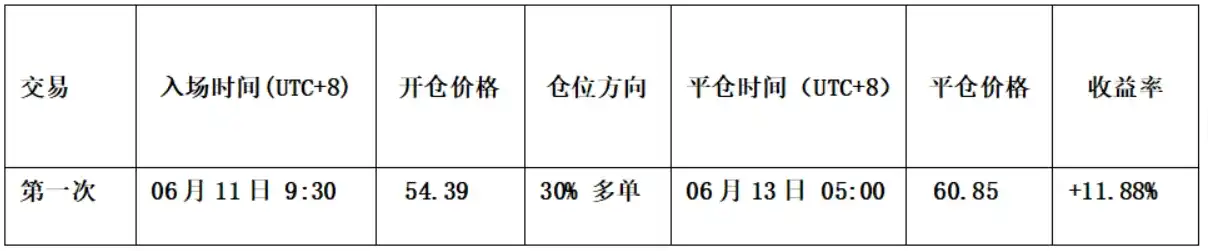
• HYPE Short-Term Trade Performance: Successfully executed one short-term long position (1x leverage) last week, achieving a profit of approximately 11.88%. (Detailed in Table One)

• BTC Market Prediction Verification: Last week's article noted that after an instantaneous dip below the $60,000 threshold, the price would find support and stage a short-term rebound to confirm the validity of the break below the key level. Current market movements have validated our previous prediction.

• HYPE Market Prediction Verification: Last week's article noted that when HYPE price retested the key support zone of $55-57, showing signs of stopping its decline and stabilizing, and combined with bottom signals triggered by two major models, a light long position could be considered. Current market movements are highly consistent with our predicted view.

One: In-Depth Analysis of Bitcoin's Hourly Timeframe Structure

Bitcoin _ 4-Hour Candlestick Chart
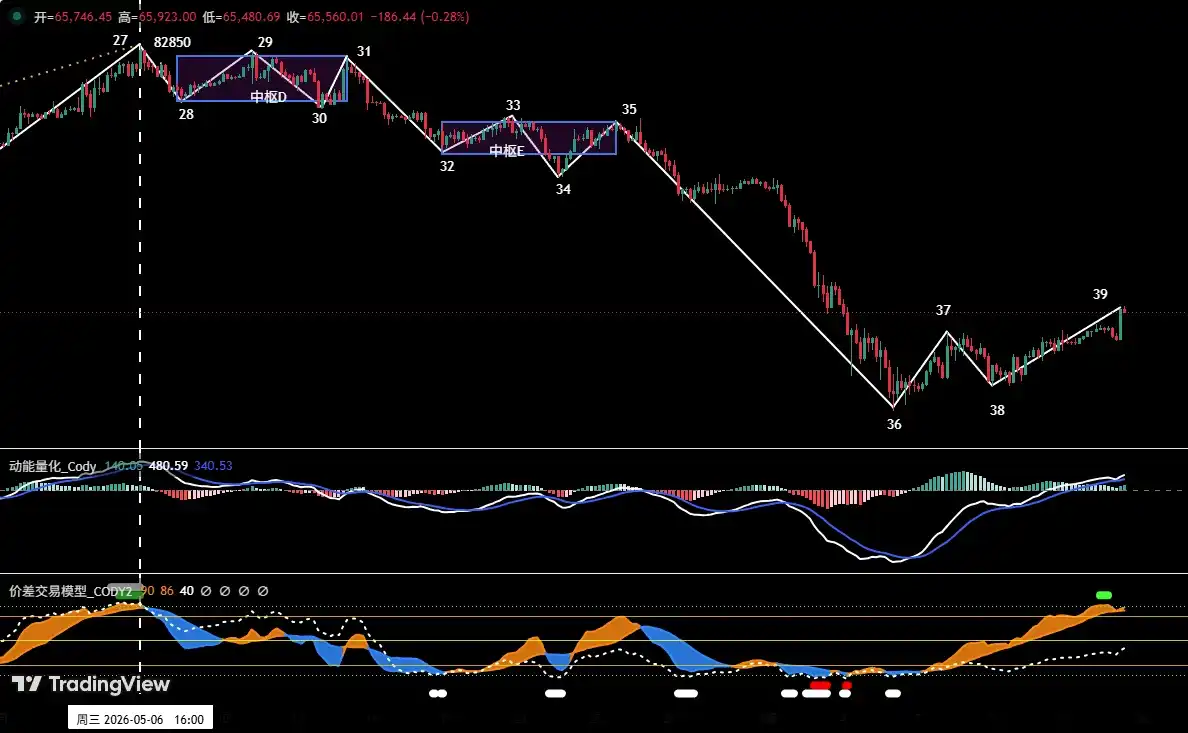
Figure One

1. As shown in (Figure One), since the high of $82,850 on May 6th, the correction in the 4-hour chart can be subdivided into a 12-stage adjustment structure. This includes two descending pivots: Pivot D and Pivot E. The overall structure is clear, presenting a typical complex correction pattern.

2. From the 4-hour structural perspective, the market is currently in the 38-39 segment rebound. The price has now broken above $65,000. If the subsequent breakout is confirmed as valid, the next key resistance for the rebound will be in the $69,500~$70,500 zone.

Two: Bitcoin's Market Outlook and Trading Strategies for This Week

1. BTC Market Outlook for This Week:

Core View This Week: Focus on the result of the price's pullback confirmation after breaking above $65,000.

• If the pullback fails to hold this level, the market may retest the core support range of $60,000~$62,000.

• If it effectively stabilizes above, it will challenge the core resistance zone of $69,500~$70,500. This area will be a key region for us to plan medium-term short positions.

2. Core Resistance Levels:

• First Resistance Zone: $69,500~$70,500 area (previous high-volume consolidation zone)

• Second Resistance Zone: $72,500~$74,500 area (previous high-volume consolidation zone)

3. Core Support Levels:

• First Support Level: Around $65,000

• Second Support Level: $59,000~$60,000 area (previous key support level)

• Third Support Level: Around $55,000 (previous key support level)

4. Trading Strategy for This Week (Excluding Impact of Sudden News)

1. Medium-Term Strategy:

Bitcoin _ Daily Candlestick Chart: (Position Monitoring Model)
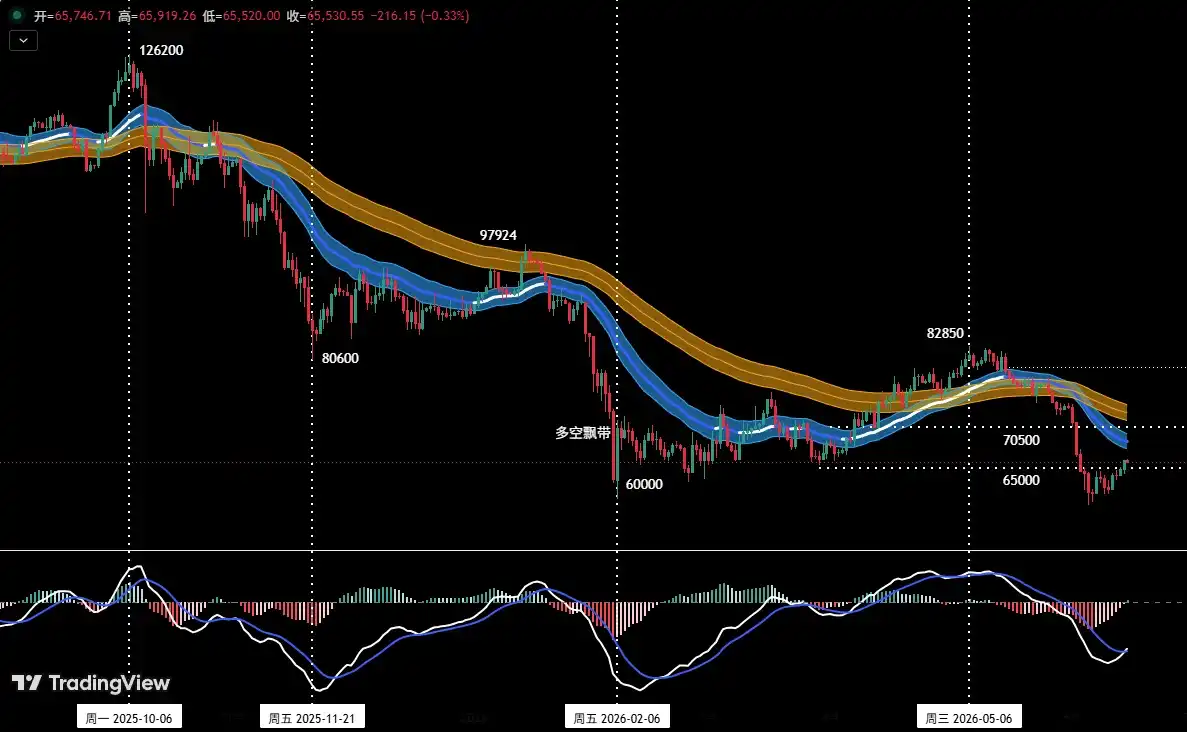
Figure Two

Position Monitoring Model: As shown in (Figure Two), the price has effectively broken below the "Bull-Bear Channel," indicating the technical structure has shifted to a bear-dominated pattern. The market did not meet our planned (short) entry conditions last week, so the medium-term position remains empty for now.

This week, based on the outcome of the battle between bulls and bears around $65,000, medium-term short positions can be built gradually according to the following three-level strategy:

Add at Strong Resistance: If the price successfully stabilizes in the $65,000 area and subsequently rallies to the $69,500~$70,500 zone, showing clear signs of resistance, consider initiating a medium-term (short) position, with total exposure controlled below 60%.

• Short on Support Break: If the price loses the $65,000 support and shows signs of a valid breakdown, preliminarily establish a 30% medium-term short position.

Short on Further Breakdown: If the price loses the $65,000 support and effectively breaks below the $59,000~$60,000 support zone, add to the short position accordingly, with total exposure controlled below 60%.

2. Short-Term Strategy: Utilize 30% of capital, set stop-losses, and seek "spread" trading opportunities based on support and resistance levels. (Using 30-minute/60-minute as the operational timeframe).

3. For dynamic response to complex market changes in short-term operations, we have prepared two specific operational plans in advance: Plan A/B.

Plan A: Enter at Strong Resistance.

• Entry: If the price successfully stabilizes in the $65,000 area and subsequently rallies near $69,500~$70,500 showing signs of stalling, combined with quantitative model top signals, consider entering a short position with exposure below 30%.

• Risk Control: Set an initial stop-loss.

• Exit: Gradually close the position for profit when the price adjusts near key support levels, combined with model signals.

Plan B: Short on Valid Support Break.

• Entry: If the price loses the $65,000 support and shows signs of a valid breakdown, consider entering a short position with exposure below 30%.

• Risk Control: Set an initial stop-loss.

• Exit: Gradually close the position for profit when the price declines to key support levels, combined with model signals.

Three: HYPE Hourly Timeframe Structure Analysis

HYPE_ 4-Hour Candlestick Chart
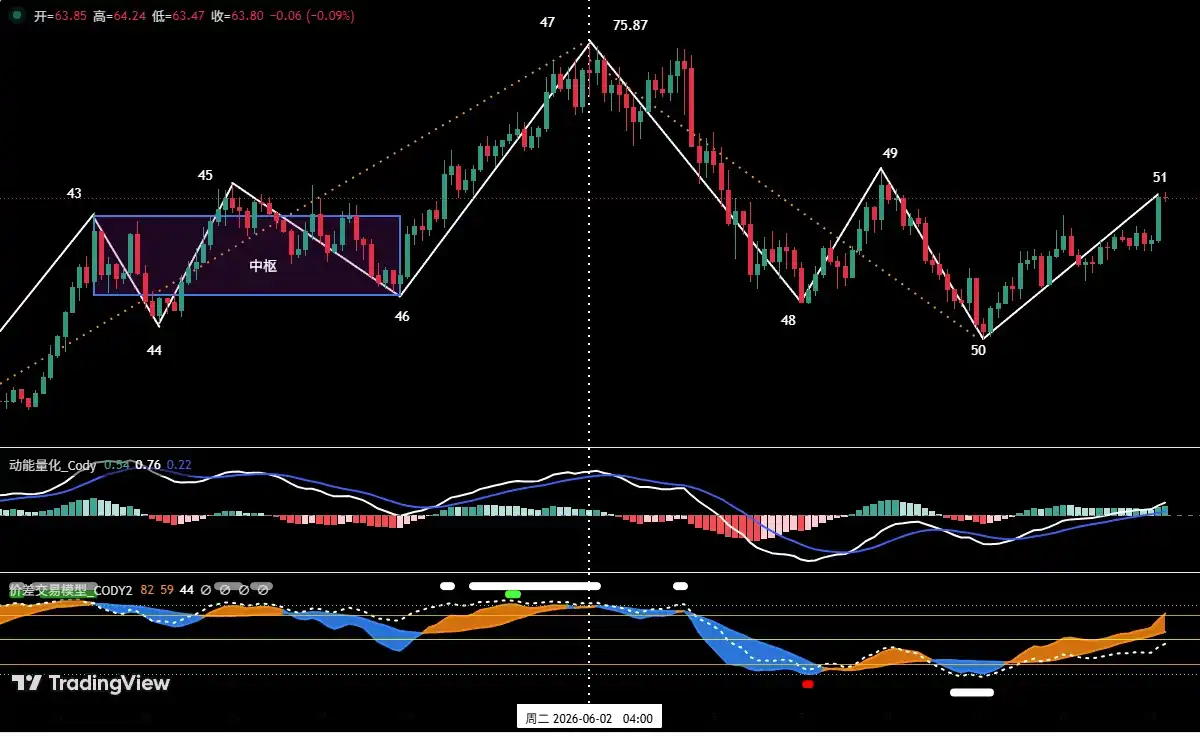
Figure Three

1. As shown in (Figure Three), in the 4-hour timeframe, HYPE's correction since the high of $75.87 on June 2nd can be subdivided into a four-stage adjustment structure: (47-48), (48-49), (49-50), (50-51).

2. Currently, HYPE price has stabilized and rebounded from the support area around $52 and is in the rebound process of segment (50-51). Its overhead resistance lies in the $62.5 to $64.57 zone. If (Endpoint 51) forms a high in this area (it is highly probable the overall structure will form a "descending pivot" here), the price will likely continue downward to seek stronger support.

Four: HYPE Market Outlook and Short-Term Trading Strategies for This Week

1. HYPE Market Outlook for This Week:

1. Core Resistance Levels:

• First Resistance Level: $62.5-64.57 area;

• Second Resistance Level: $68-70 area;

2. Core Support Levels:

• First Support Level: $52-55.5 area;

• Second Support Level: $47-49 area;

Core View on HYPE This Week:

• Observe the resistance effect in the $62.5-64.57 area and the price level at which "Endpoint 51" forms a high.

2. HYPE Short-Term Trading Strategy for This Week: (Long on Support)

This week's HYPE short-term trading should adhere to the strategy of "accumulate on dips, avoid chasing rallies."

Short-Term Strategy: Test Long on Support Zone Stabilization

When HYPE price retests the key support areas of $52-54.5 or the deeper $47-49, showing signs of stopping its decline and stabilizing, and combined with bottom signals triggered by the two major models, consider testing a light long position. Exposure must be controlled below 30%, with strict stop-loss discipline.

Five: HYPE Trade Review

1. Short-Term Trade Review: (See Table One)

We strictly followed the operational plan. Based on trading signals from our proprietary "Spread Trading Model" and "Momentum Quant Model," we executed one short-term (long) trade last week, achieving a profit of 11.88%.

2. HYPE Short-Term Trade Details Summary: (Leverage*1x)
3. Short-Term Trade Review: (See Figure Four)

1. Entry Strategy:

• A relatively complete downtrend correction structure had already occurred;

• Our proprietary "Spread Trading Model" had issued strong bottom warning signals in advance (red and white dots in the chart);

• Our proprietary "Momentum Quant Model" had issued a momentum bottom divergence signal;

Based on the above three points, we entered a 30% long position around $54.39.

2. Exit Strategy:

• The price encountered resistance when approaching $62.5;

• Our proprietary "Spread Trading Model" had issued top warning signals in advance (white dots in the chart);

• Our proprietary "Momentum Quant Model" had issued a momentum top divergence signal;

Therefore, we closed the entire position around $60.85.

3. Summary: This trade successfully yielded a profit of approximately 11.88%.

HYPE_ 30-Minute Candlestick Chart: (Momentum Quant Model + Spread Trading Model)
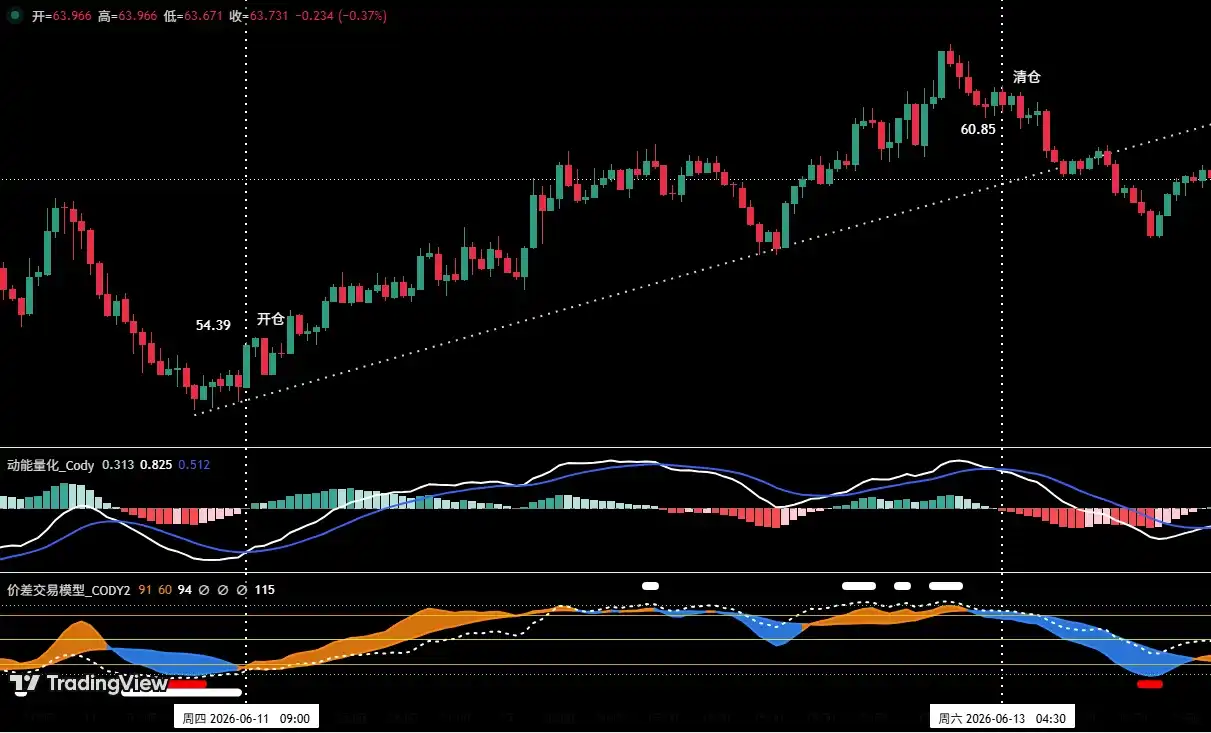
Figure Four (Short-Term Trade Illustration)

Six: Special Notes:

1. When entering a position: Immediately set an initial stop-loss.

2. When profit reaches 1%: Move the stop-loss to the entry price (breakeven point) to ensure capital safety.

3. When profit reaches 2%: Move the stop-loss to the 1% profit level.

4. Continuous Tracking: Thereafter, for every additional 1% profit, move the stop-loss up by 1% accordingly, dynamically protecting and locking in profits.

Financial markets change rapidly; all market analysis and trading strategies require dynamic adjustment. All views, analytical models, and operational strategies mentioned herein are derived from personal technical analysis, intended solely for personal trading log purposes, and do not constitute any investment advice or operational basis. The market carries risks; investment requires caution. Do not make decisions based solely on this content.


Трендові криптовалюти

Пов'язані питання

QAccording to the article, what is the crucial level for Bitcoin this week that will determine its subsequent direction?

AAccording to the article, the crucial level for Bitcoin this week is $65,000. The core view is to focus on the result of the price's retest and confirmation after breaking above $65,000. If it holds above this level effectively, it may challenge the $69,500-$70,500 resistance zone. If it fails and falls back below, the market may test the $60,000-$62,000 core support zone again.

QWhat is the recommended trading strategy for HYPE in the short term, as outlined in the article?

AThe recommended short-term trading strategy for HYPE is to 'buy on dips and avoid chasing rallies.' Specifically, when the HYPE price retests key support areas like $52-$54.5 or the deeper $47-$49 zone, if it shows signs of stopping the decline and stabilizing, and this is combined with bottom signals from the two proprietary models mentioned, one can consider lightly testing a long position. The position size must be controlled below 30% with strict stop-loss discipline.

QWhat two proprietary models did the analyst use for the HYPE trade execution and复盘 described in the article?

AThe analyst used two proprietary models for the HYPE trade execution and review: the 'Spread Trading Model' and the 'Dynamic Quantitative Model'.

QBased on the Bitcoin analysis, what are the two main pressure zones identified above the $65,000 level?

ABased on the Bitcoin analysis, the two main pressure zones identified above the $65,000 level are: First Pressure Zone: $69,500-$70,500 (a previous筹码密集成交区 / high-volume transaction area). Second Pressure Zone: $72,500-$74,500 (another previous筹码密集成交区 / high-volume transaction area).

QWhat is the core principle the article emphasizes for managing risk in a trade, specifically regarding stop-loss placement?

AThe article emphasizes a dynamic trailing stop-loss principle for risk management. Key steps include: 1) Set an initial stop-loss immediately upon opening a position. 2) When profit reaches 1%, move the stop-loss to the entry price (breakeven point). 3) When profit reaches 2%, move the stop-loss to lock in a 1% profit. 4) Continuously track the price, and for every additional 1% profit gained, move the stop-loss up by 1% to dynamically protect and lock in profits.

Пов'язані матеріали

The "Impossible Triad" Is Fundamentally a Pseudo-Problem

The article argues that blockchain's fundamental limitation is not the scalability trilemma (decentralization, scalability, security), which has been largely solved, but the lack of **privacy** and, until recently, clear **legitimacy**. Blockchain is described as a slow, expensive, globally shared computer whose core value is censorship resistance and verifiability. While ideal for native digital assets like money (e.g., stablecoins), its default transparency acts as a **tax**, exposing all transactions and enabling MEV extraction, which deters serious institutional capital. Simultaneously, its permissionless nature created regulatory ambiguity. The piece contends that **privacy** is the missing critical feature. It rejects the false choice between total transparency and complete anonymity. Modern cryptography (like zero-knowledge proofs) enables **compliant privacy**: users can prove facts (solvency, KYC status, compliance) without revealing the underlying sensitive data (specific holdings, identities). This preserves auditability for regulators and eliminates the leak of financial information. With recent regulatory progress (e.g., the GENIUS Act) addressing legitimacy, adding default, provably compliant privacy becomes a pure upgrade. It transforms blockchain from a costly, public ledger into a confidential settlement layer, finally bridging the gap to mainstream institutional and individual adoption of on-chain finance.

链捕手4 год тому

The "Impossible Triad" Is Fundamentally a Pseudo-Problem

链捕手4 год тому

Optical Chips: Collective Capacity Expansion

The global optical chip industry is experiencing a massive wave of expansion driven by surging AI data center demand. Major players across the US, Japan, Europe, and China are aggressively investing to ramp up production capacity. In the US, Coherent is expanding its 6-inch Indium Phosphide (InP) semiconductor fab in Texas, supported by CHIPS Act funding and a $2 billion strategic investment from NVIDIA. Lumentum is building a new factory for InP optical devices, and Nokia is scaling its advanced photonic chip packaging and testing capabilities. NVIDIA's investments aim to secure future supply of critical lasers and optical interconnect products for AI infrastructure. Japan's JX Advanced Metals, a leading InP substrate supplier, plans a multi-billion yen investment to increase its capacity 7-10 times, strengthening its grip on the crucial upstream materials market. In Europe, IQE and Tower Semiconductor settled a patent dispute and signed a multi-year InP epitaxial wafer supply agreement, highlighting that next-generation silicon photonics platforms will integrate high-performance InP components. STMicroelectronics and Sivers Semiconductors are also expanding silicon photonics production and partnerships. China is rapidly building out its domestic supply chain. Dongshan Precision's subsidiary, Source Photonics, announced a $12 billion project to expand optical chip and module production. Companies like Sanan Optoelectronics and Yunnan Germanium are scaling up InP chip manufacturing and substrate production, moving towards vertical integration from materials to modules. While debate continues around the exact future architecture—whether CPO (Co-Packaged Optics), NPO, or pluggables will dominate—analysts like Morgan Stanley argue the underlying driver is unchangeable: the explosive growth in bandwidth demand. This will inevitably increase the volume of optical engines, lasers, and related content per GPU, regardless of the final technical path. The competition for "more light" in the AI era has intensified into a global, full-chain capacity race.

marsbit7 год тому

Optical Chips: Collective Capacity Expansion

marsbit7 год тому

Stablecoins Finally Find Real Yield: An In-Depth Look at On-Chain Reinsurance Re | A Conversation with Re Founder Karan Saroya

Stablecoin Real Yield Found: A Deep Dive into On-Chain Reinsurance with Re's Karan Saroya As stablecoin supply exceeds $170 billion, the search for sustainable, non-speculative yield intensifies. Re, an on-chain reinsurance platform, provides an answer: connecting stablecoin capital to the trillion-dollar traditional reinsurance market. Re operates as a regulated reinsurer, accepting stablecoin deposits as collateral to back US insurance companies. These insurers pay premiums, generating yield that flows back to on-chain depositors. Currently supporting 35 insurers and underwriting $500 million, Re projects scaling to over $1 billion soon. Key insights from a Bankless podcast with founder Karan Saroya and investor Avichal of Electric Capital: 1. **Uncorrelated, Real-World Yield:** Re offers stablecoin holders access to reinsurance returns (targeting 12-14%+), an asset class entirely separate from crypto or equity markets. 2. **Operational Efficiency via Smart Contracts:** Re replaces traditional, labor-intensive capital fundraising with smart contracts, allowing a ~12-person team to compete with industry giants. 3. **Regulatory Leverage:** For every $1 of collateral, regulations allow backing $5-7 in written premiums. This leverage amplifies returns from the underlying risk-free rate. 4. **DeFi Integration:** Depositors receive receipt tokens, which can be used in protocols like Morpho for "looping," potentially pushing yields to 18-20%+. 5. **The "DeFi Mullet" Model:** A compliant front-end (regulated reinsurer) paired with a decentralized back-end (smart contracts, DeFi capital markets). 6. **RE Governance Token:** Modeled on Lloyd's of London, the token governs the central capital pool's allocation, counterparty acceptance, and parameters. 7. **Real Economic Impact:** Capital funds real-world productivity (factories, clinics, businesses) via insurance, moving beyond crypto's internal loops. The discussion highlights a pivotal moment: DeFi's supply-side infrastructure is now met by real demand for productive yield, potentially kickstarting a flywheel where vast on-chain stablecoin capital seeks these real-world returns.

链捕手8 год тому

Stablecoins Finally Find Real Yield: An In-Depth Look at On-Chain Reinsurance Re | A Conversation with Re Founder Karan Saroya

链捕手8 год тому

1996 or 1999? Walsh's First Test is 'How to View AI'

"1996 or 1999? Wall's First Big Test Is 'How to View AI'" Federal Reserve Chairman Wall's initial challenge is not whether to raise or cut rates, but a more fundamental judgment: what kind of boom is the current AI boom? This will determine the Fed's policy path and define his legacy. Economics is split between two opposing views, according to reporter Nick Timiraos. One sees imminent productivity gains that will increase supply and cool inflation, allowing the Fed to hold steady. The other argues that while productivity benefits are distant, demand shocks are here now, and waiting for data confirmation risks missing the intervention window, forcing sharper rate hikes later. Wall has signaled a leaning toward the first view, echoing 1996-era Alan Greenspan, who embraced strong, productivity-driven growth without fear of inflation. However, Wall faces a different macro environment than Greenspan did, with tariff pressures, expanding fiscal deficits, and diminishing globalization benefits, which could force more significant inflation pressures even if AI benefits materialize. Wall's logic, expressed before taking office, is that AI-driven productivity gains won't show in official data for years. If the Fed waits for confirmation, it might mistakenly tighten policy and choke off the very growth that could suppress inflation. This argues for using forward-looking narratives over lagging data. Chicago Fed President Austan Goolsbee presents a key counter-argument. He distinguishes between expected and unexpected productivity booms. A widely anticipated boom, like the current AI wave, can cause people to spend future wealth gains in advance, overheating the economy before productivity actually rises, thus requiring preemptive rate hikes. He cites rising costs for AI data centers as evidence of such overheating. Fed Governor Christopher Waller offers a rebuttal to Goolsbee, noting the "expected spending" mechanism only works if people can borrow against future income, which many households cannot do due to borrowing constraints. Wall also faces a paradox related to his desire to reduce the Fed's use of "forward guidance" (pre-announcing policy moves). This practice was established in 1999 when Greenspan began signaling hikes to avoid market shocks. If the economy follows a less optimistic path, Wall may be forced to choose between using the guidance he wants to abolish or risking market volatility by staying silent. The ultimate question defining Wall's first major test remains: Is this 1996 or 1999?

marsbit9 год тому

1996 or 1999? Walsh's First Test is 'How to View AI'

marsbit9 год тому

Торгівля

Спот
Ф'ючерси

Популярні статті

Що таке BITCOIN

Розуміння HarryPotterObamaSonic10Inu (ERC-20) та його позиції у крипто-просторі Останніми роками ринок криптовалют спостерігав за зростанням популярності мем-коінів, які привертають інтерес не тільки трейдерів, але й тих, хто шукає спілкування та розважальну цінність. Серед цих унікальних токенів є HarryPotterObamaSonic10Inu (ERC-20), інтригуючий проект, що поєднує культурні посилання з тканинами криптовалюти. Ця стаття досліджує ключові аспекти HarryPotterObamaSonic10Inu, вивчаючи його механізми, спільноту та його взаємодію з ширшим крипто-ландшафтом. Що таке HarryPotterObamaSonic10Inu (ERC-20)? Як випливає з його назви, HarryPotterObamaSonic10Inu є мем-коіном, побудованим на блокчейні Ethereum, класифікованим за стандартом ERC-20. На відміну від традиційних криптовалют, які можуть підкреслювати практичну корисність або інвестиційний потенціал, цей токен процвітає завдяки розважальній цінності та силі своєї спільноти. Проект спрямований на створення середовища, де зацікавлені користувачі можуть об'єднуватися, ділитися ідеями та брати участь у заходах, натхненних різноманітними культурними явищами. Однією з примітних особливостей HarryPotterObamaSonic10Inu є нульовий податок на транзакції. Цей привабливий елемент має на меті заохочувати торгівлю та участь у спільноті, позбавлену додаткових витрат, які можуть відлякувати дрібних трейдерів. Загальна пропозиція монет становить один мільярд токенів, що позначає намір підтримувати суттєву циркуляцію в межах спільноти. Творець HarryPotterObamaSonic10Inu (ERC-20) Походження HarryPotterObamaSonic10Inu дещо окутане таємницею; деталі про творця залишаються невідомими. Розвиток цього токена позбавлений впізнаваної команди або чіткої стратегії, що не є рідкістю в секторі мем-коінів. Натомість проект виник органічно, а його розвиток значною мірою залежить від ентузіазму та участі його спільноти. Інвестори HarryPotterObamaSonic10Inu (ERC-20) Щодо зовнішніх інвестицій та підтримки, HarryPotterObamaSonic10Inu також залишається невизначеним. Токен не зазначає жодних відомих інвестиційних фондів або значної організаційної підтримки. Натомість життєва сила проекту полягає в його базовій спільноті, яка інформує про його зростання та стійкість через колективні дії та залученість у крипто-просторі. Як працює HarryPotterObamaSonic10Inu (ERC-20)? Як мем-коін, HarryPotterObamaSonic10Inu функціонує передусім поза традиційними рамками, що часто регулюють вартість активів. Є кілька відмінних аспектів, що визначають, як працює проект: Транзакції без податку: Завдяки відсутності податкових зборів на транзакції, користувачі можуть вільно купувати та продавати токен, не турбуючись про приховані витрати. Залучення спільноти: Проект процвітає завдяки взаємодії спільноти, використовуючи соціальні медіа для створення шуму та сприяння залученню. Обговорення, обмін контентом та залученість є ключовими елементами, що допомагають розширити його охоплення та зміцнити лояльність серед прихильників. Відсутність практичної корисності: Слід зазначити, що HarryPotterObamaSonic10Inu не пропонує конкретної корисності в рамках фінансової екосистеми. Натомість він класифікується як токен, що призначений в основному для розваги та спільнотних активностей. Культурне посилання: Токен кмітливо вплітає елементи популярної культури, щоб привернути інтерес, зв'язуючи з ентузіастами мемів та крипто-стежками. HarryPotterObamaSonic10Inu ілюструє, як мем-коіни функціонують інакше, ніж традиційні криптовалютні проекти, увійшовши на ринок як інноваційні соціальні конструкти, а не утилітарні активи. Хронологія HarryPotterObamaSonic10Inu (ERC-20) Історія HarryPotterObamaSonic10Inu відзначена кількома значними етапами: Створення: Токен виник з вірусного мему, захопивши уяву багатьох крипто-ентузіастів. Конкретні дати створення недоступні, що підкреслює його органічний розвиток. Лістинг на біржах: HarryPotterObamaSonic10Inu з'явився на різних біржах, дозволяючи зручніший доступ і торгівлю спільноти. Ініціативи залучення спільноти: Ведення діяльності, спрямованої на покращення взаємодії спільноти, включаючи конкурси, кампанії в соціальних мережах та створення контенту від фанатів та прихильників. Плани на майбутнє: Дорожня карта проекту включає запуск колекції NFT, мерчандайзинг та електронну комерцію, пов'язану з його культурними темами, що далі залучає спільноту та намагається додати більше вимірів до його екосистеми. Ключові моменти про HarryPotterObamaSonic10Inu (ERC-20) Спільнотний підхід: Проект надає пріоритет колективному внеску та креативності, забезпечуючи, щоб участь користувачів була в центрі його розвитку. Класифікація як мем-коін: Це є його епігенез розважальної криптовалюти, що відрізняється від традиційних інвестиційних інструментів. Жодного прямого відношення до Bitcoin: Незважаючи на схожість у назві, HarryPotterObamaSonic10Inu є відмінним і не має жодного зв’язку з Bitcoin або іншими усталеними криптовалютами. Зосередженість на співпраці: HarryPotterObamaSonic10Inu створено для того, щоб надати простір для співпраці та обміну історіями серед його власників, забезпечуючи шлях для творчості та спільного зв'язку. Перспективи на майбутнє: Амбіція розширитися за межі початкової концепції в NFT та мерчандайз відкриває шлях для проекту потенційно потрапити в більш мейнстрімні сфери цифрової культури. Оскільки мем-коіни продовжують захоплювати уяву спільноти криптовалют, HarryPotterObamaSonic10Inu (ERC-20) вирізняється своїми культурними зв'язками та орієнтованим на спільноту підходом. Хоча він може не відповідати типовій моделі утилітарного токена, його суть полягає в радощах і товариськості, що підтримуються серед його прихильників, підкреслюючи еволюційну природу криптовалют в усе більш цифрову епоху. Оскільки проект продовжує розвиватися, важливо спостерігати за тим, як динаміка спільноти вплине на його траєкторію в постійно змінюваному ландшафті технології блокчейн.

2.1k переглядів усьогоОпубліковано 2024.04.01Оновлено 2024.12.03

Що таке BITCOIN

Як купити BTC

Ласкаво просимо до HTX.com! Ми зробили покупку Bitcoin (BTC) простою та зручною. Дотримуйтесь нашої покрокової інструкції, щоб розпочати свою криптовалютну подорож.Крок 1: Створіть обліковий запис на HTXВикористовуйте свою електронну пошту або номер телефону, щоб зареєструвати обліковий запис на HTX безплатно. Пройдіть безпроблемну реєстрацію й отримайте доступ до всіх функцій.ЗареєструватисьКрок 2: Перейдіть до розділу Купити крипту і виберіть спосіб оплатиКредитна/дебетова картка: використовуйте вашу картку Visa або Mastercard, щоб миттєво купити Bitcoin (BTC).Баланс: використовуйте кошти з балансу вашого рахунку HTX для безперешкодної торгівлі.Треті особи: ми додали популярні способи оплати, такі як Google Pay та Apple Pay, щоб підвищити зручність.P2P: Торгуйте безпосередньо з іншими користувачами на HTX.Позабіржова торгівля (OTC): ми пропонуємо індивідуальні послуги та конкурентні обмінні курси для трейдерів.Крок 3: Зберігайте свої Bitcoin (BTC)Після придбання Bitcoin (BTC) збережіть його у своєму обліковому записі на HTX. Крім того, ви можете відправити його в інше місце за допомогою блокчейн-переказу або використовувати його для торгівлі іншими криптовалютами.Крок 4: Торгівля Bitcoin (BTC)Легко торгуйте Bitcoin (BTC) на спотовому ринку HTX. Просто увійдіть до свого облікового запису, виберіть торгову пару, укладайте угоди та спостерігайте за ними в режимі реального часу. Ми пропонуємо зручний досвід як для початківців, так і для досвідчених трейдерів.

4.8k переглядів усьогоОпубліковано 2024.12.12Оновлено 2026.06.02

Як купити BTC

Що таке $BITCOIN

ЦИФРОВЕ ЗОЛОТО ($BITCOIN): Комплексний аналіз Вступ до ЦИФРОВОГО ЗОЛОТА ($BITCOIN) ЦИФРОВЕ ЗОЛОТО ($BITCOIN) — це проект на основі блокчейну, що працює в мережі Solana, який має на меті поєднати характеристики традиційних дорогоцінних металів з інноваціями децентралізованих технологій. Хоча він має таку ж назву, як і Bitcoin, який часто називають “цифровим золотом” через його сприйняття як засобу збереження вартості, ЦИФРОВЕ ЗОЛОТО є окремим токеном, розробленим для створення унікальної екосистеми в ландшафті Web3. Його мета — позиціонувати себе як життєздатний альтернативний цифровий актив, хоча деталі щодо його застосувань і функціональностей все ще розробляються. Що таке ЦИФРОВЕ ЗОЛОТО ($BITCOIN)? ЦИФРОВЕ ЗОЛОТО ($BITCOIN) — це токен криптовалюти, спеціально розроблений для використання в блокчейні Solana. На відміну від Bitcoin, який виконує широко визнану роль зберігання вартості, цей токен, здається, зосереджується на більш широких застосуваннях і характеристиках. Помітні аспекти включають: Інфраструктура блокчейну: Токен побудований на блокчейні Solana, відомому своєю здатністю обробляти швидкі та низьковартісні транзакції. Динаміка постачання: ЦИФРОВЕ ЗОЛОТО має максимальне постачання, обмежене 100 квадрильйонами токенів (100P $BITCOIN), хоча деталі щодо його обігового постачання наразі не розголошуються. Утиліта: Хоча точні функціональності не викладені, є вказівки на те, що токен може бути використаний для різних застосувань, потенційно пов'язаних з децентралізованими додатками (dApps) або стратегіями токенізації активів. Хто є творцем ЦИФРОВОГО ЗОЛОТА ($BITCOIN)? На даний момент особа творців і команди розробників, що стоять за ЦИФРОВИМ ЗОЛОТОМ ($BITCOIN), залишається невідомою. Ця ситуація є типовою для багатьох інноваційних проектів у сфері блокчейну, особливо тих, що пов'язані з децентралізованими фінансами та феноменом мем-коінів. Хоча така анонімність може сприяти культурі, орієнтованій на спільноту, вона посилює занепокоєння щодо управління та підзвітності. Хто є інвесторами ЦИФРОВОГО ЗОЛОТА ($BITCOIN)? Доступна інформація вказує на те, що ЦИФРОВЕ ЗОЛОТО ($BITCOIN) не має жодних відомих інституційних спонсорів або помітних венчурних капіталовкладень. Проект, здається, працює за моделлю “рівний до рівного”, зосереджуючись на підтримці та прийнятті спільноти, а не на традиційних шляхах фінансування. Його активність і ліквідність переважно розташовані на децентралізованих біржах (DEX), таких як PumpSwap, а не на встановлених централізованих торгових платформах, що ще більше підкреслює його підхід знизу вгору. Як працює ЦИФРОВЕ ЗОЛОТО ($BITCOIN) Операційні механізми ЦИФРОВОГО ЗОЛОТА ($BITCOIN) можна детальніше розглянути на основі його дизайну блокчейну та характеристик мережі: Механізм консенсусу: Використовуючи унікальний proof-of-history (PoH) Solana в поєднанні з моделлю proof-of-stake (PoS), проект забезпечує ефективну валідацію транзакцій, що сприяє високій продуктивності мережі. Токеноміка: Хоча конкретні дефляційні механізми не були детально описані, велике максимальне постачання токенів вказує на те, що воно може задовольняти мікротранзакції або нішеві випадки використання, які ще потрібно визначити. Інтероперабельність: Існує потенціал для інтеграції з більш широкою екосистемою Solana, включаючи різні платформи децентралізованих фінансів (DeFi). Однак деталі щодо конкретних інтеграцій залишаються невизначеними. Хронологія ключових подій Ось хронологія, яка підкреслює значні віхи, пов'язані з ЦИФРОВИМ ЗОЛОТОМ ($BITCOIN): 2023: Початкове розгортання токена відбувається на блокчейні Solana, позначене його адресою контракту. 2024: ЦИФРОВЕ ЗОЛОТО набуває видимості, оскільки стає доступним для торгівлі на децентралізованих біржах, таких як PumpSwap, що дозволяє користувачам торгувати ним проти SOL. 2025: Проект спостерігає спорадичну торгову активність і потенційний інтерес до ініціатив, очолюваних спільнотою, хоча на даний момент не зафіксовано жодних значних партнерств або технічних досягнень. Критичний аналіз Сильні сторони Масштабованість: Основна інфраструктура Solana підтримує високі обсяги транзакцій, що може підвищити утиліту $BITCOIN у різних сценаріях транзакцій. Доступність: Потенційно низька торгова ціна за токен може привабити роздрібних інвесторів, сприяючи більш широкій участі завдяки можливостям дробового володіння. Ризики Відсутність прозорості: Відсутність публічно відомих спонсорів, розробників або процесу аудиту може викликати скептицизм щодо стійкості та надійності проекту. Волатильність ринку: Торгова активність сильно залежить від спекулятивної поведінки, що може призвести до значної волатильності цін і невизначеності для інвесторів. Висновок ЦИФРОВЕ ЗОЛОТО ($BITCOIN) постає як цікавій, але неоднозначний проект у швидко розвиваючійся екосистемі Solana. Хоча він намагається використати наратив “цифрового золота”, його відхід від встановленої ролі Bitcoin як засобу збереження вартості підкреслює необхідність чіткішого розмежування його передбачуваної утиліти та структури управління. Майбутнє прийняття та адаптація, ймовірно, залежатиме від вирішення поточної непрозорості та більш чіткого визначення його операційних та економічних стратегій. Примітка: Цей звіт охоплює синтезовану інформацію, доступну станом на жовтень 2023 року, і можуть відбутися події, що виходять за межі дослідницького періоду.

82 переглядів усьогоОпубліковано 2025.05.13Оновлено 2025.05.13

Що таке $BITCOIN

Обговорення

Ласкаво просимо до спільноти HTX. Тут ви можете бути в курсі останніх подій розвитку платформи та отримати доступ до професійної ринкової інформації. Нижче представлені думки користувачів щодо ціни BTC (BTC).

活动图片