Bitcoin Retail Demand Turns Positive Again: Is The Crowd Coming Back?

bitcoinistОпубліковано о 2026-05-13Востаннє оновлено о 2026-05-13

Анотація

Bitcoin retail demand has turned positive again, with its 30-day change surging to +4.38% after plunging into negative territory in March. This metric tracks transaction activity for transfers under $10,000, indicating renewed interest from small-scale investors. While this marks a significant improvement from last month's low of -8.2%, overall retail transaction volume remains below February levels. Concurrently, the recent price recovery has improved the situation for short-term holders (STHs), with the percentage of their supply in loss dropping to 38%. Bitcoin is currently trading around $80,700. The key question is whether this positive shift in retail sentiment will continue and lead to a full-scale return of small investors.

On-chain data shows the Bitcoin retail demand change has surged back into the green zone after a plunge underwater earlier in the year.

Bitcoin Retail Investor Demand Change Has Surged To +4%

In a new post on X, CryptoQuant author Axel Adler Jr has talked about the latest trend in the 30-day change of the Retail Investor Demand for Bitcoin. This indicator measures, as its name suggests, the degree of demand for the network that’s coming from retail traders.

Retail investors refer to the smallest of entities on the network who don’t tend to have any notable number of tokens in their wallet balance. As a proxy for their demand, the indicator makes use of the amount of transaction activity that they are participating in.

Naturally, the transfers made by this group are usually quite small in scale, so the metric specifically tracks the transfer volume associated with transactions involving a value of less than $10,000.

Below is the chart shared by Adler Jr that shows the trend in the 30-day change of the Bitcoin Retail Investor Demand over the last few years.
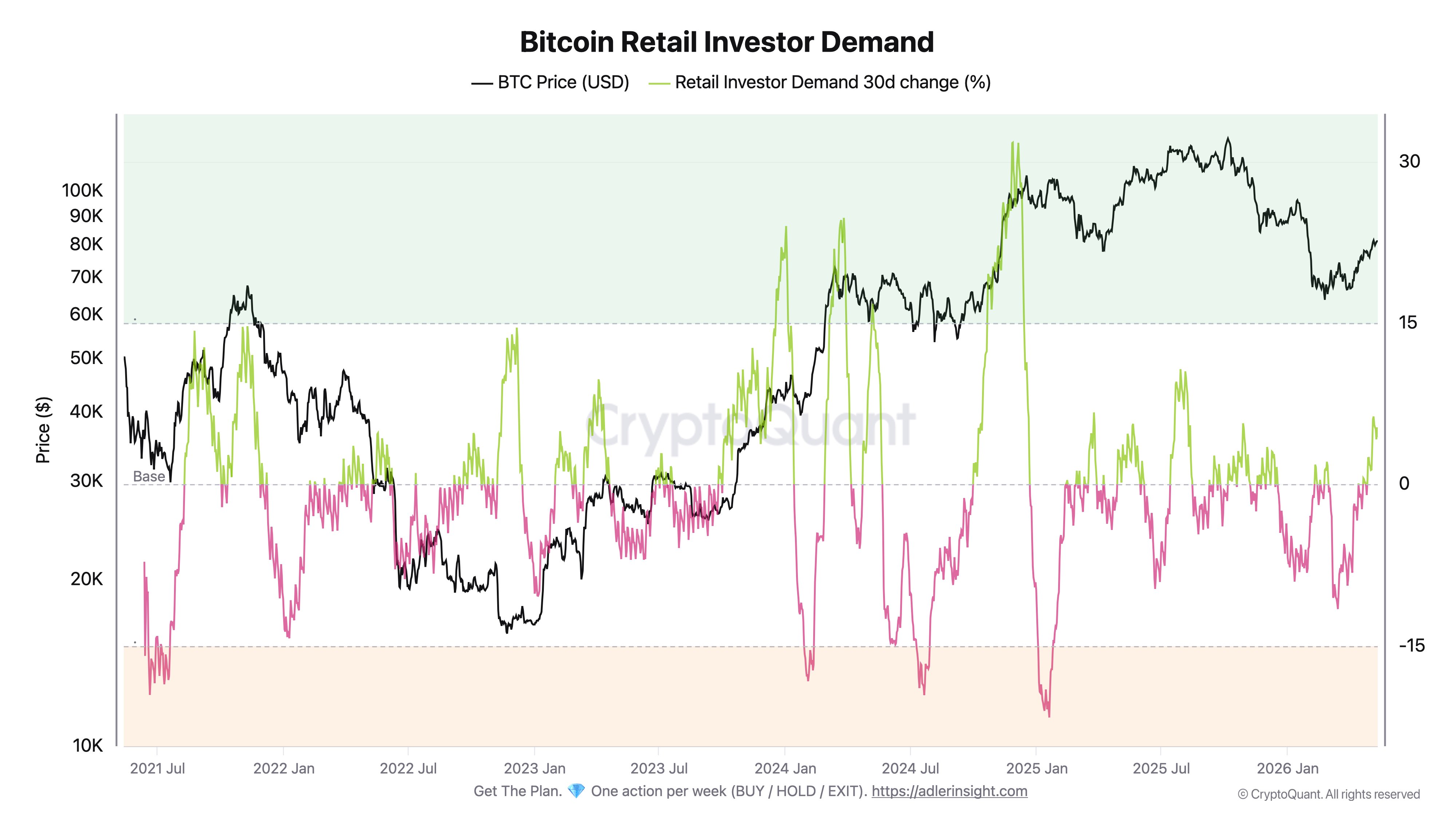
Looks like the value of the metric has been climbing in recent days | Source: @AxelAdlerJr on X

As is visible in the graph, the Bitcoin Retail Investor Demand saw its 30-day change collapse deep into the negative zone back in March. This means that retail traders shifted their attention away from the cryptocurrency.

Since then, however, the metric has climbed its way back up, with its value returning back into the green zone recently. Earlier, the indicator dropped to -8.2%, but this recovery has meant that it’s now sitting at +4.38%, a notable swing.

While this indicates a relative improvement in retail mood compared to one month ago, the analyst noted that full participation from the cohort has still not returned, with the transaction volume sitting at levels lower than February. It now remains to be seen whether the 30-day change in the Bitcoin Retail Investor Demand will continue its recent trajectory in the near future and if small investors will start pouring back into the asset in full force.

In some other news, the recent price recovery has led to an improvement in the situation of the short-term holders (STH), as analyst Maartunn has pointed out in an X post. The STHs refer to the BTC investors who purchased their tokens within the past 155 days.

Previously, these investors saw the vast majority of their supply dip into losses as Bitcoin went through its drawdown. As the below chart shows, though, the percentage of the STH supply in loss has dropped to just 38% after the recent price rally.
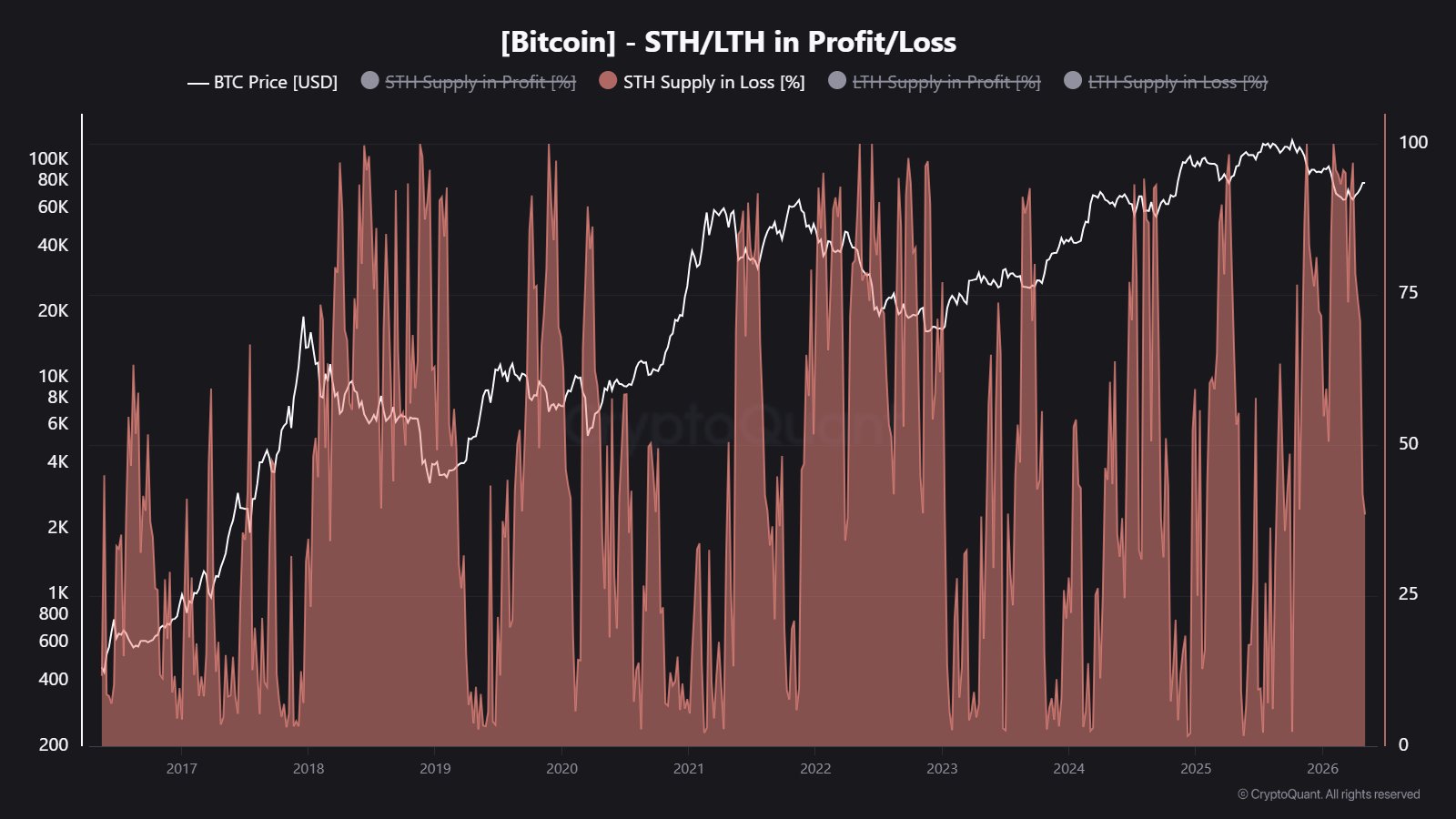
The trend in the STH Supply in Loss over the past decade | Source: @JA_Maartun on X

BTC Price

At the time of writing, Bitcoin is trading around $80,700, down 1% over the past week.

The price of the coin seems to have been moving sideways recently | Source: BTCUSDT on TradingView


Трендові криптовалюти

Пов'язані питання

QWhat is the '30-day change of the Retail Investor Demand for Bitcoin' indicator, and what does a recent positive value signify?

AThe '30-day change of the Retail Investor Demand for Bitcoin' indicator measures the degree of demand for the Bitcoin network from retail traders, specifically by tracking the transfer volume of transactions valued under $10,000. Its recent surge to a positive value of +4.38% signifies that retail demand has turned positive again after being in negative territory, indicating a relative improvement in retail investor sentiment and activity compared to one month ago.

QAccording to the analyst, what is the current state of full retail participation compared to earlier in the year?

AAccording to the analyst, while the retail demand indicator shows improvement, full participation from retail investors has not yet returned. The transaction volume associated with retail activity is still at levels lower than those seen in February.

QHow did the recent Bitcoin price recovery affect Short-Term Holders (STHs), and what is an STH?

AAn STH (Short-Term Holder) is a Bitcoin investor who purchased their tokens within the past 155 days. The recent price recovery has significantly improved their situation. The percentage of the STH supply held at a loss has dropped to just 38% after having seen the vast majority of their supply in losses during the previous price drawdown.

QWhat was the approximate Bitcoin price mentioned in the article, and what was its weekly performance?

AAt the time of writing in the article, Bitcoin was trading around $80,700. It was down approximately 1% over the past week, with its price described as moving sideways recently.

QWhat key metric related to retail demand dropped into deep negative territory in March, and what was its approximate value at that low point?

AThe key metric was the 30-day change of the Bitcoin Retail Investor Demand. It collapsed deep into negative territory in March, dropping to approximately -8.2%, indicating retail traders were shifting their attention away from Bitcoin.

Пов'язані матеріали

Unpacking the Truth Behind On-chain Assets: Leverage, Liquidity, and Risk

The article analyzes the concept of "real-world asset" (RWA) tokenization, arguing that while tokenizing assets on-chain is a useful step, it is far from transformative on its own. The author compares it to placing a barcode on a shipping container—it enables identification but does not build the necessary market infrastructure. The core argument is that true value emerges not from tokenization, but from integrating these tokens into DeFi systems where they can be valued, financed, hedged, traded, and liquidated under stress. Key challenges identified include: 1. **Multiple Time Clocks**: A fundamental tension exists between blockchain's 24/7 settlement and the slower, business-hour-dependent processes of traditional markets, custody, and redemption. This "duration mismatch" can create dangerous liquidity gaps during crises. 2. **Liquidity Misconceptions**: True liquidity is not measured by Total Value Locked (TVL) or trading pairs, but by the ability to exit a position within a required timeframe at an acceptable price. It requires analyzing multiple exit paths and stress-testing scenarios. 3. **Leverage and Risk**: Leverage unlocks economic utility (e.g., using tokenized assets as collateral) but also introduces fragility. Risk models must account for more than asset volatility, incorporating factors like legal enforceability, oracle freshness, and market structure. Paradoxically, a "safer" asset like tokenized Treasury bonds could require a higher collateral discount than ETH due to slower, less-proven liquidation mechanisms. 4. **A Risk Graph**: RWA risk should be modeled as a network of interconnected dependencies (e.g., issuers, custodians, oracles, stablecoin pools), not a single score. Failures can propagate through this graph, turning operational issues into systemic liquidity crises. The article states that tokenized government bonds are merely an entry point, while more complex frontiers like computing power and energy assets present greater challenges and opportunities. It also examines the interplay and risks between tokenized stocks and perpetual futures contracts. The conclusion is that the future lies not in "tokenizing everything," but in building robust market layers where tokenized rights become resilient financial primitives within a programmable capital system. The token is just the barcode; the market is the machine.

marsbit11 хв тому

Unpacking the Truth Behind On-chain Assets: Leverage, Liquidity, and Risk

marsbit11 хв тому

The End of Mathematics: 40 Top Mathematicians Gather at Secret OpenAI Meeting

In August 2026, OpenAI hosted a closed-door summit with approximately 40 leading mathematicians, including recent Fields Medalist Jacob Tsimerman and OpenAI researcher Sébastien Bubeck. The meeting, spurred by a series of recent AI breakthroughs in mathematics, grappled with the potential existential threat AI poses to the field. The backdrop includes several high-profile AI achievements: OpenAI models disproving long-standing conjectures like the unit distance problem, generating 10 new mathematical discoveries, and Anthropic's Claude aiding in constructing complex multidimensional objects. These results often bypass traditional academic pipelines, appearing directly on social media. The mathematical community is divided. Over 3000 researchers signed the "Leiden Statement," advocating for responsible AI use and verification. Others resist AI entirely to preserve human-centric mathematics. A key concern is AI's current inability to *explain* proofs, particularly the difficult steps, which is central to mathematical understanding. At the summit, Bubeck outlined four potential futures: mathematics becoming like collaborative software engineering, a compute-driven field like physics, a curatorial exercise where humans interpret AI output, or a mass transition of mathematicians into AI safety. While emphasizing that "mathematics only makes sense when mathematicians learn from it," no consensus was reached. The event highlights a profound moment of reflection. As AI demonstrates increasing competence in solving complex problems, mathematicians are forced to question their future role and the very meaning of their discipline.

marsbit16 хв тому

The End of Mathematics: 40 Top Mathematicians Gather at Secret OpenAI Meeting

marsbit16 хв тому

Anthropic's New Models 'Catch the Gossip', The Strongest Fable 5 Unexpectedly Falls Flat

Anthropic has been discovered working on two new, previously unknown models codenamed "Marshmallow" (claude-marshmallow-eap) and "Melon" (claude-melon-eap), with early tests showing Marshmallow potentially surpassing Claude Opus 5 in conversational naturalness. Their emergence coincides with surprising new data revealing that Anthropic's flagship Fable 5 model, released two months ago as its strongest and most expensive offering, is being largely ignored by the enterprise market. According to spending data from Ramp tracking over 70,000 US companies, Fable 5 accounts for only about 11% of total token spending on Anthropic's models. This pales in comparison to OpenAI's flagship GPT-5.6 Sol, which commands roughly 25% of token spending in the same period. The tepid adoption is largely attributed to Fable 5's extremely high cost—double that of Opus 4.8 and ten times that of Haiku 4.5—without delivering proportionally superior performance for most business applications. Compounding the issue, the later-released Claude Opus 5, priced at half the cost of Fable 5, has achieved comparable or even better results in key benchmarks like programming and knowledge work, quickly surpassing Fable 5 in enterprise spending share. Furthermore, the rapid rise of powerful, low-cost open-source models—whose token usage share surged from 11% in April to 62% in August while costing less than 4% of enterprise AI budgets—applies additional pressure. Analysts suggest the sudden appearance of Marshmallow and Melon may be an urgent move by Anthropic to address this gap in its lineup. The goal is to offer models that are not only powerful but also cost-effective enough for businesses to adopt widely and sustainably, moving beyond a flagship that serves more as a showcase than a workhorse.

marsbit16 хв тому

Anthropic's New Models 'Catch the Gossip', The Strongest Fable 5 Unexpectedly Falls Flat

marsbit16 хв тому

Three Months After the Passing of Little Dog Rosie, Her Medical Records Transformed into an AI Healthcare Company

Three months after the passing of his dog Rosie, AI entrepreneur Paul S. Conyngham secured $4 million in seed funding from Founders Fund for his new startup, Gamgee. The company aims to industrialize the experimental, AI-assisted process he pioneered to create a personalized mRNA cancer vaccine for Rosie, who suffered from mast cell tumors. With no formal biology background, Conyngham used AI tools like ChatGPT and AlphaFold to analyze Rosie's tumor DNA, identify target neoantigens, and design a custom mRNA vaccine sequence. Laboratory partners at UNSW produced the vaccine. Initial treatment showed tumor reduction, but Rosie's cancer later recurred and she was euthanized. Gamgee's goal is to streamline this "N-of-1" approach into a repeatable service for canine cancer patients, handling sequencing, vaccine design, production, and delivery. Clinical trials are planned in Australia in collaboration with research institutions. The company also eyes a longer-term vision of establishing personalized, mRNA-based medicine across species. The story highlights the broader challenge in personalized cancer treatment: compressing the entire timeline from design and regulatory approval to manufacturing and administration to match the patient's prognosis. While AI can accelerate target discovery, the remaining logistical and regulatory hurdles are significant. The article concludes by emphasizing that, for now, consulting qualified veterinary oncologists remains the responsible path for pet owners.

marsbit26 хв тому

Three Months After the Passing of Little Dog Rosie, Her Medical Records Transformed into an AI Healthcare Company

marsbit26 хв тому

Торгівля

Спот

Популярні статті

Що таке BITCOIN

Розуміння HarryPotterObamaSonic10Inu (ERC-20) та його позиції у крипто-просторі Останніми роками ринок криптовалют спостерігав за зростанням популярності мем-коінів, які привертають інтерес не тільки трейдерів, але й тих, хто шукає спілкування та розважальну цінність. Серед цих унікальних токенів є HarryPotterObamaSonic10Inu (ERC-20), інтригуючий проект, що поєднує культурні посилання з тканинами криптовалюти. Ця стаття досліджує ключові аспекти HarryPotterObamaSonic10Inu, вивчаючи його механізми, спільноту та його взаємодію з ширшим крипто-ландшафтом. Що таке HarryPotterObamaSonic10Inu (ERC-20)? Як випливає з його назви, HarryPotterObamaSonic10Inu є мем-коіном, побудованим на блокчейні Ethereum, класифікованим за стандартом ERC-20. На відміну від традиційних криптовалют, які можуть підкреслювати практичну корисність або інвестиційний потенціал, цей токен процвітає завдяки розважальній цінності та силі своєї спільноти. Проект спрямований на створення середовища, де зацікавлені користувачі можуть об'єднуватися, ділитися ідеями та брати участь у заходах, натхненних різноманітними культурними явищами. Однією з примітних особливостей HarryPotterObamaSonic10Inu є нульовий податок на транзакції. Цей привабливий елемент має на меті заохочувати торгівлю та участь у спільноті, позбавлену додаткових витрат, які можуть відлякувати дрібних трейдерів. Загальна пропозиція монет становить один мільярд токенів, що позначає намір підтримувати суттєву циркуляцію в межах спільноти. Творець HarryPotterObamaSonic10Inu (ERC-20) Походження HarryPotterObamaSonic10Inu дещо окутане таємницею; деталі про творця залишаються невідомими. Розвиток цього токена позбавлений впізнаваної команди або чіткої стратегії, що не є рідкістю в секторі мем-коінів. Натомість проект виник органічно, а його розвиток значною мірою залежить від ентузіазму та участі його спільноти. Інвестори HarryPotterObamaSonic10Inu (ERC-20) Щодо зовнішніх інвестицій та підтримки, HarryPotterObamaSonic10Inu також залишається невизначеним. Токен не зазначає жодних відомих інвестиційних фондів або значної організаційної підтримки. Натомість життєва сила проекту полягає в його базовій спільноті, яка інформує про його зростання та стійкість через колективні дії та залученість у крипто-просторі. Як працює HarryPotterObamaSonic10Inu (ERC-20)? Як мем-коін, HarryPotterObamaSonic10Inu функціонує передусім поза традиційними рамками, що часто регулюють вартість активів. Є кілька відмінних аспектів, що визначають, як працює проект: Транзакції без податку: Завдяки відсутності податкових зборів на транзакції, користувачі можуть вільно купувати та продавати токен, не турбуючись про приховані витрати. Залучення спільноти: Проект процвітає завдяки взаємодії спільноти, використовуючи соціальні медіа для створення шуму та сприяння залученню. Обговорення, обмін контентом та залученість є ключовими елементами, що допомагають розширити його охоплення та зміцнити лояльність серед прихильників. Відсутність практичної корисності: Слід зазначити, що HarryPotterObamaSonic10Inu не пропонує конкретної корисності в рамках фінансової екосистеми. Натомість він класифікується як токен, що призначений в основному для розваги та спільнотних активностей. Культурне посилання: Токен кмітливо вплітає елементи популярної культури, щоб привернути інтерес, зв'язуючи з ентузіастами мемів та крипто-стежками. HarryPotterObamaSonic10Inu ілюструє, як мем-коіни функціонують інакше, ніж традиційні криптовалютні проекти, увійшовши на ринок як інноваційні соціальні конструкти, а не утилітарні активи. Хронологія HarryPotterObamaSonic10Inu (ERC-20) Історія HarryPotterObamaSonic10Inu відзначена кількома значними етапами: Створення: Токен виник з вірусного мему, захопивши уяву багатьох крипто-ентузіастів. Конкретні дати створення недоступні, що підкреслює його органічний розвиток. Лістинг на біржах: HarryPotterObamaSonic10Inu з'явився на різних біржах, дозволяючи зручніший доступ і торгівлю спільноти. Ініціативи залучення спільноти: Ведення діяльності, спрямованої на покращення взаємодії спільноти, включаючи конкурси, кампанії в соціальних мережах та створення контенту від фанатів та прихильників. Плани на майбутнє: Дорожня карта проекту включає запуск колекції NFT, мерчандайзинг та електронну комерцію, пов'язану з його культурними темами, що далі залучає спільноту та намагається додати більше вимірів до його екосистеми. Ключові моменти про HarryPotterObamaSonic10Inu (ERC-20) Спільнотний підхід: Проект надає пріоритет колективному внеску та креативності, забезпечуючи, щоб участь користувачів була в центрі його розвитку. Класифікація як мем-коін: Це є його епігенез розважальної криптовалюти, що відрізняється від традиційних інвестиційних інструментів. Жодного прямого відношення до Bitcoin: Незважаючи на схожість у назві, HarryPotterObamaSonic10Inu є відмінним і не має жодного зв’язку з Bitcoin або іншими усталеними криптовалютами. Зосередженість на співпраці: HarryPotterObamaSonic10Inu створено для того, щоб надати простір для співпраці та обміну історіями серед його власників, забезпечуючи шлях для творчості та спільного зв'язку. Перспективи на майбутнє: Амбіція розширитися за межі початкової концепції в NFT та мерчандайз відкриває шлях для проекту потенційно потрапити в більш мейнстрімні сфери цифрової культури. Оскільки мем-коіни продовжують захоплювати уяву спільноти криптовалют, HarryPotterObamaSonic10Inu (ERC-20) вирізняється своїми культурними зв'язками та орієнтованим на спільноту підходом. Хоча він може не відповідати типовій моделі утилітарного токена, його суть полягає в радощах і товариськості, що підтримуються серед його прихильників, підкреслюючи еволюційну природу криптовалют в усе більш цифрову епоху. Оскільки проект продовжує розвиватися, важливо спостерігати за тим, як динаміка спільноти вплине на його траєкторію в постійно змінюваному ландшафті технології блокчейн.

2.8k переглядів усьогоОпубліковано 2024.04.01Оновлено 2024.12.03

Що таке BITCOIN

Як купити BTC

Ласкаво просимо до HTX.com! Ми зробили покупку Bitcoin (BTC) простою та зручною. Дотримуйтесь нашої покрокової інструкції, щоб розпочати свою криптовалютну подорож.Крок 1: Створіть обліковий запис на HTXВикористовуйте свою електронну пошту або номер телефону, щоб зареєструвати обліковий запис на HTX безплатно. Пройдіть безпроблемну реєстрацію й отримайте доступ до всіх функцій.ЗареєструватисьКрок 2: Перейдіть до розділу Купити крипту і виберіть спосіб оплатиКредитна/дебетова картка: використовуйте вашу картку Visa або Mastercard, щоб миттєво купити Bitcoin (BTC).Баланс: використовуйте кошти з балансу вашого рахунку HTX для безперешкодної торгівлі.Треті особи: ми додали популярні способи оплати, такі як Google Pay та Apple Pay, щоб підвищити зручність.P2P: Торгуйте безпосередньо з іншими користувачами на HTX.Позабіржова торгівля (OTC): ми пропонуємо індивідуальні послуги та конкурентні обмінні курси для трейдерів.Крок 3: Зберігайте свої Bitcoin (BTC)Після придбання Bitcoin (BTC) збережіть його у своєму обліковому записі на HTX. Крім того, ви можете відправити його в інше місце за допомогою блокчейн-переказу або використовувати його для торгівлі іншими криптовалютами.Крок 4: Торгівля Bitcoin (BTC)Легко торгуйте Bitcoin (BTC) на спотовому ринку HTX. Просто увійдіть до свого облікового запису, виберіть торгову пару, укладайте угоди та спостерігайте за ними в режимі реального часу. Ми пропонуємо зручний досвід як для початківців, так і для досвідчених трейдерів.

5.6k переглядів усьогоОпубліковано 2024.12.12Оновлено 2026.06.02

Як купити BTC

Що таке $BITCOIN

ЦИФРОВЕ ЗОЛОТО ($BITCOIN): Комплексний аналіз Вступ до ЦИФРОВОГО ЗОЛОТА ($BITCOIN) ЦИФРОВЕ ЗОЛОТО ($BITCOIN) — це проект на основі блокчейну, що працює в мережі Solana, який має на меті поєднати характеристики традиційних дорогоцінних металів з інноваціями децентралізованих технологій. Хоча він має таку ж назву, як і Bitcoin, який часто називають “цифровим золотом” через його сприйняття як засобу збереження вартості, ЦИФРОВЕ ЗОЛОТО є окремим токеном, розробленим для створення унікальної екосистеми в ландшафті Web3. Його мета — позиціонувати себе як життєздатний альтернативний цифровий актив, хоча деталі щодо його застосувань і функціональностей все ще розробляються. Що таке ЦИФРОВЕ ЗОЛОТО ($BITCOIN)? ЦИФРОВЕ ЗОЛОТО ($BITCOIN) — це токен криптовалюти, спеціально розроблений для використання в блокчейні Solana. На відміну від Bitcoin, який виконує широко визнану роль зберігання вартості, цей токен, здається, зосереджується на більш широких застосуваннях і характеристиках. Помітні аспекти включають: Інфраструктура блокчейну: Токен побудований на блокчейні Solana, відомому своєю здатністю обробляти швидкі та низьковартісні транзакції. Динаміка постачання: ЦИФРОВЕ ЗОЛОТО має максимальне постачання, обмежене 100 квадрильйонами токенів (100P $BITCOIN), хоча деталі щодо його обігового постачання наразі не розголошуються. Утиліта: Хоча точні функціональності не викладені, є вказівки на те, що токен може бути використаний для різних застосувань, потенційно пов'язаних з децентралізованими додатками (dApps) або стратегіями токенізації активів. Хто є творцем ЦИФРОВОГО ЗОЛОТА ($BITCOIN)? На даний момент особа творців і команди розробників, що стоять за ЦИФРОВИМ ЗОЛОТОМ ($BITCOIN), залишається невідомою. Ця ситуація є типовою для багатьох інноваційних проектів у сфері блокчейну, особливо тих, що пов'язані з децентралізованими фінансами та феноменом мем-коінів. Хоча така анонімність може сприяти культурі, орієнтованій на спільноту, вона посилює занепокоєння щодо управління та підзвітності. Хто є інвесторами ЦИФРОВОГО ЗОЛОТА ($BITCOIN)? Доступна інформація вказує на те, що ЦИФРОВЕ ЗОЛОТО ($BITCOIN) не має жодних відомих інституційних спонсорів або помітних венчурних капіталовкладень. Проект, здається, працює за моделлю “рівний до рівного”, зосереджуючись на підтримці та прийнятті спільноти, а не на традиційних шляхах фінансування. Його активність і ліквідність переважно розташовані на децентралізованих біржах (DEX), таких як PumpSwap, а не на встановлених централізованих торгових платформах, що ще більше підкреслює його підхід знизу вгору. Як працює ЦИФРОВЕ ЗОЛОТО ($BITCOIN) Операційні механізми ЦИФРОВОГО ЗОЛОТА ($BITCOIN) можна детальніше розглянути на основі його дизайну блокчейну та характеристик мережі: Механізм консенсусу: Використовуючи унікальний proof-of-history (PoH) Solana в поєднанні з моделлю proof-of-stake (PoS), проект забезпечує ефективну валідацію транзакцій, що сприяє високій продуктивності мережі. Токеноміка: Хоча конкретні дефляційні механізми не були детально описані, велике максимальне постачання токенів вказує на те, що воно може задовольняти мікротранзакції або нішеві випадки використання, які ще потрібно визначити. Інтероперабельність: Існує потенціал для інтеграції з більш широкою екосистемою Solana, включаючи різні платформи децентралізованих фінансів (DeFi). Однак деталі щодо конкретних інтеграцій залишаються невизначеними. Хронологія ключових подій Ось хронологія, яка підкреслює значні віхи, пов'язані з ЦИФРОВИМ ЗОЛОТОМ ($BITCOIN): 2023: Початкове розгортання токена відбувається на блокчейні Solana, позначене його адресою контракту. 2024: ЦИФРОВЕ ЗОЛОТО набуває видимості, оскільки стає доступним для торгівлі на децентралізованих біржах, таких як PumpSwap, що дозволяє користувачам торгувати ним проти SOL. 2025: Проект спостерігає спорадичну торгову активність і потенційний інтерес до ініціатив, очолюваних спільнотою, хоча на даний момент не зафіксовано жодних значних партнерств або технічних досягнень. Критичний аналіз Сильні сторони Масштабованість: Основна інфраструктура Solana підтримує високі обсяги транзакцій, що може підвищити утиліту $BITCOIN у різних сценаріях транзакцій. Доступність: Потенційно низька торгова ціна за токен може привабити роздрібних інвесторів, сприяючи більш широкій участі завдяки можливостям дробового володіння. Ризики Відсутність прозорості: Відсутність публічно відомих спонсорів, розробників або процесу аудиту може викликати скептицизм щодо стійкості та надійності проекту. Волатильність ринку: Торгова активність сильно залежить від спекулятивної поведінки, що може призвести до значної волатильності цін і невизначеності для інвесторів. Висновок ЦИФРОВЕ ЗОЛОТО ($BITCOIN) постає як цікавій, але неоднозначний проект у швидко розвиваючійся екосистемі Solana. Хоча він намагається використати наратив “цифрового золота”, його відхід від встановленої ролі Bitcoin як засобу збереження вартості підкреслює необхідність чіткішого розмежування його передбачуваної утиліти та структури управління. Майбутнє прийняття та адаптація, ймовірно, залежатиме від вирішення поточної непрозорості та більш чіткого визначення його операційних та економічних стратегій. Примітка: Цей звіт охоплює синтезовану інформацію, доступну станом на жовтень 2023 року, і можуть відбутися події, що виходять за межі дослідницького періоду.

525 переглядів усьогоОпубліковано 2025.05.13Оновлено 2025.05.13

Що таке $BITCOIN

Обговорення

Ласкаво просимо до спільноти HTX. Тут ви можете бути в курсі останніх подій розвитку платформи та отримати доступ до професійної ринкової інформації. Нижче представлені думки користувачів щодо ціни BTC (BTC).

活动图片