Are Dogecoin ETFs Dead On Arrival? Dwindling Volume Suggests Investors Are Not Interest – Details

bitcoinistОпубліковано о 2025-12-11Востаннє оновлено о 2025-12-11

Анотація

Dogecoin ETFs have experienced consistently low demand and dwindling trading volumes since their launch in late November, indicating a lack of institutional interest. Data from SoSoValue shows daily volumes have declined significantly, with only three days reaching seven-figure trades out of twelve. Total net assets for these funds stand at just $6.01 million, far below Grayscale’s Chainlink ETF, which has $77.71 million in assets. Analysts had predicted lower interest for meme coins like DOGE compared to major cryptos, and this is reflected as even newer Solana and XRP ETFs are performing better. DOGE’s status as a meme coin with limited utility is seen as a key reason for its poor ETF uptake. The token’s price also fell over 6% to $0.138 at the time of writing.

The Dogecoin ETFs have continued to record low demand since they launched last month, indicating the lack of interest from institutional investors in the meme coin. Notably, DOGE has also seen the lowest demand through these ETFs among the top coins by market cap.

Dogecoin ETFs Record Dwindling Volume And Inflows

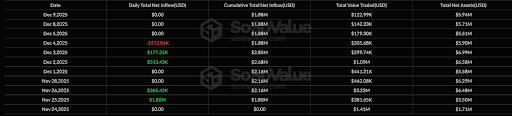
SoSoValue data shows that the Dogecoin ETFs have continued to see their daily volume and inflows decline since they launched last month. On December 10, the Grayscale and Bitwise DOGE ETFs recorded a trading volume of $125,100. Meanwhile, these funds as a group saw a total net inflow of $171,920 on the day.

Further data from SoSo Value shows that the Dogecoin ETFs trading volume has been on a decline since December 2, when they recorded a daily trading volume of $1.09 million. These funds have recorded only three 7-figure trading volume days out of 12 trading days since November 24, when Grayscale’s Dogecoin fund launched.
Source: Chart from SoSoValue on X

This is relatively low and signifies little demand for the DOGE ETFs among institutional investors. For context, Grayscale’s Chainlink ETF, the only LINK fund at the moment, has outperformed the Dogecoin ETFs despite launching at the start of this month. Grayscale’s LINK ETF has a total net asset of $77.71 million, while the DOGE ETFs have total net assets of $6.01 million.

The net flows also highlight the underperformance of these Dogecoin ETFs. Since launching, Bitwise’s DOGE fund has recorded a net outflow of $972,840. Meanwhile, Grayscale’s fund has taken in just over $3 million. The funds, as a group, have recorded net inflows on five of 12 trading days.

Possible Reason For The Underperformance

Bloomberg analyst Eric Balchunas had warned before now that crypto ETFs like the Dogecoin ETFs would record fewer assets given their distance from Bitcoin in terms of market cap. “’The further away you get from BTC, the less asset there will be,’ he said. Notably, DOGE funds have the lowest net assets among the top 10 cryptos by market cap with ETF wrappers.

The Solana and XRP ETFs, which also just launched last month, have outperformed the Dogecoin ETFs, although there are more funds offering SOL and XRP. Meanwhile, Balachunas’ theory hasn’t applied to the LINK ETF, as it has outperformed DOGE funds despite Chainlink having a lower market cap than Dogecoin.

Furthermore, the Hedera and Litecoin ETFs also boast larger net assets than the Dogecoin ETFs, indicating that institutional investors are simply not bullish on DOGE, possibly due to its meme coin status and lack of utility. DOGE is, so far, the only meme coin with an ETF wrapper.

At the time of writing, the DOGE price is trading at around $0.138, down over 6% in the last 24 hours, according to data from CoinMarketCap.

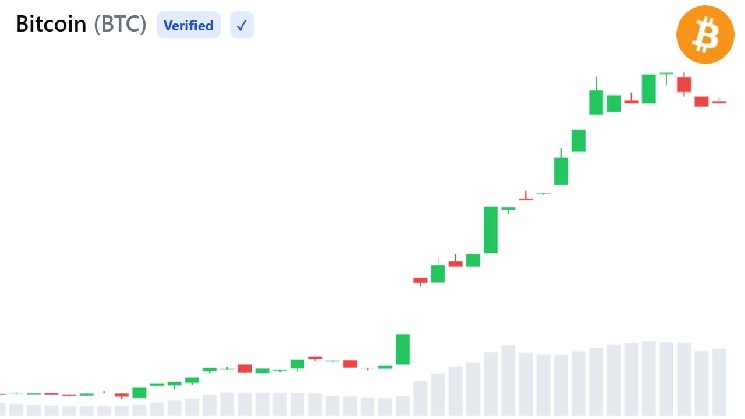
DOGE trading at $0.13 on the 1D chart | Source: DOGEUSDT on Tradingview.com

Пов'язані матеріали

Odaily Editorial Department Tea Party (July 8)

Odaily Editorial Team Casual Chat (July 8) This is an informal column from Odaily's editorial team, sharing immediate thoughts on industry news, data, and hot topics from various angles. It presents investment ideas and opportunity hypotheses still under verification—which may not be direct wealth codes but questions in themselves—alongside observations from industry interactions and materials that genuinely enhance the team's understanding. The content is based on real investment and observation experiences, carries no advertising, and does not constitute investment advice. Its purpose is to broaden perspectives and supplement information sources, not to create consensus. Team Member Shares: * **Wenser (@wenser2010):** Noted a deeper correction (nearly 30%) in US and Korean stocks, including memory stocks, but remains bullish on DRAM due to perceived supply shortages. In prediction markets, personal small bets outperformed blind copying; favors France to win the World Cup. Views crypto-related stocks like STRK as bearish for now, while seeing Circle and Coinbase as potential rebound plays. Observes recent strength in software stocks like Microsoft but is unsure if it's a sustained recovery. * **Bcxiongdi (@bcxiongdi):** Discusses the recent "recovery training" in meme coin markets on Solana and BSC, characterized by small-scale PVP opportunities, admitting to having sold many assets too early. Suggests also watching the Robinhood chain. Found World Cup prediction markets challenging, advising to consider buying during matches rather than only before. * **Azuma (@azuma_eth):** Focuses on the US stock market, particularly the significant semiconductor correction. Believes demand fundamentals remain and considers buying the dip in DRAM stocks. Notes a potential rotation signal as hedge funds have recently concentrated buying in tech stocks. Plans to continue adding to RKLB (Rocket Lab) stock, seeing limited downside and high upside potential at current levels after its founder's share sale window closed.

Odaily星球日报7 хв тому

Odaily Editorial Department Tea Party (July 8)

Odaily星球日报7 хв тому

Former Huawei 'Genius Teen' Who Questioned DeepSeek Interview Lands in 'Crossfire' from Web3 Investor

Former Huawei "Genius Youth" Li Bojie recently drew public attention by criticizing his interview experience with DeepSeek. The controversy escalated when Du Jun, co-founder of Web3 investment firm ABCDE Capital, publicly accused Li of being "the founder with the least sense of contractual spirit" he had ever cooperated with, sparking a dispute over Li's startup project, Metagent. Li detailed a frustrating DeepSeek interview where he was accused of potential plagiarism, leading him to end the session. The spotlight then shifted to his venture, Metagent, a Web3+AI project aiming to tokenize AI agents. ABCDE invested $1.5 million, with an initial $500k disbursed. Du Jun claimed the project's progress was severely lacking, with a poor-quality demo and minimal social media activity. He alleged Li stopped communicating, deleted his Telegram, and failed to provide proper financial reporting. In response, Li argued the remaining $1 million was never received, crippling operations and forcing salary cuts. He stated he left Metagent in October 2024 due to family reasons and Web3 compliance concerns, with board approval. He claimed to have fulfilled disclosure duties and that his subsequent projects avoided conflicting fields. Other investors, including ArkStream Capital, shared negative due diligence experiences, citing unprofessional contracts and evasive answers on tokenomics. Metagent's social media went silent in June 2024, effectively stalling. Li has since moved to a new consumer AI agent platform, Pine AI (formerly Logenic AI), which has raised $25 million in Series A funding. He served as its Chief Scientist but recently left, clarifying he was not the founder and departed due to a shift in research interests.

Foresight News37 хв тому

Former Huawei 'Genius Teen' Who Questioned DeepSeek Interview Lands in 'Crossfire' from Web3 Investor

Foresight News37 хв тому

SemiAnalysis: Anthropic's Q3 Profit to Exceed $1 Billion

Research firm SemiAnalysis reveals that Anthropic is reshaping the AI commercialization landscape with profitability and growth rates far exceeding competitors. Leveraging a high-margin, API-centric business model, Anthropic has become a leader in the B2B AI market. The report projects that Anthropic will achieve a GAAP EBIT of $1 billion in Q3 2026, with a 6% margin. Its Annual Recurring Revenue (ARR) has surged from $9 billion at the end of 2025 to over $60 billion currently. If it maintains a Net New ARR (NNARR) of approximately $15 billion per month, its ARR could reach $300 billion by the end of 2027, implying a $6 trillion enterprise value and making it the world's most valuable company. Anthropic secretly filed for an IPO on June 1st. SemiAnalysis argues the timing is strategically urgent due to narrowing capital market windows as rivals like Alphabet and Meta secure major funding. The superior financials and business model suggest Anthropic should go public before OpenAI to seize the competitive initiative. The performance inflection stems from the explosive adoption of Claude Code, which now accounts for over 7% of all GitHub commits, driving monthly NNARR from $3 billion in January to $11 billion in March. Anthropic's revenue structure differs significantly from OpenAI's. Approximately 75-85% of Anthropic's ARR comes from usage-based API fees, with consumer subscriptions constituting only about 5%. In contrast, over 65% of OpenAI's Q1 2026 revenue was from subscriptions, with ~40% from consumers. The API model's key advantage is no per-user revenue cap, enabling growth within existing accounts. Anthropic's Net Revenue Retention (NRR) is an extraordinary 500%. This drives superior gross margins, now in the mid-60% range versus -94% in 2024, with API margins exceeding 80%. Core drivers are improved inference efficiency and a largely enterprise-focused model without the cost of serving hundreds of millions of free users. The report introduces "EBTIT" (Earnings Before Training & Interest & Taxes) to measure re-investment capacity, projecting Anthropic's cumulative EBTIT through 2028 will be $250 billion higher than OpenAI's. Over 65% of lab ARR currently comes from programming use cases. Cybersecurity is seen as the next major vertical, with upcoming model releases like Fable expected to further increase token pricing and expand NNARR. Indirect sales via hyperscaler platforms (AWS Bedrock, Azure Foundry) now account for 15-20% of ARR. A core constraint is compute supply. By 2030, combined unconstrained compute demand from Anthropic and OpenAI could exceed 100 GW, far outstripping projected new capacity. IPO proceeds are seen as crucial to lock in future compute resources. Key risks include potential price cuts by OpenAI, competitive pressure from Google DeepMind and Meta in coding models, potential government restrictions on frontier model releases, and margin dilution from growing indirect "Token-as-a-Service" sales. Regulatory actions that narrow the capability gap between open-source and proprietary models are highlighted as a fundamental threat to Anthropic's moat.

marsbit50 хв тому

SemiAnalysis: Anthropic's Q3 Profit to Exceed $1 Billion

marsbit50 хв тому

Торгівля

Спот
活动图片