On-chain Analyst: Why Are Most Zcash Transactions Still Traceable?

marsbitОпубліковано о 2026-05-26Востаннє оновлено о 2026-05-26

Анотація

Title: Why Most Zcash Transactions Remain Traceable Zcash, a privacy-focused cryptocurrency launched in 2016, was designed to offer anonymity by hiding transaction details like sender, receiver, and amount using zero-knowledge proof technology (zk-SNARKs). However, in practice, a significant portion of ZEC transactions are still traceable on-chain. The key reason is Zcash's dual-address system. It features transparent addresses (t-addresses), which work like standard Bitcoin addresses with all data public, and shielded addresses (z-addresses) that encrypt transaction details. There are four transaction types with varying privacy levels: fully transparent (t→t), partially shielded (t→z and z→t), and fully private (z→z). Despite its privacy capabilities, most real-world Zcash activity involves transparent addresses, primarily because major exchanges and institutions use them for regulatory compliance. As a result, blockchain analytics platforms like Arkham can track and attribute a substantial volume of Zcash transactions. Arkham reports it has identified entities behind over $420 billion in ZEC transaction volume. Case studies highlight this traceability: the U.S. government holds seized Zcash from a dark web case, visible via its transparent wallet, and individual traders' profitable moves are trackable from purchase to exchange deposit. In conclusion, Zcash's privacy is not inherent but user-dependent. While purely shielded (z→z) transactions remain cryptographically pr...

Author: Willo, Arkham

Compiled by: Yuliya, PANews

Editor's Note: Zcash, a cryptocurrency launched in 2016 focused on privacy protection, is built on the codebase of Bitcoin. Despite its core vision of concealing transaction information, in practical application, the majority of ZEC transactions can still be traced on-chain. This article will analyze how Zcash works and explore why most ZEC on-chain transactions are still traceable, illustrating that the actual degree of privacy protection Zcash can provide depends entirely on how users choose to use it.
Zcash is a digital currency built on Bitcoin's underlying technology, but its design goal was to address what its creators saw as Bitcoin's biggest flaw: the complete transparency of transaction information. Like Bitcoin, Zcash has a hard cap of 21 million coins, halves its block reward every four years, and operates on a Proof-of-Work (PoW) consensus mechanism. At the underlying architectural level, it also shares Bitcoin's UTXO transaction model. In most cases, Zcash transactions look identical to Bitcoin transactions. The difference is that part of Zcash's transactions are designed to be completely invisible.

In the current crypto cycle, privacy is one of the most emblematic themes. As global regulatory pressure intensifies and on-chain monitoring tools become increasingly powerful, more retail and institutional users are beginning to question whether public blockchains expose too much information about users and their transactions? In this context, privacy coins have leaped from a niche area of the market to a high-profile focal category. Because of this, Zcash has become one of the best-performing assets of 2025.

History and Evolution

Zcash was launched in October 2016 by the Electric Coin Company (ECC), founded by cryptographer Zooko Wilcox-O'Hearn, and co-developed by an experienced team of academic cryptographers. The project's origins can be traced back to a 2014 paper introducing the Zerocash protocol, co-authored by researchers from MIT, Johns Hopkins University, and Tel Aviv University. The paper theoretically proposed a protocol that would allow users to make private payments while maintaining processing speeds comparable to Bitcoin.

The core zk-SNARK cryptography technology of Zcash did not originate with cryptocurrency but stems from decades of theoretical research in computer science. The contribution of the Electric Coin Company was to transform this theory into practical technology capable of running efficiently on a real blockchain. In 2016, the team held a cryptographic setup ceremony to generate system parameters; subsequently, in 2018, a second ceremony called Sapling was held. This upgrade significantly improved the efficiency of shielded transactions, making them practical for everyday use.

Zcash's governance system consists of two organizations: the Electric Coin Company, responsible for protocol development and maintenance, and the independent non-profit Zcash Foundation, responsible for overseeing the broader ecosystem development. A portion of newly mined ZEC coins is allocated as funding for these two organizations, ensuring the project's continued development without relying on external investment.

Zero-Knowledge Proofs

The core technology enabling Zcash's privacy protection is called "zero-knowledge proofs." Specifically, Zcash employs a derivative technology known as zk-SNARKs (Zero-Knowledge Succinct Non-Interactive Argument of Knowledge).

This concept may sound abstract, but its core idea is actually very easy to understand. A zero-knowledge proof allows one party to prove to another that something is true without revealing any specific information. In the case of Zcash, network nodes can verify whether a transaction is legal and valid (e.g., confirming that the sender indeed has sufficient funds and did not forge coins out of thin air) without needing to know who the sender is, who the recipient is, or the specific transaction amount.

This technology is a major breakthrough in cryptography. Bitcoin's transparent nature, while beneficial for auditing and tracing, is a major pain point for users who desire financial privacy. The Zcash development team cleverly layered zk-SNARK technology on top of Bitcoin's codebase, providing users with an optional layer of privacy protection.

Transaction Types

The Zcash system includes two types of addresses: transparent addresses (t-addresses) and shielded addresses (z-addresses).

  • Transparent addresses operate exactly like Bitcoin addresses; all transaction activity is publicly visible on the blockchain.

  • Shielded addresses exist in an encrypted pool of funds, where the sender, recipient, and transaction amount are hidden from external observers.

The combination of these two address types produces four different transaction types, each with different levels of privacy protection:

  • t → t (Transparent to Transparent): Completely Public. The sender, recipient, and amount are clearly visible on the blockchain. This is indistinguishable from a standard Bitcoin transaction.

  • t → z (Transparent to Shielded): The amount of funds entering the shielded pool is public, but the recipient is hidden. It's like watching money go through a door: you can see it went in, but you don't know into whose hands it ultimately went.

  • z → t (Shielded to Transparent): The recipient and amount are public, but the sender is hidden. The funds flow out of the encrypted pool, but their ultimate origin cannot be traced by outsiders.

  • z → z (Shielded to Shielded): Completely Private. The only publicly visible data on the blockchain is the transaction fee. The sender, recipient, and amount are all thoroughly hidden through cryptography.

In practical application, historically, the vast majority of Zcash transaction activity remains transparent. Due to compliance requirements, most cryptocurrency exchanges and institutional participants default to using transparent addresses (t-addresses). This means the proportion of publicly readable data in Zcash's transaction history is far greater than one might expect from a "privacy coin."
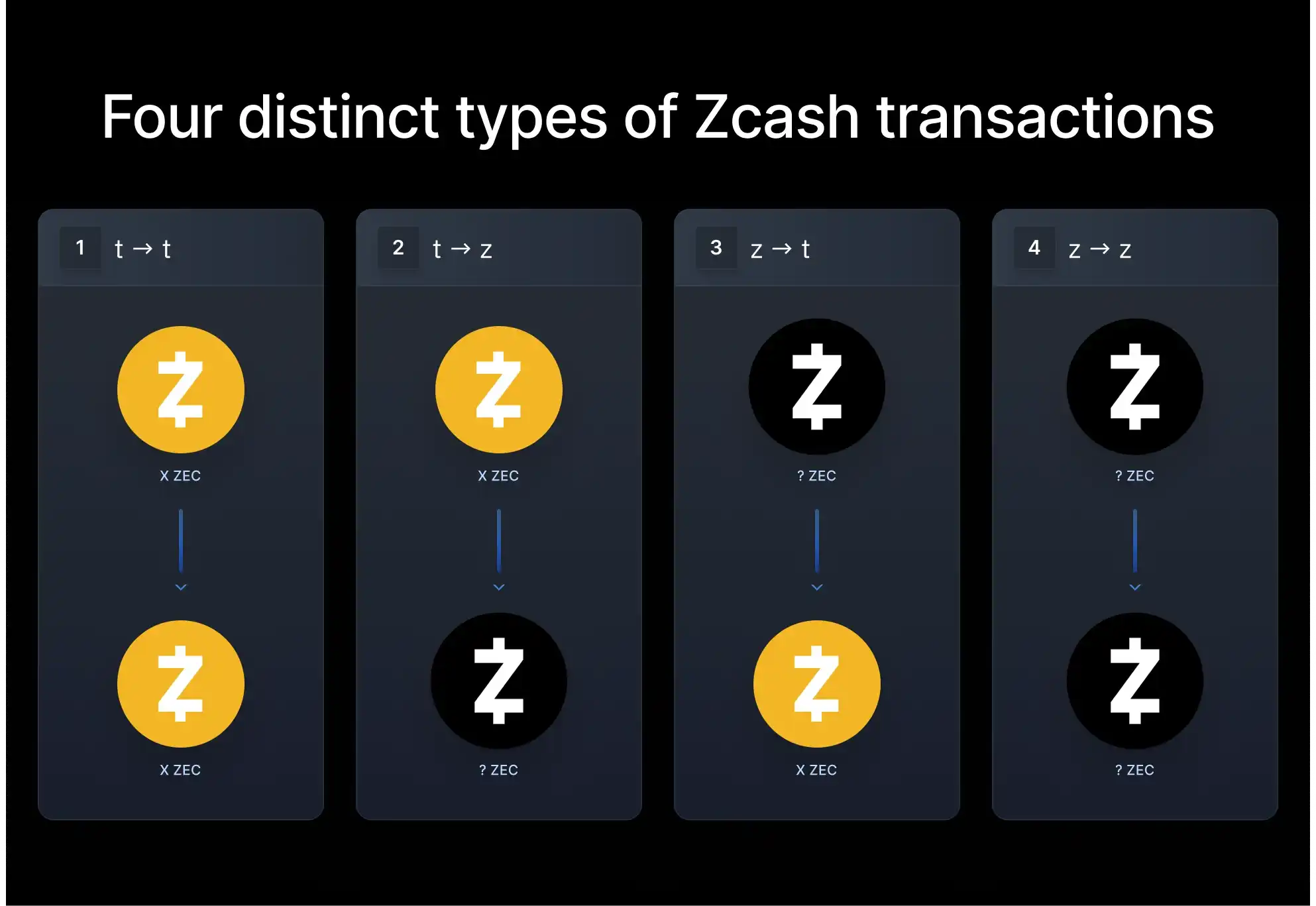
ZEC Transaction Types

Tracking Zcash with Arkham

Conventional wisdom holds that privacy coins are untraceable, but the reality of Zcash challenges this perception.

Currently, the blockchain data analytics platform Arkham has successfully labeled over half of Zcash's on-chain activity and identified the individuals and institutions behind a staggering $420 billion in transaction volume. This is a shocking statistic for a blockchain network specifically designed to hide transaction data. This tracing is possible fundamentally because most Zcash transactions still use the transparent mode. Furthermore, as gateways for funds entering and exiting the system, cryptocurrency exchanges, custodians, and major financial institutions typically retain and use transparent addresses for ease of fund transfer and management.

Of course, shielded transactions themselves remain highly opaque: z→z (shielded to shielded) transaction activity is untraceable; such shielded addresses are simply labeled as "SHIELDED" on the Arkham platform. However, the points where funds enter and leave the encrypted pool are often publicly visible, and this is the breakthrough point for data intelligence analysis.
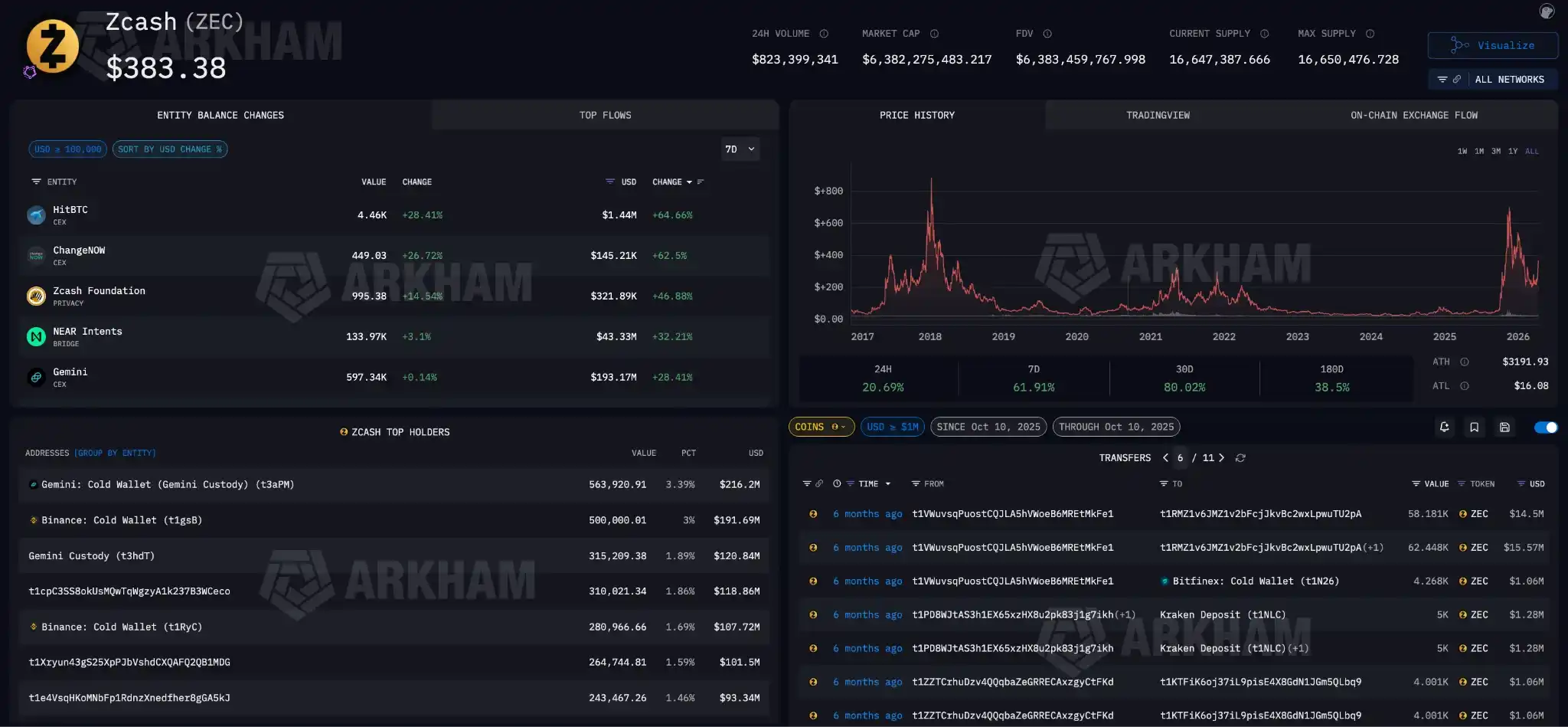
Zcash on Arkham

Case Study: The U.S. Government's Zcash Holdings

In Arkham's Zcash data records, one particularly notable entity is the United States Government. The U.S. government's wallet holds Zcash seized from Alexandre Cazes, the founder of the darknet marketplace AlphaBay, who was arrested in 2017. At the time of seizure, this Zcash was worth approximately $737,000. For eight years, this asset remained unmoved, and its market value has since doubled. The public can track this wallet's activity in real-time on the Arkham platform.

Case Study: A $6.6 Million Profit Trade

Arkham's data can also reveal large fund movements by individual traders. For example, an address purchased $4.49 million worth of Zcash during the market crash on October 10th. After holding for five and a half weeks, this address transferred the tokens to the Gemini exchange. Assuming the trader immediately sold upon depositing the tokens to the exchange, this trade would have generated a net profit of $6.6 million, meaning their initial investment more than doubled. On the Arkham platform, the complete history of this trade is clearly visible, including the specific times of each fund transfer and the name of the exchange where the tokens ultimately flowed.
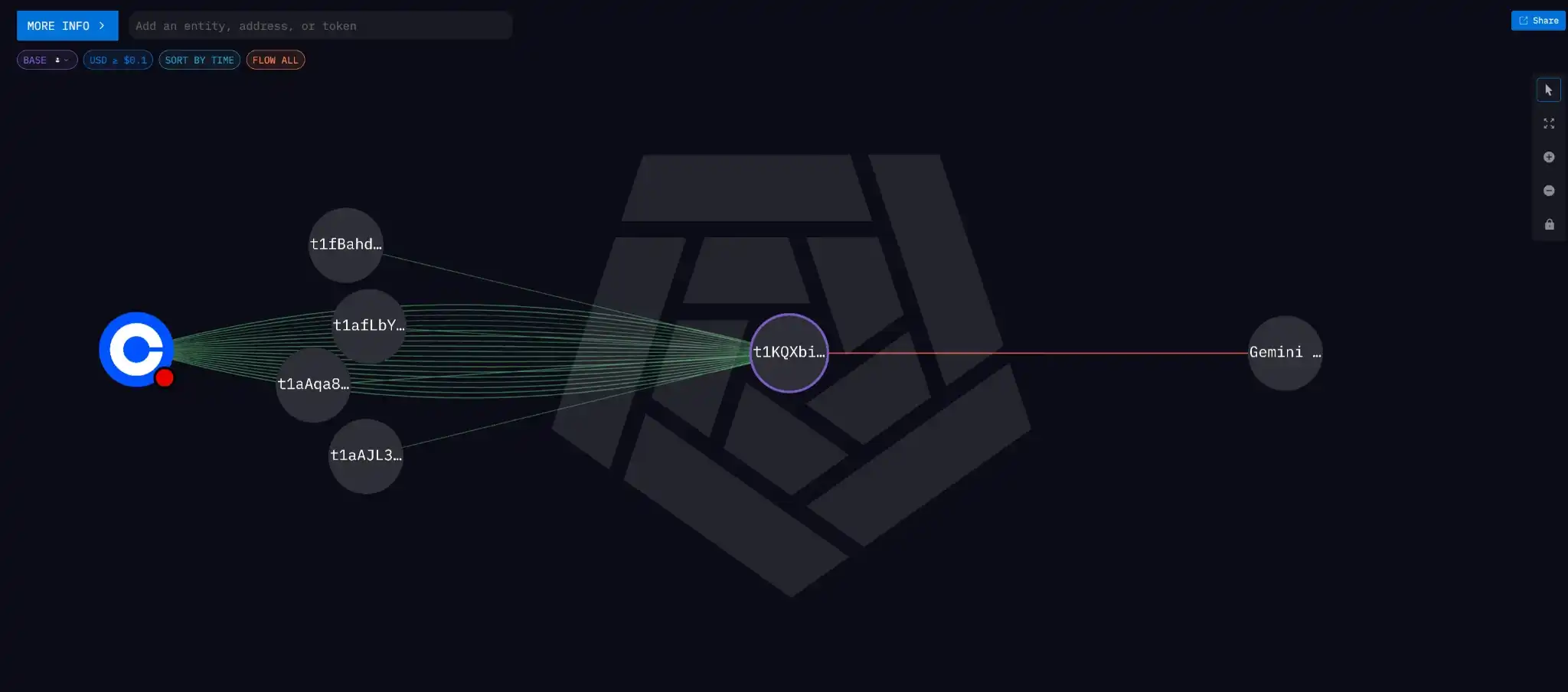
Arkham Visualization Tool

Conclusion

Zcash occupies a very unique position. It is one of the most technologically complex privacy tools in the cryptocurrency space, yet also one of the most misunderstood projects. People often assume that privacy coins are completely untraceable by default, but this is not accurate. In practice, the vast majority of Zcash fund flows pass through transparent addresses; to comply with regulations, major exchanges also default to using public, transparent addresses. It is precisely because of this that blockchain intelligence platforms like Arkham can successfully associate over $420 billion in transaction volume with known entities on a blockchain explicitly designed to resist data analysis.

This does not mean Zcash's privacy capabilities are flawed. Pure shielded transactions (z to z) remain cryptographically impregnable and unobservable. All of this shows that the actual degree of privacy protection Zcash can provide depends entirely on how users choose to use it.

For any user wishing to explore Zcash's on-chain activity firsthand, Arkham's extensive data coverage provides the most comprehensive information picture available today. Users can use it to track ZEC transaction history, entity identities, and account balances, set alerts for significant fund movements, and leverage Arkham's AI technology to deeply mine potential information across the entire blockchain network.


Пов'язані питання

QWhat are the two types of addresses in the Zcash network and how do they differ?

AZcash has two types of addresses: transparent addresses (t-addresses) and shielded addresses (z-addresses). Transparent addresses function exactly like Bitcoin addresses, with all transaction details (sender, receiver, amount) publicly visible on the blockchain. Shielded addresses exist within an encrypted pool, hiding the sender, receiver, and transaction amount from external observers.

QWhy can a significant portion of Zcash transactions be tracked on-chain, according to the article?

AMost Zcash transactions can be tracked because the majority of transaction activity is conducted using transparent addresses (t-addresses). Furthermore, key on-ramps and off-ramps like cryptocurrency exchanges and financial institutions default to using transparent addresses for compliance and operational reasons, creating visible entry and exit points for funds.

QWhat is the core cryptographic technology that enables Zcash's privacy features?

AThe core technology enabling Zcash's privacy features is a form of zero-knowledge proof called zk-SNARKs (Zero-Knowledge Succinct Non-Interactive Argument of Knowledge). This allows network nodes to verify that a transaction is valid without learning the sender, receiver, or transaction amount.

QWhich Zcash transaction type provides complete privacy, and what information remains public?

AThe z→z (shielded to shielded) transaction type provides complete privacy. In these transactions, the sender, receiver, and amount are all cryptographically hidden. The only information that remains publicly visible on the blockchain is the transaction fee.

QWhat key point does the article make about the effectiveness of Zcash's privacy protection?

AThe article concludes that the actual privacy protection Zcash provides is not inherent or default but is entirely dependent on how users choose to use it. While pure shielded (z→z) transactions are cryptographically secure and untraceable, the prevalence of transparent address usage means much of the network's activity is visible.

Пов'язані матеріали

Microsoft Halts Vibe Coding: "Burning Tokens" Is Now More Expensive Than Employees

Microsoft has halted the widespread internal use of Claude Code, withdrawing licenses from most employees by the end of its fiscal year, June 30, 2026. This reversal comes just six months after actively promoting the AI coding tool to boost productivity via "vibe coding"—where developers describe intent in natural language and let the LLM generate code. The core issue isn't the tool's effectiveness; internal reports suggest employees preferred Claude Code over Microsoft's own Copilot CLI. The problem is financial: the "copilot mode" adds a variable, consumption-based token cost on top of existing employee salaries without a proportional revenue increase. As usage grew, the token bills became unsustainable, leading to what sources describe as a cost-structure failure. Similar overruns have been reported at other firms like Uber. The article contrasts this with the approach of AI-native startups, exemplified by Y Combinator's philosophy. Here, high token consumption is strategic—it replaces, rather than supplements, human labor. Startups operate with tiny teams where AI agents handle work previously done by many, making the high token bill financially viable as it offsets much larger personnel costs. The conclusion is that "vibe coding" isn't dead, but its economics fail within traditional corporate structures that treat AI as a productivity add-on for existing staff. Success requires a foundational shift to an AI-native organization, where processes are built to be "legible to AI," and the company's core knowledge and assets reside in documented, AI-accessible systems rather than solely in employees' minds. The future divide will be between companies that merely add AI tools and those that redesign their organizations around them.

marsbit10 хв тому

Microsoft Halts Vibe Coding: "Burning Tokens" Is Now More Expensive Than Employees

marsbit10 хв тому

Metrics Ventures Market Watch: The Brewing Storm

In the past month, the market has been actively trading contrasting expectations, balancing global supply chain disruptions fueling re-inflation against both actual and anticipated (Walsh) interest rate hikes. This volatility has impacted commodities and most equities, though tech has temporarily benefited from concentrated short-term liquidity. Fundamentally, as previously analyzed regarding the Strait of Hormuz situation, the US faces deep-seated balance sheet issues beyond what any single Fed chair can resolve. Hypotheses around a figure like Walsh could only materialize if AI fundamentally reshapes production relations. Until then, most non-AI-leading nations (effectively all except the US and China) risk fiscal and monetary policy collapse, rendering the identity of the Fed chair ultimately irrelevant. For crypto assets, there is currently no clear role in these dominant narratives. The market remains strongly capped by the 200-day moving average. While trends may shift from "anything but AI" to "anything but mines," this phase is dominated by the silicon vs. carbon (AI vs. traditional) dichotomy, leaving little room for crypto—though its time will come. **Market Overview & Commentary** The crypto market lacks significant catalysts beyond hype, plagued by low volume and scarce innovation, with clear technical resistance. Currently, crypto struggles for attention as global focus lies elsewhere. Assets like gold, oil, and grains are more direct hedges against supply-chain-driven inflation/stagflation. Bitcoin needs more time for capitulation and consolidation; this reset is expected to last until at least Q4 2026. Looking ahead, three factors will likely drive future market volatility: 1. Whether Walsh repeats the patterns of predecessors like Bassant or Musk, shifting stance into a new policy cycle. 2. The market underestimates the severity of global supply chain damage and the prolonged time needed for repair, which will eventually lead to recognition of acute resource shortages and price swings. 3. AI non-beneficiary, high-inflation nations (e.g., UK, Japan) will face severe fiscal and monetary crises. Rapid AI-driven displacement could trigger a collapse of existing credit and welfare systems. Ultimately, the market may realize that an AI bubble burst could spark contagious sovereign credit crises. The monetary and fiscal responses to such a scenario could serve as the ultimate catalyst for Bitcoin's next major bull run.

marsbit1 год тому

Metrics Ventures Market Watch: The Brewing Storm

marsbit1 год тому

Insiders Betting on Musk Are Reaping 'Historic Returns'

The largest IPO in history is imminent as SpaceX, led by Elon Musk, is set to price its offering on June 12. At a targeted valuation near $2 trillion, this event will mint new billionaires from Musk's inner circle of long-time allies, rewarding their loyalty with unprecedented returns. Key beneficiaries include Antonio Gracias, Musk's close friend and confidant, who holds a 7.3% stake potentially worth over $140 billion, making him the second-largest individual shareholder. Gwynne Shotwell, President and COO since 2002, holds shares valued at roughly $2 billion. Bret Johnsen, the CFO, holds stock worth approximately $1.4 billion. Luke Nosek, a PayPal co-founder and early investor, stands to gain about $5.3 billion. The IPO filing also reveals complex and controversial financial arrangements. SpaceX has guaranteed nearly $20 billion in payments from xAI's subsidiary to Gracias's Valor Equity Partners for AI hardware leases—deals auditors flagged as "failed sale-leaseback" transactions, forcing SpaceX to record them as debt. Despite rapid revenue growth, SpaceX is not profitable, posting a $49 billion loss in 2025 and a $4.3 billion loss in Q1 2026. Capital expenditures are soaring, with over 60% directed toward AI. Public investors will inherit these losses, significant debts, and a governance structure heavily controlled by insiders, including a provision granting Musk up to a billion additional shares if one million people live on Mars.

链捕手1 год тому

Insiders Betting on Musk Are Reaping 'Historic Returns'

链捕手1 год тому

Ethereum Reduced to a Chinese Concept Stock

The article titled "Ethereum Becomes a Chinese Concept Stock" presents a critical analysis of Ethereum's perceived decline in market confidence and its structural parallels to Chinese companies listed on US stock exchanges. It begins by noting significant sell-offs by early investors like Wanxiang and key figures like Bankless's Hoffman in 2026, despite Ethereum's strong fundamental activity. The piece questions the erosion of trust in Vitalik Buterin and the Ethereum Foundation (EF), arguing that while other ecosystems have faced founder controversies, Ethereum's issues stem from its internal governance model. The author draws a direct comparison to "China concept stocks," which are Chinese businesses operating globally but reliant on foreign capital and listings. Similarly, Ethereum, funded early by Chinese capital like Wanxiang, developed a strong institutional framework from its IXO to its PoS transition. The core problem, according to the article, is a leadership vacuum regarding price and direction. Vitalik's move to make the EF smaller and less active is framed as a mistake. While he advocates for ETH as a "commodity," the ecosystem lacks a clear entity to steward its price stability, creating tension within the PoS system, as seen with Lido's challenges. The narrative suggests that excessive abstraction and a hands-off approach from the EF have left the community adrift, contrasting with more proactive foundations like Solana's. The article then examines emerging technical narratives for Ethereum: privacy (ZK-proofs), AI integration, and a refocus on Layer-1. However, it observes a shift from Ethereum leading as a "world computer" to merely adapting to trends like AI, where crypto-native projects are finding success independently of Ethereum. The piece posits that Ethereum's unique value in an increasingly fragmented world may be as a permissionless, global financial testing ground—a neutral platform amid geopolitical tensions. In conclusion, it asserts that Ethereum's fate mirrors that of China concept stocks: an asset born from one region (conceptually "A"), funded by another ("B"), and dependent on "B" for exit liquidity. While Ethereum's "golden age" may be over, and selling pressure from early backers will continue, it remains positioned as a critical linkage point in a divided global landscape, standing at a new, albeit uncertain, starting point.

marsbit1 год тому

Ethereum Reduced to a Chinese Concept Stock

marsbit1 год тому

Торгівля

Спот
Ф'ючерси
活动图片