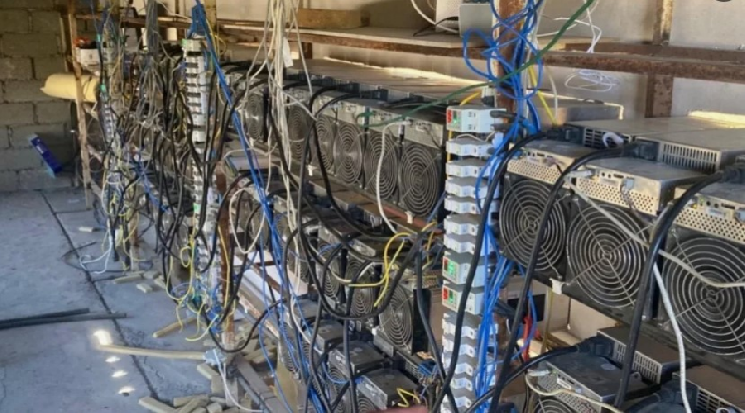
Ethereum Reduced to a Chinese Concept Stock

marsbitОпубліковано о 2026-05-26Востаннє оновлено о 2026-05-26

Анотація

The article titled "Ethereum Becomes a Chinese Concept Stock" presents a critical analysis of Ethereum's perceived decline in market confidence and its structural parallels to Chinese companies listed on US stock exchanges. It begins by noting significant sell-offs by early investors like Wanxiang and key figures like Bankless's Hoffman in 2026, despite Ethereum's strong fundamental activity. The piece questions the erosion of trust in Vitalik Buterin and the Ethereum Foundation (EF), arguing that while other ecosystems have faced founder controversies, Ethereum's issues stem from its internal governance model. The author draws a direct comparison to "China concept stocks," which are Chinese businesses operating globally but reliant on foreign capital and listings. Similarly, Ethereum, funded early by Chinese capital like Wanxiang, developed a strong institutional framework from its IXO to its PoS transition. The core problem, according to the article, is a leadership vacuum regarding price and direction. Vitalik's move to make the EF smaller and less active is framed as a mistake. While he advocates for ETH as a "commodity," the ecosystem lacks a clear entity to steward its price stability, creating tension within the PoS system, as seen with Lido's challenges. The narrative suggests that excessive abstraction and a hands-off approach from the EF have left the community adrift, contrasting with more proactive foundations like Solana's. The article then examines emerging t...

In 2023, early Ethereum investor Wanxiang sold tokens multiple times, at an average price of $2,047. In May 2026, Bankless founder Hoffman fully liquidated his ETH holdings, also at an average price of around $2,000.

Bankless can be considered Ethereum's external propaganda department, single-handedly amplifying the top-tier meme concept of 'ETH is Money.' During the 2021 bull market, fervor for ETH equated to a firm bullish stance on the future of blockchain.

Perhaps due to its importance, or perhaps due to eight consecutive departures from the Ethereum Foundation, Ethereum's founder and spiritual leader, Vitalik Buterin, wrote a long confessional article. He candidly stated that the EF (Ethereum Foundation) controls only 0.16% of the ETH supply and should not hold a position superior to other ecosystem nodes. He also mentioned he would gradually withdraw from operations, returning freedom to Ethereum.

Ethereum Has No Killer

ETH is Money?

Whether you believe it or not, I certainly do.

But how did all this vanish? I'm referring to the market's confidence in $ETH's price, and holders' trust in the Ethereum Foundation and Vitalik. In terms of fundamental activity, now is arguably Ethereum's strongest period of dominance. So why is there so much discontent? Is it just because of the token price?

If $BTC plunges, it's seen as a good buying opportunity. If $SOL drops sharply, its extreme rebound post-FTX has proven its value. If $HYPE falls, one can trade the waves with Arthur Hayes.

Attributing it to Vitalik personally is a convenient reason. However, there's no shortage of abstract public chain founders and foundations. Solana founder Anatoly proactively hard-pitches Perp DEX concepts within the Hyperliquid community. Multiple Ripple founders engaged in wholesale dumping of $XRP. Let alone the proliferation of L2 founders in this era, mostly ego-inflated masters of TGE, seen with the Movement clique.

Upon careful comparison, while Vitalik might be abstract and the EF might be 'inefficient,' it's hard to say they created Ethereum's current predicament. If they are not the problem themselves, then perhaps the broader environment is.
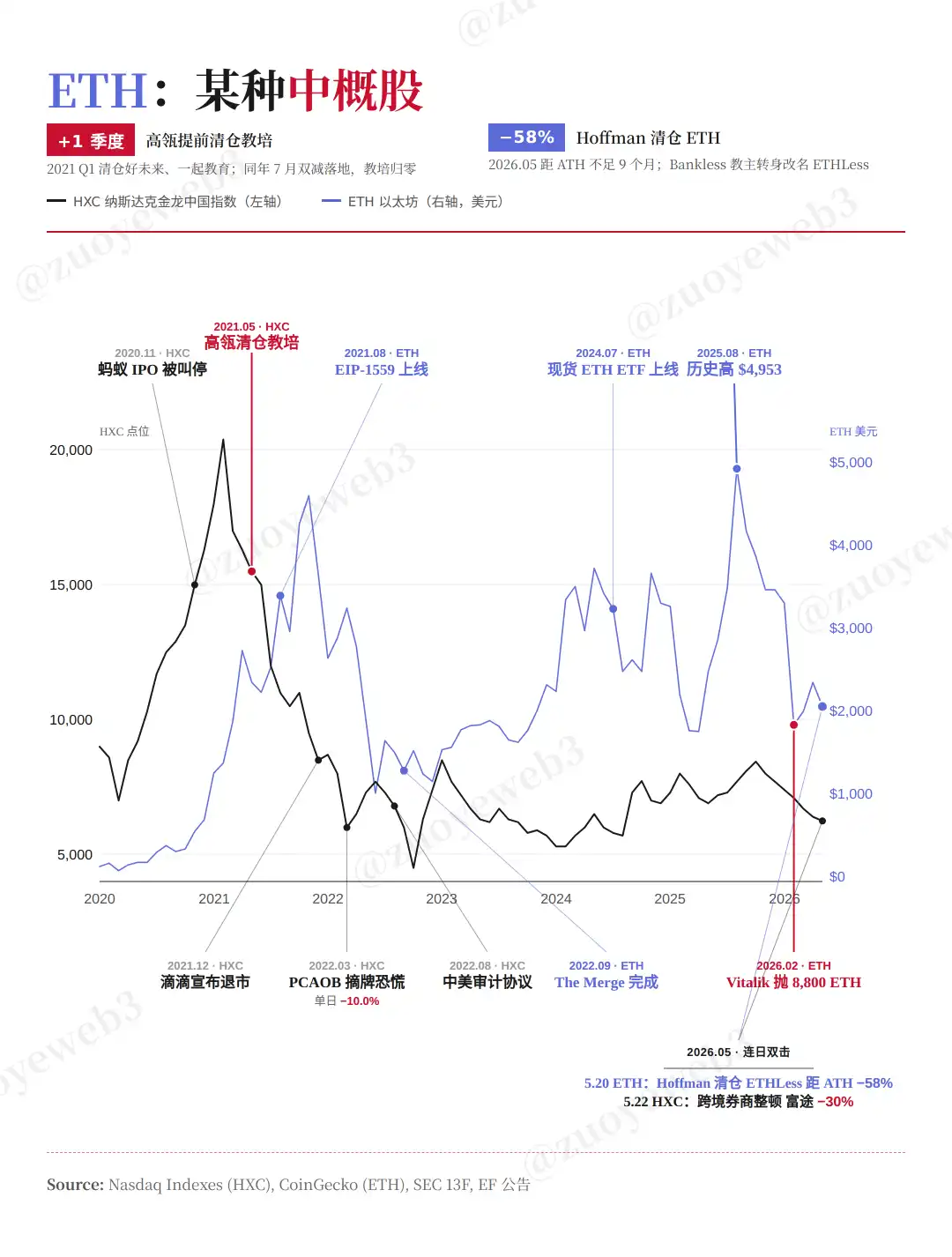
Image Caption: ETH is Money?

Image Source: @zuoyeweb3

The most typical case is Chinese concept stocks. Offshore structures + dollar funds + US IPO created a wealth myth over the past 20 years. Setting aside trial products like Brilliance Auto and China.com, the true first Chinese concept stock was Sina.com in 2000, formally initiating the wave.

The division of labor model of 'US concept + Chinese implementation' we see today is a legacy of this system. Even Ethereum itself is the last remnant of a certain type of Chinese implementation that went global.

In 2014/15, Vitalik first became a guest of Shen Bo and then received a $500,000 investment from Wanxiang, led by Xiao Feng. Unlike Bitcoin's mining model, Ethereum's IXO fundraising, PoW mining, and later PoS staking pulled three waves of passengers onto one vehicle.

In other words, ETH has been a system with relatively strong institutional involvement from the start. I don't mean to say ETH is a heavily manipulated token, and Vitalik indeed wishes for the EF to be just an ordinary node. However, within the Ethereum ecosystem, there absolutely does not exist a state of equal status uniformly distributed among all nodes. It wasn't before, isn't now, and won't be in the future.

Under these circumstances, the public chain founder and foundation actually need to take on more functions. This is unrelated to the token price. Precisely because Ethereum is fragmented with competing powers, someone must stand up and use relatively strong appeal to curb the system's disorderly entropy increase.

But Vitalik chose to first let the EF become bloated, from 'Infinite Garden' to the 'Ladder' theory. Excessive abstraction has left token holders at a loss, especially during the rsETH incident where Aave founder Stani essentially became the 'Duke Huan of Qi,' acting in the name of the king to pacify the lords.

Even the Solana Foundation set aside past grievances to actively endorse DeFi United, only to be met with the EF's routine token sales and Vitalik's personal silence.

Doing too much is centralization. But doing nothing, being overly restrained, is also an abuse of a dominant position—deliberately suppressing oneself, premised on 'the self believing it is important.'

Therefore, Vitalik's choice to make the EF smaller is a mistake. The correct approach would be for Vitalik to recede into the background as a mysterious figure and hand the foundation over to strong institutional players, more pragmatically focused on Ethereum's future.

Apart from Bitcoin, all other public chains need to face the practical demands of ecosystem development and adoption rates. On this point, the Ethereum Foundation holds no special status. The enthusiasm for DeFi and ETH is precisely a memory of past times, not pure wealth effect.

In terms of ecological prosperity and real-world adoption, Ethereum's 'killers' have never succeeded. Solana might be anxious about Hyperliquid, but Ethereum is not, just as BTC isn't anxious about Ethereum.

But this preferential treatment is fading. The crisis does not come from external forces but from within. The real distinction lies in: who is responsible for ETH's price, and who is responsible for Ethereum's direction?

Now, Vitalik is choosing to go all-in on privacy, but he should not 'prevent' others from taking responsibility for the token price.

New Narratives Await the Right Price

Commodity or Productive money?

After the $rsETH incident and the approval of staking ETFs, players like BitMine are rapidly building their own Staking services. Meanwhile, LST players like Lido are increasingly focusing on the 'productive ETH' narrative, with protocols like Spark only recognizing Lido's $wstETH product.

Everything is being reassessed. Lido is not as comfortable as it claims. With ETH prices lingering around $2,000, the marginal effect of continuing to scale diminishes, while the pressure to maintain APR returns increases, casting a shadow over the productivity narrative as well.

This highlights the importance of price—or rather, who is responsible for ETH's price. Currently, the situation is that the EF is not responsible, Lido cannot be responsible, and the entire Ethereum PoS system operates in this awkward environment.

Drawing another parallel to Chinese concept stocks: after US stock markets effectively ceased to be viable exit channels, ChangXin Memory Storage latched onto the AI concept, DeepSeek transformed with state capital taking the lead, and aerospace/robotics concepts oscillate between A-shares and H-shares. Whether you like it or not, this is the new narrative framework.
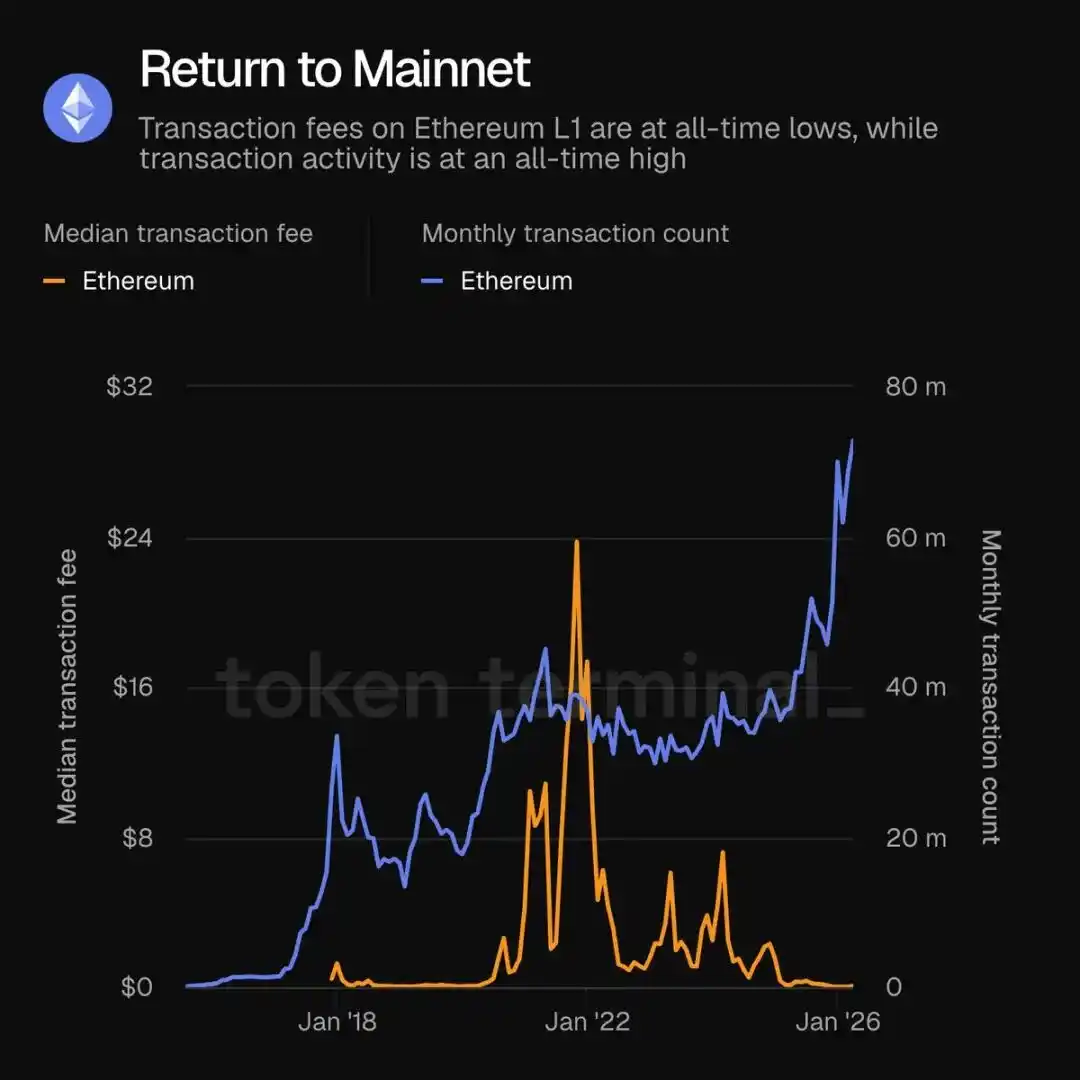
Image Caption: Return to Mainnet.

Image Source: @tokenterminal

With Ethereum's shift back to focusing on L1, mainnet activity exploded. Yet, you don't feel the Ethereum ecosystem is genuinely improving, let alone the token price rising. Something is clearly wrong, but people can't define the problem.

So, what about the current Ethereum technical narratives?

  1. Privacy: Everything can be ZK, the last bastion of decentralization ideals.
  2. AI: Teams like dAI are migrating centralized architectures on-chain, focusing on small model on-device deployment and Agent invocation.
  3. L1: Complete abandonment of the L2-centric model, with all competition over speed and revenue returning to L1.

Compared to the 'world computer' and smart contract technical synergy, Ethereum now needs to forge more connections with reality. Beyond the three above, there are stablecoins, RWA, and many other narratives. But these are not how Ethereum views the world; rather, it's Ethereum's place *within* the world.

The subject and object are inverted, or rather, its position in the new world is unclear. The grand ambition of 'everything can go on-chain' and 'blockchain fights for the future' is gone. Yet, there's always a feeling blockchain can do more. This contradiction, entanglement, and repetition form the threefold chorus of current market sentiment. People hope to see a better Ethereum, but seeing a good Ethereum seems unlikely.

After over a decade of striving, Ethereum did not become the world computer, but it is truly an open computer. Any activity or idea can be experimented with and run on it. While Bankless promoted 'ETH is Money,' Vitalik insisted 'ETH is a Commodity,' a digital product carrying specific functions.

On this point, no one can accuse Vitalik of lying. When Vitalik sold 8,800 tokens in February 2026, he did so slowly via CowSwap. He didn't follow Curve's founder by staking $CRV for stablecoins, nor did he emulate Justin Sun's tactics with $USDD to fleece retail investors.

But as in the Chiang Mai dialogue in January 2026, when asked if given a chance to turn back time ten years, would one choose blockchain or AI, Vitalik didn't give a firm answer. Yet, the reality is set: more and more crypto project teams are pivoting to AI, skillfully applying Go-To-Market methodologies.

  • Hermes Agent broke into the mainstream AI developer circle, with the founding team from Nous Research.
  • xBubble is developed by DappOS, combining AI + intent execution frameworks.
  • OpenRouter founder Alex Atallah is from OpenSea.

You'll find crypto project teams' marketing capabilities aren't limited to on-chain activities. Even in the globally watched AI trend, they can repeatedly keep pace. Even the transit hub model intertwines with stablecoins, traffic distribution, and operations.

But all this has a weak connection to Ethereum. Although dAI and virtuals jointly proposed ERC-8183, attempting to define an autonomous Agent economic activity framework, it's not that the team isn't working. It feels more like active adaptation rather than a leading posture.

If we consider the present a moment for narrative bottom-fishing, the core question is: what value does a public chain hold in the AI era?

Claude repeatedly attacks SaaS, security, and external Agent frameworks. Imagine an absurd scenario: if Claude created its own chain, what would happen to Ethereum?

Under the PoS mechanism, asset migration costs are low enough. But in terms of compliance costs, Claude would still be bound by human legal constraints. An unrestricted free financial testing ground might be Ethereum's most unique value proposition.

Just as when Mythos hammered Palantir's stock, QiAnXin would surge against the trend because hitting the opponent triggers an arms race among counterparts across the ocean, creating an infinite loop.

In other words, in a world of increasing polarization, the demand for connecting the globe will persist long-term. Canton belongs to Wall Street, but Ethereum belongs to all humanity. Just as people in the Sahara have no shoes, pessimists exit, and optimists rejoice.

However, the golden age of $ETH will not return. Wanxiang, the EF, and other institutions will continue to sell. But ETH at $2,000 is at least ten times $200. We stand at a new starting point; we just need a course to sail.

Conclusion

Destined to be alike, ETH truly shares a fate similar to Chinese concept stocks. Both are assets from Country A, invested in by Country B's capital, and exited on Country B's secondary markets. Country A only bears market and channel value.

This is the best of times. Under such fragmentation, new markets will be born. Following Country B's dynamics, similar assets in Country A will experience analogous cycles. Amidst the fragmentation, both A and B still need new connection points. Ethereum remains the best choice.


Пов'язані питання

QWhat is the main argument presented in the article regarding Ethereum's current predicament?

AThe article argues that Ethereum's core problem is not its technology or competitors, but a lack of clear leadership and responsibility for its price and direction. It draws a parallel to Chinese concept stocks (中概股), suggesting Ethereum suffers from a similar disconnect where its primary value accrual (price/exit) happens in a market (B country/crypto speculation) separate from its core development and user base (A country/decentralized ethos). Vitalik Buterin and the Ethereum Foundation's move towards excessive abstraction and minimal intervention, rather than proactive stewardship, has created a leadership vacuum and eroded confidence.

QAccording to the article, how does the 'ETH is Money' narrative conflict with Vitalik Buterin's own view?

AThe 'ETH is Money' narrative, heavily promoted by entities like Bankless, positioned ETH as a form of currency or sound money during the 2021 bull market. However, the article states that Vitalik Buterin himself has consistently viewed ETH not as 'money' but as a 'Commodity'—a digital product designed to carry specific functions (like paying for gas fees) within the Ethereum ecosystem.

QWhat three key technical narratives is Ethereum currently pursuing, as mentioned in the article?

AThe article lists three key technical narratives for Ethereum: 1. Privacy: Focusing on zero-knowledge (ZK) proofs as the last bastion of decentralization. 2. AI: Projects like dAI aim to bring centralized AI architectures on-chain, focusing on small model on-device deployment and Agent invocation. 3. L1 Focus: Shifting away from an L2-centric roadmap and refocusing competition on Layer-1 speed and revenue generation.

QWhat analogy does the article make between Ethereum and Chinese concept stocks (中概股)?

AThe article draws a direct analogy, stating Ethereum has become like a Chinese concept stock. Both are seen as 'A-country assets' (Ethereum's tech/decentralized ideals / China's companies) funded by 'B-country capital' (global crypto VCs / US dollar funds) with their primary exit and valuation mechanism in the 'B-country secondary market' (global crypto exchanges / US stock markets). The 'A-country' (core ecosystem/China) mainly provides market access and utility, but doesn't fully capture the financial value creation.

QWhat does the article suggest is Ethereum's unique and enduring value proposition in the current landscape?

AThe article suggests Ethereum's unique value is as a 'limitless financial testing ground' and a global, permissionless linking layer. In an increasingly fragmented world with rising geopolitical tensions, the need for a neutral, global financial and coordination platform persists. While projects like Canton Network serve institutional Wall Street, Ethereum belongs to 'all of humanity,' offering a space for uncensored experimentation that centralized entities or AI models like Claude, bound by human laws, cannot replicate.

Пов'язані матеріали

Metrics Ventures Market Watch: The Brewing Storm

In the past month, the market has been actively trading contrasting expectations, balancing global supply chain disruptions fueling re-inflation against both actual and anticipated (Walsh) interest rate hikes. This volatility has impacted commodities and most equities, though tech has temporarily benefited from concentrated short-term liquidity. Fundamentally, as previously analyzed regarding the Strait of Hormuz situation, the US faces deep-seated balance sheet issues beyond what any single Fed chair can resolve. Hypotheses around a figure like Walsh could only materialize if AI fundamentally reshapes production relations. Until then, most non-AI-leading nations (effectively all except the US and China) risk fiscal and monetary policy collapse, rendering the identity of the Fed chair ultimately irrelevant. For crypto assets, there is currently no clear role in these dominant narratives. The market remains strongly capped by the 200-day moving average. While trends may shift from "anything but AI" to "anything but mines," this phase is dominated by the silicon vs. carbon (AI vs. traditional) dichotomy, leaving little room for crypto—though its time will come. **Market Overview & Commentary** The crypto market lacks significant catalysts beyond hype, plagued by low volume and scarce innovation, with clear technical resistance. Currently, crypto struggles for attention as global focus lies elsewhere. Assets like gold, oil, and grains are more direct hedges against supply-chain-driven inflation/stagflation. Bitcoin needs more time for capitulation and consolidation; this reset is expected to last until at least Q4 2026. Looking ahead, three factors will likely drive future market volatility: 1. Whether Walsh repeats the patterns of predecessors like Bassant or Musk, shifting stance into a new policy cycle. 2. The market underestimates the severity of global supply chain damage and the prolonged time needed for repair, which will eventually lead to recognition of acute resource shortages and price swings. 3. AI non-beneficiary, high-inflation nations (e.g., UK, Japan) will face severe fiscal and monetary crises. Rapid AI-driven displacement could trigger a collapse of existing credit and welfare systems. Ultimately, the market may realize that an AI bubble burst could spark contagious sovereign credit crises. The monetary and fiscal responses to such a scenario could serve as the ultimate catalyst for Bitcoin's next major bull run.

marsbit34 хв тому

Metrics Ventures Market Watch: The Brewing Storm

marsbit34 хв тому

Insiders Betting on Musk Are Reaping 'Historic Returns'

The largest IPO in history is imminent as SpaceX, led by Elon Musk, is set to price its offering on June 12. At a targeted valuation near $2 trillion, this event will mint new billionaires from Musk's inner circle of long-time allies, rewarding their loyalty with unprecedented returns. Key beneficiaries include Antonio Gracias, Musk's close friend and confidant, who holds a 7.3% stake potentially worth over $140 billion, making him the second-largest individual shareholder. Gwynne Shotwell, President and COO since 2002, holds shares valued at roughly $2 billion. Bret Johnsen, the CFO, holds stock worth approximately $1.4 billion. Luke Nosek, a PayPal co-founder and early investor, stands to gain about $5.3 billion. The IPO filing also reveals complex and controversial financial arrangements. SpaceX has guaranteed nearly $20 billion in payments from xAI's subsidiary to Gracias's Valor Equity Partners for AI hardware leases—deals auditors flagged as "failed sale-leaseback" transactions, forcing SpaceX to record them as debt. Despite rapid revenue growth, SpaceX is not profitable, posting a $49 billion loss in 2025 and a $4.3 billion loss in Q1 2026. Capital expenditures are soaring, with over 60% directed toward AI. Public investors will inherit these losses, significant debts, and a governance structure heavily controlled by insiders, including a provision granting Musk up to a billion additional shares if one million people live on Mars.

链捕手36 хв тому

Insiders Betting on Musk Are Reaping 'Historic Returns'

链捕手36 хв тому

AI Agents Fundamentally Transform Web3 Gaming: From the Rugpull Bakery Bot Controversy to the New Agent Paradigm in 2026

AI Agents Are Redefining Web3 Gaming: From the Rugpull Bakery Bot Controversy to the 2026 Agentic Paradigm The recent controversy in Rugpull Bakery, a competitive baking game on Abstract chain, highlighted a pivotal shift. Player complaints about unfair bot automation in Season 2 led developers to not ban them, but instead formally integrate AI agents as core gameplay in Season 3, providing official guides (skill.md, agent.json). This move signals Web3 gaming's transition into the "Agentic Gaming" era, where AI agents are sovereign entities with independent strategy and economic rights, moving beyond simple automation. By 2026, AI agent integration has evolved into three core models reshaping the ecosystem: 1. **Autonomous Competitors & Economic Entities:** Agents act as independent players. Examples include TEN Protocol's poker-playing agents, AI Arena's trainable NFT fighters, Satoshi Strike Force's "Digital Athletes" trained on player data, and Somnia's "Agentic L1" blockchain providing native infrastructure for millions of autonomous agents. 2. **Modular Infrastructure & Programmable Environments:** Games like EVE Frontier enable "server-side modding," allowing AI agents to program game world logic directly into structures like smart storage, turrets, and stargates via Smart Assemblies. Coupled with standards like ERC-8183, which enables autonomous job creation and payment between agents, in-game infrastructure gains a "commercial soul." 3. **Hybrid Companions & Dynamic Adaptive Worlds:** This model focuses on human-AI collaboration. In Parallel Colony, players guide highly autonomous AI Avatars with unique personalities and goals. Illuvium plans to use AI to transform NPCs into dynamic, context-aware entities that create personalized, emergent narratives. The conclusion is clear: blocking automation is futile. The future lies in leveraging blockchain's transparency and programmability to empower AI agents as first-class citizens. Web3 gaming is shifting from inefficient human labor to efficient algorithmic interplay and emergent intelligence, creating a "post-human" digital frontier where players become commanders and symbiotic partners in a new socioeconomic experiment.

marsbit1 год тому

AI Agents Fundamentally Transform Web3 Gaming: From the Rugpull Bakery Bot Controversy to the New Agent Paradigm in 2026

marsbit1 год тому

Where Did China's Q1 AI Funding Exceeding 100 Billion RMB Go?

In Q1 2026, China's AI sector raised over 110 billion yuan (approximately $152 billion) across nearly 600 financing deals, a 185.4% year-on-year increase. Major recipients included large model companies and embodied AI firms. Approximately 30-50% of funding was allocated to computing power (GPU procurement and cloud services), highlighting its critical role as a barrier to entry. Significant portions also went to R&D and global talent acquisition. In the large model sector, three key players emerged with distinct strategies: Moonshot AI (valued at $20 billion) pursued an open-source route, achieving rapid commercialization with its Kimi K2.5 model. StepFun (raising billions) focused on a trillion-parameter foundation model and terminal device integration, backed by smartphone supply chain capital. DeepSeek, launching its first funding round at a $45 billion valuation, maintained its open-source, cost-effective approach, now attracting state fund interest. The embodied AI sector saw over 50 deals totaling around 20 billion yuan, creating over 10 unicorns with valuations exceeding 10 billion yuan each. Leading companies like Galaxy General, Qianxun AI, Independent Variable Robotics, and Zhi Jian Power secured major funding, with some beginning initial product deliveries. However, a gap between high valuations and actual revenue poses bubble risks. Key trends identified include: a shift from VC-dominated funding to mixed industrial and state capital; rapidly rising valuations intensifying the "Matthew Effect"; accelerating IPO pipelines; the competitive advantage of open-source strategies; and embodied AI transitioning from proof-of-concept to small-batch delivery. Ultimately, the massive capital influx is pushing China's AI competition into a high-stakes phase where sustaining cash flow and operational endurance may be as decisive as technological breakthroughs.

marsbit1 год тому

Where Did China's Q1 AI Funding Exceeding 100 Billion RMB Go?

marsbit1 год тому

Торгівля

Спот
Ф'ючерси

Популярні статті

Що таке ETH 2.0

ETH 2.0: Нова ера для Ethereum Вступ ETH 2.0, широко відомий як Ethereum 2.0, є величезним оновленням для блокчейну Ethereum. Ця трансформація не є лише косметичною зміною; вона має на меті фундаментально покращити масштабованість, безпеку та сталий розвиток мережі. З переходом від енергомісткого механізму консенсусу Proof of Work (PoW) до більш ефективного Proof of Stake (PoS), ETH 2.0 обіцяє трансформаційний підхід до екосистеми блокчейнів. Що таке ETH 2.0? ETH 2.0 — це збірка особливих, взаємопов’язаних оновлень, спрямованих на оптимізацію можливостей та продуктивності Ethereum. Це перетворення розроблене для вирішення критичних викликів, з якими стикалося існуюче механізм Ethereum, зокрема щодо швидкості транзакцій та заторів у мережі. Мета ETH 2.0 Основні цілі ETH 2.0 зосереджені на покращенні трьох ключових аспектів: Масштабованість: Мета — значно підвищити кількість транзакцій, які мережа може обробити за секунду; ETH 2.0 прагне вийти за межі поточного обмеження приблизно в 15 транзакцій на секунду, потенційно досягнувши тисяч. Безпека: Підвищені заходи безпеки є невід’ємною частиною ETH 2.0, зокрема через покращену стійкість до кібератак і збереження децентралізованої етики Ethereum. Сталий розвиток: Новий механізм PoS розроблений не тільки для підвищення ефективності, але й для різкого зменшення споживання енергії, що узгоджує операційну структуру Ethereum з екологічними міркуваннями. Хто є творцем ETH 2.0? Створення ETH 2.0 можна віднести до Ethereum Foundation. Ця неприбуткова організація, яка відіграє важливу роль у підтримці розвитку Ethereum, очолюється відомим співавтором Віталіком Бутеріним. Його бачення більш масштабованого та стійкого Ethereum стало рушійною силою цього оновлення, залучаючи внески зі всього світу від розробників і ентузіастів, які прагнуть покращити протокол. Хто є інвесторами ETH 2.0? Хоча подробиці про інвесторів ETH 2.0 не були оприлюднені, відомо, що Ethereum Foundation отримує підтримку від різних організацій та осіб у сфері блокчейну та технологій. Ці партнери включають венчурні капітальні компанії, технологічні компанії та філантропічні організації, які мають спільний інтерес у підтримці розвитку децентралізованих технологій та інфраструктури блокчейну. Як працює ETH 2.0? ETH 2.0 відзначається введенням низки ключових функцій, які відрізняють його від попередника. Proof of Stake (PoS) Перехід до механізму консенсусу PoS є одним із знакових змін ETH 2.0. На відміну від PoW, який покладається на енергомісткий видобуток для перевірки транзакцій, PoS дозволяє користувачам підтверджувати транзакції та створювати нові блоки відповідно до кількості ETH, яку вони ставлять у мережі. Це призводить до підвищення енергоефективності, зменшуючи споживання приблизно на 99,95%, завдяки чому Ethereum 2.0 стає значно більш екологічною альтернативою. Шардові ланцюги Шардові ланцюги є ще одним ключовим нововведенням ETH 2.0. Ці менші ланцюги працюють паралельно з основним ланцюгом Ethereum, що дозволяє обробляти кілька транзакцій одночасно. Це підходи покращує загальну ємність мережі, усуваючи проблеми масштабованості, які переслідували Ethereum. Beacon Chain У центрі ETH 2.0 знаходиться Beacon Chain, яка координує мережу і управляє протоколом PoS. Вона виконує роль організатора: контролює валідаторів, забезпечує з’єднання шард з мережею і моніторить загальний стан екосистеми блокчейнів. Хронологія ETH 2.0 Шлях ETH 2.0 характеризується кількома ключовими етапами, які відображають еволюцію цього значного оновлення: Грудень 2020: Запуск Beacon Chain ознаменував введення PoS, проклавши шлях до міграції на ETH 2.0. Вересень 2022: Завершення "Злиття" є знаковим моментом, коли мережа Ethereum успішно перейшла з PoW на PoS, відкриваючи нову еру для Ethereum. 2023: Очікуване розгортання шардових ланцюгів має на меті подальше покращення масштабованості мережі Ethereum, закріплюючи ETH 2.0 як надійну платформу для децентралізованих додатків і послуг. Ключові особливості та переваги Покращена масштабованість Однією з найзначніших переваг ETH 2.0 є його покращена масштабованість. Поєднання PoS та шардових ланцюгів дозволяє мережі розширити свою ємність, що дозволяє їй обробляти набагато більший обсяг транзакцій в порівнянні з класичною системою. Енергоефективність Запровадження PoS є величезним кроком до енергоефективності в технології блокчейн. Значно зменшуючи споживання енергії, ETH 2.0 не тільки знижує операційні витрати, але також ближче узгоджується з глобальними цілями сталого розвитку. Підвищена безпека Оновлені механізми ETH 2.0 сприяють підвищенню безпеки по всій мережі. Впровадження PoS, поряд з інноваційними контрольними заходами, встановленими через шардові ланцюги та Beacon Chain, забезпечує вищий рівень захисту від потенційних загроз. Зниження витрат для користувачів З покращенням масштабованості вплив на витрати на транзакції також стане очевидним. Збільшена ємність і зменшені затори, як очікується, призведуть до зниження зборів для користувачів, що зробить Ethereum більш доступним для повсякденних транзакцій. Висновок ETH 2.0 є значною еволюцією в екосистемі блокчейну Ethereum. Оскільки він вирішує важливі питання, такі як масштабованість, споживання енергії, ефективність транзакцій і загальна безпека, важливість цього оновлення не можна недооцінювати. Перехід до Proof of Stake, введення шардових ланцюгів і фундаментальна робота Beacon Chain свідчать про майбутнє, в якому Ethereum може задовольнити зростаючі вимоги децентралізованого ринку. В індустрії, що рухається вперед завдяки інноваціям та прогресу, ETH 2.0 є підтвердженням можливостей технології блокчейн у прокладенні шляху до більш сталого та ефективного цифрового економіки.

168 переглядів усьогоОпубліковано 2024.04.04Оновлено 2024.12.03

Що таке ETH 2.0

Що таке ETH 3.0

ETH3.0 та $eth 3.0: Глибоке дослідження майбутнього Ethereum Вступ У швидко змінюваному світі криптовалют та технології блокчейн, ETH3.0, часто позначуваний як $eth 3.0, став темою значного інтересу та спекуляцій. Цей термін охоплює два основні концепти, які потребують уточнення: Ethereum 3.0: Це потенційне майбутнє оновлення, яке має на меті покращення можливостей існуючого блокчейну Ethereum, зокрема, фокусуючись на поліпшенні масштабованості та продуктивності. ETH3.0 Мем Токен: Цей окремий криптовалютний проект прагне використовувати блокчейн Ethereum для створення екосистеми, орієнтованої на меми, сприяючи залученню до криптовалютної громади. Розуміння цих аспектів ETH3.0 є важливим не лише для криптоентузіастів, але й для тих, хто спостерігає за широкими технологічними тенденціями у цифровому просторі. Що таке ETH3.0? Ethereum 3.0 Ethereum 3.0 пропонується як оновлення вже існуючої мережі Ethereum, яка стала основою багатьох децентралізованих додатків (dApps) та смарт-контрактів з моменту свого виникнення. Передбачувані удосконалення зосереджені в основному на масштабованості — інтегруючи передові технології, такі як шардінг та нульові знання (zk-докази). Ці технологічні нововведення націлені на забезпечення безпрецедентної кількості транзакцій на секунду (TPS), потенційно досягаючи мільйонів, тим самим вирішуючи одну з найзначніших обмежень, з якими стикається сучасна технологія блокчейн. Покращення є не лише технічним, а й стратегічним; воно спрямоване на підготовку мережі Ethereum до широкого прийняття та корисності в майбутньому, позначеному збільшеним попитом на децентралізовані рішення. ETH3.0 Мем Токен На відміну від Ethereum 3.0, ETH3.0 Мем Токен пропонує легшу та грайливішу домену, поєднуючи культуру інтернет-мемів із динамікою криптовалют. Цей проект дозволяє користувачам купувати, продавати та обмінювати меми на блокчейні Ethereum, надаючи платформу, яка сприяє залученню громади через креативність та спільні інтереси. ETH3.0 Мем Токен має на меті продемонструвати, як технологія блокчейн може перетинатися з цифровою культурою, створюючи випадки використання, які є водночас розважальними та фінансово життєздатними. Хто є творцем ETH3.0? Ethereum 3.0 Ініціатива щодо Ethereum 3.0 переважно підтримується консорціумом розробників та дослідників у межах громади Ethereum, зокрема, до складу якого входить Джастін Дрейк. Відомий своїми думками та внеском у розвиток Ethereum, Дрейк є помітною особистістю в обговореннях щодо переходу Ethereum на новий рівень консенсусу, який називається «Beam Chain». Цей колабораційний підхід до розробки свідчить про те, що Ethereum 3.0 не є продуктом єдиного творця, а скоріше втіленням колективної винахідливості, спрямованої на просування технології блокчейн. ETH3.0 Мем Токен Деталі про творця ETH3.0 Мем Токена наразі не відстежуються. Природа мем-токенів часто призводить до більш децентралізованої та громартової структури, що може пояснити відсутність специфічної атрибуції. Це узгоджується з етикою ширшої крипто-спільноти, де інновації часто виникають з колективних, а не індивідуальних зусиль. Хто є інвесторами ETH3.0? Ethereum 3.0 Підтримка Ethereum 3.0 переважно надходить від Фонду Ethereum поряд з ентузіастичною спільнотою розробників та інвесторів. Це базове співробітництво надає значний градус легітимності та підвищує ймовірність успішної реалізації, оскільки воно використовує довіру та авторитет, накопичені за роки роботи мережі. У швидко змінюваному кліматі криптовалют підтримка громади займає важливу роль у розвитку та прийнятті, позиціонуючи Ethereum 3.0 як серйозного конкурента для майбутніх блокчейн-інновацій. ETH3.0 Мем Токен Хоча наразі доступні джерела не надають явної інформації щодо інвестиційних фондів або організацій, що підтримують ETH3.0 Мем Токен, це свідчить про типову модель фінансування для мем-токенів, яка часто спирається на підтримку знизу та залучення громади. Інвестори в такі проекти зазвичай складаються з осіб, які мотивовані потенціалом інновацій, що керуються спільнотою, та духом співпраці, притаманним крипто-спільноті. Як працює ETH3.0? Ethereum 3.0 Відмінні риси Ethereum 3.0 полягають у його запропонованій реалізації технології шардінгу та zk-proof. Шардінг — це метод розподілу блокчейну на менші, керовані частини чи «шарди», які можуть обробляти транзакції одночасно, а не послідовно. Це децентралізоване оброблення допомагає запобігти заторам та забезпечити оперативність мережі навіть під великим навантаженням. Технологія нульових доказів (zk-proof) надає ще один рівень складності, дозволяючи валідацію транзакцій без розкриття підпорядкованих даних. Цей аспект не лише підвищує конфіденційність, а й збільшує загальну ефективність мережі. Також обговорюється включення нульової Ефірної віртуальної машини (zkEVM) в це оновлення, що ще більше підвищить можливості та корисність мережі. ETH3.0 Мем Токен ETH3.0 Мем Токен виділяється завдяки використанню популярності культури мемів. Він створює ринок, на якому користувачі можуть брати участь у торгівлі мемами не лише для розваги, але й для потенційного економічного вигоди. Інтегруючи функції, такі як стейкінг, забезпечення ліквідності та механізми управління, проект сприяє створенню середовища, яке заохочує взаємодію та участь громади. Пропонуючи унікальне поєднання розваг та економічних можливостей, ETH3.0 Мем Токен прагне залучити різну аудиторію, яка охоплює від криптоентузіастів до casual-консумерів мемів. Хронологія ETH3.0 Ethereum 3.0 11 листопада 2024: Джастін Дрейк натякає на майбутнє оновлення ETH 3.0, яке зосереджене на поліпшеннях масштабованості. Це оголошення означає початок формальних обговорень щодо майбутньої архітектури Ethereum. 12 листопада 2024: Очікується, що запропоновану пропозицію для Ethereum 3.0 буде представлено на Devcon у Бангкоку, що готує ґрунт для більш широкого зворотного зв'язку від громади та потенційних наступних кроків у розвитку. ETH3.0 Мем Токен 21 березня 2024: ETH3.0 Мем Токен офіційно потрапляє у список на CoinMarketCap, що означає його дебют у публічному крипто-просторі та підвищує видимість для його меморієнтованої екосистеми. Ключові моменти На завершення, Ethereum 3.0 представляє значну еволюцію в межах мережі Ethereum, зосереджуючись на подоланні обмежень щодо масштабованості та продуктивності через передові технології. Його запропоновані оновлення відображають проактивний підхід до майбутніх вимог і корисності. Натомість ETH3.0 Мем Токен втілює суть культури, керованої громадою, у сфері криптовалют, використовуючи культуру мемів для створення привабливих платформ, які заохочують творчість і участь користувачів. Розуміння окремих цілей і функцій ETH3.0 та $eth 3.0 є надзвичайно важливим для кожного, хто цікавиться поточними подіями в крипто-просторі. З обома ініціативами, які прокладають унікальні шляхи, вони разом підкреслюють динамічну та багатогранну природу інновацій у блокчейн-технологіях.

158 переглядів усьогоОпубліковано 2024.04.04Оновлено 2024.12.03

Що таке ETH 3.0

Як купити ETH

Ласкаво просимо до HTX.com! Ми зробили покупку Ethereum (ETH) простою та зручною. Дотримуйтесь нашої покрокової інструкції, щоб розпочати свою криптовалютну подорож.Крок 1: Створіть обліковий запис на HTXВикористовуйте свою електронну пошту або номер телефону, щоб зареєструвати обліковий запис на HTX безплатно. Пройдіть безпроблемну реєстрацію й отримайте доступ до всіх функцій.ЗареєструватисьКрок 2: Перейдіть до розділу Купити крипту і виберіть спосіб оплатиКредитна/дебетова картка: використовуйте вашу картку Visa або Mastercard, щоб миттєво купити Ethereum (ETH).Баланс: використовуйте кошти з балансу вашого рахунку HTX для безперешкодної торгівлі.Треті особи: ми додали популярні способи оплати, такі як Google Pay та Apple Pay, щоб підвищити зручність.P2P: Торгуйте безпосередньо з іншими користувачами на HTX.Позабіржова торгівля (OTC): ми пропонуємо індивідуальні послуги та конкурентні обмінні курси для трейдерів.Крок 3: Зберігайте свої Ethereum (ETH)Після придбання Ethereum (ETH) збережіть його у своєму обліковому записі на HTX. Крім того, ви можете відправити його в інше місце за допомогою блокчейн-переказу або використовувати його для торгівлі іншими криптовалютами.Крок 4: Торгівля Ethereum (ETH)Легко торгуйте Ethereum (ETH) на спотовому ринку HTX. Просто увійдіть до свого облікового запису, виберіть торгову пару, укладайте угоди та спостерігайте за ними в режимі реального часу. Ми пропонуємо зручний досвід як для початківців, так і для досвідчених трейдерів.

3.0k переглядів усьогоОпубліковано 2024.12.10Оновлено 2025.03.21

Як купити ETH

Обговорення

Ласкаво просимо до спільноти HTX. Тут ви можете бути в курсі останніх подій розвитку платформи та отримати доступ до професійної ринкової інформації. Нижче представлені думки користувачів щодо ціни ETH (ETH).

活动图片