Odaily Editorial Department Tea Party (July 8)

Odaily星球日报Опубліковано о 2026-07-08Востаннє оновлено о 2026-07-08

Анотація

Odaily Editorial Team Casual Chat (July 8) This is an informal column from Odaily's editorial team, sharing immediate thoughts on industry news, data, and hot topics from various angles. It presents investment ideas and opportunity hypotheses still under verification—which may not be direct wealth codes but questions in themselves—alongside observations from industry interactions and materials that genuinely enhance the team's understanding. The content is based on real investment and observation experiences, carries no advertising, and does not constitute investment advice. Its purpose is to broaden perspectives and supplement information sources, not to create consensus. Team Member Shares: * **Wenser (@wenser2010):** Noted a deeper correction (nearly 30%) in US and Korean stocks, including memory stocks, but remains bullish on DRAM due to perceived supply shortages. In prediction markets, personal small bets outperformed blind copying; favors France to win the World Cup. Views crypto-related stocks like STRK as bearish for now, while seeing Circle and Coinbase as potential rebound plays. Observes recent strength in software stocks like Microsoft but is unsure if it's a sustained recovery. * **Bcxiongdi (@bcxiongdi):** Discusses the recent "recovery training" in meme coin markets on Solana and BSC, characterized by small-scale PVP opportunities, admitting to having sold many assets too early. Suggests also watching the Robinhood chain. Found World Cup prediction ma...

This is an 'informal' column from inside the Odaily editorial department. The authors here share immediate reflections and perspectives on industry news, data, hot events, and their peripheral details; explore investment ideas and opportunity hypotheses still under verification—these may not be direct wealth codes, but could be the questions themselves; share observations gained from interacting with industry practitioners; and materials that have genuinely improved our cognition, whether from inside or outside.

The content of this column is based on the real investment and observation experiences of Odaily editorial department members. It does not accept any form of commercial advertising, nor does it constitute investment advice (after all, we are equally experienced in losing money). Its purpose is solely to expand perspectives and supplement information sources, not to manufacture consensus. Welcome to join the Odaily community (Telegram chat, X official account) to discuss, question, and banter together.
Wenser(@wenser2010)

Profile: Tea-serving assistant, crypto casual observer, media commentator.

Shares: 1. U.S. and South Korean stocks corrected, with the correction depth even exceeding the previously mentioned 20%-25%, nearing 30%. Although industry analysis suggests the memory chip hype cycle has passed and it's time for the cloud provider hype wave, considering the cooperation between CXMT and Apple, I believe DRAM is still in a phase of supply shortage. I tend to think memory stocks are currently in a deep crouch phase.

2. Following predictions in prediction markets actually lost money badly, while placing my own small bets made a modest profit. It just goes to show you can't blindly follow, including the Argentina vs. Cape Verde and Argentina vs. Egypt matches. Although the stronger teams ultimately won, the weaker teams' on-field performances were actually more commendable. It seems referees and FIFA's commercial profit maximization are the eternal themes of the World Cup. Therefore, I'm more bullish on France winning. The 10 U invested in France based on the earlier championship prediction has already doubled.

3. STRK briefly recovered above 90 before falling below again. Currently, I'm still inclined to short crypto-related stocks, especially DAT treasury company targets; Circle and Coinbase fall into the category of targets for betting on a rebound.

4. The software stock sector in U.S. stocks has performed relatively well recently, including Microsoft, Salesforce, ServiceNow. It's still uncertain whether this is a dead cat bounce or a genuine fundamentals-driven recovery.

Bcxiongdi(@bcxiongdi)

Profile: Forever profitable by selling early.

Shares: 1. Meme market recovery training. In the past week, there have been many opportunities on both SOL and BSC, but overall, it's still dominated by small-scale PVP. I also missed a ton by selling too early. You can keep an eye on the Robinhood chain emerging today.

2. Tried a couple of World Cup-related prediction markets, found them even harder than Memes. You might consider not buying before matches; if you favor a certain team, wait for opportunities to buy the dip during the game.

Azuma(@azuma_eth)

Profile: Noob, still learning a lot.

Shares: 1. Continue focusing on U.S. stocks. First, the major semiconductor pullback the market is most concerned about. The biggest uncertainty now is whether the giants will maintain capex. SK Hynix's U.S. listing this Friday might be a short-term sentiment relief point, but medium to long term, it depends on how the giants plan subsequent capex in their quarterly earnings reports. Personally, I believe market demand won't change and would consider buying on dips (focus on DRAM).

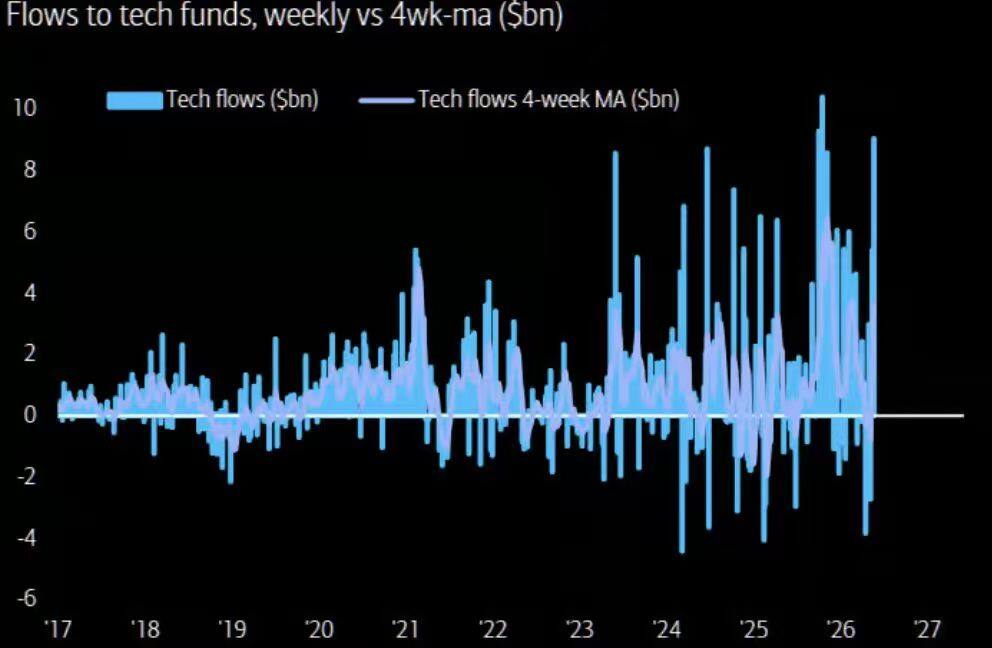
2. A potential rotation signal: since last October, hedge funds have been buying tech stocks heavily again, consider following.
3. The founder of RKLB's scheduled stock sale window officially closes today. The stock price also fell back last night to the initial level where I reduced my position, and I will continue to add more. At this price, the little rocket has limited downside volatility and sufficient upward imagination.


Пов'язані питання

QWhat is the main purpose of the Odaily Editorial Tea Party column?

AThe column aims to share informal, immediate thoughts on industry news and data, explore investment ideas, offer observations from industry interactions, and share materials that have genuinely improved the editors' understanding. It focuses on expanding perspectives and supplementing information sources, not on providing investment advice or creating consensus.

QWhat are the investment opinions of Wenser regarding semiconductor memory stocks?

AWenser believes that despite recent market corrections, DRAM memory stocks like Changxin are still in a phase of supply shortage. He considers the current price drop a 'deep squat' phase and remains positive about the sector's fundamentals, referencing Changxin's collaboration with Apple.

QAccording to Bcxiongdi, what has been his experience with Meme coin trading recently?

ABcxiongdi notes that there have been opportunities in Meme coins on SOL and BSC chains recently, but the market is characterized by small-scale PVP (player-versus-player) trading. He admits to having sold his holdings too early and suggests keeping an eye on the Robinhood chain.

QWhat is Azuma's view and action plan regarding the US stock market semiconductor correction?

AAzuma suggests that the key uncertainty in the semiconductor correction is whether industry giants will maintain their capital expenditures (capex). He sees SK Hynix's US listing as a potential short-term relief point but believes long-term trends depend on future capex plans in upcoming earnings reports. He personally leans towards buying the dip, especially in DRAM stocks.

QWhat is the stance of the Odaily editorial team on the content of this 'Tea Party' column?

AThe editorial team states that the content is based on their real investment and observation experiences. It does not accept commercial advertising, does not constitute investment advice, and is intended to expand perspectives and supplement information sources rather than create consensus or guarantee profits.

Пов'язані матеріали

Embodied Intelligence 'Gaokao' is Insanely Hard, Humans Score 100, Best Model Only 12.8

Embodied AI Faces a Daunting "Everest": New Benchmark Reveals Huge Gap Between Models and Humans A comprehensive new benchmark for robotic manipulation, RoboDojo, has been released, painting a stark picture of the current state of embodied AI. It serves as a unified evaluation platform covering both simulation and real-world robot tasks. The benchmark assesses five core capabilities: Generalization (adapting to new scenes/objects), Memory, Precision manipulation, Long-Horizon multi-step tasks, and Open semantic understanding. It includes 42 simulation tasks and 18 standardized real-world tasks across three dual-arm robot platforms. The results are sobering. In simulation, the best-performing generalist robot policy achieved an average success rate of only 8.80%. Performance in the real world was slightly higher but still low, with the top model succeeding 12.8% of the time on average. In stark contrast, human experts scored 76.03% in simulation and 100% in real-world tests. The benchmark highlights significant, uneven gaps in current models' abilities. While some excel in specific areas like visual recognition or simple actions, they struggle with reliability, especially in long-horizon tasks where errors accumulate and in open-ended semantic instructions. The low scores, particularly in real-world deployment with physical uncertainties like camera noise and contact dynamics, underscore that today's models are far from being robust, general-purpose operational robots. RoboDojo is more than just a ranking; it's an infrastructure designed for fair, reproducible comparison. Its companion system, XPolicyLab, standardizes the interface for different models to be evaluated. Maintained by an academic consortium without commercial ties, it aims to provide a community-wide "altitude meter" to track genuine progress toward reliable and generalizable robot manipulation.

marsbit12 хв тому

Embodied Intelligence 'Gaokao' is Insanely Hard, Humans Score 100, Best Model Only 12.8

marsbit12 хв тому

Zuckerberg's 'Mango' Image Generation Model Trails Only GPT Image 2, It Learned to Revise Prompts on Its Own

Meta's MSL has launched Muse Image, an advanced image generation model nicknamed "Mango," which ranks second globally in text-to-image benchmarks, closely trailing OpenAI's GPT Image 2. Its key innovation is agent-like behavior: it searches for factual information, writes code for charts, and, most notably, has developed self-correction abilities through reinforcement learning, allowing it to revise its own outputs without explicit programming. This shift emphasizes reasoning over immediate generation. Integrated with Meta's ecosystem, Mango connects with the Muse Spark language model for complex tasks and features a unique "@" function that can incorporate public Instagram photos into generated images—raising privacy concerns as it's enabled by default. The model is directly accessible in Meta AI, Instagram, and WhatsApp, leveraging Meta's vast user base for distribution rather than competing solely on image quality. Accompanying Mango is the preview of Muse Video, a video generation model with integrated audio, currently ranked third in its category. All Mango-generated images include an invisible, persistent watermark (Content Seal) for AI identification, alongside a public detection tool. While Mango advances "thinking" image models, its use of social data poses new ethical questions about consent and digital boundaries.

marsbit1 год тому

Zuckerberg's 'Mango' Image Generation Model Trails Only GPT Image 2, It Learned to Revise Prompts on Its Own

marsbit1 год тому

Weng Li's New Blog Proposes 'Self-Evolution Should Start from Harness', DeepSeek's Cui Tianyi Endorses with Repost

Lilian Weng, former OpenAI security VP and co-founder of Thinking Machines Lab, has published a new blog post titled "Harness Engineering for Self-Improvement," proposing a pragmatic path for AI self-evolution. She argues that Recursive Self-Improvement (RSI) may practically begin at the "Harness" layer—the external runtime system governing how models use tools, manage context, and execute tasks—rather than directly from the model rewriting its own weights. The blog outlines a progression from optimizing prompts (Context Engineering) to designing workflows, and ultimately to Self-Improving Harness systems. These systems can identify their own weaknesses, propose targeted, verifiable modifications to the harness code, and validate improvements. Works like Self-Harness and Darwin Gödel Machine (DGM) demonstrate significant performance gains on benchmarks like SWE-bench through such automated harness evolution, rivaling handcrafted agents. DeepSeek researcher Tianyi Cui endorsed the view, noting harness-based self-evolution is as promising as model-based approaches. Weng emphasizes this is complementary to model training, with both reinforcing each other. However, key challenges remain: weak evaluators for subjective tasks, reward hacking, diversity collapse, managing long-term system health versus short-term success, and defining the human oversight role. The consensus is growing: the harness is a critical variable, as the same model can exhibit vastly different capabilities within different harness systems.

marsbit1 год тому

Weng Li's New Blog Proposes 'Self-Evolution Should Start from Harness', DeepSeek's Cui Tianyi Endorses with Repost

marsbit1 год тому

Торгівля

Спот
活动图片