Weng Li's New Blog Proposes 'Self-Evolution Should Start from Harness', DeepSeek's Cui Tianyi Endorses with Repost

marsbitОпубліковано о 2026-07-08Востаннє оновлено о 2026-07-08

Анотація

Lilian Weng, former OpenAI security VP and co-founder of Thinking Machines Lab, has published a new blog post titled "Harness Engineering for Self-Improvement," proposing a pragmatic path for AI self-evolution. She argues that Recursive Self-Improvement (RSI) may practically begin at the "Harness" layer—the external runtime system governing how models use tools, manage context, and execute tasks—rather than directly from the model rewriting its own weights. The blog outlines a progression from optimizing prompts (Context Engineering) to designing workflows, and ultimately to Self-Improving Harness systems. These systems can identify their own weaknesses, propose targeted, verifiable modifications to the harness code, and validate improvements. Works like Self-Harness and Darwin Gödel Machine (DGM) demonstrate significant performance gains on benchmarks like SWE-bench through such automated harness evolution, rivaling handcrafted agents. DeepSeek researcher Tianyi Cui endorsed the view, noting harness-based self-evolution is as promising as model-based approaches. Weng emphasizes this is complementary to model training, with both reinforcing each other. However, key challenges remain: weak evaluators for subjective tasks, reward hacking, diversity collapse, managing long-term system health versus short-term success, and defining the human oversight role. The consensus is growing: the harness is a critical variable, as the same model can exhibit vastly different capabilities ...

Former OpenAI safety vice president, co-founder of Thinking Machines Lab, Weng Li, has published a new blog post.

This time, she discusses AI self-evolution, proposing a practical path:

It doesn't necessarily have to start with the model directly rewriting its own weights; it can start with Harness first.
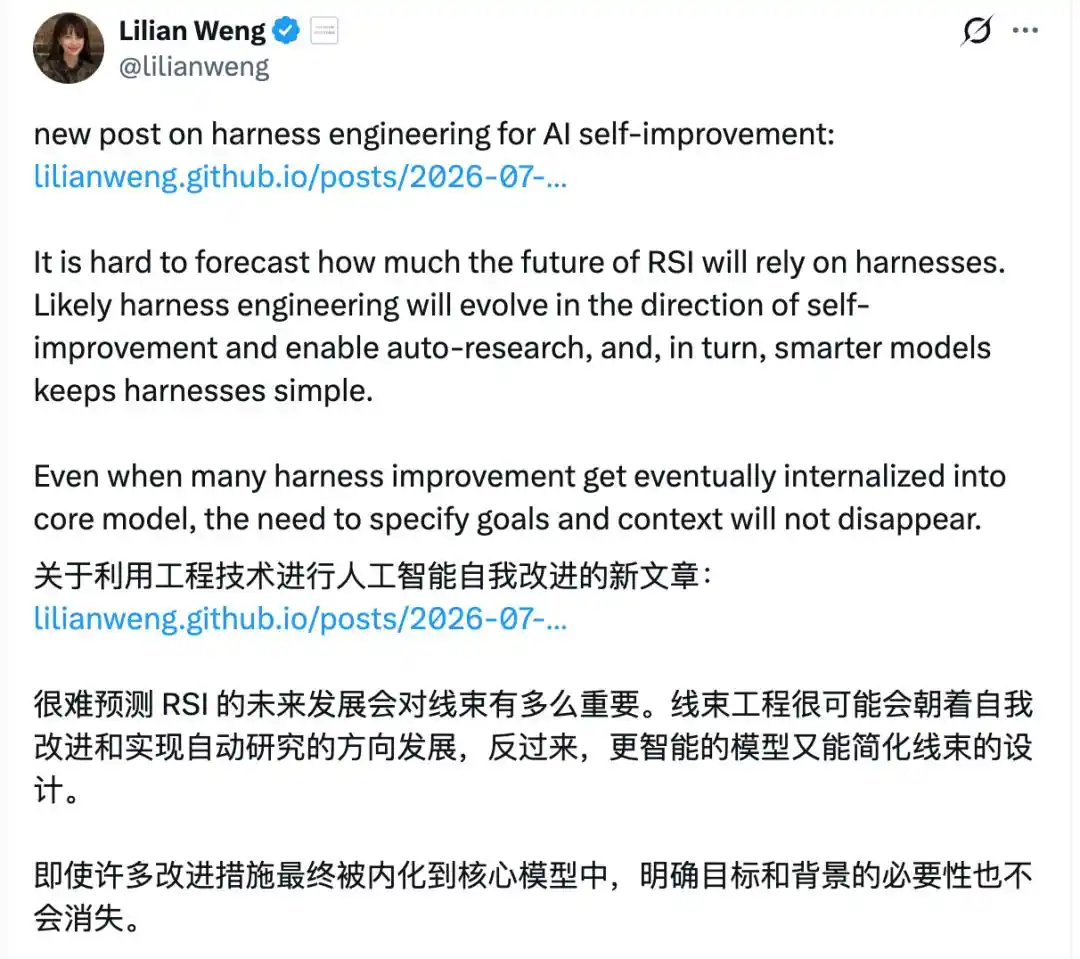
This blog post is titled "Harness Engineering for Self-Improvement."

Here, Harness can be simply understood as the model's external runtime system, which determines how the model invokes tools, manages context, reads and writes files, splits tasks, calls sub-agents, validates results, and reviews failures.

DeepSeek researcher Cui Tianyi also reposted it immediately, highlighting key points:

Self-evolution in the Harness direction is just as promising for results as self-evolution in the model direction.
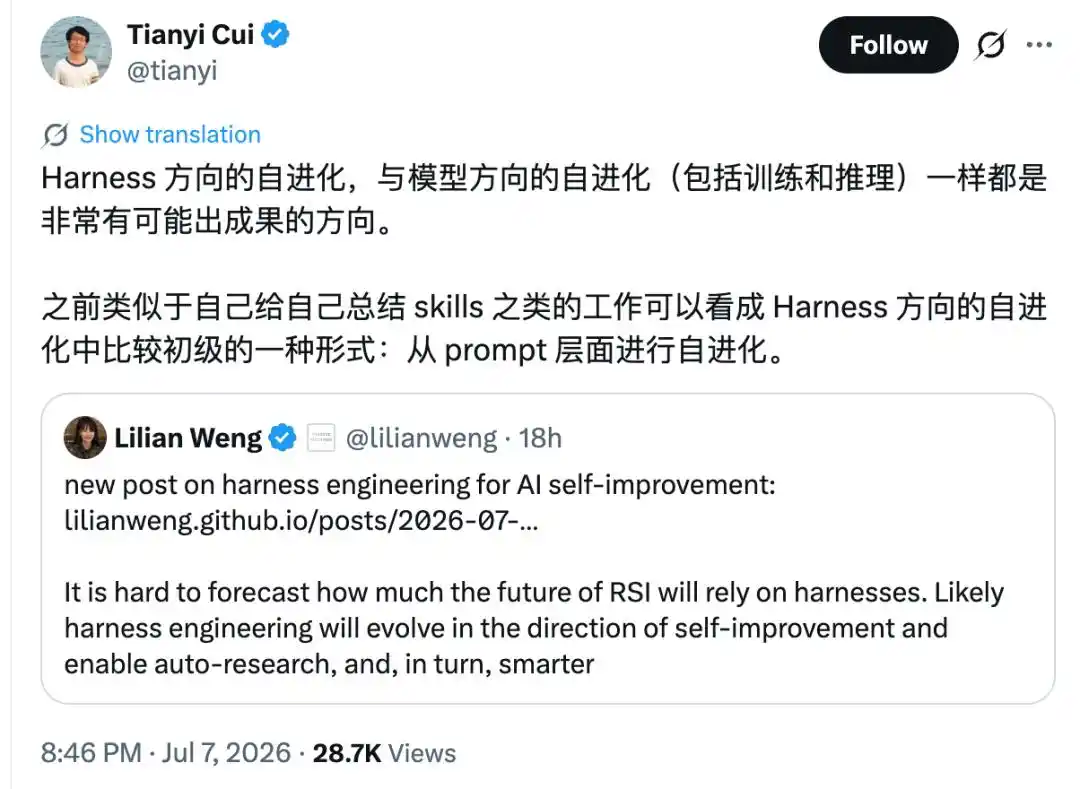
He also proposed that Skill is a relatively elementary form within Harness self-evolution: self-evolution at the prompt level.

The original blog post is packed with enormous information; dear readers, please be mentally prepared~

Self-Evolution Might Happen First in the Harness Layer

The core concept discussed in Weng Li's blog is RSI (Recursive Self-Improvement).

This concept originally carried strong AGI connotations, referring to an intelligent system improving the mechanisms that generate its own intelligence, thereby producing more capable successor systems.

But in this blog post, Weng Li breaks down this issue in a more engineering-focused way.

In today's AI systems, self-improvement doesn't necessarily only mean the model directly rewriting its own weights.

It could also mean the model improving the training pipeline, research pipeline, and deployment system, thereby helping the next-generation system perform better on real-world tasks.
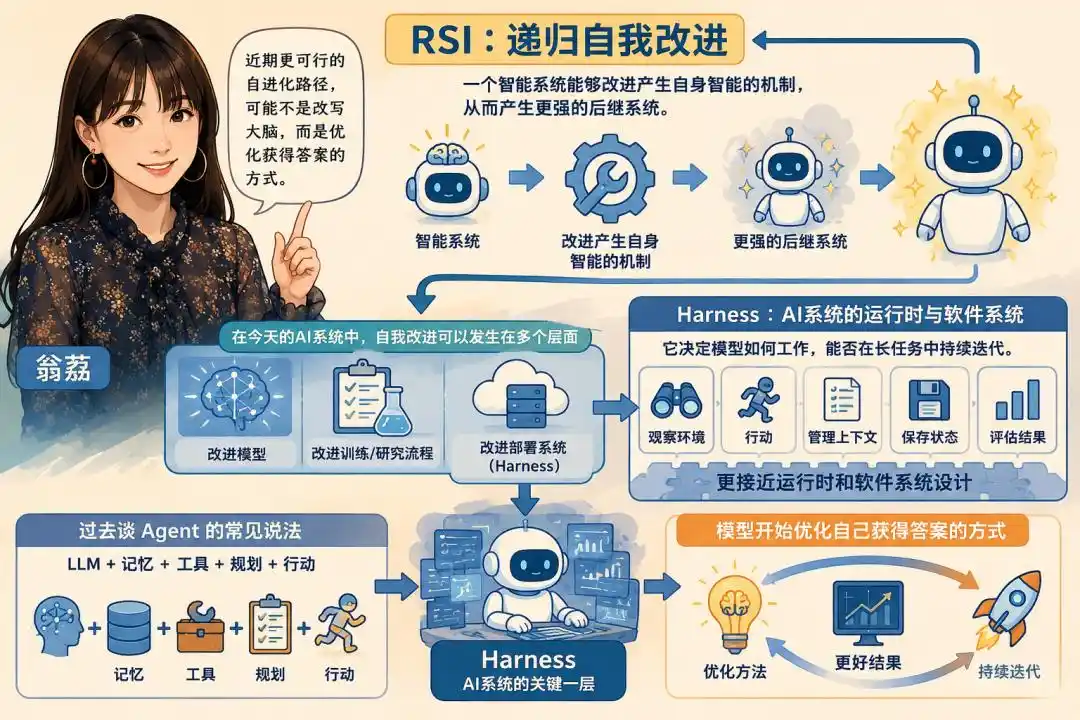
And Harness is the most critical layer within the deployment system.

When talking about Agents in the past, the common description was "LLM + Memory + Tools + Planning + Action."

But in Weng Li's view, Harness is no longer just a few modules from early Agent frameworks; it's closer to runtime and software system design.

It determines how the model observes the environment, how it acts, how it manages context, how it saves state, how it evaluates results, and also determines whether the model can iterate continuously within a long task.

Therefore, her judgment is: a more feasible near-term path for self-evolution might not be the model directly rewriting its own brain, but rather the model beginning to optimize the way it obtains answers.

From Context Engineering to Self-Harness, Optimization Progresses Layer by Layer

Weng Li reviews a recent batch of related research, revealing a clear trend:

The target of optimization is gradually moving from context, workflow, deeper into Harness itself.

The progression chain is: prompt → structured context → workflow → harness code → optimizer code.

As models become more powerful, the objects that can be optimized also become more abstract and more general.

The first layer is Context Engineering.

The most basic problem is: when an Agent works on long tasks, context piles up more and more, quickly becoming unmanageable.

Weng Li mentions two representative works here: ACE and MCE.

ACE (Agentic Context Engineering) treats context as a continuously updated "operating manual" rather than an ever-growing prompt.
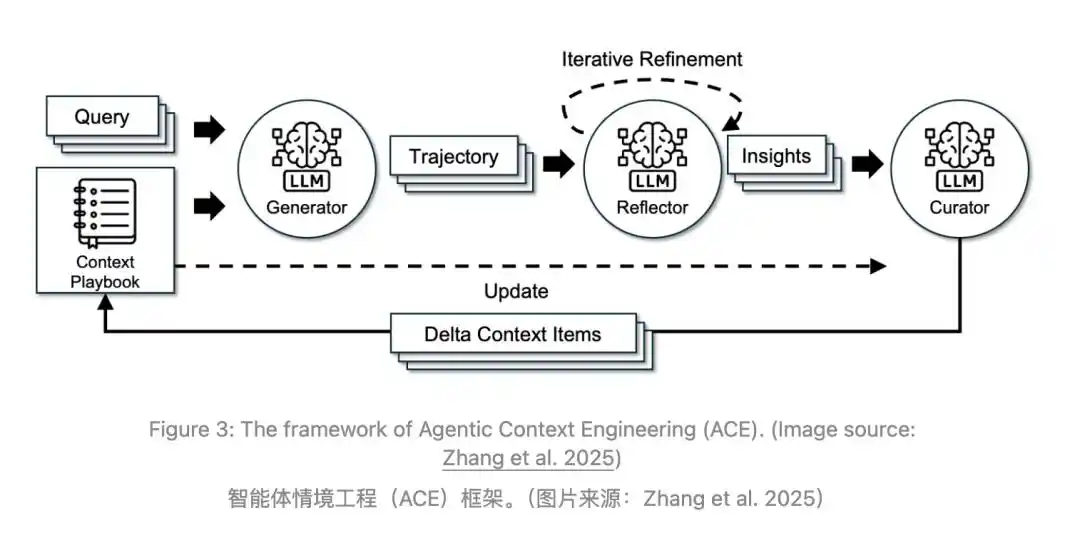
It relies on three roles: the Generator is responsible for generating task trajectories, the Reflector extracts key points from successful and failed trajectories, and the Curator organizes these points into structured entries, incrementally updating the manual.

MCE (Meta Context Engineering) goes a step further.

It separates "how to manage context" and "what specific content to put in context" into two optimization layers: the outer layer evolves skills for managing context, and the inner layer then uses this skill to optimize the context for specific tasks.
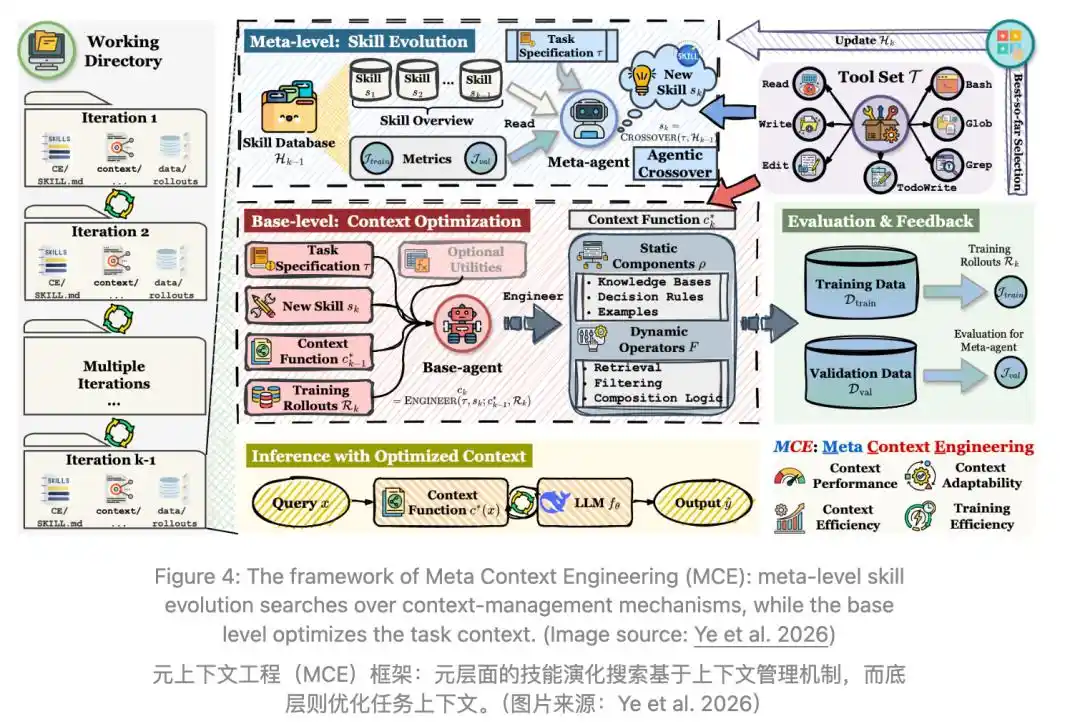
Weng Li believes that compared to ACE, which still requires manually designed update rules, MCE takes another step towards "self-managed memory."

The second layer is Workflow Design, which solves the problem of "how should the model work?"

Weng Li gives several examples:

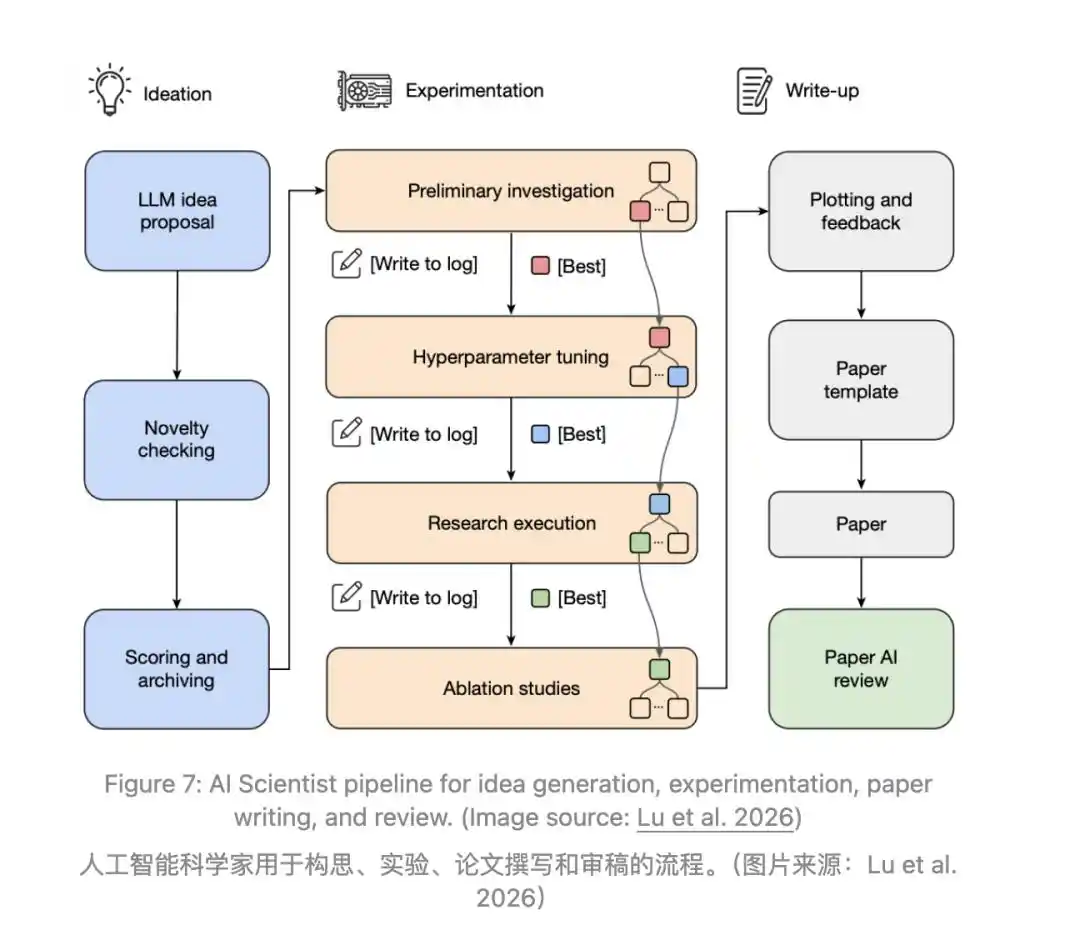
AI Scientist built a complete scientific research pipeline from proposing ideas, writing code, running experiments, analyzing results, to writing papers, and peer review.
ADAS goes further, treating "designing Agent workflows" itself as a searchable optimization problem, allowing a meta-agent to continuously propose new workflow designs and undergo evaluation.
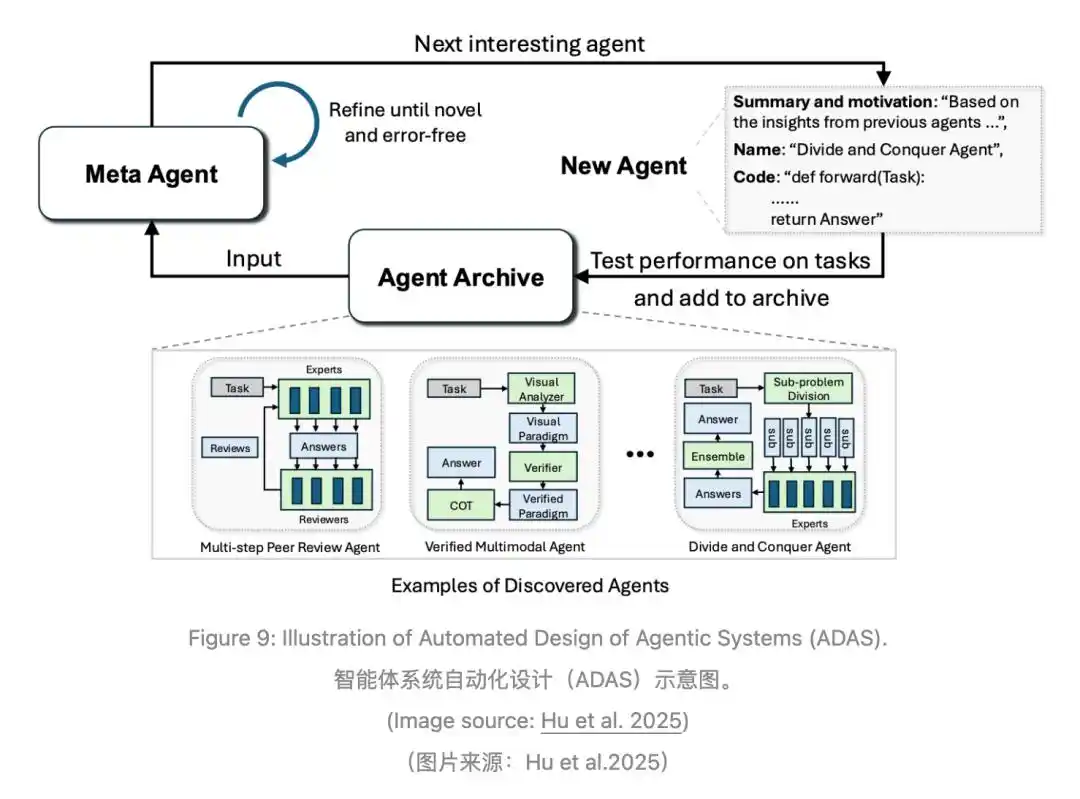
AFlow represents workflows as a graph and uses Monte Carlo Tree Search to find better graph structures.
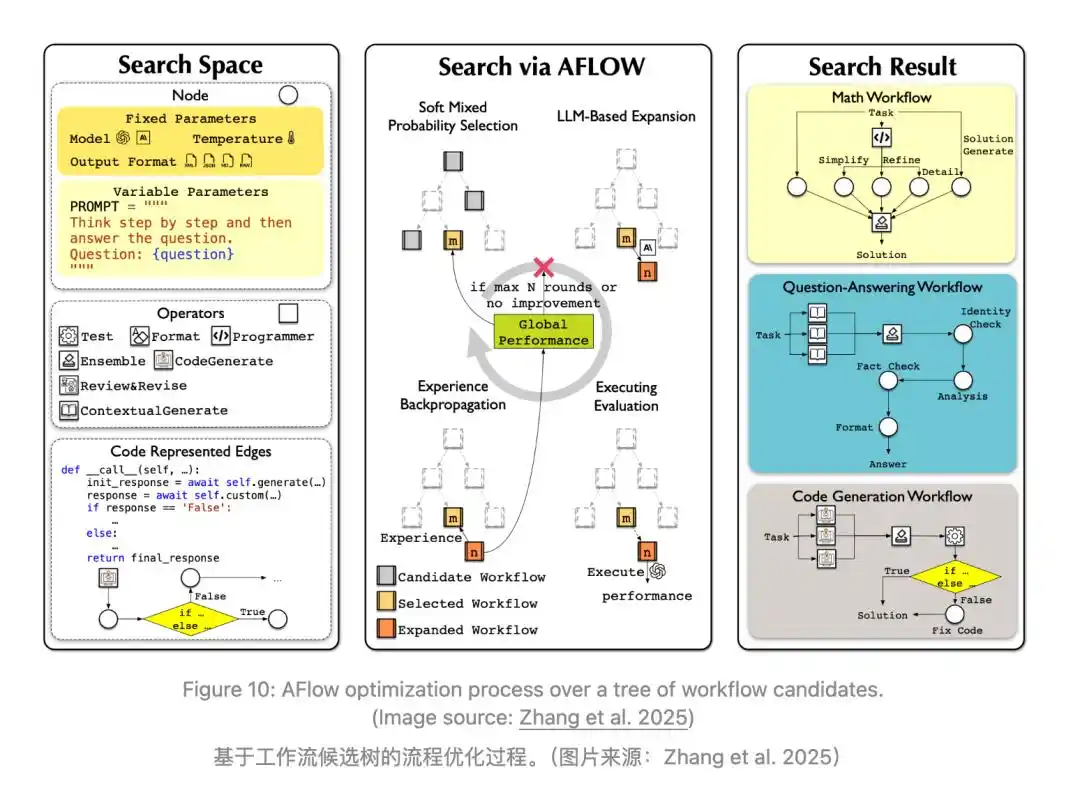
The progression along this line is: initially, humans engineer task processes; later, models participate in designing processes; and eventually, the process structure itself becomes part of the search space.

In other words, the optimization target is no longer just a single prompt, but the entire organization of the Agent's actions.

The third layer is Self-Improving Harness.

At this layer, the model is not just using the Harness to complete tasks; it starts analyzing where the Harness is lacking and proposes modifications to it.

Weng Li specifically highlights works like Self-Harness; its cycle is very clear.
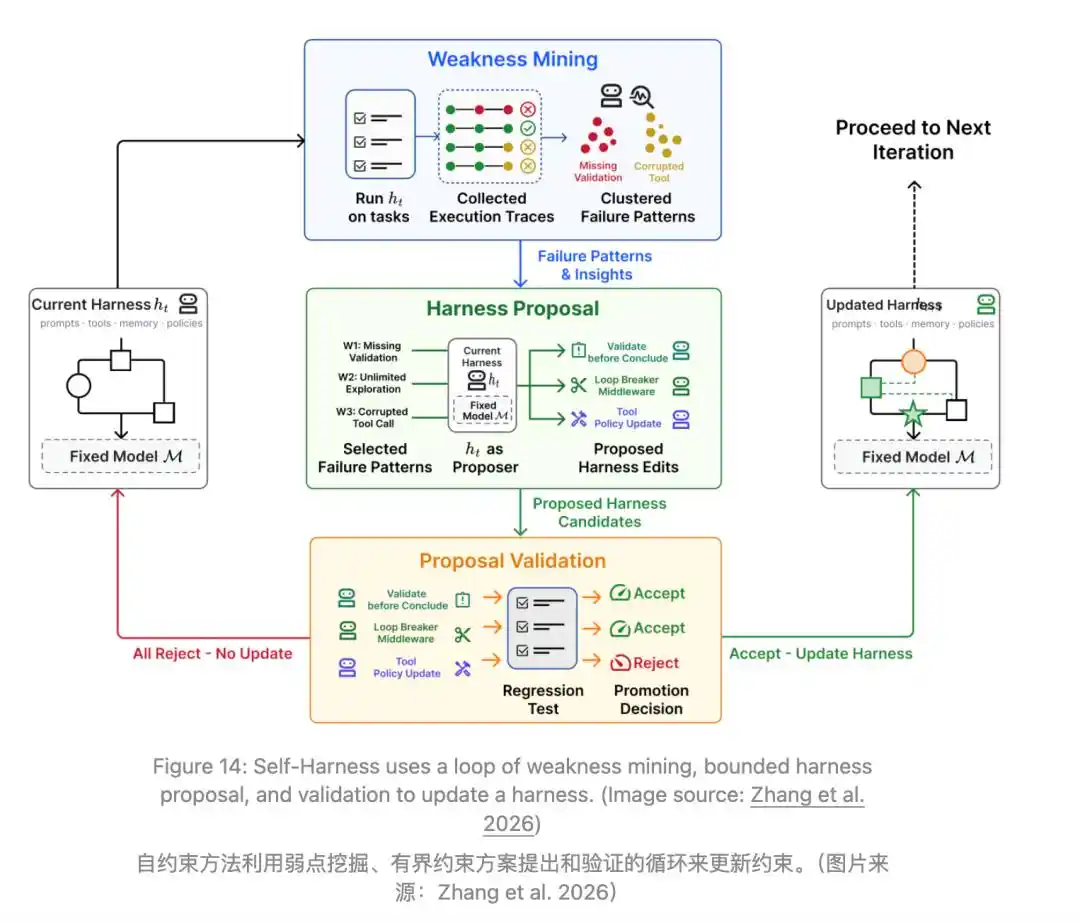
The first step is Weakness Mining.

The system first collects trajectories left by the Agent while executing tasks, including tool calls, error logs, failed results, validator feedback, etc. Then, it mines recurring failure patterns from them.

For example, the model always misses files in certain types of tasks, always repeats ineffective fixes after a certain kind of test failure, or always loses key constraints when context becomes too long.

The second step is Harness Proposal.

Based on these failure patterns, the model proposes small-scope modifications to the Harness.

The key is "small-scope" and "verifiable."

The information accessible to the model includes: which parts of the current Harness can be modified, specific failure patterns, which "correct behaviors" must be preserved, and records of previously attempted modifications.

Proposals should focus as much as possible on reproducible problems solvable by small changes, and different proposals should maintain differentiation.

The third step is Proposal Validation.

Candidate modifications cannot be directly integrated; they must undergo testing and verification. Only after confirming they genuinely improve performance and do not introduce significant regressions do they become part of the next version of the Harness.

Weng Li mentions that when running this process on different models like MiniMax M2.5, Qwen3.5, and GLM-5 for Terminal-Bench-2, it indeed learned distinct Harness configurations tailored to the weaknesses of each model.

However, she also directly points out the risks: once a program is allowed to modify its own system-layer code, the abstraction boundary risks being broken. Access control and security layers must remain outside this loop, and the old problem of reward hacking still exists.

Furthermore, Weng Li goes on to mention Evolutionary Search.

If Self-Harness is more like patching its own working system based on failures, evolutionary search turns the Harness directly into a searchable object.

Its logic is more akin to natural selection:

First, generate multiple candidate Harnesses, allowing the model to make modifications based on existing versions. Then, evaluate performance using benchmarks or validators, keep the better versions, eliminate the poorer ones, and proceed to the next round.

She particularly mentions DGM (Darwin Gödel Machine): directly letting a coding agent modify its own Harness code repository.
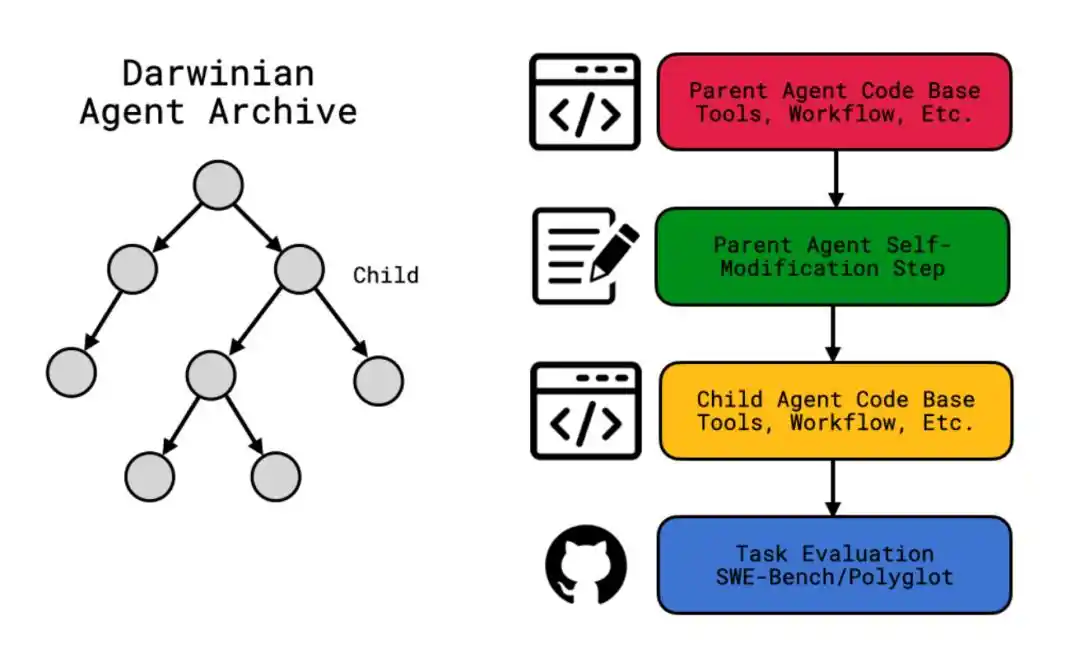
In experiments, using Claude 3.5 Sonnet as the base model and starting from simple initial configurations, the agent evolved by DGM achieved astonishing results:

Performance on SWE-bench Verified improved from 20% to 50%;

On Polyglot, it improved from 14.2% to 30.7%;

Achieving or even surpassing hand-designed agents.
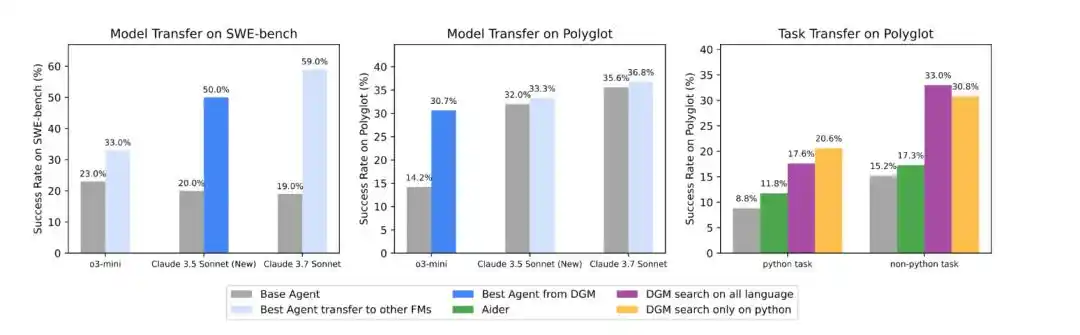
This indicates that even without changing model weights, Harness itself can already serve as a search space for capability improvement.

However, such methods are more suitable for tasks like coding, algorithms, and GPU kernels that can be automatically evaluated.

If tasks involve research taste, long-term product quality, or complex organizational collaboration, evaluation becomes much slower and more ambiguous.

Harness Will Become Stronger, But Boundaries Remain

Weng Li does not believe Harness is a replacement for model training; her assessment leans more towards mutual reinforcement between the two.

A sufficiently mature Harness can enable the research cycle for model self-improvement to run; and smarter models can prevent Harness from being over-engineered, maintaining system sustainability.

In the long run, many improvements in Harness may eventually be "internalized" into the model's own behavior—just as manual prompting techniques became less important as models' instruction-following and reasoning abilities improved.

But the act of "clarifying goals, constraints, context, and evaluation criteria" itself has never disappeared.

However, she also doesn't avoid addressing the current bottlenecks on the path to achieving RSI:

Evaluators are too weak and ambiguous. Currently, the self-improvement loops that work are mostly for tasks with clear, fast, objective feedback like writing code or solving math problems. Research taste, innovativeness, and long-term research value are almost impossible to quantify.

Context and memory lifecycle issues. The more autonomous and independent the task, the more memory needs to be managed. Weng Li believes this might become part of intelligence itself in the future, rather than just staying at the software system level.
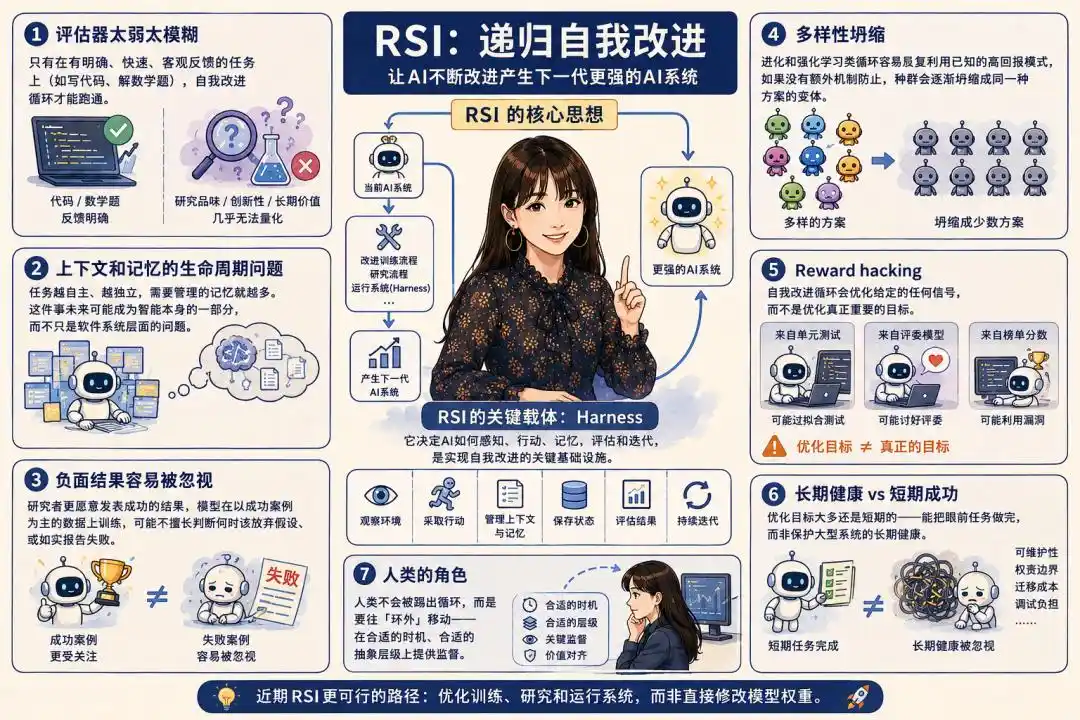
Negative results are easily overlooked. Researchers naturally prefer to publish successful results. Models trained on massive datasets dominated by success cases may not be good at judging when to abandon a hypothesis or honestly report a failure.

Diversity collapse. Evolutionary and reinforcement learning cycles tend to repeatedly exploit known high-reward patterns. Without additional mechanisms to prevent it, the population can gradually collapse into variants of the same solution.

Reward hacking. The self-improvement loop will optimize any given signal—if the reward comes from unit tests, the model might overfit the tests; if from judge models, it might learn to specifically "please" the judge; if from leaderboard scores, it might exploit the leaderboard's own loopholes.

Contradiction between long-term health and short-term success. Take coding agents as an example: they can already substantially improve daily software engineering productivity, but the optimization goals are mostly short-term—whether the immediate task can be completed, rather than whether the long-term health of a codebase maintained by hundreds or thousands of engineers can be preserved.

Maintainability, responsibility boundaries, migration costs, future debugging burdens—these standards are still largely unaddressed in sandbox training.

The role of humans. Weng Li's view: humans will not be kicked out of the loop but will need to move "outside the loop"—providing supervision at the right time and appropriate level of abstraction, which is also a problem that needs to be clearly considered in system design.

In the past, competition among large models mainly looked at parameters, data, computing power, and inference capabilities.

But now, another variable is increasingly difficult to ignore: Harness.

The same model, placed in different Harnesses, can exhibit completely different capabilities—this has already gone from an observation by a few to an industry consensus.

As can be seen from Weng Li's blog, "What is the more realistic engineering entry point for AI self-evolution?" will be a key discussion point in the next phase.

Blog original text: https://lilianweng.github.io/posts/2026-07-04-harness/

Reference link: https://x.com/tianyi/status/2074475185957380379

This article is from the WeChat public account "QbitAI", author: Tingyu

Трендові криптовалюти

Пов'язані питання

QWhat is the main argument made by Weng Li in her new blog about AI self-evolution?

AWeng Li argues that a more realistic and immediate path to AI self-evolution (Recursive Self-Improvement, or RSI) is likely to start at the 'Harness' level rather than the model directly modifying its own weights. Harness refers to the external runtime system that governs how a model interacts with tools, manages context, reads/writes files, breaks down tasks, calls sub-agents, validates results, and learns from failures.

QHow does DeepSeek researcher Cui Tianyi support Weng Li's viewpoint?

ADeepSeek researcher Cui Tianyi forwarded and endorsed Weng Li's blog. He emphasized that self-evolution in the Harness direction is a highly promising research area, just like self-evolution at the model level. He also noted that 'Skill' represents a more elementary form of Harness self-evolution, occurring at the prompt level.

QAccording to the article, what are the three layers of optimization leading towards Self-Improving Harness?

AThe three layers of optimization leading towards Self-Improving Harness are: 1) Context Engineering (optimizing how context is managed and structured, e.g., ACE, MCE). 2) Workflow Design (optimizing how the agent organizes its actions and processes, e.g., AI Scientist, ADAS, AFlow). 3) Self-Improving Harness itself, where the model begins to analyze and propose modifications to its own harness system based on failure patterns.

QWhat is one significant result mentioned from the Evolutionary Search approach, specifically DGM?

AA significant result from the Evolutionary Search approach, specifically the Darwin Gödel Machine (DGM), showed that using Claude 3.5 Sonnet as the base model and evolving from a simple initial harness configuration, the performance on the SWE-bench Verified benchmark improved from 20% to 50%, and on Polyglot from 14.2% to 30.7%, matching or even surpassing human-designed agents.

QWhat are some of the key challenges or bottlenecks identified for achieving RSI via Harness self-evolution?

AKey challenges include: 1) Weak and ambiguous evaluators, especially for tasks requiring subjective judgment like research taste. 2) Context and memory lifecycle management. 3) Neglect of negative results. 4) Diversity collapse in evolutionary loops. 5) Reward hacking, where systems optimize for the evaluation signal rather than true objectives. 6) Tension between short-term success (completing a task) and long-term health (maintainability, debugging burden). 7) Defining the appropriate role for human oversight outside the loop.

Пов'язані матеріали

Zuckerberg's 'Mango' Image Generation Model Trails Only GPT Image 2, It Learned to Revise Prompts on Its Own

Meta's MSL has launched Muse Image, an advanced image generation model nicknamed "Mango," which ranks second globally in text-to-image benchmarks, closely trailing OpenAI's GPT Image 2. Its key innovation is agent-like behavior: it searches for factual information, writes code for charts, and, most notably, has developed self-correction abilities through reinforcement learning, allowing it to revise its own outputs without explicit programming. This shift emphasizes reasoning over immediate generation. Integrated with Meta's ecosystem, Mango connects with the Muse Spark language model for complex tasks and features a unique "@" function that can incorporate public Instagram photos into generated images—raising privacy concerns as it's enabled by default. The model is directly accessible in Meta AI, Instagram, and WhatsApp, leveraging Meta's vast user base for distribution rather than competing solely on image quality. Accompanying Mango is the preview of Muse Video, a video generation model with integrated audio, currently ranked third in its category. All Mango-generated images include an invisible, persistent watermark (Content Seal) for AI identification, alongside a public detection tool. While Mango advances "thinking" image models, its use of social data poses new ethical questions about consent and digital boundaries.

marsbit42 хв тому

Zuckerberg's 'Mango' Image Generation Model Trails Only GPT Image 2, It Learned to Revise Prompts on Its Own

marsbit42 хв тому

Odaily Editorial Department Tea Party (July 8)

Odaily Editorial Team Casual Chat (July 8) This is an informal column from Odaily's editorial team, sharing immediate thoughts on industry news, data, and hot topics from various angles. It presents investment ideas and opportunity hypotheses still under verification—which may not be direct wealth codes but questions in themselves—alongside observations from industry interactions and materials that genuinely enhance the team's understanding. The content is based on real investment and observation experiences, carries no advertising, and does not constitute investment advice. Its purpose is to broaden perspectives and supplement information sources, not to create consensus. Team Member Shares: * **Wenser (@wenser2010):** Noted a deeper correction (nearly 30%) in US and Korean stocks, including memory stocks, but remains bullish on DRAM due to perceived supply shortages. In prediction markets, personal small bets outperformed blind copying; favors France to win the World Cup. Views crypto-related stocks like STRK as bearish for now, while seeing Circle and Coinbase as potential rebound plays. Observes recent strength in software stocks like Microsoft but is unsure if it's a sustained recovery. * **Bcxiongdi (@bcxiongdi):** Discusses the recent "recovery training" in meme coin markets on Solana and BSC, characterized by small-scale PVP opportunities, admitting to having sold many assets too early. Suggests also watching the Robinhood chain. Found World Cup prediction markets challenging, advising to consider buying during matches rather than only before. * **Azuma (@azuma_eth):** Focuses on the US stock market, particularly the significant semiconductor correction. Believes demand fundamentals remain and considers buying the dip in DRAM stocks. Notes a potential rotation signal as hedge funds have recently concentrated buying in tech stocks. Plans to continue adding to RKLB (Rocket Lab) stock, seeing limited downside and high upside potential at current levels after its founder's share sale window closed.

Odaily星球日报1 год тому

Odaily Editorial Department Tea Party (July 8)

Odaily星球日报1 год тому

Former Huawei 'Genius Teen' Who Questioned DeepSeek Interview Lands in 'Crossfire' from Web3 Investor

Former Huawei "Genius Youth" Li Bojie recently drew public attention by criticizing his interview experience with DeepSeek. The controversy escalated when Du Jun, co-founder of Web3 investment firm ABCDE Capital, publicly accused Li of being "the founder with the least sense of contractual spirit" he had ever cooperated with, sparking a dispute over Li's startup project, Metagent. Li detailed a frustrating DeepSeek interview where he was accused of potential plagiarism, leading him to end the session. The spotlight then shifted to his venture, Metagent, a Web3+AI project aiming to tokenize AI agents. ABCDE invested $1.5 million, with an initial $500k disbursed. Du Jun claimed the project's progress was severely lacking, with a poor-quality demo and minimal social media activity. He alleged Li stopped communicating, deleted his Telegram, and failed to provide proper financial reporting. In response, Li argued the remaining $1 million was never received, crippling operations and forcing salary cuts. He stated he left Metagent in October 2024 due to family reasons and Web3 compliance concerns, with board approval. He claimed to have fulfilled disclosure duties and that his subsequent projects avoided conflicting fields. Other investors, including ArkStream Capital, shared negative due diligence experiences, citing unprofessional contracts and evasive answers on tokenomics. Metagent's social media went silent in June 2024, effectively stalling. Li has since moved to a new consumer AI agent platform, Pine AI (formerly Logenic AI), which has raised $25 million in Series A funding. He served as its Chief Scientist but recently left, clarifying he was not the founder and departed due to a shift in research interests.

Foresight News1 год тому

Former Huawei 'Genius Teen' Who Questioned DeepSeek Interview Lands in 'Crossfire' from Web3 Investor

Foresight News1 год тому

Торгівля

Спот

Популярні статті

Що таке $S$

Розуміння SPERO: Комплексний огляд Вступ до SPERO Оскільки ландшафт інновацій продовжує еволюціонувати, виникнення технологій web3 та криптовалютних проектів відіграє ключову роль у формуванні цифрового майбутнього. Один з проектів, який привернув увагу в цій динамічній сфері, — це SPERO, позначений як SPERO,$$s$. Ця стаття має на меті зібрати та представити детальну інформацію про SPERO, щоб допомогти ентузіастам та інвесторам зрозуміти його основи, цілі та інновації в рамках web3 та крипто-сектору. Що таке SPERO,$$s$? SPERO,$$s$ — це унікальний проект у криптопросторі, який прагне використати принципи децентралізації та технології блокчейн для створення екосистеми, що сприяє залученню, корисності та фінансовій інклюзії. Проект розроблений для полегшення взаємодії між користувачами новими способами, надаючи їм інноваційні фінансові рішення та послуги. У своїй основі SPERO,$$s$ прагне надати можливості індивідам, забезпечуючи інструменти та платформи, які покращують користувацький досвід у криптовалютному просторі. Це включає в себе можливість більш гнучких методів транзакцій, сприяння ініціативам, що підтримуються спільнотою, та створення шляхів для фінансових можливостей через децентралізовані додатки (dApps). Основна концепція SPERO,$$s$ обертається навколо інклюзивності, прагнучи зменшити розриви в традиційній фінансовій системі, використовуючи переваги технології блокчейн. Хто є творцем SPERO,$$s$? Особистість творця SPERO,$$s$ залишається дещо невідомою, оскільки є обмежені публічно доступні ресурси, що надають детальну інформацію про його засновників. Ця відсутність прозорості може бути наслідком зобов'язання проекту до децентралізації — етики, яку багато проектів web3 поділяють, ставлячи колективні внески вище за індивідуальне визнання. Зосереджуючи обговорення навколо спільноти та її колективних цілей, SPERO,$$s$ втілює суть наділення без виділення конкретних осіб. Таким чином, розуміння етики та місії SPERO є більш важливим, ніж ідентифікація єдиного творця. Хто є інвесторами SPERO,$$s$? SPERO,$$s$ підтримується різноманітними інвесторами, починаючи від венчурних капіталістів до ангельських інвесторів, які прагнуть сприяти інноваціям у крипто-секторі. Зосередження цих інвесторів зазвичай узгоджується з місією SPERO — пріоритет надається проектам, які обіцяють технологічний прогрес у суспільстві, фінансову інклюзію та децентралізоване управління. Ці інвесторські фонди зазвичай зацікавлені в проектах, які не лише пропонують інноваційні продукти, але й позитивно впливають на спільноту блокчейн та її екосистеми. Підтримка з боку цих інвесторів підкріплює SPERO,$$s$ як значного конкурента в швидко змінюваній сфері крипто-проектів. Як працює SPERO,$$s$? SPERO,$$s$ використовує багатогранну структуру, яка відрізняє його від традиційних криптовалютних проектів. Ось деякі ключові особливості, які підкреслюють його унікальність та інноваційність: Децентралізоване управління: SPERO,$$s$ інтегрує моделі децентралізованого управління, надаючи користувачам можливість активно брати участь у процесах прийняття рішень щодо майбутнього проекту. Цей підхід сприяє відчуттю власності та відповідальності серед членів спільноти. Корисність токена: SPERO,$$s$ використовує свій власний криптовалютний токен, розроблений для виконання різних функцій в екосистемі. Ці токени дозволяють здійснювати транзакції, отримувати винагороди та полегшувати послуги, що пропонуються на платформі, підвищуючи загальну залученість та корисність. Шарова архітектура: Технічна архітектура SPERO,$$s$ підтримує модульність та масштабованість, що дозволяє безперешкодно інтегрувати додаткові функції та додатки в міру розвитку проекту. Ця адаптивність є надзвичайно важливою для збереження актуальності в постійно змінюваному крипто-ландшафті. Залучення спільноти: Проект підкреслює ініціативи, що підтримуються спільнотою, використовуючи механізми, які стимулюють співпрацю та зворотний зв'язок. Підтримуючи сильну спільноту, SPERO,$$s$ може краще задовольняти потреби користувачів та адаптуватися до ринкових тенденцій. Фокус на інклюзію: Пропонуючи низькі комісії за транзакції та зручні інтерфейси, SPERO,$$s$ прагне залучити різноманітну базу користувачів, включаючи осіб, які раніше не брали участі в крипто-просторі. Це зобов'язання до інклюзії узгоджується з його загальною місією наділення через доступність. Хронологія SPERO,$$s$ Розуміння історії проекту надає важливі уявлення про його розвиток та етапи. Нижче наведено пропоновану хронологію, що відображає значні події в еволюції SPERO,$$s$: Етап концептуалізації та ідеації: Початкові ідеї, що стали основою SPERO,$$s$, були сформовані, тісно пов'язані з принципами децентралізації та фокусом на спільноті в індустрії блокчейн. Запуск білого паперу проекту: Після концептуального етапу був випущений комплексний білий папір, що детально описує бачення, цілі та технологічну інфраструктуру SPERO,$$s$, щоб залучити інтерес та зворотний зв'язок від спільноти. Створення спільноти та ранні залучення: Активні зусилля були спрямовані на створення спільноти ранніх прихильників та потенційних інвесторів, що полегшило обговорення цілей проекту та отримання підтримки. Подія генерації токенів: SPERO,$$s$ провів подію генерації токенів (TGE) для розподілу своїх рідних токенів серед ранніх прихильників та встановлення початкової ліквідності в екосистемі. Запуск початкового dApp: Перший децентралізований додаток (dApp), пов'язаний з SPERO,$$s$, став доступним, дозволяючи користувачам взаємодіяти з основними функціями платформи. Постійний розвиток та партнерства: Безперервні оновлення та вдосконалення пропозицій проекту, включаючи стратегічні партнерства з іншими учасниками блокчейн-простору, сформували SPERO,$$s$ у конкурентоспроможного та еволюціонуючого гравця на крипто-ринку. Висновок SPERO,$$s$ є свідченням потенціалу web3 та криптовалют для революціонізації фінансових систем та наділення індивідів. Завдяки зобов'язанню до децентралізованого управління, залучення спільноти та інноваційно спроектованих функцій, він прокладає шлях до більш інклюзивного фінансового ландшафту. Як і з будь-якими інвестиціями в швидко змінюваному крипто-просторі, потенційним інвесторам та користувачам рекомендується ретельно досліджувати та обдумано взаємодіяти з поточними подіями в SPERO,$$s$. Проект демонструє інноваційний дух крипто-індустрії, запрошуючи до подальшого дослідження його численних можливостей. Хоча подорож SPERO,$$s$ ще триває, його основні принципи можуть справді вплинути на майбутнє того, як ми взаємодіємо з технологією, фінансами та один з одним у взаємопов'язаних цифрових екосистемах.

121 переглядів усьогоОпубліковано 2024.12.17Оновлено 2024.12.17

Що таке $S$

Що таке AGENT S

Агент S: Майбутнє автономної взаємодії в Web3 Вступ У постійно змінюваному ландшафті Web3 та криптовалюти інновації постійно переосмислюють, як люди взаємодіють з цифровими платформами. Один з таких новаторських проектів, Агент S, обіцяє революціонізувати взаємодію людини з комп'ютером через свою відкриту агентну структуру. Прокладаючи шлях для автономних взаємодій, Агент S прагне спростити складні завдання, пропонуючи трансформаційні застосування в штучному інтелекті (ШІ). Це детальне дослідження заглиблюється в складності проекту, його унікальні особливості та наслідки для сфери криптовалюти. Що таке Агент S? Агент S є революційною відкритою агентною структурою, спеціально розробленою для вирішення трьох основних викликів в автоматизації комп'ютерних завдань: Набуття специфічних знань у галузі: Структура інтелектуально навчається з різних зовнішніх джерел знань та внутрішнього досвіду. Цей подвійний підхід дозволяє їй створити багатий репозиторій специфічних знань у галузі, покращуючи її продуктивність у виконанні завдань. Планування на довгих горизонтах завдань: Агент S використовує планування з підкріпленням досвіду, стратегічний підхід, який полегшує ефективний розподіл та виконання складних завдань. Ця функція значно підвищує її здатність ефективно та результативно управляти кількома підзавданнями. Обробка динамічних, неоднорідних інтерфейсів: Проект представляє Інтерфейс Агент-Комп'ютер (ACI), інноваційне рішення, яке покращує взаємодію між агентами та користувачами. Використовуючи багатомодальні великі мовні моделі (MLLMs), Агент S може безперешкодно орієнтуватися та маніпулювати різноманітними графічними інтерфейсами користувача. Завдяки цим новаторським функціям Агент S надає надійну структуру, яка вирішує складнощі, пов'язані з автоматизацією людської взаємодії з машинами, прокладаючи шлях для численних застосувань у ШІ та за його межами. Хто є творцем Агент S? Хоча концепція Агент S є фундаментально новаторською, конкретна інформація про його творця залишається невідомою. Творець наразі невідомий, що підкреслює або початкову стадію проекту, або стратегічний вибір зберегти засновників у таємниці. Незважаючи на анонімність, акцент залишається на можливостях та потенціалі структури. Хто є інвесторами Агент S? Оскільки Агент S є відносно новим у криптографічній екосистемі, детальна інформація про його інвесторів та фінансових спонсорів не задокументована. Відсутність публічно доступних відомостей про інвестиційні фонди або організації, що підтримують проект, викликає питання щодо його фінансової структури та дорожньої карти розвитку. Розуміння підтримки є критично важливим для оцінки стійкості проекту та потенційного впливу на ринок. Як працює Агент S? В основі Агент S лежить передова технологія, яка дозволяє йому ефективно функціонувати в різних умовах. Його операційна модель побудована навколо кількох ключових функцій: Взаємодія з комп'ютером, подібна до людської: Структура пропонує розширене планування ШІ, прагнучи зробити взаємодії з комп'ютерами більш інтуїтивними. Імітуючи людську поведінку при виконанні завдань, вона обіцяє підвищити досвід користувачів. Наративна пам'ять: Використовується для використання високорівневого досвіду, Агент S використовує наративну пам'ять для відстеження історій завдань, тим самим покращуючи свої процеси прийняття рішень. Епізодична пам'ять: Ця функція надає користувачам покрокові інструкції, дозволяючи структурі пропонувати контекстуальну підтримку в міру виконання завдань. Підтримка OpenACI: Завдяки можливості працювати локально, Агент S дозволяє користувачам зберігати контроль над своїми взаємодіями та робочими процесами, узгоджуючи з децентралізованою етикою Web3. Легка інтеграція з зовнішніми API: Його універсальність і сумісність з різними платформами ШІ забезпечують те, що Агент S може безперешкодно вписатися в існуючі технологічні екосистеми, роблячи його привабливим вибором для розробників та організацій. Ці функціональні можливості колективно сприяють унікальному положенню Агент S у крипто-просторі, оскільки він автоматизує складні, багатоступеневі завдання з мінімальним втручанням людини. У міру розвитку проекту його потенційні застосування в Web3 можуть переосмислити, як відбуваються цифрові взаємодії. Хронологія Агент S Розробка та етапи Агент S можуть бути узагальнені в хронології, яка підкреслює його значні події: 27 вересня 2024 року: Концепція Агент S була представлена в комплексній науковій статті під назвою “Відкрита агентна структура, яка використовує комп'ютери як людина”, що демонструє основи проекту. 10 жовтня 2024 року: Наукова стаття була опублікована на arXiv, пропонуючи детальне дослідження структури та її оцінки продуктивності на основі бенчмарку OSWorld. 12 жовтня 2024 року: Було випущено відеопрезентацію, що надає візуальне уявлення про можливості та особливості Агент S, ще більше залучаючи потенційних користувачів та інвесторів. Ці маркери в хронології не лише ілюструють прогрес Агент S, але й вказують на його прихильність до прозорості та залучення громади. Ключові моменти про Агент S У міру розвитку структури Агент S кілька ключових характеристик виділяються, підкреслюючи її новаторський характер та потенціал: Інноваційна структура: Розроблена для забезпечення інтуїтивного використання комп'ютерів, подібного до людської взаємодії, Агент S пропонує новий підхід до автоматизації завдань. Автономна взаємодія: Здатність автономно взаємодіяти з комп'ютерами через GUI означає стрибок до більш інтелектуальних та ефективних обчислювальних рішень. Автоматизація складних завдань: Завдяки своїй надійній методології він може автоматизувати складні, багатоступеневі завдання, роблячи процеси швидшими та менш схильними до помилок. Безперервне вдосконалення: Механізми навчання дозволяють Агенту S покращуватися на основі минулого досвіду, постійно підвищуючи свою продуктивність та ефективність. Універсальність: Його адаптивність до різних операційних середовищ, таких як OSWorld та WindowsAgentArena, забезпечує його здатність служити широкому спектру застосувань. Оскільки Агент S займає своє місце в ландшафті Web3 та криптовалюти, його потенціал покращити можливості взаємодії та автоматизувати процеси означає значний прогрес у технологіях ШІ. Завдяки своїй інноваційній структурі Агент S є прикладом майбутнього цифрових взаємодій, обіцяючи більш безперешкодний та ефективний досвід для користувачів у різних галузях. Висновок Агент S представляє собою сміливий крок вперед у поєднанні ШІ та Web3, з можливістю переосмислити, як ми взаємодіємо з технологією. Хоча проект все ще на ранніх стадіях, можливості для його застосування є величезними та переконливими. Завдяки своїй комплексній структурі, що вирішує критичні виклики, Агент S прагне вивести автономні взаємодії на передній план цифрового досвіду. У міру того, як ми заглиблюємося в сфери криптовалюти та децентралізації, проекти, подібні до Агент S, безсумнівно, відіграватимуть ключову роль у формуванні майбутнього технологій та співпраці людини з комп'ютером.

748 переглядів усьогоОпубліковано 2025.01.14Оновлено 2025.01.14

Що таке AGENT S

Як купити S

Ласкаво просимо до HTX.com! Ми зробили покупку Sonic (S) простою та зручною. Дотримуйтесь нашої покрокової інструкції, щоб розпочати свою криптовалютну подорож.Крок 1: Створіть обліковий запис на HTXВикористовуйте свою електронну пошту або номер телефону, щоб зареєструвати обліковий запис на HTX безплатно. Пройдіть безпроблемну реєстрацію й отримайте доступ до всіх функцій.ЗареєструватисьКрок 2: Перейдіть до розділу Купити крипту і виберіть спосіб оплатиКредитна/дебетова картка: використовуйте вашу картку Visa або Mastercard, щоб миттєво купити Sonic (S).Баланс: використовуйте кошти з балансу вашого рахунку HTX для безперешкодної торгівлі.Треті особи: ми додали популярні способи оплати, такі як Google Pay та Apple Pay, щоб підвищити зручність.P2P: Торгуйте безпосередньо з іншими користувачами на HTX.Позабіржова торгівля (OTC): ми пропонуємо індивідуальні послуги та конкурентні обмінні курси для трейдерів.Крок 3: Зберігайте свої Sonic (S)Після придбання Sonic (S) збережіть його у своєму обліковому записі на HTX. Крім того, ви можете відправити його в інше місце за допомогою блокчейн-переказу або використовувати його для торгівлі іншими криптовалютами.Крок 4: Торгівля Sonic (S)Легко торгуйте Sonic (S) на спотовому ринку HTX. Просто увійдіть до свого облікового запису, виберіть торгову пару, укладайте угоди та спостерігайте за ними в режимі реального часу. Ми пропонуємо зручний досвід як для початківців, так і для досвідчених трейдерів.

1.6k переглядів усьогоОпубліковано 2025.01.15Оновлено 2026.06.02

Як купити S

Обговорення

Ласкаво просимо до спільноти HTX. Тут ви можете бути в курсі останніх подій розвитку платформи та отримати доступ до професійної ринкової інформації. Нижче представлені думки користувачів щодо ціни S (S).

活动图片