Behind ANSEM's 300% Weekly Surge: The Recovery and Traps of Solana Meme Coins

Foresight NewsОпубліковано о 2026-07-08Востаннє оновлено о 2026-07-08

Анотація

The meme coin ANSEM surged nearly 299% in a week, driving a resurgence in Solana-based meme token activity. Data from DeFiLlama shows Pump.fun's weekly DEX volume reached $5.33 billion, with July 4th marking the platform's first $1 billion daily volume since April. This revival saw a spike in new token launches and heightened trading activity, with memes again accounting for over 20% of Solana's weekly transaction volume. However, industry reports highlight significant risks. The average meme coin holding time has plummeted to around 100 seconds, and sophisticated bots often front-run retail investors, acquiring large portions of supply at launch before dumping. Research analyzing thousands of projects indicates widespread market manipulation, with a majority of top-gaining tokens showing signs of wash trading and pool manipulation. While meme coins effectively attract new users and generate hype for the Solana ecosystem, the current rally raises the critical question of whether this cycle can break free from the established pattern where late-arriving retail traders become exit liquidity for early bots and coordinated groups. The market's future trajectory hinges on whether the momentum can be sustained or if it will fade, leading traders back to major assets like SOL.


Author: Gino Matos

Compiled by: Chopper, Foresight News


The Meme coin ANSEM has surged nearly 299% in seven days, driving a recovery in the Solana Meme coin market. According to DeFiLlama data, the weekly trading volume of Pump.fun on decentralized exchanges (DEX) reached $5.33 billion, with a 30-day trading volume of $18.22 billion.


July 4th marked the first time since April 8th that Pump.fun and PumpSwap's daily trading volume exceeded $1 billion, and the trading volume for the week of June 29th to July 5th was the first to surpass $5 billion since late March.


Driven by the ANSEM rally, on July 1st, the Solana Meme coin launch platform saw the number of newly launched tokens and graduating projects hit an 80-day high. Alongside ANSEM's explosive popularity, a large number of copycat tokens emerged simultaneously. The proliferation of copycats has historically been a typical signal of a Meme coin bull market revival. A Phemex research report on July 1st pointed out that within just two weeks, the issuance fees on the Pump.fun platform recovered to 62% of their previous peak, and trading volume rebounded to 55%.
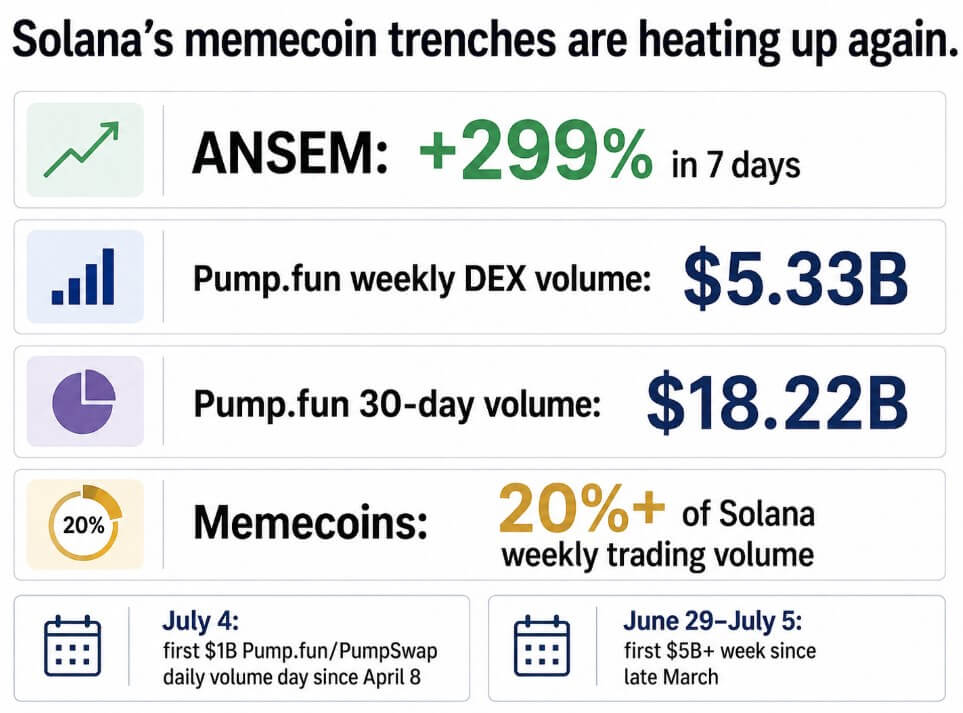

ANSEM rose 299% in a week, Pump.fun's weekly trading volume was $5.33 billion, and Meme coins accounted for over 20% of Solana's trading volume


This recovery trend is also reflected in the broader market. Data from Blockworks shows that Meme coins account for over 20% of Solana's weekly trading volume, the first time since mid-May.


A Galaxy research report from October 2025 noted that in Q4 2024, Meme coins once accounted for 50% of Solana's weekly trading volume. The current 20% share indicates only a modest market recovery, still far from its peak.


Galaxy also pointed out that compared to various formal DeFi products, Meme coins can more quickly attract ordinary retail investors to create wallets, use decentralized exchanges, and cross-chain bridges. These tokens have an extremely low barrier to entry and inherent social virality, directly converting traffic and hype into tradable assets.


However, the contradiction within the sector is also highlighted here. While Meme coins can attract new users, their ultra-fast-paced trading rules foster an extremely unequal playing field, where retail investors often end up as exit liquidity for bots and whales. The meteoric rise of ANSEM has brought this contradiction back into the spotlight.


Statistics from Galaxy show that the current average holding time for Meme coins is only 100 seconds, down from about 300 seconds in previous cycles, indicating a significant acceleration in trading pace. Sniping bots and batch wallets hoard large amounts of tokens the moment they launch, then sell off to cash out once retail investors FOMO in.


A paper presented at the 2026 ACM Conference on Computer and Communications Security, titled "Preventing Manipulative Bots in Meme Coin Copy Trading," fully dissects this harvesting logic: copy trading has become the mainstream entry method for retail, but bots react far faster than humans. The paper surveyed over 6,000 Meme projects, finding that the vast majority of tokens are swept up by bots within 1 to 5 blocks of launch.


The MemeTrans platform, tracking over 41,000 Solana Meme projects and 200 million on-chain transactions, found that various coordinated manipulation accounts hold an average of 36.5% of a project's circulating supply; while holdings appear dispersed, they are actually highly concentrated. In the survey, 84.13% of projects were flagged as high-risk. Another research report analyzed 34,988 Meme tokens, revealing that among the top gainers, 82.8% showed signs of artificial volume generation like wash trading and pool manipulation, with over 17,000 wallet addresses incurring cumulative losses exceeding $9.3 million.


These data clearly reflect a pattern: the Meme coins with the most exaggerated gains often have the most severe artificial manipulation.


So, has the Meme market recovered?


A bull market scenario is characterized by Pump's daily trading volume consistently exceeding $1 billion, with Solana's Meme coins accounting for close to 30% of weekly trading volume.


ANSEM drives the continuous emergence of explosive secondary Meme coins, with user growth, launch speed, and attention reinforcing each other. This situation more closely resembles the early rise of Meme coins.


In a bear market scenario, ANSEM's copycats distract investors, Pump's weekly trading volume falls back below $3 billion, and Meme coins' share of Solana's total trading volume drops to 15%-18%. In this case, ANSEM would be a flash in the pan, and traders would turn back to SOL, mainstream cryptocurrencies, and other more liquid altcoins.
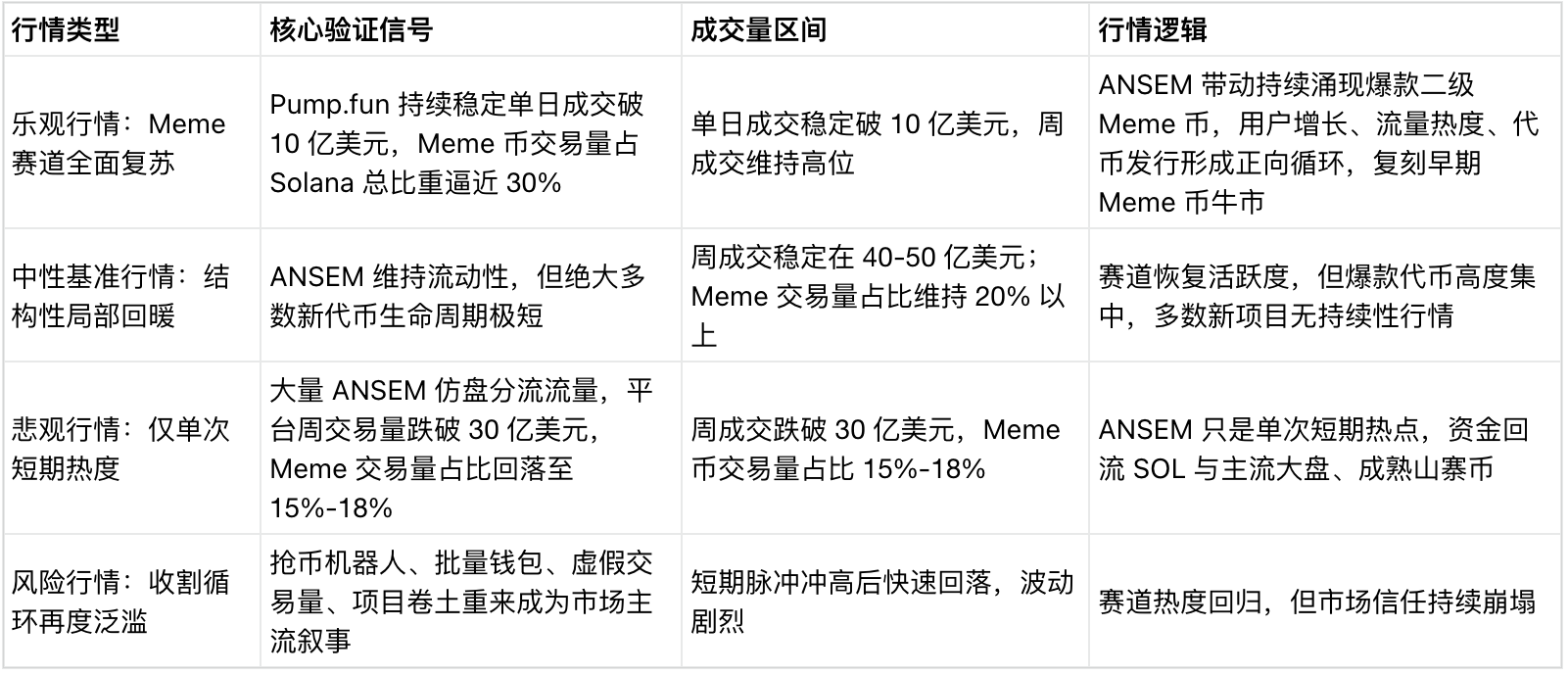

Four subsequent market scenarios


It is undeniable that the Solana Meme sector possesses strong traffic-driving capabilities, achieving levels of attention and hype that most formal blockchain products find hard to match. However, with this ANSEM-driven market recovery, the industry needs to consider: Can this wave of hype break free from the old cycle of bot sniping and whale manipulation, and stop making later-entering retail investors the exit liquidity for early funds?


Трендові криптовалюти

Пов'язані питання

QAccording to the article, what is the key indicator of a true bull market for Solana meme coins?

AA true bull market for Solana meme coins is indicated by the daily trading volume on platforms like Pump.fun consistently exceeding $10 billion and meme coins accounting for close to 30% of Solana's total weekly trading volume.

QWhat significant risk for retail investors in the meme coin market is highlighted by the academic paper presented at the 2026 International Conference on Computer Communication and Networks?

AThe paper highlights the risk of 'sniping bots' and manipulation. It details that bots can execute trades within 1 to 5 blocks after a meme coin launches, accumulating large positions before most human investors can react, creating an uneven and potentially predatory trading environment.

QBased on the data from MemeTrans, what percentage of the analyzed Solana meme projects were flagged as high-risk?

AAccording to the MemeTrans platform's analysis of over 41,000 Solana meme projects, 84.13% of them were flagged as high-risk assets.

QWhat does the article suggest is the primary contradiction or paradox within the Solana meme coin ecosystem?

AThe primary contradiction is that while meme coins are excellent at attracting new users to the Solana ecosystem due to their low barrier to entry and viral nature, they also create a hyper-fast, unequal trading environment. This environment, dominated by bots and coordinated groups, often results in retail investors becoming exit liquidity for early, manipulative insiders.

QWhat scenario would likely lead ANSEM to be a fleeting phenomenon, causing traders to shift focus back to major assets like SOL?

AANSEM would become a fleeting phenomenon in a bearish market scenario. This is characterized by its numerous copycat versions diluting investor attention, weekly trading volume on Pump.fun falling back below $3 billion, and the meme coin share of Solana's total trading volume dropping to 15-18%.

Пов'язані матеріали

Embodied Intelligence 'Gaokao' is Insanely Hard, Humans Score 100, Best Model Only 12.8

Embodied AI Faces a Daunting "Everest": New Benchmark Reveals Huge Gap Between Models and Humans A comprehensive new benchmark for robotic manipulation, RoboDojo, has been released, painting a stark picture of the current state of embodied AI. It serves as a unified evaluation platform covering both simulation and real-world robot tasks. The benchmark assesses five core capabilities: Generalization (adapting to new scenes/objects), Memory, Precision manipulation, Long-Horizon multi-step tasks, and Open semantic understanding. It includes 42 simulation tasks and 18 standardized real-world tasks across three dual-arm robot platforms. The results are sobering. In simulation, the best-performing generalist robot policy achieved an average success rate of only 8.80%. Performance in the real world was slightly higher but still low, with the top model succeeding 12.8% of the time on average. In stark contrast, human experts scored 76.03% in simulation and 100% in real-world tests. The benchmark highlights significant, uneven gaps in current models' abilities. While some excel in specific areas like visual recognition or simple actions, they struggle with reliability, especially in long-horizon tasks where errors accumulate and in open-ended semantic instructions. The low scores, particularly in real-world deployment with physical uncertainties like camera noise and contact dynamics, underscore that today's models are far from being robust, general-purpose operational robots. RoboDojo is more than just a ranking; it's an infrastructure designed for fair, reproducible comparison. Its companion system, XPolicyLab, standardizes the interface for different models to be evaluated. Maintained by an academic consortium without commercial ties, it aims to provide a community-wide "altitude meter" to track genuine progress toward reliable and generalizable robot manipulation.

marsbit26 хв тому

Embodied Intelligence 'Gaokao' is Insanely Hard, Humans Score 100, Best Model Only 12.8

marsbit26 хв тому

Zuckerberg's 'Mango' Image Generation Model Trails Only GPT Image 2, It Learned to Revise Prompts on Its Own

Meta's MSL has launched Muse Image, an advanced image generation model nicknamed "Mango," which ranks second globally in text-to-image benchmarks, closely trailing OpenAI's GPT Image 2. Its key innovation is agent-like behavior: it searches for factual information, writes code for charts, and, most notably, has developed self-correction abilities through reinforcement learning, allowing it to revise its own outputs without explicit programming. This shift emphasizes reasoning over immediate generation. Integrated with Meta's ecosystem, Mango connects with the Muse Spark language model for complex tasks and features a unique "@" function that can incorporate public Instagram photos into generated images—raising privacy concerns as it's enabled by default. The model is directly accessible in Meta AI, Instagram, and WhatsApp, leveraging Meta's vast user base for distribution rather than competing solely on image quality. Accompanying Mango is the preview of Muse Video, a video generation model with integrated audio, currently ranked third in its category. All Mango-generated images include an invisible, persistent watermark (Content Seal) for AI identification, alongside a public detection tool. While Mango advances "thinking" image models, its use of social data poses new ethical questions about consent and digital boundaries.

marsbit1 год тому

Zuckerberg's 'Mango' Image Generation Model Trails Only GPT Image 2, It Learned to Revise Prompts on Its Own

marsbit1 год тому

Weng Li's New Blog Proposes 'Self-Evolution Should Start from Harness', DeepSeek's Cui Tianyi Endorses with Repost

Lilian Weng, former OpenAI security VP and co-founder of Thinking Machines Lab, has published a new blog post titled "Harness Engineering for Self-Improvement," proposing a pragmatic path for AI self-evolution. She argues that Recursive Self-Improvement (RSI) may practically begin at the "Harness" layer—the external runtime system governing how models use tools, manage context, and execute tasks—rather than directly from the model rewriting its own weights. The blog outlines a progression from optimizing prompts (Context Engineering) to designing workflows, and ultimately to Self-Improving Harness systems. These systems can identify their own weaknesses, propose targeted, verifiable modifications to the harness code, and validate improvements. Works like Self-Harness and Darwin Gödel Machine (DGM) demonstrate significant performance gains on benchmarks like SWE-bench through such automated harness evolution, rivaling handcrafted agents. DeepSeek researcher Tianyi Cui endorsed the view, noting harness-based self-evolution is as promising as model-based approaches. Weng emphasizes this is complementary to model training, with both reinforcing each other. However, key challenges remain: weak evaluators for subjective tasks, reward hacking, diversity collapse, managing long-term system health versus short-term success, and defining the human oversight role. The consensus is growing: the harness is a critical variable, as the same model can exhibit vastly different capabilities within different harness systems.

marsbit1 год тому

Weng Li's New Blog Proposes 'Self-Evolution Should Start from Harness', DeepSeek's Cui Tianyi Endorses with Repost

marsbit1 год тому

Торгівля

Спот

Популярні статті

Що таке MEME 2.0

Memecoin 2.0: Поява $MEME 2.0 у світі криптовалюти Вступ У постійно змінному ландшафті криптовалюти з'явився новий претендент. Memecoin 2.0, що символізується як $MEME 2.0, підносить концепцію мем-криптовалют на захоплюючий новий рівень. Як побічний продукт оригінального Memecoin, цей проєкт привернув увагу крипто-спільноти, змістивши акцент з типової фінансової вигоди на захоплюючий і розважальний досвід. Працюючи на блокчейні Ethereum, Memecoin 2.0 сміливо переосмислює залучення спільноти у криптосфері. Що таке Memecoin 2.0, $MEME 2.0? У своїй основі, Memecoin 2.0 є криптовалютним проєктом, який надає пріоритет спільнотному духу і розвагам, пов'язаним з мем-культурою. На відміну від звичайних криптовалют, які зосереджені на практичних випадках використання та матеріальних вигодах, Memecoin 2.0 вирізняється тим, що обіймає легшу сторону цифрової валюти. Цей проєкт існує без обіцянок утиліти, структурованої дорожньої карти чи фінансових повернень, зосереджуючи увагу на створенні яскравої спільноти навколо мемів та спільних розваг. Зробивши це, він використовує зростаючу тенденцію мем-культури у онлайн-пробі, що робить його унікальним гравцем у світі цифрових активів. Творець Memecoin 2.0, $MEME 2.0 Не зважаючи на численні дослідження витоків Memecoin 2.0, чітка особистість його творця залишається невідомою. Ця анонімність не є рідкістю у крипто-спільноті, де багато проєктів очолюються особами або групами, які надають перевагу залишатися за лаштунками. Відсутність публічно доступної інформації про творця може розглядатися як стратегічний крок, що ставить в центр уваги залучення спільноти, а не індивідуальної популярності у цій сфері. Інвестори Memecoin 2.0, $MEME 2.0 Інформації щодо інвесторів або фінансової підтримки Memecoin 2.0 замало. Відсутність деталей може свідчити про те, що проєкт є самофінансованим або що його увага до спільноти, а не традиційних інвестиційних структур, привабила інший тип підтримки. Оскільки світ мем-криптовалют зазвичай передбачає більше участі низового рівня, а не інституційних інвестицій, цей підхід узгоджується з етосом проєктів, що управляються спільнотою. Як працює Memecoin 2.0, $MEME 2.0? Memecoin 2.0 повністю працює на блокчейні Ethereum, використовуючи його потужні функції безпеки та масштабованості. Використовуючи сильні сторони Ethereum, Memecoin 2.0 може запропонувати безпечне середовище для взаємодії користувачів, забезпечуючи при цьому, що транзакції є ефективними та економічними. Одна з унікальних характеристик Memecoin 2.0 полягає в його структурі, що керується спільнотою. Цінність та популярність токена $MEME 2.0 походять з активної участі його користувачів, а не з вродженої утиліти. Ця концепція підкреслює акцент проєкту на розважальному аспекті криптовалюти, натякаючи на те, що сміх та залучення спільноти є справжніми валютами, що ведуть до його успіху. Крім того, проєкт вписується в ширшу екосистему мем-криптовалют, де цінність кожної мем-криптовалюти коливається залежно від культури, тенденцій і участі спільноти, а не традиційних економічних принципів. Хронологія Memecoin 2.0, $MEME 2.0 Щоб краще зрозуміти еволюцію та віхи Memecoin 2.0, ось хронологія, що підкреслює значні події в його історії: 2024: Зародження Memecoin 2.0 вважається відгалуженням оригінального Memecoin, яке встановлює себе в процвітаючому контексті мем-криптовалют, працюючи на блокчейні Ethereum. 13 липня 2024: Memecoin 2.0 офіційно позиціонує себе як мем-криптовалюта, орієнтована на спільноту, в мережі Ethereum, підкреслюючи свій підхід, зосереджений на розвагах, який запрошує користувачів брати участь у його розвитку. Ключові моменти про Memecoin 2.0, $MEME 2.0 Кілька критичних характеристик визначають Memecoin 2.0: Спільнотно-центричний підхід: Основною метою Memecoin 2.0 є створення веселого, захоплюючого досвіду для спільноти, використовуючи колективне задоволення, що випливає з меметичної культури. Побудовано на Ethereum: Робота на блокчейні Ethereum надає проєкту важливу інфраструктуру, що забезпечує безпеку та масштабованість. Відсутність утиліти або дорожньої карти: У вражаючому відході від традиційних криптовалют, Memecoin 2.0 не обіцяє жодних утилітарних функцій або фінансових повернень, підтверджуючи свою прихильність до участі спільноти та соціального залучення. Акцент на меметичній культурі: Обіймаючи гумористичні та культурні аспекти мем-періоду, Memecoin 2.0 надає платформу для користувачів для залучення до крипти офлайн та онлайн. Додатковий контекст: Значення мем-криптовалют Мем-криптовалюти з'явилися як окрема класифікація криптовалюти, часто керуючись гумором та легким підходом до торгівлі. Ці валюти, як правило, не мають значної утиліти або розробницьких дорожніх карт, залучаючи користувачів обіцянкою розваг, взаємодії в спільноті та культурної значущості. В рамках ширшої екосистеми криптовалют, мем-криптовалюти відновлюють важливість залучення спільноти, протистоячи лише прибутковим підходам. Проєкти, такі як Memecoin 2.0, відкривають еру, в якій розваги можуть гармонізувати з фінансовими прагненнями, перетворюючи блокчейн на ігровий майданчик для творчості та соціальної взаємодії. Висновок Memecoin 2.0, або $MEME 2.0, втілює нову хвилю криптовалюти, яка надає пріоритет залученню спільноти над жорсткими фінансовими структурами. Зосереджуючись на гуморі та соціальній взаємодії, він використовує захоплення навколо мем-культури. Працюючи на блокчейні Ethereum, Memecoin 2.0 використовує можливості технології, залишаючись непохитним у своїй прихильності до розважальної цінності цифрової валюти. Коли простір навколо криптовалют продовжує еволюціонувати, Memecoin 2.0 служить доказом того, що майбутнє цифрових активів може значною мірою залежати від спільних досвідів, сміху та надійних зв'язків у спільноті. У непередбачуваному світі крипто, можливо, радість може бути такою ж цінною, як і традиційний фінансовий прибуток.

133 переглядів усьогоОпубліковано 2024.04.04Оновлено 2024.12.03

Що таке MEME 2.0

Як купити MEME

Ласкаво просимо до HTX.com! Ми зробили покупку Memeland (MEME) простою та зручною. Дотримуйтесь нашої покрокової інструкції, щоб розпочати свою криптовалютну подорож.Крок 1: Створіть обліковий запис на HTXВикористовуйте свою електронну пошту або номер телефону, щоб зареєструвати обліковий запис на HTX безплатно. Пройдіть безпроблемну реєстрацію й отримайте доступ до всіх функцій.ЗареєструватисьКрок 2: Перейдіть до розділу Купити крипту і виберіть спосіб оплатиКредитна/дебетова картка: використовуйте вашу картку Visa або Mastercard, щоб миттєво купити Memeland (MEME).Баланс: використовуйте кошти з балансу вашого рахунку HTX для безперешкодної торгівлі.Треті особи: ми додали популярні способи оплати, такі як Google Pay та Apple Pay, щоб підвищити зручність.P2P: Торгуйте безпосередньо з іншими користувачами на HTX.Позабіржова торгівля (OTC): ми пропонуємо індивідуальні послуги та конкурентні обмінні курси для трейдерів.Крок 3: Зберігайте свої Memeland (MEME)Після придбання Memeland (MEME) збережіть його у своєму обліковому записі на HTX. Крім того, ви можете відправити його в інше місце за допомогою блокчейн-переказу або використовувати його для торгівлі іншими криптовалютами.Крок 4: Торгівля Memeland (MEME)Легко торгуйте Memeland (MEME) на спотовому ринку HTX. Просто увійдіть до свого облікового запису, виберіть торгову пару, укладайте угоди та спостерігайте за ними в режимі реального часу. Ми пропонуємо зручний досвід як для початківців, так і для досвідчених трейдерів.

357 переглядів усьогоОпубліковано 2024.12.12Оновлено 2026.06.02

Як купити MEME

Обговорення

Ласкаво просимо до спільноти HTX. Тут ви можете бути в курсі останніх подій розвитку платформи та отримати доступ до професійної ринкової інформації. Нижче представлені думки користувачів щодо ціни MEME (MEME).

活动图片