Ether ETFs break outflow streak while XRP products hit multi-week highs

cointelegraphОпубліковано о 2025-12-23Востаннє оновлено о 2025-12-23

Анотація

US spot Ether ETFs broke a seven-day outflow streak with $84.6 million in net inflows on Monday, reversing a trend that saw over $700 million exit the previous week. Cumulative net inflows for Ether products now stand at approximately $12.5 billion. Meanwhile, XRP ETFs extended their uninterrupted inflow streak, recording $43.9 million in net inflows—their strongest day since early December—bringing cumulative inflows to over $1.1 billion. Solana and Chainlink ETFs also saw steady inflows, reaching about $750 million and $58 million cumulatively, respectively. In contrast, Dogecoin ETF demand cooled further. Despite these gains, global crypto ETPs faced nearly $1 billion in outflows last week, largely due to spot Bitcoin and Ether fund withdrawals amid regulatory uncertainty.

Spot Ether exchange-traded funds (ETFs) in the US recorded $84.6 million in net inflows on Monday, breaking a seven-day outflow streak in one of the biggest single-day reversals this month.

The shift came after over $700 million exited spot Ether (ETH) products last week, highlighting a pause in selling pressure. According to SoSoValue data, the rebound lifted cumulative net inflows to about $12.5 billion.

At the same time, XRP (XRP) ETFs extended their uninterrupted inflow streak, recording $43.9 million in net inflows on Monday, their strongest daily showing since early December. XRP ETFs have not experienced a single net outflow day since their launch, resulting in cumulative net inflows exceeding $1.1 billion.

While XRP ETF volumes remain modest compared to Ether products, the consistency of the inflows stands out. Instead of the rapid in-and-out rotation, the data suggested that early allocators are gradually building exposure, treating the asset as a positioning tool rather than a short-term trade.
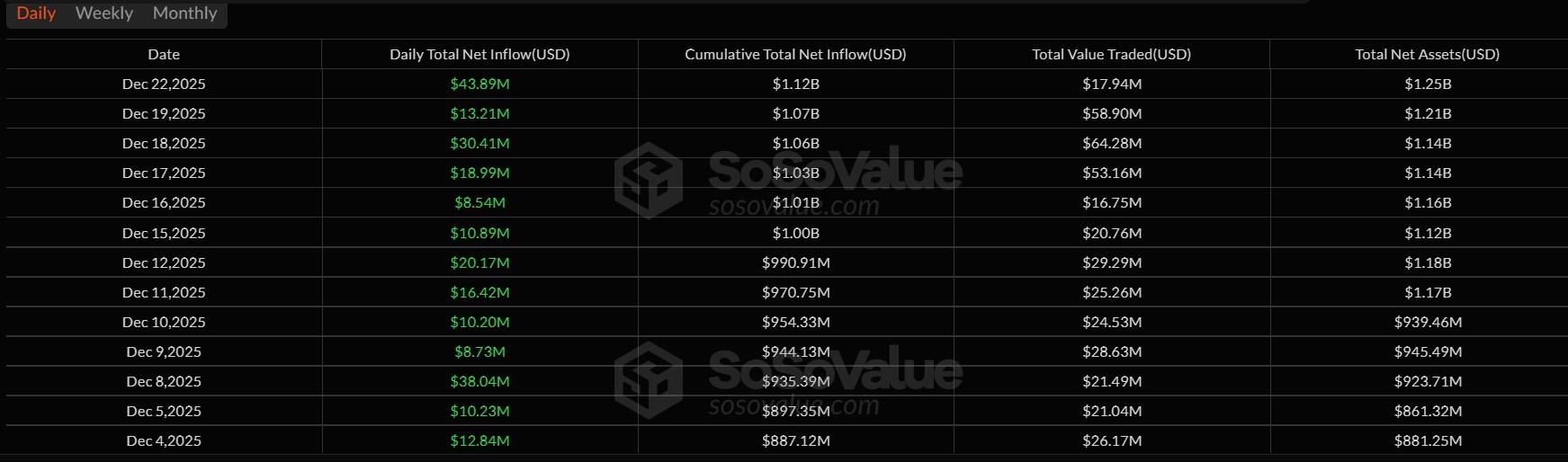
Daily inflow data for XRP ETFs. Source: SoSoValue

US altcoin ETF flows diverge

Beyond Ether and XRP, flows across other altcoin ETFs point to increasing differentiation within the crypto exchange-traded products (ETPs) space.

Solana (SOL) ETFs continued to attract steady capital, lifting cumulative net inflows to about $750 million. After a net negative on Dec. 3, Solana products returned to consistent positive flows, but on smaller levels compared to XRP. In total, Solana ETF products have had only three outflow days since launch.

Chainlink ETFs showed a similar pattern of incremental accumulation throughout December. Chainlink (LINK) products added nearly $2 million in inflows on Monday, bringing its cumulative net inflows to about $58 million.

Several flat-flow days point to muted trading activity, with inflows appearing steadier rather than driven by short-term speculation.

Meanwhile, Dogecoin (DOGE) ETFs, which showed early signs of cooling demand in December, continued the downtrend.

SoSoValue data showed that cumulative net inflow remained stuck at $2 million, while its total value traded fell to $67,000 on Monday, its second-lowest day in December.

Related: Crypto ETPs could see a flood of liquidations by 2027: Analyst

Global crypto ETF outflows neared $1 billion last week

While several altcoin ETFs continue to attract steady inflows, their volumes remain too small to offset broader market trends. Last week, global crypto ETPs recorded roughly $952 million in net outflows, driven primarily by spot Bitcoin and Ether funds.

Asset manager CoinShares attributed the pullback to delays surrounding the Digital Asset Market Clarity Act, which prolonged regulatory uncertainty and coincided with increased selling pressure from large holders.

Magazine: Ethereum’s Fusaka fork explained for dummies: What the hell is PeerDAS?

Трендові криптовалюти

Пов'язані питання

QWhat was the net inflow for US spot Ether ETFs on Monday, and why was it significant?

AUS spot Ether ETFs recorded $84.6 million in net inflows on Monday, breaking a seven-day outflow streak in one of the biggest single-day reversals this month.

QHow have XRP ETF inflows performed since their launch, and what does the data suggest about investor behavior?

AXRP ETFs have not experienced a single net outflow day since their launch, with cumulative net inflows exceeding $1.1 billion. The data suggests that early allocators are gradually building exposure, treating the asset as a positioning tool rather than a short-term trade.

QWhich altcoin ETFs showed steady inflows in December besides Ether and XRP?

ASolana (SOL) ETFs continued to attract steady capital, lifting cumulative net inflows to about $750 million, and Chainlink (LINK) ETFs showed a pattern of incremental accumulation, bringing its cumulative net inflows to about $58 million.

QWhat was the trend for Dogecoin (DOGE) ETFs in December, according to SoSoValue data?

ADogecoin ETFs showed early signs of cooling demand in December, with cumulative net inflow stuck at $2 million and total value traded falling to $67,000 on Monday, its second-lowest day in December.

QWhat was the main reason for the $952 million in net outflows from global crypto ETPs last week, as attributed by CoinShares?

AAsset manager CoinShares attributed the pullback to delays surrounding the Digital Asset Market Clarity Act, which prolonged regulatory uncertainty and coincided with increased selling pressure from large holders.

Пов'язані матеріали

Wang Xing Is Happy, Wang Xingxing Is Not Necessarily

Yu Shu Technology's (Unitree) IPO on the STAR Market sparked discussions centered on wealth creation: the surge in founder Wang Xingxing's net worth, the substantial gains for early investors like Meituan's Wang Xing, and employee stock wealth. Yet, a key observation from the listing ceremony was the founder's calm demeanor, contrasting with the celebratory atmosphere. The article explores this divergence. For investor Wang Xing, the IPO represents a successful bet on embodied AI and robotics as the next foundational tech wave, with Meituan's stake now highly valuable. For founder Wang Xingxing, the milestone brings a new set of pressures. His company, now valued at ~341.8 billion yuan, must transition from proving technological feasibility (which it has done with its quadruped and humanoid robots) to delivering scalable commercial success. The market's high valuation is an advance payment for a future that Yu Shu must now build. Post-IPO, Yu Shu faces the critical challenge of moving beyond impressive demos to creating sustainable businesses. This means making robots reliable, affordable, and indispensable for both consumers and industrial clients, proving their real-world economic value. As the "first stock" in embodied AI on the STAR Market, Yu Shu also becomes a public benchmark for the entire industry, its performance influencing sector-wide expectations. Ultimately, while investors can celebrate realized gains, Wang Xingxing's work is just beginning. He must now manage a public company, meet heightened market expectations, and navigate the complex journey from innovative engineering to large-scale commercial execution. The IPO is a starting line, not a finish line.

marsbit6 хв тому

Wang Xing Is Happy, Wang Xingxing Is Not Necessarily

marsbit6 хв тому

U.S. Market Trend (August 20): U.S. Treasury Intervention Halts Stock Decline; Moderna's Cancer Vaccine Breakthrough Sparks 180% Surge

U.S. Stocks Rebound on Treasury Intervention; Moderna Soars 180% on Cancer Vaccine Breakthrough Key Points: • U.S. stocks ended a three-day decline, with the rebound driven primarily by the U.S. Treasury Department's move to significantly increase its long-term bond repurchase ceiling. This action briefly pushed the 30-year Treasury yield down by about 10 basis points, easing long-term interest rate pressures. • Despite this, the market faced a countervailing force from the hawkish July FOMC meeting minutes, which revealed broader support for potential rate hikes among officials due to lingering inflation concerns. • Moderna shares skyrocketed nearly 180% after announcing positive Phase 3 trial results for its personalized mRNA cancer vaccine in partnership with Merck, which also rose nearly 13%. This fueled a major rally in the healthcare sector. • Contrary to the broader market, the Philadelphia Semiconductor Index fell over 2%, highlighting persistent pressure on the AI hardware chain. Concerns include AI's potential inflationary impact and questions about application-side cash flows supporting high capital expenditures. • Commodities and cryptocurrencies rallied alongside the equity rebound, supported by a weaker dollar and lower long-term yields. Geopolitical risks continued to underpin oil prices. Outlook: Market focus shifts to whether long-term bond yields stabilize post-intervention, upcoming U.S. economic data (jobless claims, Philly Fed index), and the impact of SK Hynix's massive share buyback plan on the memory chip sector. The tech sector's full recovery remains contingent on the semiconductor index's performance.

marsbit15 хв тому

U.S. Market Trend (August 20): U.S. Treasury Intervention Halts Stock Decline; Moderna's Cancer Vaccine Breakthrough Sparks 180% Surge

marsbit15 хв тому

The 19 Must-Know Top Chinese and American Entrepreneurs Born After 2000 • The 21st-Century Successors Have Arrived

The 21st century's first generation of entrepreneurs, born in the 2000s, are already taking center stage. This analysis of publicly prominent founders reveals distinct trends between China and the U.S., shaped by their respective ecosystems. In China, young founders are heavily focused on giving AI a physical presence, tackling challenges in robotics and hardware. Examples include Huang Yi (RoboParty, humanoid robots), Qin Shentao (Yuanchen Taichu, embodied AI data infrastructure), and founders working on robotic hands, home cleaning robots, and computing power networks. Their paths often emerge from university labs and robotics competitions, prioritizing prototype demonstration, cost control, and manufacturing delivery. In contrast, their U.S. counterparts frequently leverage software, AI, and capital networks to rapidly reorganize digital services and information flows. Startups like Mercor (AI talent/data, reaching $10B revenue), Etched (AI chips), and various AI-powered SaaS tools for consumers and SMBs demonstrate a focus on user growth, subscription models, and global scalability. However, this velocity has also led to high-profile cases questioning business practices and credibility. The key differentiator for this generation is not merely youth, but the compressed early stage of venture creation. Access to open-source tools, AI models, mature supply chains, and willing venture capital allows them to bypass traditional career ladders. Yet, while technology lowers the barrier to product creation, it does not reduce the challenges of building a sustainable company—managing teams, ensuring reliable delivery, and establishing trust remain hard-earned skills. The article concludes that the true test for these founders will be the "second growth": evolving from product creators into responsible company leaders capable of sustained execution and organizational building. For established businesses, the rise of these fast-moving, technologically adept teams necessitates new strategies for collaboration, competition, and investment.

marsbit20 хв тому

The 19 Must-Know Top Chinese and American Entrepreneurs Born After 2000 • The 21st-Century Successors Have Arrived

marsbit20 хв тому

A Trillion-Dollar Consumer Credit Market Lacks Key Players

The trillion-dollar global consumer credit market remains largely untapped by blockchain technology. While projects like Pharos have rapidly attracted millions in stablecoin deposits for short-term consumer loans in emerging markets, they represent early attempts to bring this massive asset class on-chain. The core challenge isn't technical tokenization, but the "repackaging" of countless small, heterogeneous loans into standardized, investable products that digital asset funds can understand and price. Current approaches primarily change the *distribution* of capital—using stablecoins for settlement and smart contracts for transparency—but do not eliminate underlying credit risk. Several models are emerging: Pharos and Huma Finance/Tala focus on connecting high-yield emerging market loans to global crypto capital. Figure stands out by building full-stack, regulated infrastructure, securing AAA ratings for its securitizations and proving blockchain assets can meet traditional institutional standards. Conversely, Goldfinch's difficulties highlight that on-chain transparency cannot replace offline credit underwriting and collection capabilities. The article identifies a four-layer value chain: 1) loan origination, 2) credit structuring & securitization, 3) on-chain infrastructure, and 4) capital. The current gap is in the second layer—the mature capital markets expertise for structuring, rating, credit enhancement, and institutional distribution. This is the critical link needed to transform scattered loans into large-scale, trustworthy on-chain credit assets, bridging traditional finance's rigor with blockchain's new capital pools.

marsbit55 хв тому

A Trillion-Dollar Consumer Credit Market Lacks Key Players

marsbit55 хв тому

Торгівля

Спот

Популярні статті

Що таке XRP 2.0

XRP 2.0: Нова межа в світі криптовалют Вступ до XRP 2.0 У постійно змінюючомуся світі криптовалют нові проекти постійно з'являються, змагаючись за увагу та прийняття. Однією з таких обіцяючих ініціатив є XRP 2.0, новий криптовалютний проект, що має на меті використання сучасних технологій блокчейн та надійних методів шифрування. Хоча назва нагадує про XRP від Ripple, важливо зазначити, що XRP 2.0 функціонує автономно, концентруючи увагу на підвищенні безпеки транзакцій, конфіденційності та масштабованості. Оскільки цифровий фінансовий ландшафт все більше приймає децентралізовані рішення, XRP 2.0 прагне значно сприяти веб3 та загальному розширенню крипто проектів. Що таке XRP 2.0? У своїй основі XRP 2.0 є криптовалютним проектом, що має на меті створення безпечної та децентралізованої екосистеми цифрової валюти. Його фундаментальна технологія інтегрує складні принципи блокчейну з передовими техніками шифрування. Загальною метою XRP 2.0 є встановлення себе як надійної та ефективної платформи, що дозволяє швидко виконувати транзакції, при цьому надаючи пріоритет підвищеним захистам конфіденційності для своїх користувачів. Проект позиціонується як рішення багатьох обмежень, з якими стикаються існуючі криптовалюти, пропонуючи систему, яка може обробляти вищий обсяг транзакцій з покращеною швидкістю та конфіденційністю. Ця універсальність позиціонує XRP 2.0 як значного гравця на ринку, наповненому різними цифровими валютами. Хто творець XRP 2.0? Особистість творця XRP 2.0 була позначена як «Вілбур». Проте, вичерпні деталі про Вілбура або пов'язану з ним організацію залишаються недоступними. Анонімність багатьох творців криптовалют не є незвичним явищем в індустрії, часто запроваджена для збереження певного рівня конфіденційності та безпеки. Хто інвестори XRP 2.0? На даний момент конкретна інформація про інвестиційні фонди або організації, що підтримують XRP 2.0, не є публічно доступною. У секторі криптовалют підтримка від визнаних інвесторів може значно вплинути на кредитоспроможність і успіх проекту, але прозорість щодо фінансових підтримувачів XRP 2.0 не була встановлена. Як працює XRP 2.0? XRP 2.0 вирізняється використанням комбінації технології блокчейн та просунутих алгоритмів шифрування, що забезпечують безпечні та децентралізовані транзакції. Його інноваційна структура включає унікальні функції, спрямовані на залучення користувачів та розширення функціональності за межами традиційних транзакцій криптовалюти. Серед цих функцій, XRP 2.0 включає можливості на базі ШІ, такі як текст в зображення та текст в мову. Ці нововведення розроблені для покращення інтерактивного досвіду для користувачів, сприяючи ширшій застосовності в різних секторах. Завдяки поєднанню технологічних досягнень з орієнтованим на користувача дизайном, XRP 2.0 прагне привернути увагу різноманітних осіб і підприємств, які шукають способи інтеграції рішень криптовалют у свої операційні структури. Хронологія XRP 2.0 Розуміння XRP 2.0 вимагає вивчення основних етапів, які визначили його подорож до теперішнього часу: 23 липня 2023 року: XRP 2.0 представлено як новий криптовалютний проект, що має на меті революціонізувати безпечні та децентралізовані можливості транзакцій у галузі блокчейн. 8 вересня 2023 року: Запускається інший проект, XRP20, що відзначає виникнення токена ERC-20 на блокчейні Ethereum, який не пов'язаний з XRP 2.0. 13 листопада 2023 року: XRP Ledger зазнає значного оновлення з виходом програмного забезпечення rippled server версії 2.0.0. Важливо зазначити, що цей розвиток не пов'язаний з криптовалютним проектом XRP 2.0. Ключові моменти про XRP 2.0 Щоб узагальнити суть XRP 2.0, кілька критично важливих факторів emerge: Унікальні функції: Включення функцій, таких як текст в зображення і текст в мову на базі ШІ, ще більше розширює потенційні застосування XRP 2.0. Технологія блокчейн: Архітектура використовує сучасні механізми блокчейн і протоколи шифрування, забезпечуючи безпечне та децентралізоване середовище для транзакцій. Масштабованість і конфіденційність: XRP 2.0 надає пріоритет підвищеним захистам конфіденційності в процесах транзакцій і масштабованості, необхідній для задоволення зростаючої бази користувачів. Відсутність зв'язку з Ripple: Важливо, що, незважаючи на свою назву, XRP 2.0 не має жодної прив'язки чи співпраці з XRP від Ripple, що відрізняє його операційну структуру та цілі в рамках криптовалютної екосистеми. Висновок XRP 2.0 представляє амбітну ініціативу у світі криптовалют, прагнучи запропонувати поєднання безпеки, конфіденційності та ефективності у цифрових транзакціях. Інтегруючи складні технології та дружні до користувача функції, проект ставить за мету розширити горизонти того, що криптовалюта може досягти в сучасній цифровій економіці. Хоча анонімність його творця та відсутність розкритих інвесторів можуть викликати запитання у деяких, фокус XRP 2.0 на передових функціональностях і децентралізації підвищує його привабливість на дедалі більшому ринку криптовалют. Оскільки ландшафт криптовалют продовжує еволюціонувати, XRP 2.0 може ще стати важливим гравцем у розширенні безпечних і масштабованих рішень блокчейн.

321 переглядів усьогоОпубліковано 2024.04.05Оновлено 2024.12.03

Що таке XRP 2.0

Як купити XRP

Ласкаво просимо до HTX.com! Ми зробили покупку XRP (XRP) простою та зручною. Дотримуйтесь нашої покрокової інструкції, щоб розпочати свою криптовалютну подорож.Крок 1: Створіть обліковий запис на HTXВикористовуйте свою електронну пошту або номер телефону, щоб зареєструвати обліковий запис на HTX безплатно. Пройдіть безпроблемну реєстрацію й отримайте доступ до всіх функцій.ЗареєструватисьКрок 2: Перейдіть до розділу Купити крипту і виберіть спосіб оплатиКредитна/дебетова картка: використовуйте вашу картку Visa або Mastercard, щоб миттєво купити XRP (XRP).Баланс: використовуйте кошти з балансу вашого рахунку HTX для безперешкодної торгівлі.Треті особи: ми додали популярні способи оплати, такі як Google Pay та Apple Pay, щоб підвищити зручність.P2P: Торгуйте безпосередньо з іншими користувачами на HTX.Позабіржова торгівля (OTC): ми пропонуємо індивідуальні послуги та конкурентні обмінні курси для трейдерів.Крок 3: Зберігайте свої XRP (XRP)Після придбання XRP (XRP) збережіть його у своєму обліковому записі на HTX. Крім того, ви можете відправити його в інше місце за допомогою блокчейн-переказу або використовувати його для торгівлі іншими криптовалютами.Крок 4: Торгівля XRP (XRP)Легко торгуйте XRP (XRP) на спотовому ринку HTX. Просто увійдіть до свого облікового запису, виберіть торгову пару, укладайте угоди та спостерігайте за ними в режимі реального часу. Ми пропонуємо зручний досвід як для початківців, так і для досвідчених трейдерів.

1.8k переглядів усьогоОпубліковано 2024.12.10Оновлено 2026.06.02

Як купити XRP

Обговорення

Ласкаво просимо до спільноти HTX. Тут ви можете бути в курсі останніх подій розвитку платформи та отримати доступ до професійної ринкової інформації. Нижче представлені думки користувачів щодо ціни XRP (XRP).

活动图片