‘Elite’ traders hunt dopamine-seeking retail on prediction markets: 10x Research

cointelegraphОпубліковано о 2025-12-09Востаннє оновлено о 2025-12-09

Анотація

Prediction markets are becoming a new arena in crypto where elite, well-equipped traders are systematically profiting from retail participants who often treat trading like gambling, driven by dopamine and narratives rather than discipline. According to 10x Research, a small, informed minority accurately prices probabilities and hedges exposure to extract value from retail-driven longshots. Data shows that on Polymarket, only 16.7% of wallets are profitable, while 83% have lost money. Concerns about insider trading are growing, with some users showing near-perfect win rates. Additionally, a bug was discovered that double-counts trading volume on third-party dashboards, though this is due to data errors rather than illegal wash trading.

Prediction markets are emerging as a new battleground in the crypto economy, where the best-informed traders are competing against casual retail bettors for profits.

Most users are behaving more like sports bettors than disciplined traders, according to a Tuesday report from research firm 10x Research, which said they are trading “dopamine and narrative for discipline and edge.” “Accuracy and profit are driven not by the crowd, but by a tiny, informed elite who price probability, hedge exposure, and extract premium from retail-driven longshots.”

The rising liquidity and retail participation are incentivizing professional trading desks to increase their prediction market activity and capture the spread and “misinformation asymmetry” arising from this market structure, 10x added.
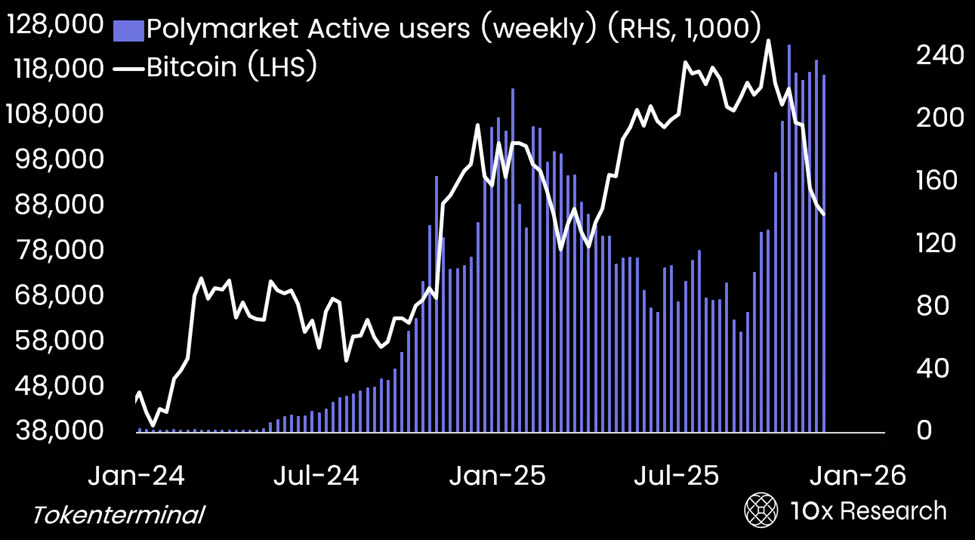
Polymarket active users, weekly, Bitcoin left-hand-side price, year-to-date chart. Source: 10x Research

Related: Bitcoin now settles Visa-scale volumes, but most is for wholesale, not coffee

The report is a concerning sign for casual traders looking to make easy money on prediction markets, as blockchain data suggests that most users lose their initial investment.
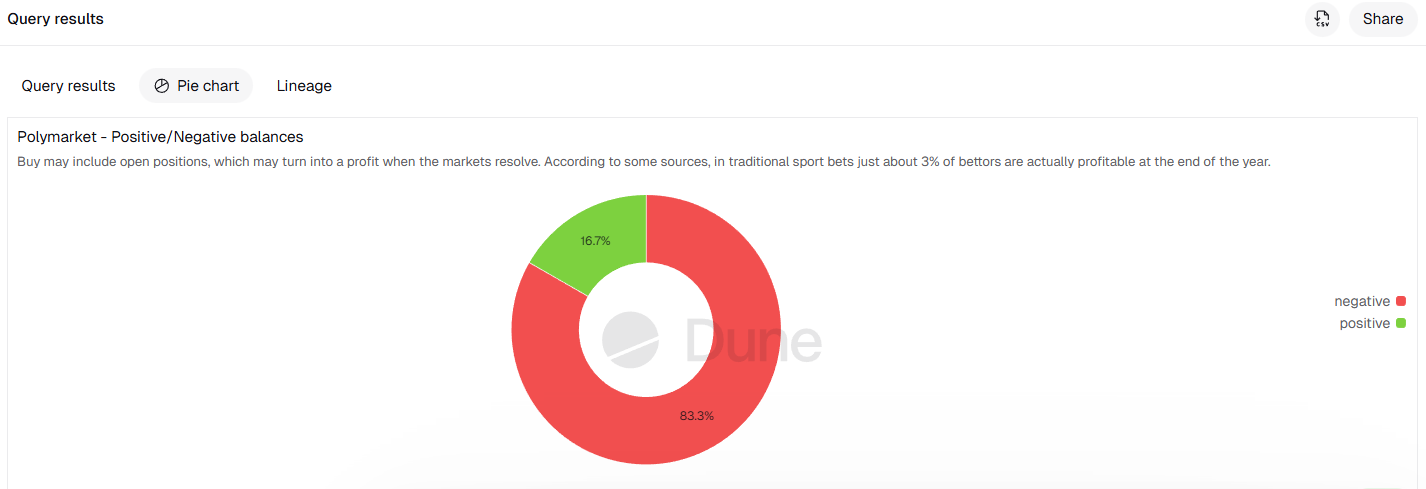
Polymarket, positive/negative wallet balances. Source: Dune.com

Only about 16.7% of wallets on Polymarket are in profit, while the remaining 83% have incurred losses, according to blockchain data from Dune.

Related: Prediction markets emerge as speculative ‘arbitrage arena’ for crypto traders

Perfect win rates fuel insider concerns

The flawless track record of some prediction market accounts is stoking concerns about possible insider trading, as certain users appear to win every time.

Polymarket user “pony-pony” boasts a 100% win rate with over $77,000 in realized profit by betting on events related to the artificial intelligence development company, OpenAI, prediction market data aggregator Polymarket Money said in a Monday X post.

Another user, “AlphaRaccoon,” also triggered insider allegations after generating over $1 million in a single day by successfully winning 22 out of 23 bets related to Google search trends.
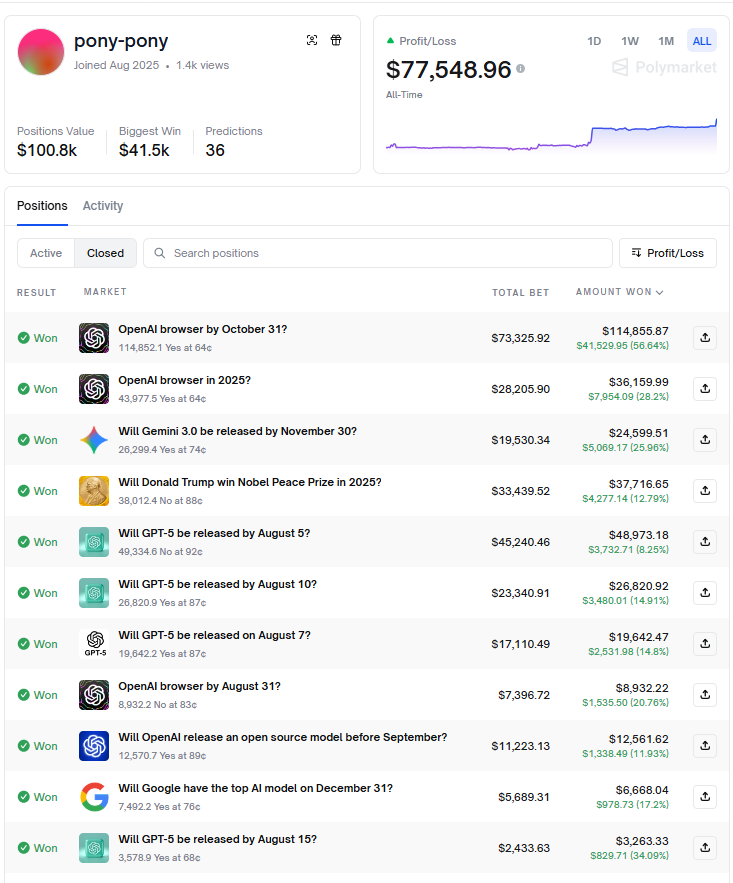
Source: Polymarket Money

Meanwhile, concerns are brewing over the reliability of Polymarket data on third-party data dashboards after a Paradigm researcher discovered a bug that double-counts the prediction market’s trading volume, Cointelegraph reported earlier on Tuesday.

The bug is inflating the primary volume metrics used to gauge prediction market activity, including the notional volume, which counts the number of contracts traded, and the cashflow volume, which measures the dollar value traded at the time of each trade, wrote Paradigm researcher Storm in a Tuesday X post.

However, the inflated volumes on data dashboards are due to errors in data interpretation, not wash trading, which is a deceptive and illegal practice in which entities buy and trade the same instrument to create a false impression of growing market activity.

Paradigm’s newly discovered bug was “validated” by multiple data dashboards, including AlliumLabs and DefiLlama, which are now updating their Polymarket dashboards to eliminate the double-counting error.

Magazine: Train AI agents to make better predictions... for token rewards

Пов'язані матеріали

USDC Begins Nested Issuance, Coinbase Launches Custom Stablecoin Branding Service

Coinbase has launched its "Custom Stablecoins" platform, enabling businesses to offer branded stablecoins. The first client is Flipcash, a social payments app, which has introduced USDF. USDF is a Solana-based stablecoin, pegged 1:1 to USDC, and is designed to serve as a stable pricing and settlement unit for Flipcash's user-created community currencies. This move shifts the focus of stablecoins from being standalone assets or investment products to becoming embedded payment and settlement components within broader applications. For businesses like Flipcash, the core need is not to become a stablecoin issuer, but to integrate stable, reliable digital cash functionality—handling pricing, payments, and settlements—without managing the complex underlying infrastructure of issuance, reserves, on-chain contracts, fiat on-ramps, and compliance. Coinbase's platform provides this infrastructure as a service, positioning the exchange as a stablecoin infrastructure provider. While USDC remains the foundational reserve asset, the branded token (e.g., USDF) offers applications a tailored, user-facing financial tool. This development highlights a potential path for stablecoins to become ubiquitous backend utilities in social, gaming, and e-commerce applications, though it also brings significant regulatory and operational complexities associated with handling real user funds.

链捕手1 год тому

USDC Begins Nested Issuance, Coinbase Launches Custom Stablecoin Branding Service

链捕手1 год тому

Detained for 37 Days: The First Wave of People Who Got Rich from 'AI Gateways' Are Starting to Go to Jail

A prominent AI proxy service operator was reportedly detained for 37 days and is now on bail pending trial, highlighting the legal risks in China's booming but unregulated AI intermediary market. These services act as "AI scalpers," providing domestic users with access to restricted overseas models (like OpenAI, Claude) by bundling APIs, handling payments, and bypassing network blocks, all for a fee. Their controversial profitability stems from practices like bulk-registering accounts to resell free credits, exploiting refund policies, overcharging for tokens, substituting cheaper models, and illegally selling user conversation data. Major figures, including cryptocurrency entrepreneurs, are now entering this space. Legally, these operations face severe risks. Their core model often involves unauthorized API access and operating without required telecom licenses, potentially constituting illegal business operations. They fail to meet data security obligations for the vast amounts of user data they process, risking charges for failing to fulfill network security duties. Crucially, the unauthorized collection and sale of user data, which can include personal and commercial secrets, easily meets the threshold for the crime of infringing on personal information. The case underscores a critical juncture for the AI industry. While proxies lower access barriers, they expose user data to unsecured middlemen and undermine the business models of AI developers, forcing them to divert resources to security and distorting market value perceptions. The article argues that the industry's sustainable future depends on building trust, protecting data, and fostering compliant competition, moving away from its current "wild growth" phase.

marsbit2 год тому

Detained for 37 Days: The First Wave of People Who Got Rich from 'AI Gateways' Are Starting to Go to Jail

marsbit2 год тому

Putting Markets On-Chain: Canton Network Quietly Becomes the New Backbone of Institutional Finance

**Title: Letting the Market Itself Go On-Chain: Canton Network Quietly Becomes the New Backbone for Institutional Finance** **Summary:** The Canton Network, a blockchain platform designed for institutional finance, is gaining significant traction. A key sign of its maturity was Visa's recent entry as a super-validator, a proposal approved in just three days—highlighting prior, extensive collaboration between traditional finance and crypto. Unlike public chains like Ethereum that prioritize transparency and asset onboarding, Canton focuses on enabling confidential, compliant business operations for regulated institutions. Its core design features built-in **data visibility control**, meaning transaction details are only shared between direct counterparties. This privacy is fundamental, allowing competing institutions (like banks Goldman Sachs, JPMorgan, and BNP Paribas, all validators) to interact on the same network without exposing sensitive positions or strategies. Developed by Wall Street veterans at Digital Asset, Canton has taken a slow, deliberate approach to onboard real financial activity. It now handles over **$9 trillion monthly** in transaction volume, primarily from real-world institutional use cases like **tokenized repo agreements**, Treasury settlements, and collateral mobility. Major live applications include **JPM Coin** for institutional payments and **DTCC's tokenized U.S. Treasuries** project. Canton's native token, **CC**, is framed as a "network utility asset" with zero pre-mine or VC allocations. Its value is intended to be driven by the volume of real financial activity on the network. Looking ahead, Canton aims to become the invisible foundational layer for global finance—enabling atomic settlement (where payment and asset delivery occur simultaneously), 24/7 capital flows, and the native issuance and settlement of various asset classes, from corporate bonds to potentially equities. The main challenges are no longer technical but involve navigating fragmented global regulations and integrating with legacy financial systems.

marsbit2 год тому

Putting Markets On-Chain: Canton Network Quietly Becomes the New Backbone of Institutional Finance

marsbit2 год тому

Торгівля

Спот
Ф'ючерси
活动图片