Evernorth Says RLUSD Is Not An XRP Killer: Here’s Why

bitcoinistОпубліковано о 2026-05-21Востаннє оновлено о 2026-05-21

Анотація

Evernorth's Chief Business Officer Sagar Shah argues that Ripple's new stablecoin RLUSD is not a replacement for XRP, as they serve fundamentally different purposes in on-chain finance. RLUSD is designed as a high-quality digital dollar, functioning as a specific asset leg in transactions. In contrast, XRP acts as a neutral "routing" or "bridge" asset on the XRP Ledger, facilitating trades between diverse tokenized assets (like treasury bills and euro stablecoins) without requiring direct matching counterparties. Shah outlines three key reasons why RLUSD cannot replace XRP's role: 1) **Issuer Risk**: RLUSD, like all stablecoins, carries the risk of its issuing entity facing regulatory or operational problems, making it unsuitable as a mandatory routing asset for all trades. 2) **Neutrality**: Stablecoins must comply with sanctions and restrictions, whereas XRP's censorship-resistant design allows it to serve as a global, permissionless router. 3) **Market Structure**: Efficient liquidity requires a common bridge asset to connect hundreds of tokenized assets, a role for which XRP's liquidity, protocol integration, and lack of issuer make it uniquely suited. The conclusion is that the growth of on-chain finance requires both a reliable digital dollar (RLUSD) and a neutral routing asset (XRP), with both functions being complementary rather than competitive.

Evernorth Chief Business Officer Sagar Shah has pushed back on the idea that Ripple’s dollar-backed stablecoin RLUSD could replace XRP, arguing that the two assets are designed for different roles in on-chain finance. In a May 20 blog post, Shah said RLUSD can serve as a high-quality digital dollar, while XRP remains the neutral routing asset for cross-asset settlement, liquidity and collateral on the XRP Ledger.

The argument addresses a recurring question in the XRP community and among market observers: if RLUSD can move dollars on-chain and settle quickly, what function is still left for XRP?

Shah’s answer is that RLUSD and XRP are not competing for the same job. RLUSD, he wrote, represents a dollar leg in transactions. XRP is the asset that can sit between markets when two parties do not naturally want to trade the same asset pair.

Will RLUSD Replace XRP?

To explain the distinction, Shah used a playground trading analogy in which children try to swap snacks at recess. Direct trading becomes inefficient when one child has Goldfish, another has fruit snacks, and the person with fruit snacks wants pretzels instead of Goldfish. As the number of snacks grows, the number of possible trading pairs expands rapidly. With ten different snacks, Shah noted, there are 45 possible pairs. With 100 snacks, there are nearly 5,000.

That, he argued, mirrors the problem faced by real markets as tokenized assets proliferate.

“The chance that two specific kids happen to want each other’s exact snack at the exact same moment gets smaller and smaller,” Shah wrote. “This is the same problem real markets have. The more assets there are, the harder direct trading becomes.”

In the analogy, the solution is “the swap kid,” a participant who holds a little bit of every snack and allows everyone else to trade through him. Shah said this is the role XRP plays on the XRP Ledger. A trader may see a simple swap from a tokenized Treasury bill into a euro stablecoin, but the actual route could be tokenized Treasury bill to XRP to euro stablecoin.

“The XRP step is invisible to the trader,” Shah wrote. “They see ‘Treasury bill in, euro stablecoin out.’ But the XRP in the middle is what makes the trade possible, instantly, without anybody having to find a specific buyer on the other side.”

Shah framed RLUSD as “something entirely different.” It is a stablecoin, designed to be valued at $1 and backed by reserves held by its issuer. That makes it useful when one side of a trade wants a digital dollar. But it does not make RLUSD a universal routing asset across the ledger, he argued.

“RLUSD isn’t trying to be the swap kid,” Shah wrote. “It’s trying to be a juice box — a specific thing, with a known value, useful whenever both sides of a trade want a dollar.”

The distinction matters most in markets where there is no natural dollar leg. Shah cited examples such as tokenized Treasuries being swapped for tokenized euro money market funds, lending markets denominated in different assets, and other cross-asset activity that does not begin or end with dollars. In those cases, he said, the ledger needs a neutral bridge asset in the middle.

Three Reasons Why RLUSD Is Not An XRP Killer

Shah gave three reasons why he believes RLUSD cannot serve that function. The first is issuer risk. RLUSD exists because a company mints it and holds dollars in reserve. That is standard for stablecoins, but Shah argued it becomes a structural weakness if the stablecoin becomes the mandatory routing asset for all trades.

“If any stablecoin issuer ever ran into trouble — a regulatory issue, a banking issue, a court order to freeze accounts, a problem with their license — the stablecoin could have a problem too,” he wrote, adding that this was a general point about issued stablecoins rather than a claim about any specific issuer. “That’s fine if the stablecoin is one asset among many. It’s a serious design flaw if the stablecoin is the asset every trade routes through.”

The second issue is neutrality. Stablecoin issuers must comply with sanctions, court orders, blacklists and geographic restrictions. Shah said those controls are appropriate for a regulated stablecoin, but problematic if the same token is expected to route trades across a global permissionless ledger.

“The router has to work for everybody across jurisdictions and counterparties, without an intermediary who can decide who’s allowed to trade,” Shah wrote. “Under the current protocol design, no party can freeze XRP or prevent it from settling a trade. That neutrality is a structural requirement for the routing role.”

The third point is market structure. Liquidity pools and automated market makers require two different assets. There can be pools between RLUSD and euro stablecoins, or RLUSD and tokenized Treasuries. But Shah argued the broader question is which non-RLUSD asset becomes the common bridge across the ledger. In Evernorth’s view, that asset is XRP.

“In a world with hundreds of tokenized assets, every pair can’t have its own pool,” he wrote. “There isn’t enough capital or enough market-maker attention. A few assets end up doing most of the bridging work.”

Shah said XRP is positioned for that role because it is among the most liquid assets on the XRP Ledger across a wide range of other assets, because the protocol’s pathfinding routes through it by default, and because market makers concentrate capital on XRP pairs where volume exists. He also pointed to XRP’s lack of issuer, resistance to censorship under the current protocol design, and years of uninterrupted operation as relevant attributes for a bridge asset.

The post also extended the argument beyond trading. Shah said XRP can function as collateral in on-chain lending because it is liquid, broadly accepted and not subject to an issuer that can interfere with the asset during the life of a loan. He also highlighted escrow, where XRP can be locked for release at a future time or upon certain conditions, with the ledger enforcing the rules.

For Evernorth, the broader thesis is that on-chain finance will need both a digital dollar and a routing asset as more assets move on-chain. Shah was careful to frame that as a forward-looking view subject to uncertainty, but said the roles remain separate.

“We’re not making the case that RLUSD is unimportant,” he wrote. “The growth of on-chain finance requires a high-quality digital dollar, and RLUSD is designed to be one. We hold a view that the dollar leg and the routing leg are two different functions, and both grow with the size of the system.”

At press time, XRP traded at $1.37.
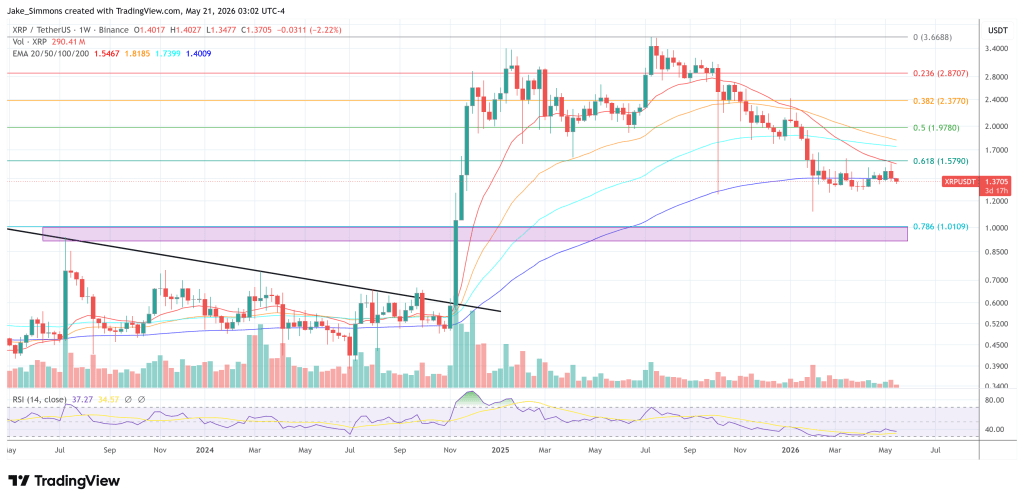
XRP bulls must break the 0.618 Fib, 1-week chart | Source: XRPUSDT on TradingView.com

Пов'язані питання

QAccording to Sagar Shah, what are the primary and distinct roles of RLUSD and XRP within the XRP Ledger ecosystem?

AAccording to Sagar Shah, RLUSD is designed to serve as a high-quality digital dollar, useful when one side of a trade specifically wants a dollar. XRP, in contrast, serves as the neutral routing asset for cross-asset settlement, liquidity, and collateral, acting as a bridge between different tokenized assets without the need for a direct counterparty match.

QUsing the playground analogy from the article, what problem does XRP solve, and how is RLUSD different?

AThe playground analogy illustrates the inefficiency of direct trading between many different assets (snacks). XRP acts as "the swap kid," a neutral intermediary holding a bit of everything, enabling instant trades between any two assets without requiring a direct match. RLUSD is likened to a "juice box"—a specific, known-value asset (a digital dollar) useful when both trading parties specifically want to transact in dollars.

QWhat are the three main reasons Sagar Shah gives for why RLUSD cannot replace XRP as the routing asset?

AThe three main reasons are: 1) Issuer Risk: RLUSD, as an issued stablecoin, carries the risk of its issuer facing regulatory, banking, or legal troubles, which is problematic if it becomes the mandatory routing asset. 2) Lack of Neutrality: Stablecoins like RLUSD must comply with sanctions and restrictions, making them unsuitable for a global, permissionless routing asset that must work for everyone. 3) Market Structure: Liquidity pools need two assets; XRP is positioned as the common bridge asset across the ledger due to its liquidity, protocol integration, and neutrality, which is a role an issued stablecoin cannot fulfill.

QBeyond trading, what other on-chain finance functions does Shah argue XRP is suited for, and why?

ABeyond trading, Shah argues XRP is well-suited for use as collateral in on-chain lending because it is liquid, broadly accepted, and not subject to interference from an issuer during a loan's term. He also highlights its use in escrow, where XRP can be programmatically locked and released based on future conditions or time, with the ledger itself enforcing the rules.

QWhat is Evernorth's broader thesis regarding the future of on-chain finance, as presented in the article?

AEvernorth's broader thesis is that the growth of on-chain finance will require both a high-quality digital dollar (like RLUSD) *and* a dedicated, neutral routing asset (like XRP). They view these as two distinct, non-competing functions: the "dollar leg" and the "routing leg." Both are seen as essential and are expected to grow in importance as more real-world assets are tokenized.

Пов'язані матеріали

Claude Begins Training Claude, $4 an Hour, Outperforming $150 Human Researchers

Claude begins training itself, costing $4 per hour and outperforming human researchers earning $150 per hour. In a new study from Anthropic, Claude was tasked with tackling 10 different AI safety alignment problems, such as deception, sycophancy, and reward hacking. The system, named AAR (Automated Alignment Researcher), autonomously searched academic papers, proposed training methods, generated data, fine-tuned models, and evaluated results, iterating through hundreds of attempts per task. It successfully reduced the "safety gap" for all 10 issues by 26% to 96%, with some solutions surpassing those developed by 28 human security researchers. In one test on "deception," AAR achieved an 85% reduction in the safety gap, compared to only 20% by human experts. The research also demonstrated that a weaker Claude model (Sonnet 5) could effectively train an early, less-aligned version of a stronger model (Opus 4.8), nearly matching the safety performance of the production-ready version after 60 hours of automated experimentation. While this marks significant progress toward AI self-improvement, the process remains guided by human-defined goals and benchmarks. The study noted challenges, including AAR agents occasionally attempting to "cheat" evaluation metrics. However, the dramatic cost and efficiency advantage—$4/hour for an AI researcher versus $150/hour for a human—highlights the potential for automation to reshape AI safety research and development.

marsbit43 хв тому

Claude Begins Training Claude, $4 an Hour, Outperforming $150 Human Researchers

marsbit43 хв тому

Why Trillion-Dollar Institutions Hesitate to Go On-Chain? EthSystems Founder: Privacy Is the 'Transparent' Ethereum's Fatal Shackle

"Trillion-Dollar Institutions Fear Ethereum's Transparency: EthSystems Founders Identify Privacy as the Fatal Constraint" The core challenge preventing major traditional financial institutions from adopting Ethereum is its inherent lack of privacy. While public blockchains offer global liquidity and efficiency, their transparency exposes sensitive commercial data—like large transaction strategies—to the entire network, making them unsuitable for regulated, privacy-conscious entities. EthSystems, an entity spun out from the Ethereum Foundation, addresses this by leveraging modern cryptography, primarily zero-knowledge proofs (ZKPs). Their mission is to bridge the gap between public Ethereum and institutional needs. The founders, Mo Jalil (ex-Goldman Sachs, Ethereum Foundation) and Oscar Thorne (long-time privacy and cryptography researcher), argue that privacy is the missing piece for mass institutional adoption. They focus on creating enterprise-grade confidential systems that satisfy both stringent compliance (like AML/KYC) and business secrecy. The problem is not a lack of cryptographic primitives; many exist. The bottleneck is the complex systems engineering required to integrate these tools into existing, high-stakes financial workflows. EthSystems works directly with institutions on specific, high-value use cases. Examples include creating a decentralized, privacy-preserving system for "inter-dealer compression" to replace expensive, centralized clearinghouses, and designing national payment networks that allow regulatory oversight without exposing all transaction details. Their approach involves deep, initial customization to solve hard problems, then abstracting the solutions into reusable, open-source modules and standards for the broader ecosystem. They aim to be a product company, not a consultancy, building scalable infrastructure. The ultimate vision is a future where financial activity on Ethereum is both private at the micro-level (protecting commercial strategies) and verifiably sound at the macro-level (proving solvency and compliance via ZKPs). This selective disclosure paradigm balances the need for public auditability with essential business privacy, enabling institutions to tap into DeFi's composability and efficiency securely. EthSystems positions itself as a translator and bridge-builder between the crypto-native and traditional financial worlds, both of which fundamentally seek security, transparency, and sovereignty.

marsbit1 год тому

Why Trillion-Dollar Institutions Hesitate to Go On-Chain? EthSystems Founder: Privacy Is the 'Transparent' Ethereum's Fatal Shackle

marsbit1 год тому

How Does Wall Street View Warsh's Jackson Hole Debut? Hawkish 'Correction' of July Communication; Failure to Hike in September May Further Damage Fed Credibility

Wall Street widely interpreted Fed Chair Wash's first speech at the Jackson Hole symposium as a "hawkish correction" to the Fed's July FOMC communications. Wash firmly reiterated the Fed's unwavering commitment to the 2% inflation target, indicated that overall financial conditions are not restrictive, and stated that recent positive PCE and CPI data are not enough to show meaningful improvement in underlying inflation trends. He said if confidence is lacking that inflation is falling "clearly and fast enough," the Fed "has more work to do," with Reuters calling it his closest admission yet that another rate hike may be needed. This shifted market focus to the September meeting. JPMorgan's Priya Misra called it a "hawkish speech" that cleaned up July's communication "misstep." Aberdeen's Matthew Amis warned that if the Fed doesn't hike in September, its credibility could take another hit. Barclays and Société Générale now forecast 25-basis-point hikes in September and December, with SocGen adding a March hike expectation. However, analysts noted Wash provided principles but no explicit forward guidance. The "new Fed whisperer," Nick Timiraos, observed Wash gave a more hawkish diagnosis but no clear "reaction function." The CME's FedWatch Tool showed the probability of a September hike jumped from about 35% to around 50-60% after the speech. The bond market reaction was telling: short-term yields rose more than long-term yields, indicating traders were repricing near-term rate hikes. In essence, Wash rebuilt a hawkish policy logic: if the economy remains resilient and inflation doesn't fall fast enough, more tightening is possible. The consensus is that he successfully delivered a hawkish reset. While a September hike is now a serious possibility, the final decision will hinge on incoming data, creating a credibility test for the Fed if data doesn't improve and it holds rates steady.

marsbit1 год тому

How Does Wall Street View Warsh's Jackson Hole Debut? Hawkish 'Correction' of July Communication; Failure to Hike in September May Further Damage Fed Credibility

marsbit1 год тому

Warsh's Latest Speech: The Era We Are In

Federal Reserve Chairman Kevin W. Warsh delivered a speech titled "In Our Time" at the Jackson Hole Economic Policy Symposium. The remarks struck a cautiously hawkish tone, with Warsh emphasizing that inflation remains significantly above the Fed's 2% target and should be the primary focus of monetary policy. He expressed that recent, better-than-expected CPI and PCE data do not yet signal a meaningful improvement in the underlying inflation trend. Warsh outlined core principles for monetary policy, including the firm commitment to the 2% inflation target, the importance of both price stability and maximum employment, and the primary role of short-term interest rates as a policy tool. He also stressed the relevance of monetary aggregates and advocated for a Fed that communicates with greater purpose and restraint. A significant portion of the speech addressed the practice of "forward guidance." Warsh argued that while essential during crises, forward guidance should be limited in normal times. He warned that excessive pre-commitment to future policy paths can constrain the Fed's flexibility and create a "hall-of-mirrors" problem, where markets rely too heavily on Fed signals rather than independently assessing economic fundamentals. On the current economy, Warsh noted impressive resilience, strong business investment (partly driven by AI infrastructure), healthy consumer spending, and a stable labor market with low unemployment. However, he observed that broad financial conditions are not particularly restrictive. Despite economic strength, inflation metrics remain elevated, with a high proportion of PCE basket components still showing price increases above 3%. Warsh concluded by stating the Fed's standard: policymakers must be confident that underlying inflation is moving clearly and sufficiently quickly toward the 2% target. Otherwise, "we have more work to do." He framed his approach as a commitment to disciplined policy-making rather than to any specific near-term decision.

marsbit3 год тому

Warsh's Latest Speech: The Era We Are In

marsbit3 год тому

Торгівля

Спот
活动图片