Japan plans major shift as crypto moves from payments to securities law

cointelegraphОпубліковано о 2025-12-10Востаннє оновлено о 2025-12-10

Анотація

Japan's Financial Services Agency (FSA) is planning to shift cryptocurrency regulation from the Payment Services Act to the Financial Instruments and Exchange Act (FIEA), treating crypto primarily as investment products rather than payment methods. This move aims to enhance user protection by imposing stricter disclosure rules for initial exchange offerings (IEOs), including mandatory pre-sale information, third-party code audits, and issuer identity disclosure. The new framework also strengthens measures against unregistered platforms and explicitly prohibits insider trading. The regulatory shift coincides with government discussions to implement a flat 20% tax rate on crypto trading profits.

Japan’s financial regulators are preparing to move crypto asset oversight out of the country’s payments regime and into a framework designed for investment and securities markets.

The Financial Services Agency (FSA) on Wednesday released a comprehensive report from the Financial System Council’s Working Group on the regulatory status of cryptocurrencies across multiple sectors.

The document outlines a plan to shift the legal basis for crypto regulation from the Payment Services Act (PSA) to the Financial Instruments and Exchange Act (FIEA), which is the primary law regulating securities markets, issuance, trading and disclosures.

“Crypto assets are increasingly being used as investment targets both domestically and internationally,” the report noted, underscoring the need to protect users by providing regulation that treats crypto as a financial product.

Strengthening data disclosure regulations

One of the core changes brought by bringing crypto under FIEA regulatory scope is strengthening data disclosure requirements for initial exchange offerings (IEOs), or token sales managed by crypto exchanges.

“Crypto transactions conducted by users are similar to securities transactions, and may involve the sale of new crypto assets or the buying and selling already in circulation,” the document reads, highlighting the importance of timely information during IEO sales.
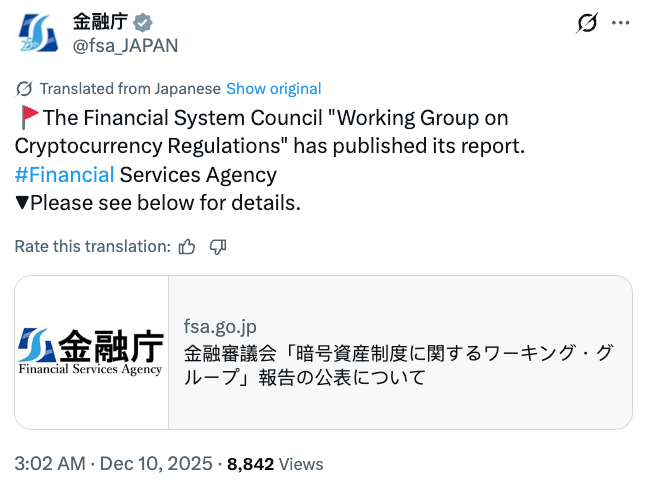
Source: FSA Japan

Among the requirements for IEOs, the proposal mandates that exchanges provide pre-sale disclosures, including detailed information about the core entities behind the offering. It also requires code audits by independent third-party experts and encourages consideration of feedback from self-regulatory organizations.

In addition to exchanges, it places responsibilities on issuers, requiring them to disclose their identities, regardless of whether the project is decentralized, and how tokens are issued and distributed.

Related: Crypto payments coming to PlayStation as Sony plans stablecoin launch in 2026

The proposed framework would also give regulators stronger tools to crack down on unregistered platforms, particularly those operating from overseas or tied to decentralized exchanges. It also includes explicit prohibitions on insider trading, echoing provisions of the European Union’s Markets in Crypto-Assets (MiCA) framework and South Korea’s regulations.

The news came amid the Japanese government’s consideration of plans to reduce the maximum tax rate on crypto profits by imposing a flat rate of 20% on all gains from crypto trading.

On Tuesday, FSA also signaled a cautious stance on permitting derivatives for foreign crypto asset exchange-traded funds, reportedly describing the underlying assets as “not desirable.”

Magazine: When privacy and AML laws conflict: Crypto projects’ impossible choice

Пов'язані матеріали

USDC Begins Nested Issuance, Coinbase Launches Custom Stablecoin Branding Service

Coinbase has launched its "Custom Stablecoins" platform, enabling businesses to offer branded stablecoins. The first client is Flipcash, a social payments app, which has introduced USDF. USDF is a Solana-based stablecoin, pegged 1:1 to USDC, and is designed to serve as a stable pricing and settlement unit for Flipcash's user-created community currencies. This move shifts the focus of stablecoins from being standalone assets or investment products to becoming embedded payment and settlement components within broader applications. For businesses like Flipcash, the core need is not to become a stablecoin issuer, but to integrate stable, reliable digital cash functionality—handling pricing, payments, and settlements—without managing the complex underlying infrastructure of issuance, reserves, on-chain contracts, fiat on-ramps, and compliance. Coinbase's platform provides this infrastructure as a service, positioning the exchange as a stablecoin infrastructure provider. While USDC remains the foundational reserve asset, the branded token (e.g., USDF) offers applications a tailored, user-facing financial tool. This development highlights a potential path for stablecoins to become ubiquitous backend utilities in social, gaming, and e-commerce applications, though it also brings significant regulatory and operational complexities associated with handling real user funds.

链捕手1 год тому

USDC Begins Nested Issuance, Coinbase Launches Custom Stablecoin Branding Service

链捕手1 год тому

Detained for 37 Days: The First Wave of People Who Got Rich from 'AI Gateways' Are Starting to Go to Jail

A prominent AI proxy service operator was reportedly detained for 37 days and is now on bail pending trial, highlighting the legal risks in China's booming but unregulated AI intermediary market. These services act as "AI scalpers," providing domestic users with access to restricted overseas models (like OpenAI, Claude) by bundling APIs, handling payments, and bypassing network blocks, all for a fee. Their controversial profitability stems from practices like bulk-registering accounts to resell free credits, exploiting refund policies, overcharging for tokens, substituting cheaper models, and illegally selling user conversation data. Major figures, including cryptocurrency entrepreneurs, are now entering this space. Legally, these operations face severe risks. Their core model often involves unauthorized API access and operating without required telecom licenses, potentially constituting illegal business operations. They fail to meet data security obligations for the vast amounts of user data they process, risking charges for failing to fulfill network security duties. Crucially, the unauthorized collection and sale of user data, which can include personal and commercial secrets, easily meets the threshold for the crime of infringing on personal information. The case underscores a critical juncture for the AI industry. While proxies lower access barriers, they expose user data to unsecured middlemen and undermine the business models of AI developers, forcing them to divert resources to security and distorting market value perceptions. The article argues that the industry's sustainable future depends on building trust, protecting data, and fostering compliant competition, moving away from its current "wild growth" phase.

marsbit2 год тому

Detained for 37 Days: The First Wave of People Who Got Rich from 'AI Gateways' Are Starting to Go to Jail

marsbit2 год тому

Putting Markets On-Chain: Canton Network Quietly Becomes the New Backbone of Institutional Finance

**Title: Letting the Market Itself Go On-Chain: Canton Network Quietly Becomes the New Backbone for Institutional Finance** **Summary:** The Canton Network, a blockchain platform designed for institutional finance, is gaining significant traction. A key sign of its maturity was Visa's recent entry as a super-validator, a proposal approved in just three days—highlighting prior, extensive collaboration between traditional finance and crypto. Unlike public chains like Ethereum that prioritize transparency and asset onboarding, Canton focuses on enabling confidential, compliant business operations for regulated institutions. Its core design features built-in **data visibility control**, meaning transaction details are only shared between direct counterparties. This privacy is fundamental, allowing competing institutions (like banks Goldman Sachs, JPMorgan, and BNP Paribas, all validators) to interact on the same network without exposing sensitive positions or strategies. Developed by Wall Street veterans at Digital Asset, Canton has taken a slow, deliberate approach to onboard real financial activity. It now handles over **$9 trillion monthly** in transaction volume, primarily from real-world institutional use cases like **tokenized repo agreements**, Treasury settlements, and collateral mobility. Major live applications include **JPM Coin** for institutional payments and **DTCC's tokenized U.S. Treasuries** project. Canton's native token, **CC**, is framed as a "network utility asset" with zero pre-mine or VC allocations. Its value is intended to be driven by the volume of real financial activity on the network. Looking ahead, Canton aims to become the invisible foundational layer for global finance—enabling atomic settlement (where payment and asset delivery occur simultaneously), 24/7 capital flows, and the native issuance and settlement of various asset classes, from corporate bonds to potentially equities. The main challenges are no longer technical but involve navigating fragmented global regulations and integrating with legacy financial systems.

marsbit2 год тому

Putting Markets On-Chain: Canton Network Quietly Becomes the New Backbone of Institutional Finance

marsbit2 год тому

Торгівля

Спот
Ф'ючерси
活动图片