Ripple IPO Could Bring ‘Something Special’ For XRP Holders, CEO Suggests

bitcoinistОпубліковано о 2026-05-08Востаннє оновлено о 2026-05-08

Анотація

Ripple CEO Brad Garlinghouse suggested XRP holders could receive "something special" if the company goes public, though he stressed an IPO is not an immediate priority. He addressed community concerns about Ripple's corporate success not directly benefiting XRP holders, stating the company's main contribution is building products and partnerships to increase XRP's utility and value. While not endorsing a near-term mechanism like a token buyback, Garlinghouse left open the possibility of a future IPO-related benefit for holders. He explained Ripple is not rushing to go public, citing poor recent crypto IPO performance and the benefits of remaining private. Garlinghouse also rejected concerns that Ripple's expansion into areas like stablecoins dilutes XRP's role, arguing the company, as the largest XRP holder, remains deeply incentivized to see the asset succeed. He reaffirmed his commitment to the XRP community, calling it a driving mission for the company.

Ripple CEO Brad Garlinghouse suggested that XRP holders could potentially receive “something special” if Ripple eventually goes public, while stressing that any such move is not an immediate priority for the company.

Speaking with Eleanor Terrett on the Crypto In America podcast at XRP Las Vegas, Garlinghouse addressed one of the more sensitive questions inside the XRP community: whether holders of the token should benefit more directly from the firm’s corporate success as the company’s valuation, acquisitions and institutional footprint continue to expand.

Garlinghouse Addresses XRP Holder Benefits

The exchange came after Terrett noted criticism that Ripple has become a major private-company success story while XRP holders remain economically separate from Ripple’s equity. Ripple, Garlinghouse said, was last valued at $50 billion in a share buyback, a figure that has intensified debate over whether the company’s growth should translate into a more direct benefit for the XRP community.

Asked whether the company had explored an XRP token buyback or another structure that would allow holders to share in Ripple’s wealth, Garlinghouse did not endorse a near-term mechanism. Instead, he framed the firm’s contribution as indirect but central: building products, infrastructure and partnerships that increase XRP’s utility, liquidity and trust.

“I hope XRP holders feel like they are benefiting from Ripple’s existence by virtue of what we’re doing to try to catalyze things within the XRP community,” Garlinghouse said. “Is there a scenario if and when Ripple goes public, would we do something special for people who hold XRP or something? Maybe. But I mean, that’s not in the immediate term.”

That “maybe” is likely to draw attention because it leaves open a possibility the company has rarely discussed publicly: a future IPO-related benefit tied to XRP ownership. Garlinghouse was careful, however, not to describe it as a plan, commitment or pending corporate action.

Ripple Still Not Rushing Toward An IPO

Garlinghouse also made clear that Ripple is not currently prioritizing a public listing. He pointed to recent crypto IPO performance as one reason the company is not in a hurry, citing BitGo and Gemini as examples of deals that “haven’t done particularly well,” and noting that Kraken has reportedly delayed its own listing plans.

“The long-term dynamic, you know, we have not prioritized going public for a whole bunch of reasons,” he said. “There’s benefits to being private. Like, I could get up here and kind of say whatever the hell I want to say.”

His remarks suggest that any special structure for XRP holders would depend on a much broader corporate decision that remains unresolved. Ripple may have the valuation and market profile of a company that could eventually test public markets, but Garlinghouse framed the IPO question as distant rather than imminent.

The discussion also touched on a recurring concern among parts of the XRP community: whether Ripple’s expansion into stablecoins, prime brokerage, treasury products and institutional infrastructure could dilute XRP’s role in the company’s strategy.

Garlinghouse rejected that reading. He argued that Ripple remains deeply aligned with XRP because the company is still the largest holder of the asset and has the strongest economic incentive to see it succeed.

“Today, Ripple is still the largest holder of XRP on the planet,” he said. “We are the most interested party in seeing XRP be successful. We will continue to be the most interested party in seeing XRP be successful.”

He added that Ripple’s strategy is designed around making XRP “the most useful digital asset,” “the most liquid digital asset” and “the most trusted digital asset.” In his telling, even initiatives that do not appear immediately connected to XRP can still serve that broader objective through a longer route.

“I don’t feel the need to constantly update the whole world about our strategy because to some degree that just informs people who want to compete against us,” Garlinghouse said. “We’re going to do things that may not at first blush make crystal clear sense. But I swear to you, even if it doesn’t have a direct line from point A to point B, point B being good for XRP, it may be point A to point B to point B to point C.”

That explanation appeared aimed at criticism around Ripple’s RLUSD stablecoin and broader institutional push. Garlinghouse’s argument is that Ripple’s corporate expansion is not a pivot away from XRP, but part of a larger effort to deepen institutional rails around the XRP Ledger and related liquidity.

Garlinghouse repeatedly emphasized his loyalty to the community, calling it the “XRP family” and saying he wants Ripple to make decisions that are good for that ecosystem. He pointed to acquisitions, external investments and support for digital asset treasury company Evernorth as examples of initiatives Ripple views through that lens.

“I freaking love the XRP family,” he said. “I want to do things that are good for the XRP community. It is a driving mission.”

At press time, XRP traded at $1.379.
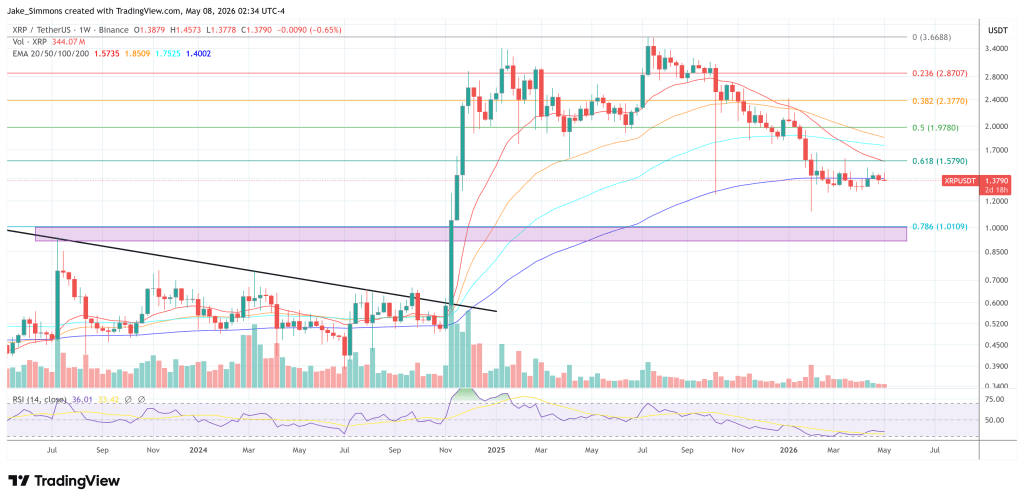
XRP trades around the 200-week EMA again, 1-week chart | Source: XRPUSDT on TradingView.com

Пов'язані питання

QWhat potential benefit did Ripple CEO Brad Garlinghouse suggest XRP holders might receive if the company goes public?

ABrad Garlinghouse suggested that XRP holders could potentially receive 'something special' if Ripple eventually conducts an IPO, though he emphasized this is not a current plan or commitment.

QAccording to Garlinghouse, what is Ripple's primary contribution to the XRP community currently?

AGarlinghouse stated that Ripple's primary contribution is indirect, focusing on building products, infrastructure, and partnerships that increase XRP's utility, liquidity, and trust.

QWhy is Ripple not currently prioritizing a public listing (IPO), as stated by its CEO?

ARipple is not prioritizing an IPO due to the poor performance of recent crypto IPOs (citing BitGo and Gemini as examples) and the benefits of remaining a private company, such as greater freedom in public statements.

QHow did Garlinghouse address concerns that Ripple's expansion into other areas could dilute XRP's role in its strategy?

AGarlinghouse rejected this concern, arguing that Ripple remains the largest holder of XRP and has the strongest economic incentive for its success. He stated that all corporate initiatives, even those not directly linked, are part of a broader strategy to make XRP the most useful, liquid, and trusted digital asset.

QWhat was the trading price of XRP mentioned at the end of the article?

AAt press time, XRP was trading at $1.379.

Пов'язані матеріали

From KYC to KYA, Is It Time to Give AI Agents Their Own 'ID Cards'?

Titled "From KYC to KYA: Is It Time to Issue 'Identity Cards' for AI Agents?", this article discusses the emerging concept of Know Your Agent (KYA) as AI agents become increasingly autonomous. In Agent-to-Agent (A2A) scenarios, where agents execute contracts, payments, and trades without human intervention, the lack of a shared identity standard creates risks like unauthorized transactions, fraud, and accountability gaps. KYA acts as a trust layer to verify an agent's origin, authority, and accountability. The need for KYA is most critical outside centralized platforms (like Google or Coinbase), such as in decentralized exchanges (DEX), A2A payments, and merchant payments. Several key players are building KYA infrastructure: - **ERC-8004**: A proposed Ethereum standard that issues a unique AgentID as an NFT, building on-chain identity, reputation, and validation systems. - **Visa TAP**: Visa's solution issues agent identity credentials, with transactions verified via triple signatures (legitimacy, delegator, payment method). - **Trulioo**: Extends its KYC/KYB compliance infrastructure using a Digital Passport for Agents (DAP), issued after verifying both the developer and user, and refreshed per transaction. - **Sumsub**: Focuses on post-issuance real-time verification, detecting agent anomalies during transactions using its existing compliance systems. Regulatory bodies are also acting. The EU AI Act mandates operator identification in logs for high-risk AI systems, the US NIST prioritizes agent identity management standards, and Singapore has released a national AI governance framework. Similar to how the 2019 FATF Travel Rule impacted crypto exchanges, possessing KYA infrastructure may determine market entry in the AI agent era. The market is expected to segment rather than produce a single winner, with success depending on integrations with merchants, payment networks, and KYC client bases.

marsbit7 хв тому

From KYC to KYA, Is It Time to Give AI Agents Their Own 'ID Cards'?

marsbit7 хв тому

The Next Generation of Payments Lies Not in the Payment Layer

The Next-Generation of Payment is Not in the Payment Layer This is the second piece in a series analyzing Stripe's AI strategy. The series stems from Stripe's vision of becoming the economic infrastructure for the AI Agent era, announced at Stripe Sessions 2026. A key debate centers on whether Know Your Agent (KYA) is merely an upgrade to existing payment systems. The author argues the opposite: payment will become a subsystem of KYA, not the other way around. Historically, major payment innovations (online banking, mobile wallets, QR codes) emerged from new transaction scenarios that broke the underlying assumptions of old systems, not from optimization within the payment layer itself. Agent economy is that new scenario, and KYA is the foundational infrastructure growing to support it. KYA's proposed five layers—Agent Identity, Authorization Scope, Intent Signing, Liability Chain Auditing, and Credit Rating—extend far beyond payments. Only authorization and auditing directly touch the payment链路. Identity, intent, and credit layers serve broader needs like cross-platform calls, AI alignment, and permission management. Stripe's strategic moves validate this view. Its focus on "economic infrastructure for AI," investments in protocols like Agentic Commerce Protocol (an identity/session protocol), Shared Payment Tokens, stablecoin infrastructure, embedded wallets, and its own Tempo blockchain for settlement, all point to building the KYA layer, not just optimizing payments. Data shows the core challenge in AI commerce has shifted upstream: determining "who this is, what they intend to do, and if they deserve resources" happens long before checkout. This is why Stripe is moving its Radar fraud prevention from the transaction moment to the entire user lifecycle—a KYA-layer concern. Legally, ultimate responsibility will still fall on a human, as laws like AB 316 dictate. However, in a distributed,网状 liability chain involving users, Agent platforms, model providers, and payment protocols, KYA's role is to use cryptography to make every entity's actions and roles verifiable and traceable. This enables accountability where it was previously impossible to pinpoint evidence, fundamentally changing责任追溯, not just payment efficiency. The next-generation payment形态 will not be designed within the payment layer. It will emerge from the Agent economy scenario after the KYA infrastructure is established.

marsbit2 год тому

The Next Generation of Payments Lies Not in the Payment Layer

marsbit2 год тому

The Next Generation of Payments Is Not in the Payment Layer

The next generation of payments won't be designed within the payment layer itself. This article argues that historical payment innovations (e.g., online banking, mobile wallets) emerged from new transactional scenarios, not from optimizing existing payment systems. The new scenario is the Agent economy. Know Your Agent (KYA) is not merely a payment-layer upgrade for efficiency. It is the foundational infrastructure layer for the Agent economy. KYA’s five layers—Agent identity, authorization scope, intent signature, accountability chain audit, and credit rating—primarily serve broader needs like cross-platform identification, AI alignment, and permission management. Payment is just one application built on top of this KYA foundation. Stripe’s strategy exemplifies this shift. Its focus on "economic infrastructure for AI," investments in protocols like the Agentic Commerce Protocol (identity/session layer), stablecoin infrastructure, embedded wallets, and moving risk management (Radar) to the user lifecycle all indicate it is building the KYA layer, not just optimizing payments. While ultimate legal liability remains with a human (as laws like AB 316 stipulate), KYA enables traceability in a distributed,网状 responsibility chain involving multiple entities (user, Agent platform, model provider, etc.). It makes accountability verifiable where previously it was opaque. The conclusion: A new class of economic actors (Agents) forces a new infrastructure layer (KYA) to emerge. This layer redefines identity, authorization, and accountability. On top of it, the next generation of payment will reorganize and emerge from the demands of the scenario, not from within the traditional payment system.

链捕手2 год тому

The Next Generation of Payments Is Not in the Payment Layer

链捕手2 год тому

Торгівля

Спот
Ф'ючерси

Популярні статті

Що таке XRP 2.0

XRP 2.0: Нова межа в світі криптовалют Вступ до XRP 2.0 У постійно змінюючомуся світі криптовалют нові проекти постійно з'являються, змагаючись за увагу та прийняття. Однією з таких обіцяючих ініціатив є XRP 2.0, новий криптовалютний проект, що має на меті використання сучасних технологій блокчейн та надійних методів шифрування. Хоча назва нагадує про XRP від Ripple, важливо зазначити, що XRP 2.0 функціонує автономно, концентруючи увагу на підвищенні безпеки транзакцій, конфіденційності та масштабованості. Оскільки цифровий фінансовий ландшафт все більше приймає децентралізовані рішення, XRP 2.0 прагне значно сприяти веб3 та загальному розширенню крипто проектів. Що таке XRP 2.0? У своїй основі XRP 2.0 є криптовалютним проектом, що має на меті створення безпечної та децентралізованої екосистеми цифрової валюти. Його фундаментальна технологія інтегрує складні принципи блокчейну з передовими техніками шифрування. Загальною метою XRP 2.0 є встановлення себе як надійної та ефективної платформи, що дозволяє швидко виконувати транзакції, при цьому надаючи пріоритет підвищеним захистам конфіденційності для своїх користувачів. Проект позиціонується як рішення багатьох обмежень, з якими стикаються існуючі криптовалюти, пропонуючи систему, яка може обробляти вищий обсяг транзакцій з покращеною швидкістю та конфіденційністю. Ця універсальність позиціонує XRP 2.0 як значного гравця на ринку, наповненому різними цифровими валютами. Хто творець XRP 2.0? Особистість творця XRP 2.0 була позначена як «Вілбур». Проте, вичерпні деталі про Вілбура або пов'язану з ним організацію залишаються недоступними. Анонімність багатьох творців криптовалют не є незвичним явищем в індустрії, часто запроваджена для збереження певного рівня конфіденційності та безпеки. Хто інвестори XRP 2.0? На даний момент конкретна інформація про інвестиційні фонди або організації, що підтримують XRP 2.0, не є публічно доступною. У секторі криптовалют підтримка від визнаних інвесторів може значно вплинути на кредитоспроможність і успіх проекту, але прозорість щодо фінансових підтримувачів XRP 2.0 не була встановлена. Як працює XRP 2.0? XRP 2.0 вирізняється використанням комбінації технології блокчейн та просунутих алгоритмів шифрування, що забезпечують безпечні та децентралізовані транзакції. Його інноваційна структура включає унікальні функції, спрямовані на залучення користувачів та розширення функціональності за межами традиційних транзакцій криптовалюти. Серед цих функцій, XRP 2.0 включає можливості на базі ШІ, такі як текст в зображення та текст в мову. Ці нововведення розроблені для покращення інтерактивного досвіду для користувачів, сприяючи ширшій застосовності в різних секторах. Завдяки поєднанню технологічних досягнень з орієнтованим на користувача дизайном, XRP 2.0 прагне привернути увагу різноманітних осіб і підприємств, які шукають способи інтеграції рішень криптовалют у свої операційні структури. Хронологія XRP 2.0 Розуміння XRP 2.0 вимагає вивчення основних етапів, які визначили його подорож до теперішнього часу: 23 липня 2023 року: XRP 2.0 представлено як новий криптовалютний проект, що має на меті революціонізувати безпечні та децентралізовані можливості транзакцій у галузі блокчейн. 8 вересня 2023 року: Запускається інший проект, XRP20, що відзначає виникнення токена ERC-20 на блокчейні Ethereum, який не пов'язаний з XRP 2.0. 13 листопада 2023 року: XRP Ledger зазнає значного оновлення з виходом програмного забезпечення rippled server версії 2.0.0. Важливо зазначити, що цей розвиток не пов'язаний з криптовалютним проектом XRP 2.0. Ключові моменти про XRP 2.0 Щоб узагальнити суть XRP 2.0, кілька критично важливих факторів emerge: Унікальні функції: Включення функцій, таких як текст в зображення і текст в мову на базі ШІ, ще більше розширює потенційні застосування XRP 2.0. Технологія блокчейн: Архітектура використовує сучасні механізми блокчейн і протоколи шифрування, забезпечуючи безпечне та децентралізоване середовище для транзакцій. Масштабованість і конфіденційність: XRP 2.0 надає пріоритет підвищеним захистам конфіденційності в процесах транзакцій і масштабованості, необхідній для задоволення зростаючої бази користувачів. Відсутність зв'язку з Ripple: Важливо, що, незважаючи на свою назву, XRP 2.0 не має жодної прив'язки чи співпраці з XRP від Ripple, що відрізняє його операційну структуру та цілі в рамках криптовалютної екосистеми. Висновок XRP 2.0 представляє амбітну ініціативу у світі криптовалют, прагнучи запропонувати поєднання безпеки, конфіденційності та ефективності у цифрових транзакціях. Інтегруючи складні технології та дружні до користувача функції, проект ставить за мету розширити горизонти того, що криптовалюта може досягти в сучасній цифровій економіці. Хоча анонімність його творця та відсутність розкритих інвесторів можуть викликати запитання у деяких, фокус XRP 2.0 на передових функціональностях і децентралізації підвищує його привабливість на дедалі більшому ринку криптовалют. Оскільки ландшафт криптовалют продовжує еволюціонувати, XRP 2.0 може ще стати важливим гравцем у розширенні безпечних і масштабованих рішень блокчейн.

162 переглядів усьогоОпубліковано 2024.04.05Оновлено 2024.12.03

Що таке XRP 2.0

Як купити XRP

Ласкаво просимо до HTX.com! Ми зробили покупку XRP (XRP) простою та зручною. Дотримуйтесь нашої покрокової інструкції, щоб розпочати свою криптовалютну подорож.Крок 1: Створіть обліковий запис на HTXВикористовуйте свою електронну пошту або номер телефону, щоб зареєструвати обліковий запис на HTX безплатно. Пройдіть безпроблемну реєстрацію й отримайте доступ до всіх функцій.ЗареєструватисьКрок 2: Перейдіть до розділу Купити крипту і виберіть спосіб оплатиКредитна/дебетова картка: використовуйте вашу картку Visa або Mastercard, щоб миттєво купити XRP (XRP).Баланс: використовуйте кошти з балансу вашого рахунку HTX для безперешкодної торгівлі.Треті особи: ми додали популярні способи оплати, такі як Google Pay та Apple Pay, щоб підвищити зручність.P2P: Торгуйте безпосередньо з іншими користувачами на HTX.Позабіржова торгівля (OTC): ми пропонуємо індивідуальні послуги та конкурентні обмінні курси для трейдерів.Крок 3: Зберігайте свої XRP (XRP)Після придбання XRP (XRP) збережіть його у своєму обліковому записі на HTX. Крім того, ви можете відправити його в інше місце за допомогою блокчейн-переказу або використовувати його для торгівлі іншими криптовалютами.Крок 4: Торгівля XRP (XRP)Легко торгуйте XRP (XRP) на спотовому ринку HTX. Просто увійдіть до свого облікового запису, виберіть торгову пару, укладайте угоди та спостерігайте за ними в режимі реального часу. Ми пропонуємо зручний досвід як для початківців, так і для досвідчених трейдерів.

1.4k переглядів усьогоОпубліковано 2024.12.10Оновлено 2025.03.21

Як купити XRP

Обговорення

Ласкаво просимо до спільноти HTX. Тут ви можете бути в курсі останніх подій розвитку платформи та отримати доступ до професійної ринкової інформації. Нижче представлені думки користувачів щодо ціни XRP (XRP).

活动图片