SUI Price Falls to Support Level Around $0.72, Traders Anticipate Rebound from Gaussian Channel

cryptonews.ruОпубліковано о 2026-07-27Востаннє оновлено о 2026-07-27

Анотація

Cryptocurrency SUI has dropped to a key support level near $0.72, touching the lower band of the Gaussian Channel—a technical analysis tool used to identify potential trend reversals. Traders are watching to see if this level holds, as a bounce with sufficient buying volume could signal a move toward the channel's midpoint. Currently trading at $0.7206 with a market cap of roughly $2.92 billion, SUI remains down approximately 86% from its all-time high of $5.35 in January of last year. Despite the price struggles, the Sui network continues to see institutional adoption. Recent developments include Mubadala Capital tokenizing a $75 million private markets fund on Sui and other chains, as well as the launch of the Hashi testnet, which enables Bitcoin to be used as collateral without wrapping. The network also reported significant stablecoin transaction volume following a protocol update. The immediate focus for SUI is whether it can maintain support at the Gaussian Channel's lower band; failure to do so may lead to a test of lower price levels.

Crypto trader Soka Data highlighted this situation in an X post over the weekend, noting that $SUI had once again descended to the lower boundary of its Gaussian Channel and asked followers if the token could breach the midpoint in the near future.

The Gaussian Channel is a technical analysis tool based on the statistical concept of normal distribution. It plots three bands — upper, middle, and lower — around an asset's price to help traders identify trend changes and potential reversal points. Another trader named El Tigre responded to the post, adding:

"$SUI returning to the Gaussian Channel's lower band is a classic support zone; if it holds and volume appears, a move up to the midpoint seems quite plausible."

The upper and lower bands of the Gaussian Channel typically serve as dynamic support and resistance levels, with a bounce from the lower band often interpreted by traders as an early signal of a potential reversal. The indicator smooths price data using an adaptive moving average, making it more sensitive to volatility changes than a standard moving average, although the predictions of both traders do not guarantee that a rebound will actually occur.

A Challenging Period for $SUI

Currently, $SUI is trading at $0.7206, with a market capitalization of approximately $2.92 billion, making it the 30th largest cryptocurrency by this metric. The token's 24-hour trading volume is around $135 million, with a circulating supply slightly over 4 billion $SUI.
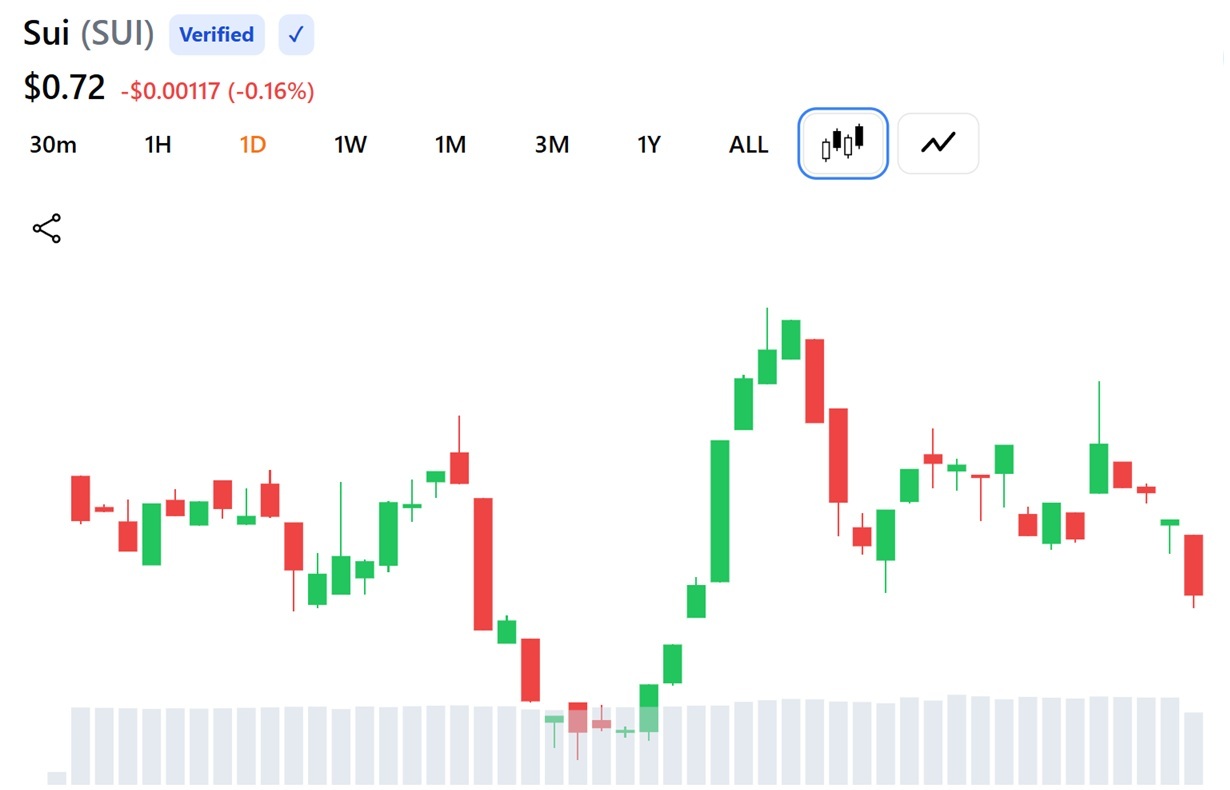
This price represents a sharp decline compared to $SUI's all-time high of $5.35 reached in January last year. The current price level is about 86% below that peak, indicating a steeper drop than most large-cap tokens over the same period.

Nevertheless, despite ongoing price challenges for $SUI, the underlying network continues to attract institutional users. For instance, the Abu Dhabi sovereign wealth fund Mubadala Capital tokenized a $75 million private markets fund, which operates primarily on Coinbase's Base network, on Solana and Sui, and also has additional share classes on Ethereum, Avalanche, Polygon, and Sei. Details about the multi-chain solution launch and Coinbase's direct participation in the fund via its balance sheet were revealed on July 23, 2026.

Bitcoin.com News reported on this event, noting that access to the fund remains limited to qualified institutional and accredited investors, with a minimum investment of around $100,000. Product management is handled by KAIO — a UAE-based tokenization infrastructure provider, which first partnered with Mubadala Capital in December 2025.

Steady Growth of Sui Networks.

Last week, the Sui Foundation and Mysten Labs launched the Hashi testnet, enabling the use of Bitcoin as loan collateral without the need to "wrap" it; the protocol is already being tested by over 25 institutional partners, including BitGo and Ledger. This followed a May protocol change that made stablecoin transfers free — which, according to Sui, helped stablecoin transaction volume exceed $65 billion in the following weeks.

The most immediate test for $SUI now is whether buyers will step in at the Gaussian Channel's lower band with sufficient volume to confirm the support analysts mentioned. Failure to hold this zone would likely open the path to retesting lower levels.

end-content

Трендові криптовалюти

Пов'язані питання

QWhat technical analysis tool are traders using to assess SUI's price movement near the $0.72 level?

ATraders are using the Gaussian Channel tool. It is a technical analysis indicator based on the statistical concept of normal distribution, plotting upper, middle, and lower bands around an asset's price to identify potential trend changes and reversal points.

QAccording to the trader El Tigre, what needs to happen for SUI's price to move towards the middle of the Gaussian Channel?

AAccording to trader El Tigre, for SUI's price to move towards the middle of the Gaussian Channel, the price needs to hold at the lower band (support zone) and there must be an increase in trading volume.

QHow does the current price of SUI compare to its all-time high, and what was that peak value?

AThe current price of SUI is $0.7206, which is approximately 86% below its all-time high of $5.35, which was reached in January of the previous year.

QWhat recent development involving Abu Dhabi's sovereign wealth fund demonstrates institutional interest in the Sui network?

AAbu Dhabi's sovereign wealth fund Mubadala Capital tokenized a $75 million private markets fund that operates primarily on Sui (among other networks like Base and Solana). This fund launch, which also involves Coinbase's direct participation, was announced on July 23, 2026.

QWhat two major protocol upgrades or launches for the Sui network were mentioned in the article?

A1. The launch of the Hashi testnet, which allows Bitcoin to be used as collateral for loans without needing to be 'wrapped'. 2. A prior protocol change in May that made stablecoin transfers free, which reportedly helped stablecoin transaction volume exceed $65 billion in the following weeks.

Пов'язані матеріали

Huang Xiaoming, Li Bin, Lei Jun, Liang Wenfeng... Changxin IPO Feast, Who's the Biggest Winner?

Changxin Technology's IPO on the Shanghai STAR Market created significant wealth for its stakeholders. Founder Zhu Yiming and his family saw their wealth surge nearly 300%, with his stake in Changxin alone valued at approximately 80 billion RMB. Over 6700 employees benefited, creating at least 237 new millionaires. Several prominent figures also profited. Liang Wenfeng, founder of Deepseek, saw a paper gain of 827 million RMB through his funds' participation. Kong Jianping, founder of Nano Labs, holds an indirect stake worth around 940 million RMB, representing a roughly 44x return on his 2020 investment. Former Midea executive Huang Xiaoming gained approximately 503 million RMB. Strategic investors included industry partners. Nio, represented by founder William Li, pledged 158 million RMB for shares now showing a paper gain of about 740 million RMB. Similarly, a Xiaomi subsidiary acquired shares resulting in an over 736 million RMB gain, though the company clarified this is a corporate investment, not directly attributable to founder Lei Jun's personal wealth. Founder Zhu Yiming further plans to donate shares worth over 37.6 billion RMB for future employee incentives. The IPO solidified Changxin's position as a leading domestic memory chip maker, triggering a widespread wealth creation event for its network of founders, employees, and investors.

Odaily星球日报16 хв тому

Huang Xiaoming, Li Bin, Lei Jun, Liang Wenfeng... Changxin IPO Feast, Who's the Biggest Winner?

Odaily星球日报16 хв тому

Aave's Stable Vault

This article explores Aave's recently launched "Stable Vaults," a product designed to bridge the gap between traditional finance users and DeFi yield. It argues that while DeFi offers transparency and potentially higher returns, its complexity and volatility are major barriers for mainstream adoption. The core problem is that users pay for convenience and simplicity, often accepting lower returns to avoid decision-making and technical hurdles. Stable Vaults allow fintech apps, neobanks, or payment platforms (operators) to integrate with Aave's lending markets once and offer their users a "savings account" with a fixed, predictable yield (e.g., 4%). The operator absorbs the underlying market volatility; if Aave's pool pays 6%, the operator pockets the 2% difference, but if it pays only 2%, the operator covers the shortfall to maintain the promised 4% for users. The piece analyzes this model from three perspectives: 1. **The User:** Gains simplicity, a fixed rate, and familiar app features (customer support, account recovery). However, they lose potential upside, accept a lower fixed yield, and take on new counterparty risks from the operator and its proprietary backend systems. 2. **The Operator (e.g., a neobank):** Can monetize idle user balances easily, generating significant fee income (the spread between the fixed rate and the actual yield) with minimal integration effort, turning a cost center into revenue. 3. **Aave:** Gains "sticky," loyalty-based deposits that are less likely to flee during minor yield fluctuations, securing a stable revenue stream crucial for its tokenomics (like buybacks). It becomes a back-end infrastructure provider for the broader consumer finance ecosystem. The author acknowledges that while sophisticated users can access higher yields directly on Aave, most people prefer convenience and security over optimization. They reference behavioral studies showing that too many choices lead to inaction. Therefore, Stable Vaults represent an acceptance of human nature—prioritizing safety, predictability, and ease—and a strategic move for Aave to capture stable, large-scale deposits from mainstream finance applications. Examples like Rise (payroll) and Kraken are already using similar embedded yield models.

marsbit21 хв тому

Aave's Stable Vault

marsbit21 хв тому

Торгівля

Спот

Популярні статті

Як купити DATA

Ласкаво просимо до HTX.com! Ми зробили покупку DATA Network (DATA) простою та зручною. Дотримуйтесь нашої покрокової інструкції, щоб розпочати свою криптовалютну подорож.Крок 1: Створіть обліковий запис на HTXВикористовуйте свою електронну пошту або номер телефону, щоб зареєструвати обліковий запис на HTX безплатно. Пройдіть безпроблемну реєстрацію й отримайте доступ до всіх функцій.ЗареєструватисьКрок 2: Перейдіть до розділу Купити крипту і виберіть спосіб оплатиКредитна/дебетова картка: використовуйте вашу картку Visa або Mastercard, щоб миттєво купити DATA Network (DATA).Баланс: використовуйте кошти з балансу вашого рахунку HTX для безперешкодної торгівлі.Треті особи: ми додали популярні способи оплати, такі як Google Pay та Apple Pay, щоб підвищити зручність.P2P: Торгуйте безпосередньо з іншими користувачами на HTX.Позабіржова торгівля (OTC): ми пропонуємо індивідуальні послуги та конкурентні обмінні курси для трейдерів.Крок 3: Зберігайте свої DATA Network (DATA)Після придбання DATA Network (DATA) збережіть його у своєму обліковому записі на HTX. Крім того, ви можете відправити його в інше місце за допомогою блокчейн-переказу або використовувати його для торгівлі іншими криптовалютами.Крок 4: Торгівля DATA Network (DATA)Легко торгуйте DATA Network (DATA) на спотовому ринку HTX. Просто увійдіть до свого облікового запису, виберіть торгову пару, укладайте угоди та спостерігайте за ними в режимі реального часу. Ми пропонуємо зручний досвід як для початківців, так і для досвідчених трейдерів.

174 переглядів усьогоОпубліковано 2026.07.01Оновлено 2026.07.01

Як купити DATA

Обговорення

Ласкаво просимо до спільноти HTX. Тут ви можете бути в курсі останніх подій розвитку платформи та отримати доступ до професійної ринкової інформації. Нижче представлені думки користувачів щодо ціни DATA (DATA).

活动图片