The CLARITY Act is at the One-Yard Line: Coinbase Says 'Time to Get it Over the Goal Line'

cryptonews.ruОпубліковано о 2026-07-28Востаннє оновлено о 2026-07-28

Анотація

Coinbase CEO Brian Armstrong urged lawmakers on July 27th to advance the CLARITY Act, calling for an immediate vote. He described the bipartisan bill as being "on the one-yard line" after years of negotiations and thousands of hours of work. Armstrong argued the legislation would enhance consumer protections, expand law enforcement tools, and establish a clear federal regulatory framework for the digital asset industry, which currently lacks one. The push comes as Senate Republicans released updated text of the bill on July 22nd. Political pressure has increased with advocacy group Stand With Crypto stating it will score lawmakers' votes on CLARITY. The bill has gained institutional support from firms like BlackRock, Fidelity, and Charles Schwab. With the Senate's legislative window narrowing ahead of elections, proponents are urging final passage to provide regulatory clarity for the crypto industry in the United States.

Coinbase (Nasdaq: COIN) CEO Brian Armstrong urged lawmakers to advance the CLARITY Act in a July 27th X post, asserting that this bipartisan proposal would strengthen consumer protections, expand law enforcement tools, and provide regulatory clarity for the cryptocurrency industry.

Calling for an immediate vote, the Coinbase executive emphasized that legislators have spent thousands of hours crafting a compromise and should finalize the legislative process without further delay.
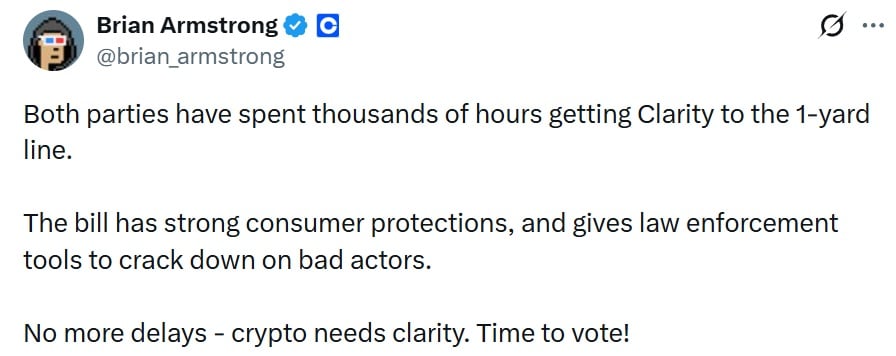
Coinbase CEO Says CLARITY Act is Close to the Finish Line

The X post also included a clip from Armstrong's July 21st interview with CNBC, where he characterized the bill as the result of years of negotiations between both parties.

Armstrong noted:

"The CLARITY Act is on the one-yard line, and it reflects the work of both parties who, along with their staff, have spent thousands of hours achieving a genuine bipartisan compromise."

The Coinbase CEO used a football metaphor to stress that the bill is on the verge of passage and should be brought to a final vote in the Senate without further delays.

The executive also stated that the bill would expand law enforcement powers, introduce new consumer protections, and create a federal regulatory framework for the digital asset industry.

"This bill will strengthen law enforcement powers. It will introduce new consumer protections, and we need to remember that currently, we have no federal laws protecting consumers or fostering this industry's growth in the United States, so the status quo is not working," Armstrong explained, concluding:

"This bill will bring huge benefits to the United States of America, and it's time to get it over the goal line."

Updated CLARITY Act Receives Industry Backing Amid Shrinking Senate Calendar

On July 22nd, Senate Republicans released updated text for the CLARITY Act, reflecting the outcome of negotiations involving the Senate Banking and Agriculture Committees. A step-by-step summary attached to the CLARITY Act outlines disclosure standards, registration requirements, anti-fraud provisions, and expanded anti-money laundering obligations for digital asset market participants.

Political pressure surrounding the CLARITY Act intensified after the Stand With Crypto organization announced that votes on CLARITY would be counted in its scorecard. The organization indicated that lawmakers' positions on this bill would become part of its public scorecard, potentially influencing millions of crypto-interested voters.

Institutional backing also ramped up: alongside support from Fidelity Investments, Charles Schwab, and Goldman Sachs CEO David Solomon, the "CLARITY Act" has been endorsed by BlackRock, as top financial leaders urged Congress to approve a federal market framework before the current legislative window closes.

The election calendar has further raised the stakes, as the Senate's working days before the midterm elections dwindle, and a full floor vote becomes the next major hurdle for market structure legislation.


Трендові криптовалюти

Пов'язані питання

QWhat did Coinbase CEO Brian Armstrong urge U.S. lawmakers to do in his July 27th post, and what were his key arguments?

AIn his July 27th post, Coinbase CEO Brian Armstrong urged U.S. lawmakers to advance the CLARITY Act and hold an immediate vote. His key arguments were that the bipartisan bill would enhance consumer protections, expand the toolkit for law enforcement, provide regulatory clarity for the crypto industry, and bring significant benefits to the United States.

QWhat specific legislative progress does Brian Armstrong refer to with his 'one yard line' football metaphor regarding the CLARITY Act?

ABrian Armstrong's 'one yard line' football metaphor refers to his claim that the CLARITY Act is on the verge of being passed, needing only a final Senate floor vote to complete the legislative process without further delay.

QAccording to the article, what are three key areas the CLARITY Act aims to address for the digital asset industry?

AAccording to the article, the CLARITY Act aims to address three key areas: 1) Establishing a federal regulatory framework for the industry, 2) Introducing new consumer protections, and 3) Expanding the authority of law enforcement, including enhanced Anti-Money Laundering (AML) obligations.

QWhich major financial institutions, besides Coinbase, are mentioned as supporting the CLARITY Act?

AThe article mentions that major financial institutions supporting the CLARITY Act include Fidelity Investments, Charles Schwab, Goldman Sachs (via its CEO David Solomon), and Blackrock.

QHow did the advocacy group Stand With Crypto increase political pressure around the CLARITY Act vote?

AThe advocacy group Stand With Crypto increased political pressure by announcing that lawmakers' votes on the CLARITY Act would be included in its public scorecard, potentially influencing millions of crypto-interested voters.

Пов'язані матеріали

In Jinjiang, Fujian, a Storage Super Unicorn Lies Quiet

In Fujian's Jinjiang, a city known for sportswear, lies a quiet semiconductor giant: Fujian Jinhua Integrated Circuit Co. (JHICC). Once a promising domestic DRAM manufacturer alongside Yangtze Memory and ChangXin Memory Technologies (CXMT), its journey was derailed in 2018 when the U.S. placed it on an Entity List and filed criminal charges for alleged trade secret theft. This halted production for years. A turning point came in February 2024 when a U.S. federal court found JHICC not guilty. However, it had lost crucial time. While CXMT soared to become a top-valued A-share company in 2024, JHICC, with an estimated valuation of 80 billion RMB, was just restarting. Its current output is primarily customized DDR4 chips, not the advanced DDR5/HBM demanded for AI, but it still benefits from the broader memory chip upcycle. JHICC's story is tied to Chen Zhengkun, a veteran engineer who left Micron to lead the venture. Founded in 2016 with state-backed funding, JHICC partnered with Taiwan's UMC to develop DRAM technology. Rapid progress was cut short by the U.S. actions, which Micron initiated, partly due to its heavy reliance on the Chinese market. Post-sanctions, Chen's team worked to rebuild the production line with reduced reliance on U.S. technology. According to its records, JHICC achieved small-scale production and revenue growth under immense pressure. It now focuses on the stable "niche" DRAM market (e.g., TVs, routers) with a monthly capacity of ~40,000 wafers, aiming for 60,000 by 2026. It holds over 1,000 patents but remains on the Entity List. For Jinjiang, investing in JHICC was a bold industrial leap. The local government provided unwavering financial and logistical support during the crisis, helping the company survive. JHICC has become the anchor for a growing local semiconductor cluster. Though its scale lags behind domestic peers, JHICC's persistence symbolizes a hard-won foothold in a global market long dominated by Samsung, SK Hynix, and Micron. Having missed one boom, it seeks a place in the new AI-driven memory supercycle.

marsbit1 год тому

In Jinjiang, Fujian, a Storage Super Unicorn Lies Quiet

marsbit1 год тому

Торгівля

Спот

Популярні статті

Як купити ONE

Ласкаво просимо до HTX.com! Ми зробили покупку Harmony (ONE) простою та зручною. Дотримуйтесь нашої покрокової інструкції, щоб розпочати свою криптовалютну подорож.Крок 1: Створіть обліковий запис на HTXВикористовуйте свою електронну пошту або номер телефону, щоб зареєструвати обліковий запис на HTX безплатно. Пройдіть безпроблемну реєстрацію й отримайте доступ до всіх функцій.ЗареєструватисьКрок 2: Перейдіть до розділу Купити крипту і виберіть спосіб оплатиКредитна/дебетова картка: використовуйте вашу картку Visa або Mastercard, щоб миттєво купити Harmony (ONE).Баланс: використовуйте кошти з балансу вашого рахунку HTX для безперешкодної торгівлі.Треті особи: ми додали популярні способи оплати, такі як Google Pay та Apple Pay, щоб підвищити зручність.P2P: Торгуйте безпосередньо з іншими користувачами на HTX.Позабіржова торгівля (OTC): ми пропонуємо індивідуальні послуги та конкурентні обмінні курси для трейдерів.Крок 3: Зберігайте свої Harmony (ONE)Після придбання Harmony (ONE) збережіть його у своєму обліковому записі на HTX. Крім того, ви можете відправити його в інше місце за допомогою блокчейн-переказу або використовувати його для торгівлі іншими криптовалютами.Крок 4: Торгівля Harmony (ONE)Легко торгуйте Harmony (ONE) на спотовому ринку HTX. Просто увійдіть до свого облікового запису, виберіть торгову пару, укладайте угоди та спостерігайте за ними в режимі реального часу. Ми пропонуємо зручний досвід як для початківців, так і для досвідчених трейдерів.

479 переглядів усьогоОпубліковано 2024.12.12Оновлено 2026.06.02

Як купити ONE

Обговорення

Ласкаво просимо до спільноти HTX. Тут ви можете бути в курсі останніх подій розвитку платформи та отримати доступ до професійної ринкової інформації. Нижче представлені думки користувачів щодо ціни ONE (ONE).

活动图片












