Strategy Opens Path to Bitcoin Sale — Michael Saylor Explains Why It Makes Sense

cryptonews.ruОпубліковано о 2026-07-28Востаннє оновлено о 2026-07-28

Анотація

Michael Saylor, Executive Chairman of Strategy Inc. (NASDAQ: MSTR), outlined the company's potential funding sources for future buybacks of its Series A Variable Rate Perpetual Preferred Stock (STRC). These buybacks could be financed through the sale of Bitcoin or MSTR shares, depending on market conditions. This strategy is seen as attractive when STRC trades significantly below its $100 par value, allowing the company to repurchase shares at a discount and reduce future dividend obligations. Strategy aims to maintain STRC trading near its $100 par value with high liquidity and low volatility. The company, adhering to its digital credit capital concept, will not issue new STRC shares below par. In the week ending July 26, Strategy repurchased approximately $25 million worth of STRC shares at an average price of $86.52 per share, taking advantage of the discount. Strategy has increased its USD reserve to a record $3.75 billion, but this reserve is reserved exclusively for preferred stock dividends and debt repayment. Therefore, future STRC buybacks will be funded separately, primarily through the issuance of MSTR common stock or the sale of Bitcoin when deemed economically justified by management. This approach provides flexibility to execute discounted buybacks without impacting funds earmarked for dividends and debt.

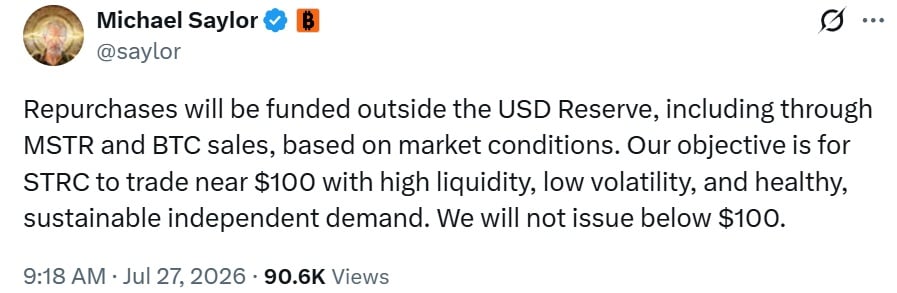
Michael Saylor, Executive Chairman of Strategy Inc. (Nasdaq: MSTR), stated in a July 27th post on X that future share repurchases of STRC could be funded through sales of Bitcoin or MSTR shares, depending on market conditions. STRC are Strategy's Series A Variable-Rate Perpetual Preferred Shares with a $100 liquidation preference, whose dividend rate is reviewed monthly by management.

Selling Bitcoin could become an attractive financing option when the price of STRC is trading significantly below $100, allowing the company to repurchase the preferred shares at a discount.

Saylor stated that the company aims to maintain STRC trading at a level close to its $100 liquidation preference, with high liquidity, low volatility, and stable independent demand. As part of Strategy's digital hybrid capital concept, the company does not intend to issue additional STRC shares below $100.
Discount Repurchases Dictate Purchase Pace

During the week ended July 26, the company repurchased 288,930 STRC shares for approximately $25 million at an average price of $86.52 per share, as reported by the company on July 27.

Saylor presented Strategy as a regular and disciplined buyer when the price is below $100, with repurchase volumes increasing at larger discounts and tapering as STRC approaches its stated preference. Under the repurchase authorization for preferred securities, approximately $975 million remains available, providing management with significant capacity for future transactions. At the latest average purchase price, the company acquired each STRC share at a $13.48 discount to its stated preference before accounting for future dividend savings.

Strategy's President & CEO, Phong Le, explained:

"At prices below $100 per share, repurchasing STRC shares represents an attractive capital investment as it allows for the reduction of future preferred dividend obligations at a discount."

"We intend to adjust purchase volumes based on both price and liquidity — increasing them at larger discounts and decreasing them as the market price of STRC shares approaches the $100 per share mark — while allowing independent market demand to form a healthy and sustainable market," he added.

In the terms of the STRC shares and the dividend policy, the current annualized dividend rate is stated as 12%, along with factors management considers during monthly assessments.

U.S. Dollar Reserve Remains Separate from Repurchase Program

Additionally, Strategy increased its U.S. dollar reserve by $525 million through the sale of MSTR common shares, bringing its balance to a record $3.75 billion. This reserve covers approximately 25 months of expected preferred dividend payments and, per a policy approved by Strategy's board of directors, remains designated exclusively for preferred dividend payments and debt obligations.

This restriction means future STRC repurchases will be funded from other sources, including the sale of MSTR shares and, as noted by Saylor, the sale of Bitcoin when justified by market conditions.

Instead of using the U.S. dollar reserve, Strategy now has two primary channels to fund STRC share repurchases: issuance of MSTR shares and sale of Bitcoin when management deems it economically sensible. This flexibility allows the company to repurchase preferred shares at a discount without impacting funds reserved for dividend payments and debt obligations.

end-content

Пов'язані питання

QWhat two primary funding sources can Strategy Inc. use for future STRC share buybacks, according to Michael Saylor?

AAccording to Michael Saylor, the two primary funding sources for future STRC share buybacks are the sale of MSTR common stock and the sale of Bitcoin, when deemed economically justified by management.

QWhat is the stated goal of Strategy Inc. regarding the trading price of its STRC preferred shares?

AThe stated goal is for the STRC preferred shares to trade close to their $100 par value, with high liquidity, low volatility, and sustained independent demand.

QHow does Strategy Inc. plan to adjust its STRC buyback volume in relation to the share price?

AStrategy plans to adjust buyback volumes based on price and liquidity: increasing purchases when the discount to the $100 par value is significant and scaling back as the market price approaches the $100 per share mark.

QWhat is the purpose of Strategy's separate USD reserve, and how much does it currently hold?

AThe separate USD reserve is intended exclusively for paying dividends on the preferred shares and repaying debt obligations. As reported, it currently holds a record $3.75 billion.

QWhy does buying back STRC shares at a discount below $100 represent an attractive capital investment for Strategy?

ABuying back STRC shares below $100 is attractive because it allows the company to retire preferred shares at a discount, thereby reducing future dividend payment obligations.

Пов'язані матеріали

Platform Token Soars 15x in Half a Month, Pons Tops Robinhood Chain Charts for Both Token Launches and Trading

In just half a month, the Pons platform token (PONS) surged over 15x in value as Pons solidified its position as the leading token launch and trading platform on Robinhood Chain, capturing both the highest daily token creation volume and transaction volume. Following the exit of previous leader NOXA, competition initially favored Flap before Pons emerged dominant around mid-July. By July 26th, Pons accounted for 77.1% of total trading volume across all Robinhood Chain launchpads. Pons's success is attributed to its streamlined, one-transaction process for deploying a token contract and its corresponding Uniswap V3 liquidity pool simultaneously, eliminating the need for bonding curves or complex migrations. This simplicity, combined with low creation costs and immediate tradability, attracted significant creation activity and speculative trading. The meteoric rise of its native token, PONS, further fueled platform growth. A tokenomics model directing 80% of protocol fees to buy back and burn PONS created a reinforcing cycle: platform usage boosted PONS value, which in turn attracted more users. Looking ahead, Pons V2 aims to expand beyond meme tokens by integrating support for paying fees in stablecoins (USDG) and RWA assets, aligning with Robinhood Chain's broader focus on on-chain finance and stock tokens.

Odaily星球日报53 хв тому

Platform Token Soars 15x in Half a Month, Pons Tops Robinhood Chain Charts for Both Token Launches and Trading

Odaily星球日报53 хв тому

Qualcomm Chip Price Hike Deals a Blow to Android Phones

Qualcomm has officially announced a new round of price increases for its entire chip portfolio, effective September 1. The hikes, reaching up to 18% for the flagship Snapdragon 8 Elite Gen 6 Pro, follow similar moves by MediaTek, intensifying cost pressures on the already strained smartphone industry. CEO Cristiano Amon confirmed the plan, citing the need to offset rising industry-wide costs and restore declining profit margins. Qualcomm's Q3 FY2026 results showed a 25% drop in net profit, with mobile revenue plunging 20% year-over-year, hitting its lowest level since 2021. The surge in AI computing demand has led memory manufacturers to prioritize HBM production, creating a shortage in general-purpose DRAM and NAND Flash chips. Their prices soared by 93%-98% and 55%-60% respectively in Q1 2026, causing the memory cost share in smartphones to jump from 10%-15% to over 30%. Coupled with the soaring cost of advanced nodes like TSMC's 2nm and packaging, overall chip costs have reached historic highs. These upstream pressures are forcing downstream smartphone brands like Xiaomi, OPPO, and vivo to cut orders for mid-to-low-end models by up to 20% and use cost-saving measures like older chipsets. Reportedly, the Snapdragon 8E5 will be repurposed as a "long-lasting" chip for sub-brand phones in H2 2026. Amid this cost crisis, the Android market remains sluggish. Q2 2026 smartphone shipments in China fell 4.3% year-over-year, marking five consecutive quarters of decline. Major Android brands saw market share drop, while Huawei and Apple, with their in-house chip advantages, gained share. Qualcomm is diversifying into automotive and IoT sectors to reduce reliance on smartphones, but these new segments cannot yet fill the mobile revenue gap. Industry observers warn that the full impact of component cost hikes will hit in the second half of 2026, likely leading to higher-than-expected price increases for Android flagships and a further contraction in the Chinese smartphone market.

marsbit1 год тому

Qualcomm Chip Price Hike Deals a Blow to Android Phones

marsbit1 год тому

Торгівля

Спот
活动图片