Musk Posted a Recruitment Ad for SpaceX, and After Reading the Comments Section, I Understood

marsbitОпубліковано о 2026-05-21Востаннє оновлено о 2026-05-21

Анотація

On May 20th, SpaceX filed for a landmark IPO with a $1.75 trillion valuation. Shortly after, Elon Musk posted a recruitment call on X, seeking "world-class engineers and physicists" for SpaceX. The application process was starkly simple: email with three bullet points proving "exceptional ability," with real, complex projects as a plus. Musk promised to review qualifying emails himself. The post garnered millions of views and thousands of replies, revealing a spectrum of responses. Most comments, including a highly-upvoted humorous one listing absurd "skills," merely listed credentials or experiences in a conventional, non-differentiating way. This highlighted a key insight: a traditional resume listing degrees and skills often fails to demonstrate true exceptionalism. Effective self-presentation requires "performance efficiency." A standout reply came from an OpenAI engineering lead, who simply stated "codex." This demonstrated that for those who have built significant, recognized products, the product itself becomes the ultimate resume. The article argues that in the AI era, any tangible, shareable output—a tool, research, or online project—serves as a living, self-evident credential more powerful than a list of attributes. However, a twist emerged when applicants found the provided email address non-functional, leading to speculation that the post might also serve as an IPO publicity stunt, projecting an image of aggressive talent acquisition to investors. Ultimately, t...

Author: Curry, Deep Chao TechFlow

On May 20th after US market close, SpaceX submitted its prospectus to the SEC with a valuation of $1.75 trillion, aiming to list on NASDAQ in June.

This is undoubtedly the largest IPO in history, likely surpassing Saudi Aramco's $29 billion fundraising record set six years ago.

Less than a day after the prospectus was submitted, on the afternoon of May 21st, Musk posted a recruitment message on X.

The gist was that SpaceX is hiring world-class engineers and physicists. Zero experience in AI is fine because smart people learn fast. The application method is incredibly simple:

Send an email listing three bullet points proving you have exceptional ability.
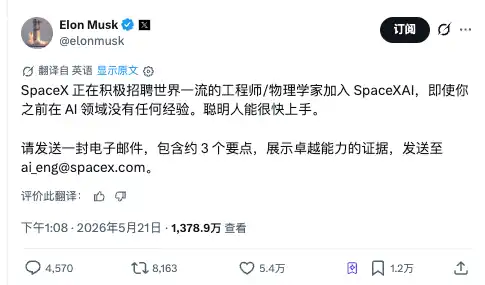
Additionally, Musk noted that having built "something very complex and actually functional" is a plus. Emails passing the basic screening will be reviewed by Musk personally. By the time I wrote this article, the post had over 13 million views and 4,500 replies.

Musk's recruitment stance seems very appealing. Degrees, companies, ten years of experience don't matter, only whether you have "exceptional ability." But upon closer thought, you realize this is actually a much harsher filter than conventional recruitment.

Do you think using 3 bullet points to explain your outstanding qualities is simple or difficult?

A conventionally formatted resume is at least one page long: positions and achievements from past jobs, alma mater, tools you know, awards won... piled together it looks full, but perhaps not a single line directly proves you are "exceptional."

Scrolling through the comments section, you'll also find the vast majority of people cannot do this.

Resumes Are Actually About "Performance Efficiency"

I scrolled through the comments section and roughly understood.

With 4,500 replies, you can probably guess the style—mostly witty one-liners. Currently, the top-rated reply is from a user named Greg who posted a so-called "resume," looking utterly absurd:
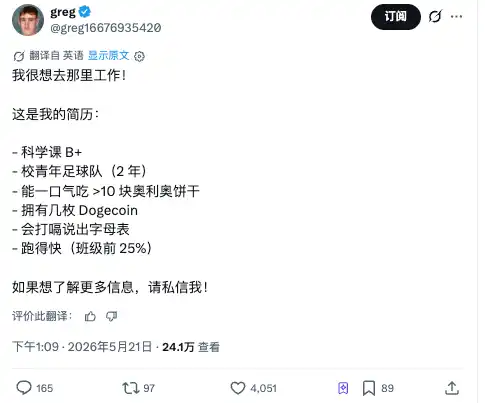
Pure self-deprecating meme is quite funny, and the answer is obviously just a joke, but it also acts as a mirror. Think carefully, the resumes I've submitted in the past seem essentially no different from this?

Replace the content of this resume: top university computer science major GPA 3.8, two years on the school basketball team, proficient in Python and Java, self-studied CFA Level 1, top fifty in school sports meet...

The format is identical, the logic is identical, only the content is less outrageous, but the essence remains listing everything you have point by point indiscriminately.

From Musk's perspective, your Python skill level versus your ability to burp the alphabet—the difference isn't actually that significant.

The comments section isn't just full of jokers. Some seriously posted their degree certificates, others threw in their child's Ivy League acceptance letter, some posted passport photos asking for work visas, and others listed paper publications and conference talks...

Compared to the jokers, these people are surely sincere about applying.

But step back and look: what they are doing is the same as that absurd joke post: listing credentials, piling up experiences, indiscriminately listing any possible shining point, hoping to create an impression of "I am excellent."

Musk asked: what have you built that is complex and useful enough. A typical interviewer in our daily lives might not be that demanding, but similarly hopes for stronger relevance in a resume.

Simply put, a resume is a performance, and performance is about efficiency. What can efficiently impress the other party most of the time is not necessarily long-winded explanations.

Product, The Better Resume

There's actually another highly upvoted comment in the section that I think perfectly satisfies the request in Musk's post: "Please use 3 bullet points to prove your excellence."

And this person even used just 1 bullet point, typing just 1 word:

codex.

Clicking into his profile, I checked—Tibo (full name Thibault Sottiaux) is an Engineering Lead at OpenAI, currently leading the Codex team. Codex is one of the most powerful AI programming tools and something developers worldwide use daily.
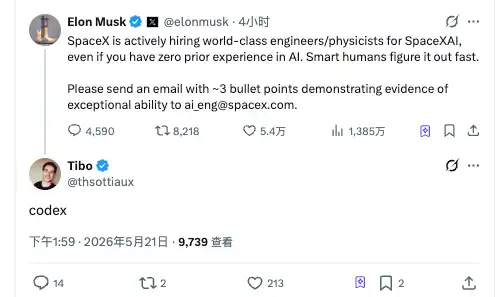
A product name is the entire resume.

The more you need to explain who you are, the less likely you are the person Musk is looking for. People who have truly built things, their name itself is evidence, the product itself is the bullet point. But you might say, he's a project lead at OpenAI, excellent enough to have the capital to reply with just one word. Ordinary people don't have that kind of confidence.

Think from another angle: Tibo can reply like that because he has something others have used, validated, that requires no self-explanation. That thing speaks for him.

Of course, elitism is not to be encouraged, but most of us aren't big shots. Yet sometimes we also just need to productize ourselves, to let the things we've done prove ourselves in a more efficient way.

Pushing this idea one layer down, it's actually unrelated to seniority.

You spent a weekend using vibe coding to build a small tool, consistently shared it and people use it—that's a kind of product; you wrote an industry research post on social media that got cited—that's also a kind of product.

These things are of course small compared to Codex, but they share a common trait: they are things you made, visible to others, requiring no explanation from you.

In the AI era, every work, every output, every tangible result you leave online that others can point to is, in a way, a living resume. It speaks for you.

You don't need to reach Codex's scale, but you should at least have something that can be pointed to.

So, the attachments in resumes today—they themselves might be the better resume.

But, Is the Recruitment Real?

The story actually has a tail end here.

In the comments section, someone, after reading Musk's post, seriously wrote an email and sent it to the address [email protected], only to find it bounced back. The system indicated the address doesn't exist...
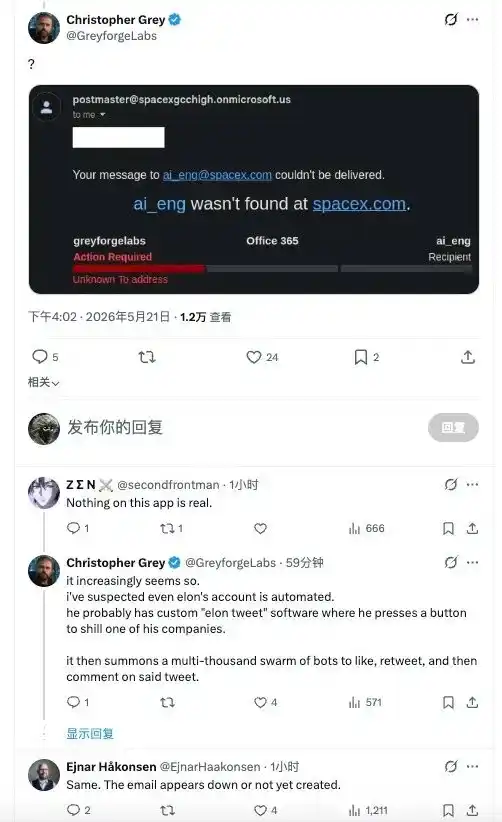
Some suspect Musk's account itself is automated, the recruitment email isn't set up yet, but the recruitment announcement went out first; others think recruiting around an IPO is part of the IPO roadshow, projecting an image of attracting top talent to strengthen the team.

Investors will certainly see Musk's post. So whether the recruitment itself is real can be set aside for now, but the posture the post conveys—"SpaceX is poaching talent"—is clear.

So, is this recruitment post actually hiring or doing a roadshow?

Perhaps the difference between the two isn't that big. In Musk's world, a single tweet can simultaneously be a job posting, an investor relations statement, and a brand advertisement. You see three bullet points; investors see "this company has the ability to attract the world's best talent."

Reading the post and the comments gives a sense of enlightenment. The witty one-liners, the one-word "Codex" self-proof, the bounced emails where applications fail—these are actually three types of roles on the same stage.

Some come to perform, some come to prove themselves, some discover the stage set seems to be made of cardboard...

In an era of scarce attention and cheap content output, finding one's own position and value remains the long-term homework we must do.

Пов'язані питання

QAccording to the article, what was the most effective response to Elon Musk's SpaceX job posting on X, and why was it considered so powerful?

AThe most effective response was from Tibo (Thibault Sottiaux), the engineering lead of OpenAI's Codex team. He simply replied 'codex'. This was powerful because a single word referenced a globally used and complex product he led, which served as irrefutable, self-explanatory proof of his 'exceptional ability'. It demonstrated that a tangible, successful product is the ultimate resume.

QHow does the author describe the fundamental problem with most traditional resumes and the typical responses to Musk's post?

AThe author argues that traditional resumes and many responses to the post follow the same flawed logic: they provide an 'undifferentiated list' of qualifications, degrees, skills, and experiences. This is akin to the satirical resume listing skills like 'burping the alphabet'. The issue is this approach merely proves you have attributes but doesn't directly or efficiently demonstrate exceptional, practical ability to build complex things.

QWhat core piece of advice does the article offer for professionals in the AI era regarding personal branding?

AThe article advises individuals to 'productize' themselves. This means creating tangible, visible outputs—like a useful tool, a well-researched report, or any shareable project—that can act as a 'live resume'. These outputs are evidence of one's abilities that 'speak for themselves' without needing lengthy personal explanation, making them a more efficient form of proof in an attention-scarce world.

QWhat suspicion did some people have about the legitimacy of the SpaceX job posting mentioned at the end of the article?

ASome people suspected the posting might not be entirely genuine. Evidence cited includes that the provided email address ([email protected]) initially bounced back as non-existent. This led to theories that the post could be automated, that the hiring process wasn't fully set up, or that it was partly a publicity move to showcase SpaceX's talent-attraction prowess to investors during its IPO roadshow.

QWhat is the 'three-act play' the author sees in the comments section of Musk's post?

AThe author sees a three-act play: 1) People 'performing' by posting humorous or generic content (like the burping resume). 2) People attempting to genuinely 'prove themselves' by listing credentials and achievements. 3) People discovering the 'stage set might be made of paper' when they find practical issues like the non-functional email address. Together, these represent different engagements with the modern challenge of proving one's value.

Пов'язані матеріали

Metrics Ventures Market Watch: The Brewing Storm

In the past month, the market has been actively trading contrasting expectations, balancing global supply chain disruptions fueling re-inflation against both actual and anticipated (Walsh) interest rate hikes. This volatility has impacted commodities and most equities, though tech has temporarily benefited from concentrated short-term liquidity. Fundamentally, as previously analyzed regarding the Strait of Hormuz situation, the US faces deep-seated balance sheet issues beyond what any single Fed chair can resolve. Hypotheses around a figure like Walsh could only materialize if AI fundamentally reshapes production relations. Until then, most non-AI-leading nations (effectively all except the US and China) risk fiscal and monetary policy collapse, rendering the identity of the Fed chair ultimately irrelevant. For crypto assets, there is currently no clear role in these dominant narratives. The market remains strongly capped by the 200-day moving average. While trends may shift from "anything but AI" to "anything but mines," this phase is dominated by the silicon vs. carbon (AI vs. traditional) dichotomy, leaving little room for crypto—though its time will come. **Market Overview & Commentary** The crypto market lacks significant catalysts beyond hype, plagued by low volume and scarce innovation, with clear technical resistance. Currently, crypto struggles for attention as global focus lies elsewhere. Assets like gold, oil, and grains are more direct hedges against supply-chain-driven inflation/stagflation. Bitcoin needs more time for capitulation and consolidation; this reset is expected to last until at least Q4 2026. Looking ahead, three factors will likely drive future market volatility: 1. Whether Walsh repeats the patterns of predecessors like Bassant or Musk, shifting stance into a new policy cycle. 2. The market underestimates the severity of global supply chain damage and the prolonged time needed for repair, which will eventually lead to recognition of acute resource shortages and price swings. 3. AI non-beneficiary, high-inflation nations (e.g., UK, Japan) will face severe fiscal and monetary crises. Rapid AI-driven displacement could trigger a collapse of existing credit and welfare systems. Ultimately, the market may realize that an AI bubble burst could spark contagious sovereign credit crises. The monetary and fiscal responses to such a scenario could serve as the ultimate catalyst for Bitcoin's next major bull run.

marsbit19 хв тому

Metrics Ventures Market Watch: The Brewing Storm

marsbit19 хв тому

Insiders Betting on Musk Are Reaping 'Historic Returns'

The largest IPO in history is imminent as SpaceX, led by Elon Musk, is set to price its offering on June 12. At a targeted valuation near $2 trillion, this event will mint new billionaires from Musk's inner circle of long-time allies, rewarding their loyalty with unprecedented returns. Key beneficiaries include Antonio Gracias, Musk's close friend and confidant, who holds a 7.3% stake potentially worth over $140 billion, making him the second-largest individual shareholder. Gwynne Shotwell, President and COO since 2002, holds shares valued at roughly $2 billion. Bret Johnsen, the CFO, holds stock worth approximately $1.4 billion. Luke Nosek, a PayPal co-founder and early investor, stands to gain about $5.3 billion. The IPO filing also reveals complex and controversial financial arrangements. SpaceX has guaranteed nearly $20 billion in payments from xAI's subsidiary to Gracias's Valor Equity Partners for AI hardware leases—deals auditors flagged as "failed sale-leaseback" transactions, forcing SpaceX to record them as debt. Despite rapid revenue growth, SpaceX is not profitable, posting a $49 billion loss in 2025 and a $4.3 billion loss in Q1 2026. Capital expenditures are soaring, with over 60% directed toward AI. Public investors will inherit these losses, significant debts, and a governance structure heavily controlled by insiders, including a provision granting Musk up to a billion additional shares if one million people live on Mars.

链捕手21 хв тому

Insiders Betting on Musk Are Reaping 'Historic Returns'

链捕手21 хв тому

Ethereum Reduced to a Chinese Concept Stock

The article titled "Ethereum Becomes a Chinese Concept Stock" presents a critical analysis of Ethereum's perceived decline in market confidence and its structural parallels to Chinese companies listed on US stock exchanges. It begins by noting significant sell-offs by early investors like Wanxiang and key figures like Bankless's Hoffman in 2026, despite Ethereum's strong fundamental activity. The piece questions the erosion of trust in Vitalik Buterin and the Ethereum Foundation (EF), arguing that while other ecosystems have faced founder controversies, Ethereum's issues stem from its internal governance model. The author draws a direct comparison to "China concept stocks," which are Chinese businesses operating globally but reliant on foreign capital and listings. Similarly, Ethereum, funded early by Chinese capital like Wanxiang, developed a strong institutional framework from its IXO to its PoS transition. The core problem, according to the article, is a leadership vacuum regarding price and direction. Vitalik's move to make the EF smaller and less active is framed as a mistake. While he advocates for ETH as a "commodity," the ecosystem lacks a clear entity to steward its price stability, creating tension within the PoS system, as seen with Lido's challenges. The narrative suggests that excessive abstraction and a hands-off approach from the EF have left the community adrift, contrasting with more proactive foundations like Solana's. The article then examines emerging technical narratives for Ethereum: privacy (ZK-proofs), AI integration, and a refocus on Layer-1. However, it observes a shift from Ethereum leading as a "world computer" to merely adapting to trends like AI, where crypto-native projects are finding success independently of Ethereum. The piece posits that Ethereum's unique value in an increasingly fragmented world may be as a permissionless, global financial testing ground—a neutral platform amid geopolitical tensions. In conclusion, it asserts that Ethereum's fate mirrors that of China concept stocks: an asset born from one region (conceptually "A"), funded by another ("B"), and dependent on "B" for exit liquidity. While Ethereum's "golden age" may be over, and selling pressure from early backers will continue, it remains positioned as a critical linkage point in a divided global landscape, standing at a new, albeit uncertain, starting point.

marsbit45 хв тому

Ethereum Reduced to a Chinese Concept Stock

marsbit45 хв тому

AI Agents Fundamentally Transform Web3 Gaming: From the Rugpull Bakery Bot Controversy to the New Agent Paradigm in 2026

AI Agents Are Redefining Web3 Gaming: From the Rugpull Bakery Bot Controversy to the 2026 Agentic Paradigm The recent controversy in Rugpull Bakery, a competitive baking game on Abstract chain, highlighted a pivotal shift. Player complaints about unfair bot automation in Season 2 led developers to not ban them, but instead formally integrate AI agents as core gameplay in Season 3, providing official guides (skill.md, agent.json). This move signals Web3 gaming's transition into the "Agentic Gaming" era, where AI agents are sovereign entities with independent strategy and economic rights, moving beyond simple automation. By 2026, AI agent integration has evolved into three core models reshaping the ecosystem: 1. **Autonomous Competitors & Economic Entities:** Agents act as independent players. Examples include TEN Protocol's poker-playing agents, AI Arena's trainable NFT fighters, Satoshi Strike Force's "Digital Athletes" trained on player data, and Somnia's "Agentic L1" blockchain providing native infrastructure for millions of autonomous agents. 2. **Modular Infrastructure & Programmable Environments:** Games like EVE Frontier enable "server-side modding," allowing AI agents to program game world logic directly into structures like smart storage, turrets, and stargates via Smart Assemblies. Coupled with standards like ERC-8183, which enables autonomous job creation and payment between agents, in-game infrastructure gains a "commercial soul." 3. **Hybrid Companions & Dynamic Adaptive Worlds:** This model focuses on human-AI collaboration. In Parallel Colony, players guide highly autonomous AI Avatars with unique personalities and goals. Illuvium plans to use AI to transform NPCs into dynamic, context-aware entities that create personalized, emergent narratives. The conclusion is clear: blocking automation is futile. The future lies in leveraging blockchain's transparency and programmability to empower AI agents as first-class citizens. Web3 gaming is shifting from inefficient human labor to efficient algorithmic interplay and emergent intelligence, creating a "post-human" digital frontier where players become commanders and symbiotic partners in a new socioeconomic experiment.

marsbit45 хв тому

AI Agents Fundamentally Transform Web3 Gaming: From the Rugpull Bakery Bot Controversy to the New Agent Paradigm in 2026

marsbit45 хв тому

Торгівля

Спот
Ф'ючерси
活动图片