In-Depth Report on the On-Chain Lending Market: When Off-Chain Credit Meets On-Chain Liquidation

HTX LearnОпубліковано о 2026-04-23Востаннє оновлено о 2026-04-23

Анотація

The on-chain lending market has evolved from a peripheral DeFi niche into core financial infrastructure. As of early 2026, total value locked (TVL) in on-chain lending protocols has reached $64.3 billion, accounting for 53.54% of total DeFi TVL, making it the largest and most mature vertical within decentralized finance. Aave dominates the sector with approximately $32.9 billion in TVL, commanding nearly half of the market—a leadership position that is unlikely to be challenged in the foreseeable future. However, the path of on-chain lending forward is not without risk. Liquidation cascades, credit defaults, and cross-chain vulnerabilities remain systemic threats hanging over the industry. At the same time, a deeper structural transformation is underway: on-chain lending is shifting from a “leverage tool for crypto-native users” to a “compliant gateway for institutional capital”. The scale of RWA (Real World Asset) lending has surpassed $18.5 billion, with U.S. Treasuries and government securities increasingly serving as core collateral. Institutional capital inflows are reshaping both the user base and risk appetite of the sector. This report systematically analyzes the evolution of on-chain lending definitions, competitive dynamics, core risks, and future trends, providing a comprehensive industry outlook for investors and trade practitioners. Key findings suggest that the “one dominant player with several strong challengers” structure will persist in the short term, while ...

I. Conceptual Evolution: From Crypto Leverage Tool to Mainstream Financial Infrastructure

On-chain lending is not a new concept. In 2020, Compound introduced liquidity mining, propelling DeFi beyond niche communities into the mainstream and ushering in the “DeFi Summer”. At that time, on-chain lending functioned primarily as a high-leverage crypto-native tool: users over-collateralized crypto assets to access liquidity, then deployed that liquidity into yield aggregators or automated market makers to chase annualized returns far exceeding traditional finance. This model performed well in bull markets but exposed structural fragility during downturns. The Terra/Luna collapse and FTX bankruptcy in 2022 revealed the vulnerability of high collateralization ratios and cascading liquidations. After two years of market restructuring, on-chain lending has completed a critical transition from a leverage primitive to a capital allocation infrastructure. This transformation is driven by three forces: 1) Regulatory clarity: Frameworks such as MiCA in the EU and growing acceptance of crypto ETFs have lowered compliance barriers for institutional capital; 2) RWA tokenization wave: U.S. Treasuries, tokenized corporate bonds, and real estate income streams are now entering on-chain lending as core collateral, reshaping asset composition and user profiles; 3) Interest rate market evolution: From pure floating rates → fixed-rate protocols (e.g., Notional, Yield Protocol) → hybrid systems (e.g., Pendle), on-chain rate formation is converging with traditional financial markets.
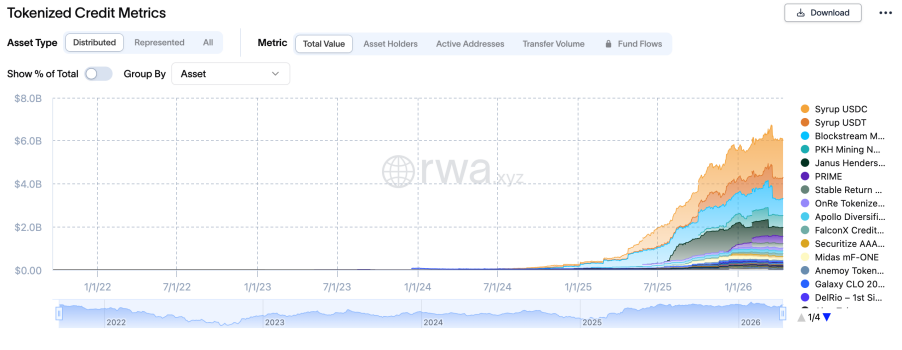
As of early 2026, the on-chain lendinge market has crystallized into a clear three-tier asset architecture: at the base lies stablecoin lending dominated by USDC, DAI, and USDT, which represents the largest, lowest-risk segment, with typical loan-to-value (LTV) ratios reaching 80%-90%; the middle layer consists of volatile-asset lending backed by major cryptocurrencies like ETH and BTC, where LTVs are typically capped at 50%-70% to mitigate liquidation risks amid sharp price swings; at the apex sits RWA-backed lending including tokenized U.S. Treasuries (e.g., Ondo Finance’s OUSG), corporate credit (e.g., Maple Finance’s private debt), and real estate income rights, which is rapidly emerging as on-chain lending’s new growth engine, particularly attractive to institutional investors seeking compliant capital entry points. Geographically, user profiles are diverging: Asian markets remain dominated by retail investors and arbitrageurs who favor high leverage and complex strategies; European and U.S. markets exhibit clear institutionalization trends, with heightened demand for compliant custody, KYC verification, and audit transparency. This divergence directly shapes regional protocol design priorities.

II. Competitive Landscape: One Dominant Player with Structural Differentiation

The market exhibits a classic “one dominant player with multiple strong challengers” structure. Aave leads decisively with approximately $32.9 billion in TVL, far exceeding competitors such as Compound (with about $2.6 billion), while capturing over 50% of lending TVL. Nevertheless, its moat is not brand or network effects—largely irrelevant in open-source ecosystems—but continuous product iteration and ecosystem expansion. From Aave V1’s floating-rate model, to V2’s credit delegation and flash loans, to V3’s Portal cross-chain liquidity and isolation mode, each Aave generation precisely addresses prevailing market pain points. The upcoming V4 release—scheduled for mid-2026—will further enhance cross-chain liquidation capabilities and embed institutional-grade compliance frameworks. Against Aave’s dominance, a cohort of differentiated protocols is carving out their own niches. Morpho Labs pursued an unconventional evolutionary path: beginning as an optimization layer atop Aave and Compound (boosting capital efficiency via P2P matching), it gradually evolved into independent offerings such as Morpho Blue (oracle-free, governance-free lending) and Morpho Vaults (professional risk managers curating yield strategies), transitioning from “optimization layer” to “standalone protocol”. Spark Finance, meanwhile, leverages MakerDAO’s DSR (DAI Savings Rate) ecosystem to establish a robust user base in stablecoin lending, with its technical synergy with Aave V3 positioning it as a key conduit for institutional adoption.
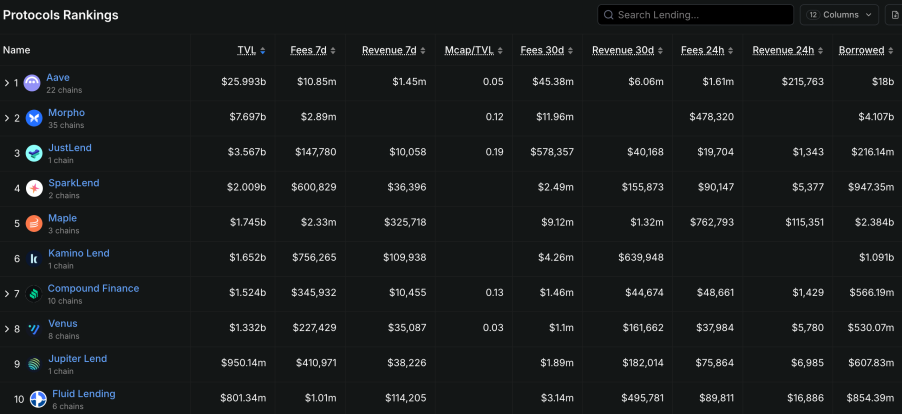
Technologically, on-chain lending protocols are diverging along three distinct pathways. First is the “liquidity aggregation” path (P2Pool), represented by Aave, Compound, and Kamino Finance. Its core premise is pooling lenders’ funds into shared liquidity reserves, dynamically adjusting interest rates algorithmically based on utilization to enable efficient capital allocation. Advantages include deep liquidity and streamlined UX; drawbacks include relatively lower capital efficiency (lenders cannot negotiate terms directly with borrowers). Second is the “peer-to-peer matching” path (P2P), exemplified by Notional Finance and Myso Finance. Its core idea is direct lender-borrower matching to deliver fixed-term, fixed-rate borrowing experiences. While offering superior rate stability, this path suffers from comparatively thin liquidity, making it better suited for borrowers with clearly defined funding timelines. Third is the “permissionless pools” path, led by Euler Finance (V2) and Ajna Finance. Its philosophy is to fully delegate risk management to the market—no oracles, no governance votes—allowing borrowers and lenders to set parameters autonomously and bear risks individually. Though maximally decentralized, this approach entails higher user education costs and elevated smart contract risk.

III. Core Risks: The Triple Challenges of Liquidation, Credit, and Cross-Chain Security

The risk landscape of on-chain lending is significantly more complex than traditional finance. Unlike banking systems, on-chain protocols lack deposit insurance, central bank lender-of-last-resort facilities, or regulatory window guidance—when crises strike, liquidation mechanisms become the sole price discovery mechanism, and their “ruthless automation” often amplifies downturns during market panic. Liquidation cascades represent the most typical systemic risk. On March 12, 2020—the “Black Thursday”—Ethereum’s price plunged 37% in a single day, triggering massive MakerDAO liquidations; insufficient liquidity led to zero-price auction executions, with ETH collateral clearing at just 50%-60% of market price. Similar events recurred during the May 2022 UST/LUNA collapse, forced liquidations of highly leveraged positions on Aave and Compound further intensified market sell pressure. To counter liquidation cascade risk, protocols have adopted varied strategies: Aave V3 introduced “Efficiency Mode”, enabling borrowers to optimize collateral efficiency for specific asset pairs; Isolation Mode quarantines high-risk assets in separate pools, preventing contagion across the protocol; Ajna Finance completely eliminated oracles, instead using supply-demand dynamics between collateral and debt for automatic pricing—fully delegating price discovery to the market.

Credit default risk forms the second major challenge. Unlike over-collateralized “machine-executed” models, uncollateralized or under-collateralized on-chain credit lending inherently faces evaluation difficulties. Goldfinch and Maple Finance employ a hybrid off-chain KYC + on-chain settlement model, leveraging real-world credit assessment firms (e.g., Blackstone Credit Partners, Van Eck) to score borrowers—resolving on-chain information asymmetry. However, this “centralized endorsement” fundamentally contradicts DeFi’s permissionless ethos. In November 2022, crypto trading firm Orthogonal Trading defaulted on Maple Finance, leaving $36 million or so in non-performing debt—an event exposing the fragility of on-chain credit lending: when borrowers are institutions rather than individuals, their asset allocation and risk management capabilities vary widely, undermining the reliability of “credit scoring”. A deeper tension arises: on-chain credit lending attempts to replicate traditional finance’s credit assessment systems within a decentralized world, yet this path confronts inherent friction between regulatory compliance (GDPR, KYC/AML) and on-chain anonymity. Building effective credit assessment mechanisms while preserving user privacy remains a core long-term challenge.

Cross-chain security constitutes the third major challenge. Aave’s Portal functionality, Morpho’s cross-chain deployment, and Ajna’s multi-chain expansion reflect how leading protocols are extending on-chain lending beyond single chains into multi-chain ecosystems. Yet this expansion exponentially increases complexity and thus security risks. The 2022 Ronin Bridge hack ($625M loss) and Harmony Horizon Bridge attack ($100M loss) revealed how cross-chain bridge vulnerabilities propagate throughout the DeFi ecosystem. When Aave V3 incorporates assets from BNB Chain, Avalanche, and Arbitrum into its lending pools, those assets must be transferred across chains via bridges whose security is often weaker than the underlying chains themselves. More critically, cross-chain assets depend on price oracles: if an oracle on any connected chain malfunctions or lags, positions collateralized by that asset may face untimely liquidation. This “weakest-link effect” means an on-chain lending protocol’s overall security hinges on the most vulnerable chain in its expanded footprint. For investors, evaluating a protocol’s cross-chain expansion strategy and bridge security is a critical dimension for assessing long-term risks.

IV. Innovation Trends: Fixed Rates, RWA, Institutionalization

Despite persistent risks, the on-chain lending innovation engine remains active. Between 2024 and 2026, three forces are reshaping the sector’s rules of engagement. First is the breakthrough in fixed-rate lending. Traditional P2Pool models are inherently floating-rate—interest rates adjust dynamically with pool utilization—exposing borrowers to surging interest costs when market rates spike. Such an uncertainty is unacceptable for enterprises and institutions seeking stable financing. Notional Finance pioneered fixed-term and fixed-rate loans, enabling borrowers to lock in rates for 12 months or longer upon loan creation, while lenders achieve term-matching by purchasing complementary yield tokens (fCash). Pendle Finance took an alternative route—tokenizing yield rights: splitting future asset yields into “Principal Tokens” (PT) and “Yield Tokens” (YT), allowing lenders to purchase PTs for guaranteed returns while transferring rate volatility risk to speculative YT holders. Both approaches jointly advance on-chain interest rate marketization.

The second force is the explosive growth of RWA lending. In early 2024, BlackRock’s tokenized fund BUIDL surpassed $5 billion, while Ondo Finance’s OUSG (U.S. Treasury yield token) exceeded $1 billion—these compliant assets are now being integrated into on-chain lending protocols as core collateral. Compared to ETH and BTC featuring extreme volatility, U.S. Treasuries offer low volatility, strong liquidity, and regulatory compliance, making them a “green lane” for institutional capital entering on-chain lending. Protocols including Maple Finance, Pendle, and Flux Finance already support borrowing against tokenized U.S. Treasuries, enabling users to unlock liquidity while retaining Treasury yield. Aave’s V4 specifically introduces an “Institutional Market” (Horizon Institutional Market) tailored for RWA assets, providing on-chain lending services to SEC-registered compliant borrowers. As of early 2026, on-chain RWA lending volume has surpassed $18.5 billion and is projected to exceed $50 billion by 2027.

The third force is accelerating institutionalization. Unlike DeFi natives’ preferences for anonymity, permissionlessness, and complex strategies, institutional capital demands compliance, auditability, and risk control. RWA lending platforms such as Centrifuge and RWA.xyz have designed product frameworks explicitly meeting institutional needs: KYC/AML verification, off-chain credit assessment, custodial clearing, and regulatory reporting—transplanting traditional finance’s infrastructure onto-chain. A deeper shift is underway: institutional participation is altering on-chain lending’s strategic dynamics. Traditional DeFi players habitually exploit leverage, flash loans, and arbitrage to extract protocol value, whereas institutional capital favors conservative “hold-lend-rehold” strategies. This divergence will fundamentally reshape lending protocols’ capital structures and yield curves, driving more long-term locked capital, more stable rates, and fewer speculative liquidations. For protocols, balancing institutional service excellence with retail liquidity retention remains a persistent, delicate challenge.

V. Investment Framework: Three Strategic Tracks and Risk Warnings

For investors and practitioners targeting the on-chain lending sector, the current market offers three clear participation tracks. The first is investment extension within the Aave ecosystem. Beyond holding AAVE tokens directly, monitoring Morpho Labs (an independent protocol evolving from Aave’s optimization layer, with Morpho Blue pioneering oracle-free lending), Spark Finance (a stablecoin lending protocol deeply integrated with MakerDAO’s DSR ecosystem, benefiting from DSR’s expansion), and new functionalities enabled by upgraded Aave V4 (e.g., Institutional Market, cross-chain liquidation) offers superior risk-adjusted returns. Historical data shows AAVE tokens consistently generate significant alpha following major Aave version upgrades or record-high TVL milestones.

The second is beta exposure to the RWA lending sector. Ondo Finance (OUSG), Maple Finance (institutional credit), and Centrifuge (physical asset financing) represent three distinct RWA entry points. Ondo’s advantage lies in deep integration with BlackRock’s BUIDL fund and stable yield from compliant U.S. Treasuries; Maple’s strength stems from established credit files with real institutional borrowers (e.g., Coinbase Ventures, Framework Ventures); Centrifuge’s edge resides in genuine physical asset financing demand and low default rates. Investors seeking RWA exposure should adopt diversified allocation strategies to mitigate black-swan risks tied to any single protocol.

The third is structural opportunities in fixed-rate innovation protocols. Pendle Finance and Notional Finance represent two distinct fixed-rate approaches: Pendle achieves “yield separation” through yield-tokenization, catering to advanced users fluent in DeFi Lego logic; Notional delivers “rate locking” via traditional fixed-term loans, better suited for institutions prioritizing stability. Notably, Pendle’s TVL surged tenfold in 2024 from under $100 million to over $1 billion, with its highly volatile YT tokens creating fertile ground for arbitrage and speculative strategies.

While pursuing these opportunities, three risks warrant close attention. First is smart contract risk—lending protocols’ massive TVL makes them high-value targets for hackers. The 2023 Euler Finance hack ($197M loss) serves as a stark reminder that even top-tier protocols may harbor undiscovered vulnerabilities. Second is liquidity concentration risk—if a single collateral type (e.g., stETH, Lido’s staked ETH) comprises an excessive share of a protocol’s TVL, extreme volatility in that asset could trigger systemic liquidations. Third is regulatory policy risk—the “permissionless lending” functionality of on-chain protocols may be classified by regulators as unregistered securities issuance or illegal fundraising, especially under U.S. and EU MiCA frameworks, significantly inflating compliance costs. For portfolio allocation, we recommend capping on-chain lending exposure at 20%-30% of overall DeFi allocations, prioritizing mature protocols with extensive audits, stable TVL, and transparent team backgrounds.

VI. Conclusion: Infrastructure Value and Investment Timing

On-chain lending is the DeFi sector closest to embodying the definition of “infrastructure”. Unlike perpetual futures chasing extreme leverage, liquidity mining dependent on token-incentive-driven artificial booms, or NFT markets facing cyclical asset obsolescence, its value is rooted in authentic financing demand, steady interest income, and gradually built institutional trust. Behind the $64.3 billion TVL lies countless individual and institutional acts of borrowing, depositing, and risk management—the scale effect of this “grassroots finance” represents DeFi’s most fundamental and powerful value proposition. Looking ahead, the on-chain lending investment timing is transitioning from the “proof-of-concept phase” into the “institutional adoption phase”. RWA inflows, institutional market formation, and regulatory framework refinement are collectively transforming this sector from a playground for crypto natives into a new battlefield for traditional finance. During this transition, striking the right balance between “DeFi-native innovation” and “institutional compliance requirements” will determine the rise and fall of individual protocols. For long-term investors, on-chain lending merits strategic allocation: core positions should focus on Aave ecosystem’s foundational assets, satellite positions can moderately capture alpha from RWA and fixed-rate innovations, while maintaining disciplined risk management and healthy respect for smart contract vulnerabilities.


Пов'язані матеріали

Dialogue with Xinhuo Chief Economist Fu Peng: Macro Bear Market Expected to End This Year, Prioritize Allocation to Value Assets

Fu Peng, Chief Economist at New Huo Group, discusses the integration of crypto assets into traditional finance, marking a shift from a speculative phase to institutionalization. He highlights the current era as the second major fusion of finance and technology, driven by AI, data, and computing power, with crypto assets becoming part of the FICC+C (Fixed Income, Currencies, Commodities + Crypto) framework. Regulatory clarity in the U.S., such as the GENIUS and Clarity Acts, has paved the way for institutional adoption by defining digital assets as financial instruments. Fu views RWA (Real World Assets) as a tool for asset tokenization rather than a standalone asset class, noting that financial innovation differs between Eastern and Western markets due to cultural approaches to risk and regulation. He emphasizes that stablecoins are essential for future finance, but Asian markets, including Hong Kong, will adopt them cautiously. Macro liquidity now significantly influences crypto markets, as institutional participation increases correlation with traditional assets. Fu suggests the macro-driven bear market may end by year-end, reducing the relevance of Bitcoin’s four-year cycle. For asset allocation, he recommends value-oriented AI stocks for stability, Bitcoin for moderate certainty, and Ethereum for higher volatility.

marsbit6 хв тому

Dialogue with Xinhuo Chief Economist Fu Peng: Macro Bear Market Expected to End This Year, Prioritize Allocation to Value Assets

marsbit6 хв тому

Only a 50% Chance of Passing This Year, Can the CLARITY Bill Succeed Before the Midterm Elections?

The CLARITY Act, which passed the U.S. House in July 2025 with strong bipartisan support (294-134), faces a critical juncture in the Senate. The Senate Banking Committee is expected to hold a markup soon, but key issues remain unresolved, including stablecoin yield provisions, DeFi regulations, and securing full Republican committee support. Additional challenges involve the Blockchain Regulatory Certainty Act (BRCA), ethics amendments for government officials, and SEC-related concerns. Galaxy estimates only a 50% chance of the bill becoming law in 2026. The tight legislative calendar, competing priorities like Iran military authorization and DHS appropriations, and the impending midterm elections create significant time pressure. If the bill is not passed before the new Congress convenes in 2027, comprehensive crypto market structure legislation could be delayed until 2030 or later, especially if leadership changes result in less favorable committee chairs. The act provides crucial regulatory clarity by defining the jurisdictional boundaries between the SEC and CFTC, establishing a path for decentralized networks to be classified as non-securities, and bringing digital commodity intermediaries under federal regulation. The outcome of ongoing Senate negotiations, particularly the release of revised text on stablecoin yields, will be a key indicator of its future prospects.

Odaily星球日报9 хв тому

Only a 50% Chance of Passing This Year, Can the CLARITY Bill Succeed Before the Midterm Elections?

Odaily星球日报9 хв тому

Four-Dimensional Resonance: Hong Kong Web3 Carnival Sub-Forum Co-Creates Blueprint for Global Financial New Infrastructure

The "Four-Dimensional Resonance: 2026 Global Financial New Infrastructure" forum, a core event of the Hong Kong Web3 Festival, was successfully held at the Hong Kong Convention and Exhibition Centre. Co-hosted by Web3Labs and DeShang Singularity Tech, with joint support from Bitroot, Injective, Microsoft, and Z Oracle, the event gathered policymakers, industry leaders, and investors to explore the integration and innovation of global financial infrastructure, focusing on RWA, AI, DeFi, and compliant payments. Policy speakers, including Hong Kong Legislative Council Member Mr. Wu Jiezhuang, South Korean National Assembly Member Mr. Min Byung-duk, and ACED Chairman Mr. Yun Seok-hun, emphasized the importance of cross-border regulatory collaboration and an open policy environment for fintech innovation. Web3Labs CEO Caspar and DeShang Singularity Tech CEO Chang Shuai highlighted Hong Kong’s role as a financial innovation center and the approaching "singularity moment" for global financial infrastructure. Technical insights were shared by MagnetX, Bitroot, Microsoft, and Injective on topics including AI Agent economies, the evolution of public blockchains, and AI’s transformative role in finance. Key partnerships and initiatives were launched: - GWDC 2026 Korea collaboration between Hong Kong and South Korea. - A strategic agreement between Web3Labs and Microsoft. - The launch of a public anti-fraud alliance by Z Oracle and partners. - The "Injective Rising Star" program to support AI and Web3 projects. Panel discussions delved into AI-driven smart payments, compliant cross-border transactions, and the fusion of RWA and DeFi. Participants agreed that integrating RWA with DeFi is crucial for the next stage of financial infrastructure, enabling a shift from physical to digital finance. The forum underscored Hong Kong’s pivotal role in advancing a globalized and sustainable Asian fintech ecosystem.

marsbit17 хв тому

Four-Dimensional Resonance: Hong Kong Web3 Carnival Sub-Forum Co-Creates Blueprint for Global Financial New Infrastructure

marsbit17 хв тому

A Hair Dryer Blows Away $34,000 from Polymarket

A hairdryer was used to manipulate a temperature sensor at Paris Charles de Gaulle Airport (LFPG) on April 6 and 15, 2026, causing short-lived artificial temperature spikes. These false readings were used to exploit a prediction market on Polymarket, where users bet on Paris’s daily maximum temperature. The attacker targeted low-probability high-temperature outcomes, which settled as "Yes" based on the corrupted data, netting a total of $34,000 in profit. The attacker’s a newly created anonymous account funded just two days before the first incident. After the successful manipulations, the funds were quickly moved through mixers and decentralized exchanges to avoid tracing. French meteorological experts and authorities confirmed the anomalies were inconsistent with actual weather conditions and nearby station data, pointing to physical intervention. Legal action was initiated for "disrupting automated data processing systems," which carries severe penalties under French law. Polymarket’s market rules relied solely on a single, publicly accessible sensor and did not account for subsequent data revisions, making the system vulnerable to such physical oracle attacks. In response, Polymarket silently switched its data source to Paris-Le Bourget Airport (LFPB) without public explanation or refunding the exploited funds. The incident highlights the risks of single-point data dependencies in prediction markets and the low-cost, high-reward potential of real-world manipulation.

marsbit42 хв тому

A Hair Dryer Blows Away $34,000 from Polymarket

marsbit42 хв тому

Торгівля

Спот
Ф'ючерси

Популярні статті

Що таке ETH 2.0

ETH 2.0: Нова ера для Ethereum Вступ ETH 2.0, широко відомий як Ethereum 2.0, є величезним оновленням для блокчейну Ethereum. Ця трансформація не є лише косметичною зміною; вона має на меті фундаментально покращити масштабованість, безпеку та сталий розвиток мережі. З переходом від енергомісткого механізму консенсусу Proof of Work (PoW) до більш ефективного Proof of Stake (PoS), ETH 2.0 обіцяє трансформаційний підхід до екосистеми блокчейнів. Що таке ETH 2.0? ETH 2.0 — це збірка особливих, взаємопов’язаних оновлень, спрямованих на оптимізацію можливостей та продуктивності Ethereum. Це перетворення розроблене для вирішення критичних викликів, з якими стикалося існуюче механізм Ethereum, зокрема щодо швидкості транзакцій та заторів у мережі. Мета ETH 2.0 Основні цілі ETH 2.0 зосереджені на покращенні трьох ключових аспектів: Масштабованість: Мета — значно підвищити кількість транзакцій, які мережа може обробити за секунду; ETH 2.0 прагне вийти за межі поточного обмеження приблизно в 15 транзакцій на секунду, потенційно досягнувши тисяч. Безпека: Підвищені заходи безпеки є невід’ємною частиною ETH 2.0, зокрема через покращену стійкість до кібератак і збереження децентралізованої етики Ethereum. Сталий розвиток: Новий механізм PoS розроблений не тільки для підвищення ефективності, але й для різкого зменшення споживання енергії, що узгоджує операційну структуру Ethereum з екологічними міркуваннями. Хто є творцем ETH 2.0? Створення ETH 2.0 можна віднести до Ethereum Foundation. Ця неприбуткова організація, яка відіграє важливу роль у підтримці розвитку Ethereum, очолюється відомим співавтором Віталіком Бутеріним. Його бачення більш масштабованого та стійкого Ethereum стало рушійною силою цього оновлення, залучаючи внески зі всього світу від розробників і ентузіастів, які прагнуть покращити протокол. Хто є інвесторами ETH 2.0? Хоча подробиці про інвесторів ETH 2.0 не були оприлюднені, відомо, що Ethereum Foundation отримує підтримку від різних організацій та осіб у сфері блокчейну та технологій. Ці партнери включають венчурні капітальні компанії, технологічні компанії та філантропічні організації, які мають спільний інтерес у підтримці розвитку децентралізованих технологій та інфраструктури блокчейну. Як працює ETH 2.0? ETH 2.0 відзначається введенням низки ключових функцій, які відрізняють його від попередника. Proof of Stake (PoS) Перехід до механізму консенсусу PoS є одним із знакових змін ETH 2.0. На відміну від PoW, який покладається на енергомісткий видобуток для перевірки транзакцій, PoS дозволяє користувачам підтверджувати транзакції та створювати нові блоки відповідно до кількості ETH, яку вони ставлять у мережі. Це призводить до підвищення енергоефективності, зменшуючи споживання приблизно на 99,95%, завдяки чому Ethereum 2.0 стає значно більш екологічною альтернативою. Шардові ланцюги Шардові ланцюги є ще одним ключовим нововведенням ETH 2.0. Ці менші ланцюги працюють паралельно з основним ланцюгом Ethereum, що дозволяє обробляти кілька транзакцій одночасно. Це підходи покращує загальну ємність мережі, усуваючи проблеми масштабованості, які переслідували Ethereum. Beacon Chain У центрі ETH 2.0 знаходиться Beacon Chain, яка координує мережу і управляє протоколом PoS. Вона виконує роль організатора: контролює валідаторів, забезпечує з’єднання шард з мережею і моніторить загальний стан екосистеми блокчейнів. Хронологія ETH 2.0 Шлях ETH 2.0 характеризується кількома ключовими етапами, які відображають еволюцію цього значного оновлення: Грудень 2020: Запуск Beacon Chain ознаменував введення PoS, проклавши шлях до міграції на ETH 2.0. Вересень 2022: Завершення "Злиття" є знаковим моментом, коли мережа Ethereum успішно перейшла з PoW на PoS, відкриваючи нову еру для Ethereum. 2023: Очікуване розгортання шардових ланцюгів має на меті подальше покращення масштабованості мережі Ethereum, закріплюючи ETH 2.0 як надійну платформу для децентралізованих додатків і послуг. Ключові особливості та переваги Покращена масштабованість Однією з найзначніших переваг ETH 2.0 є його покращена масштабованість. Поєднання PoS та шардових ланцюгів дозволяє мережі розширити свою ємність, що дозволяє їй обробляти набагато більший обсяг транзакцій в порівнянні з класичною системою. Енергоефективність Запровадження PoS є величезним кроком до енергоефективності в технології блокчейн. Значно зменшуючи споживання енергії, ETH 2.0 не тільки знижує операційні витрати, але також ближче узгоджується з глобальними цілями сталого розвитку. Підвищена безпека Оновлені механізми ETH 2.0 сприяють підвищенню безпеки по всій мережі. Впровадження PoS, поряд з інноваційними контрольними заходами, встановленими через шардові ланцюги та Beacon Chain, забезпечує вищий рівень захисту від потенційних загроз. Зниження витрат для користувачів З покращенням масштабованості вплив на витрати на транзакції також стане очевидним. Збільшена ємність і зменшені затори, як очікується, призведуть до зниження зборів для користувачів, що зробить Ethereum більш доступним для повсякденних транзакцій. Висновок ETH 2.0 є значною еволюцією в екосистемі блокчейну Ethereum. Оскільки він вирішує важливі питання, такі як масштабованість, споживання енергії, ефективність транзакцій і загальна безпека, важливість цього оновлення не можна недооцінювати. Перехід до Proof of Stake, введення шардових ланцюгів і фундаментальна робота Beacon Chain свідчать про майбутнє, в якому Ethereum може задовольнити зростаючі вимоги децентралізованого ринку. В індустрії, що рухається вперед завдяки інноваціям та прогресу, ETH 2.0 є підтвердженням можливостей технології блокчейн у прокладенні шляху до більш сталого та ефективного цифрового економіки.

168 переглядів усьогоОпубліковано 2024.04.04Оновлено 2024.12.03

Що таке ETH 2.0

Що таке ETH 3.0

ETH3.0 та $eth 3.0: Глибоке дослідження майбутнього Ethereum Вступ У швидко змінюваному світі криптовалют та технології блокчейн, ETH3.0, часто позначуваний як $eth 3.0, став темою значного інтересу та спекуляцій. Цей термін охоплює два основні концепти, які потребують уточнення: Ethereum 3.0: Це потенційне майбутнє оновлення, яке має на меті покращення можливостей існуючого блокчейну Ethereum, зокрема, фокусуючись на поліпшенні масштабованості та продуктивності. ETH3.0 Мем Токен: Цей окремий криптовалютний проект прагне використовувати блокчейн Ethereum для створення екосистеми, орієнтованої на меми, сприяючи залученню до криптовалютної громади. Розуміння цих аспектів ETH3.0 є важливим не лише для криптоентузіастів, але й для тих, хто спостерігає за широкими технологічними тенденціями у цифровому просторі. Що таке ETH3.0? Ethereum 3.0 Ethereum 3.0 пропонується як оновлення вже існуючої мережі Ethereum, яка стала основою багатьох децентралізованих додатків (dApps) та смарт-контрактів з моменту свого виникнення. Передбачувані удосконалення зосереджені в основному на масштабованості — інтегруючи передові технології, такі як шардінг та нульові знання (zk-докази). Ці технологічні нововведення націлені на забезпечення безпрецедентної кількості транзакцій на секунду (TPS), потенційно досягаючи мільйонів, тим самим вирішуючи одну з найзначніших обмежень, з якими стикається сучасна технологія блокчейн. Покращення є не лише технічним, а й стратегічним; воно спрямоване на підготовку мережі Ethereum до широкого прийняття та корисності в майбутньому, позначеному збільшеним попитом на децентралізовані рішення. ETH3.0 Мем Токен На відміну від Ethereum 3.0, ETH3.0 Мем Токен пропонує легшу та грайливішу домену, поєднуючи культуру інтернет-мемів із динамікою криптовалют. Цей проект дозволяє користувачам купувати, продавати та обмінювати меми на блокчейні Ethereum, надаючи платформу, яка сприяє залученню громади через креативність та спільні інтереси. ETH3.0 Мем Токен має на меті продемонструвати, як технологія блокчейн може перетинатися з цифровою культурою, створюючи випадки використання, які є водночас розважальними та фінансово життєздатними. Хто є творцем ETH3.0? Ethereum 3.0 Ініціатива щодо Ethereum 3.0 переважно підтримується консорціумом розробників та дослідників у межах громади Ethereum, зокрема, до складу якого входить Джастін Дрейк. Відомий своїми думками та внеском у розвиток Ethereum, Дрейк є помітною особистістю в обговореннях щодо переходу Ethereum на новий рівень консенсусу, який називається «Beam Chain». Цей колабораційний підхід до розробки свідчить про те, що Ethereum 3.0 не є продуктом єдиного творця, а скоріше втіленням колективної винахідливості, спрямованої на просування технології блокчейн. ETH3.0 Мем Токен Деталі про творця ETH3.0 Мем Токена наразі не відстежуються. Природа мем-токенів часто призводить до більш децентралізованої та громартової структури, що може пояснити відсутність специфічної атрибуції. Це узгоджується з етикою ширшої крипто-спільноти, де інновації часто виникають з колективних, а не індивідуальних зусиль. Хто є інвесторами ETH3.0? Ethereum 3.0 Підтримка Ethereum 3.0 переважно надходить від Фонду Ethereum поряд з ентузіастичною спільнотою розробників та інвесторів. Це базове співробітництво надає значний градус легітимності та підвищує ймовірність успішної реалізації, оскільки воно використовує довіру та авторитет, накопичені за роки роботи мережі. У швидко змінюваному кліматі криптовалют підтримка громади займає важливу роль у розвитку та прийнятті, позиціонуючи Ethereum 3.0 як серйозного конкурента для майбутніх блокчейн-інновацій. ETH3.0 Мем Токен Хоча наразі доступні джерела не надають явної інформації щодо інвестиційних фондів або організацій, що підтримують ETH3.0 Мем Токен, це свідчить про типову модель фінансування для мем-токенів, яка часто спирається на підтримку знизу та залучення громади. Інвестори в такі проекти зазвичай складаються з осіб, які мотивовані потенціалом інновацій, що керуються спільнотою, та духом співпраці, притаманним крипто-спільноті. Як працює ETH3.0? Ethereum 3.0 Відмінні риси Ethereum 3.0 полягають у його запропонованій реалізації технології шардінгу та zk-proof. Шардінг — це метод розподілу блокчейну на менші, керовані частини чи «шарди», які можуть обробляти транзакції одночасно, а не послідовно. Це децентралізоване оброблення допомагає запобігти заторам та забезпечити оперативність мережі навіть під великим навантаженням. Технологія нульових доказів (zk-proof) надає ще один рівень складності, дозволяючи валідацію транзакцій без розкриття підпорядкованих даних. Цей аспект не лише підвищує конфіденційність, а й збільшує загальну ефективність мережі. Також обговорюється включення нульової Ефірної віртуальної машини (zkEVM) в це оновлення, що ще більше підвищить можливості та корисність мережі. ETH3.0 Мем Токен ETH3.0 Мем Токен виділяється завдяки використанню популярності культури мемів. Він створює ринок, на якому користувачі можуть брати участь у торгівлі мемами не лише для розваги, але й для потенційного економічного вигоди. Інтегруючи функції, такі як стейкінг, забезпечення ліквідності та механізми управління, проект сприяє створенню середовища, яке заохочує взаємодію та участь громади. Пропонуючи унікальне поєднання розваг та економічних можливостей, ETH3.0 Мем Токен прагне залучити різну аудиторію, яка охоплює від криптоентузіастів до casual-консумерів мемів. Хронологія ETH3.0 Ethereum 3.0 11 листопада 2024: Джастін Дрейк натякає на майбутнє оновлення ETH 3.0, яке зосереджене на поліпшеннях масштабованості. Це оголошення означає початок формальних обговорень щодо майбутньої архітектури Ethereum. 12 листопада 2024: Очікується, що запропоновану пропозицію для Ethereum 3.0 буде представлено на Devcon у Бангкоку, що готує ґрунт для більш широкого зворотного зв'язку від громади та потенційних наступних кроків у розвитку. ETH3.0 Мем Токен 21 березня 2024: ETH3.0 Мем Токен офіційно потрапляє у список на CoinMarketCap, що означає його дебют у публічному крипто-просторі та підвищує видимість для його меморієнтованої екосистеми. Ключові моменти На завершення, Ethereum 3.0 представляє значну еволюцію в межах мережі Ethereum, зосереджуючись на подоланні обмежень щодо масштабованості та продуктивності через передові технології. Його запропоновані оновлення відображають проактивний підхід до майбутніх вимог і корисності. Натомість ETH3.0 Мем Токен втілює суть культури, керованої громадою, у сфері криптовалют, використовуючи культуру мемів для створення привабливих платформ, які заохочують творчість і участь користувачів. Розуміння окремих цілей і функцій ETH3.0 та $eth 3.0 є надзвичайно важливим для кожного, хто цікавиться поточними подіями в крипто-просторі. З обома ініціативами, які прокладають унікальні шляхи, вони разом підкреслюють динамічну та багатогранну природу інновацій у блокчейн-технологіях.

158 переглядів усьогоОпубліковано 2024.04.04Оновлено 2024.12.03

Що таке ETH 3.0

Як купити ETH

Ласкаво просимо до HTX.com! Ми зробили покупку Ethereum (ETH) простою та зручною. Дотримуйтесь нашої покрокової інструкції, щоб розпочати свою криптовалютну подорож.Крок 1: Створіть обліковий запис на HTXВикористовуйте свою електронну пошту або номер телефону, щоб зареєструвати обліковий запис на HTX безплатно. Пройдіть безпроблемну реєстрацію й отримайте доступ до всіх функцій.ЗареєструватисьКрок 2: Перейдіть до розділу Купити крипту і виберіть спосіб оплатиКредитна/дебетова картка: використовуйте вашу картку Visa або Mastercard, щоб миттєво купити Ethereum (ETH).Баланс: використовуйте кошти з балансу вашого рахунку HTX для безперешкодної торгівлі.Треті особи: ми додали популярні способи оплати, такі як Google Pay та Apple Pay, щоб підвищити зручність.P2P: Торгуйте безпосередньо з іншими користувачами на HTX.Позабіржова торгівля (OTC): ми пропонуємо індивідуальні послуги та конкурентні обмінні курси для трейдерів.Крок 3: Зберігайте свої Ethereum (ETH)Після придбання Ethereum (ETH) збережіть його у своєму обліковому записі на HTX. Крім того, ви можете відправити його в інше місце за допомогою блокчейн-переказу або використовувати його для торгівлі іншими криптовалютами.Крок 4: Торгівля Ethereum (ETH)Легко торгуйте Ethereum (ETH) на спотовому ринку HTX. Просто увійдіть до свого облікового запису, виберіть торгову пару, укладайте угоди та спостерігайте за ними в режимі реального часу. Ми пропонуємо зручний досвід як для початківців, так і для досвідчених трейдерів.

2.7k переглядів усьогоОпубліковано 2024.12.10Оновлено 2025.03.21

Як купити ETH

Обговорення

Ласкаво просимо до спільноти HTX. Тут ви можете бути в курсі останніх подій розвитку платформи та отримати доступ до професійної ринкової інформації. Нижче представлені думки користувачів щодо ціни ETH (ETH).

活动图片