这个老头凭什么让NFT届乖乖听话?

FastDailyОпубліковано о 2022-08-09Востаннє оновлено о 2022-08-09

Анотація

NFT对于我来说不应该是一个圈,而是一个生态。

老爷爷:这届NFT都是我眼里的小朋友。10KTF——会是Yuga Labs的下一步棋吗?

NFT对于我来说不应该是一个圈,而是一个生态。元宇宙概念和NFT是紧密相关的,所以NFT项目之间应该是没有壁垒的(我说的是正儿八经的项目,那些土狗或者要rug的就不说了)。那今天就来说一个比较有趣的NFT项目——10KTF。

什么是 10KTF?

10KTF是一家由 Wagmi-san 经营的在线商店,Wagmi-san (人称老爷爷)是一位虚构的顶级数码配件工匠。10KTF 允许用户从各种兼容的 NFT 系列中创建其现有 NFT 的衍生品。每个 10KTF 配件都是 1 of 1 的数字收藏品,只能创建一次。仅在有限的时间内提供,因此项目方会强烈建议持有者打开 10KTF 的 Twitter 通知,以确保不会错过任何内容。

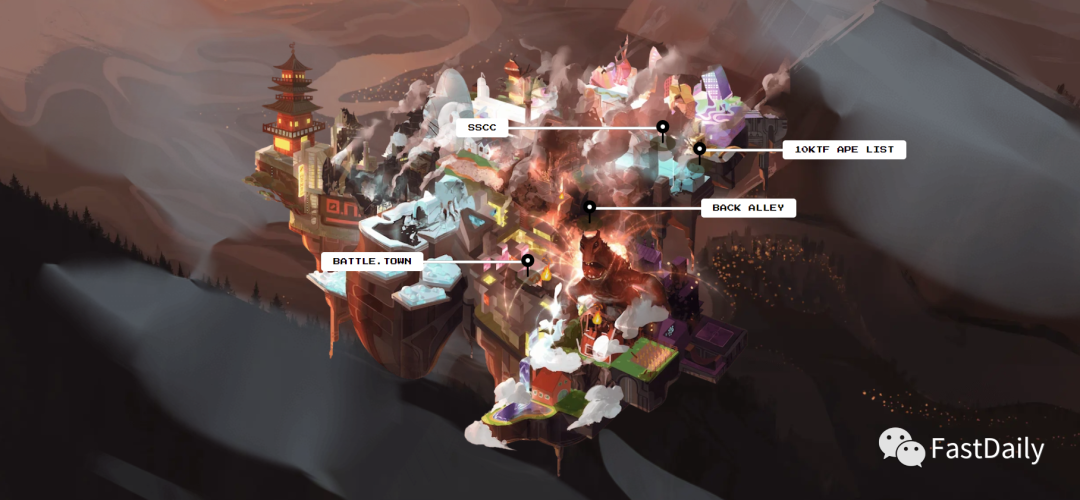
10 KTF 从 2021 年 9 月开始在 twitter 上运营,故事背景是发生在 New Tokyo(新东京)虚构城市,随着时间的推进,整个故事的主线内容及角色也在不断的扩充,在《10KTF》的官网还展示了他们的版图:
有意思的是,老爷爷的宣传视频都制作精良,引人入胜,值得反复观看。多放几个给大家欣赏一下~~

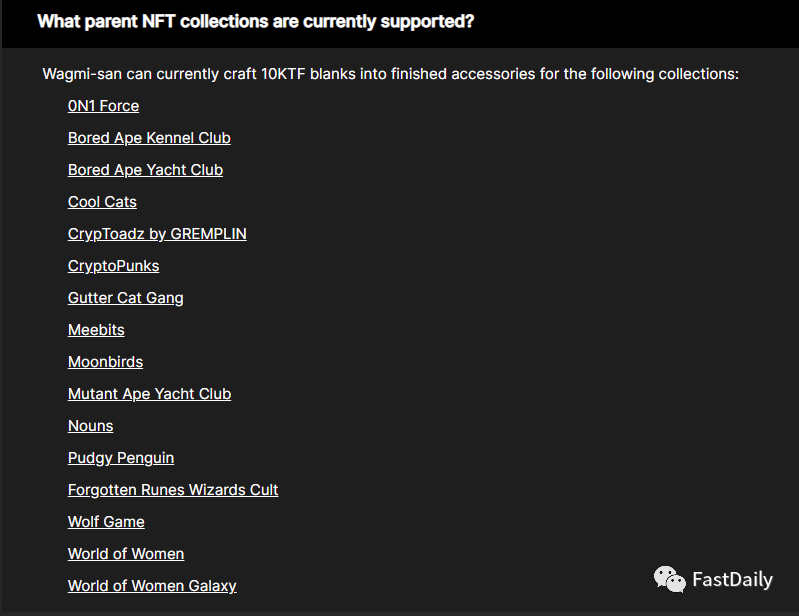
从合作方来看,老爷爷的资源是非常好的,现今为止,有16个官方合作的 NFT 项目,这些项目也被称为 Parent NFT,这些项目的共同点之一就是都给予持有者完全的商业授权,这也是《10KTF》发行他们的衍生品并构建项目的原因。
团队

《10KTF》是由 WENEW 这间公司所发起的项目,主要创办人包含 Mike Winkelmann(Beeple)、Michael Figge、Tim Smith、Guy Oseary 这 4 位,每个人都是NFT圈里面的牛中牛。Beeple这些就不用介绍了吧,如果真的不知道,那就赶紧加入我们的知识星球补补课!

时间表

别看老爷爷笑眯眯,实际上已经杀疯了。

10KTF 项目没有路线图,但它有一个关于店主越轨的生动、不断发展的故事情节。

在推出三个新的 PFP NFT 系列——Gutter Cats Gang、Wolf Game 和 CrypToadz——之后,10KTF 商店正处于制作空白阶段。商店库存收藏品的持有者可以消耗这些消耗材料来铸造这三个收藏品,而工具本身是可重复使用的。

此外,新东京的地图已经公开。这张动态地图允许访问 10KTF 商店客户的私人钱包,为他们提供有关平行宇宙中发生的事情和获得奖励的地点的信息。

到目前为止,除了 10KTF 商店外,该地图还开辟了Battle Town和Back Alley位置。在新店开张之前,一旦您连接了 MetaMask 钱包,Back Alley 就会掉落奖励(如果有的话)。

战斗镇也是如此,目前处于第 3 阶段(已完成商店建设)。这些游戏化和艺术设计的空投正在将 NFT 空间推向丰富的元宇宙方向。

根据铸造的 High Tops 和 Daypacks 的稀有度排名,Wagmi-san 向他们空投一定数量的材料来制作空白。同样,Wagmi-san 在他的 Discord 服务器上发布了关于如何通过配方使用空白的说明。

合作

十几次合作之后,10KTF 的最新成果就是 Gucci 的 Vault 项目,被称为10KTF Gucci Grail。它由 11 个 PFP 组成,灵感来自 Gucci 自己的艺术总监 Alessandro Michele。换句话说,持有 11 个 NFT 系列之一的所有者将可以用不拘一格的服装来装扮他们。一种是黄色,灵感来自 Aria 系列,另一种是红色,灵感来自 Love Parade。除此之外,LV和Puma也在他们的合作名单内。

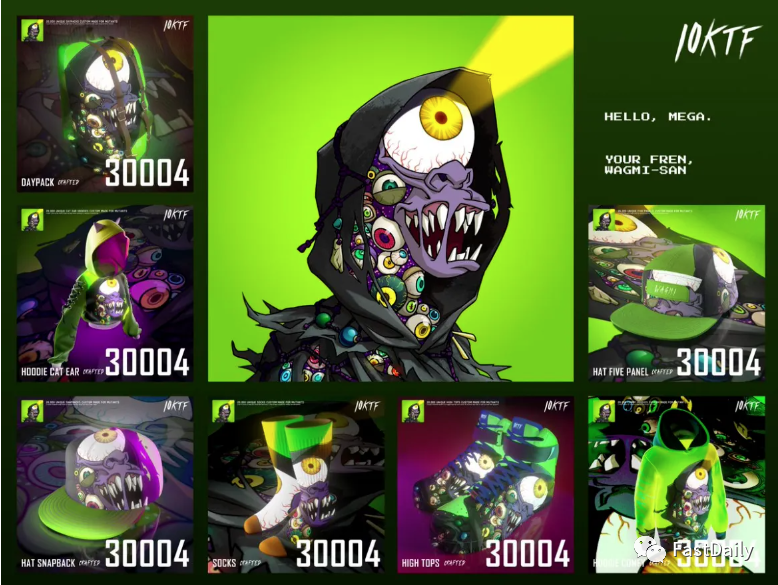
目前的周边 NFT 总共有 7 种类型:

Daypack

High Tops

Hoodie – Cat Ear

Hoodie – Comfy

Hat – Five Panel

Hat – Snapback

Socks

用1/1的化学猴做出来的展示下:
ApeCoin

老头的厉害之处
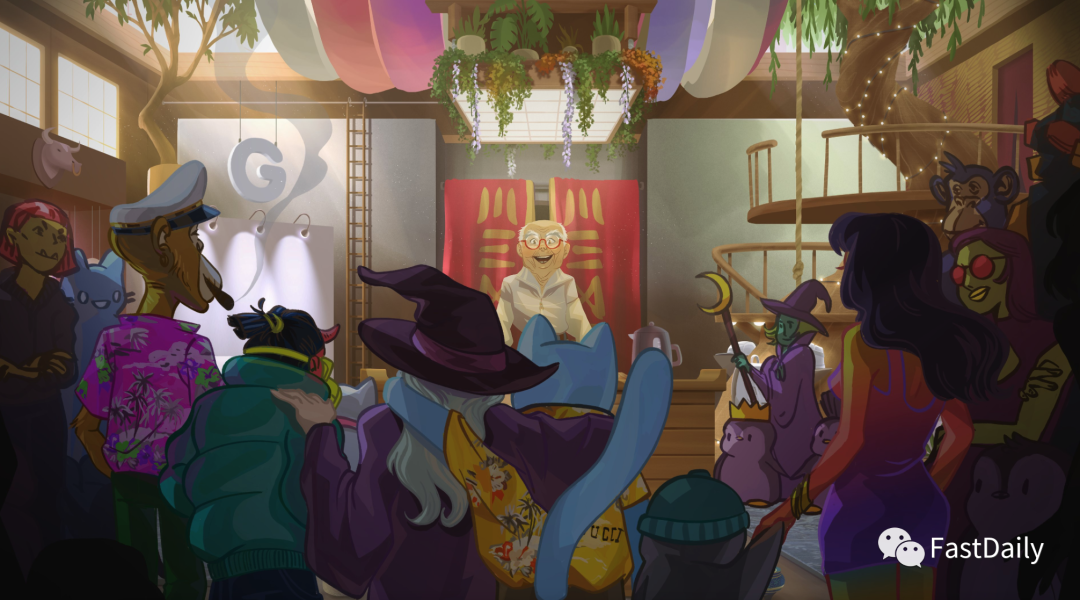
老爷爷的店铺常客都是些熟悉的面孔↑

无论 Wagmi-san 是谁,快速合作的数量之多足以说明它的未来前景。该项目无疑展示了高水平的艺术、商业、创意和技术能力。事实上,人们不得不怀疑 Wagmi-san 是否会很快出现在 Yuga Labs 即将推出的 Otherside 虚拟世界中。他当然涵盖了他们所有的主要主题——BAYC、MAYC 和 BAKC。

此外,这种猜测是基于在 10KTF 商店内发现的一个复活节彩蛋。

具体来说,右上角的长生不老药瓶与 Yuga Labs 的 Otherside 预告片中的长生不老药瓶惊人地相似。如果事实证明这是真的,我们将开始看到第一个清晰的轮廓,即元宇宙在 Facebook 围墙花园之外的样子。

人们不仅将他们的钱包用作跨平台迁移的账户,而且虚拟商品也可以作为衍生 NFT 随时用于铸造。通过非托管钱包确保隐私和安全,这创造了一个无边界的虚拟环境。

反过来,每一种资产都可以变成 NFT,变得可交易。如果 10KFT-Yuga Labs 的合作关系进一步加强,ApeCoin (APE) 将在 Otherside 找到更多用途。而现在,10KTF确实宣布了将会进行ApeCoin的空投。
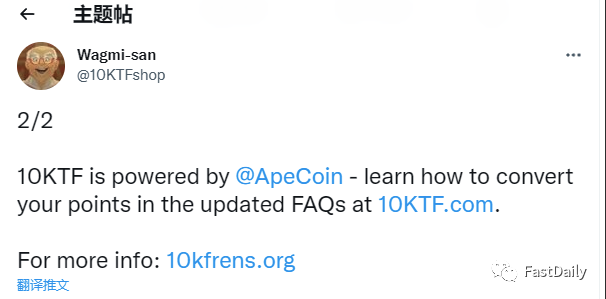
10KTF shop 宣布与 Yuga Labs 的 ApeCoin 代币建立新的合作伙伴关系,10KTF 早在 1 月份推出的期待已久的“新东京token”或俗称 NTD,被解释为将用于下一阶段的材料、物品和奖励,是实际上只是 ApeCoin,持有者可以将其用于 10KTF 生态系统。

因此,持有者将收到 $APE 空投,而不是他们期望的初始 NTD 空投。10KTF 还解释说,他们总共分配了 714,405 $APE 用于向社区空投。

还应该注意的是,自从一月份宣布 NTD 以来的几个月里,10KTF 社区中的许多人一直在积累 NTD。据透露,稍后可以将其换成 ApeCoin。

虽然这次与 Apecoin 的合作是个大新闻,但对于社区中的每个人来说,这并不一定是一个惊喜。10KT 社区中的一些人声称,由于过去几个月 10KTF 发布的有关 NTD 的各种提示,他们已经在猜测这次合作有一段时间了。

然而,这让社区想知道围绕 10KTF 的其他谣言可能是真的。

另一个关于 10KTF 商店的传言是他们将与 Yuga Labs 的 Otherside 进行某种类型的合作。这个谣言的开始是因为 10KTF 在他们的许多帖子中引用了 Otherside 以及 Otherside 在他们 7 月的第一次元宇宙之旅中似乎引用了 10KTF 的吉祥物 WAGMI-san。

老爷爷的玩法实在太多了,我们会持续关注。
Пов'язані матеріали

Valuation Rout of Old Titans: The Demise of a Generation's Asset Valuation Framework

"The Old Titans' Valuation Collapse: The Death of an Era's Valuation Framework" Between Alibaba's 2014 NYSE debut at $93.89 and its 2026 price of ~$95, twelve years have passed with zero price appreciation. This stagnation symbolizes a wholesale valuation reset for an entire generation of Chinese internet assets. Companies like Tencent, Pinduoduo, Meituan, Bilibili, and Kuaishou have seen catastrophic declines of 80-98% from their peaks. The core question arises: what framework now prices these companies, or has the framework itself expired? The valuation logic for Chinese internet stocks followed a clear "anchor-setting and anchor-removing" process. From 2014-2017, the dominant narrative was "US comparable discounting" – applying a growth premium and governance discount to US peers' multiples. This anchor loosened with the 2018 US-China trade war and the VIE structure risk, then was violently uprooted by the 2020-2021 regulatory crackdowns (Ant Group, Didi, anti-monopoly fines). The 2022 delisting panic and subsequent 2025-2026 geopolitical shocks (US military lists, AI espionage accusations) completed the demolition. The old "US对标打折" model is dead. However, this is not solely a China story. A structural mirror exists in US "old titan" stocks ("老登股"). In 2026, even Microsoft – with robust fundamentals – saw its PE compress from a 34x median to 22x, its worst performer status among the "Magnificent Seven" driven by a $190 billion annual AI capex crushing free cash flow. The core dilemma is universal: legacy platform giants, whether Alibaba or Microsoft, are spending colossal sums to chase an AI paradigm that may颠覆 their own high-margin, user/subscription-based business models. They have shifted from "companies defining the future" to "companies needing to prove they won't be淘汰ed by the future." This phenomenon of a dying valuation坐标系 has a historical precedent: post-1989 Japan. After its bubble burst, the "Japan premium" narrative ("most efficient manufacturing + perpetual growth") collapsed. A 25-year valuation vacuum ensued until Warren Buffett provided a new language in the 2010s: "low valuation + high dividend + governance reform." China's internet sector is now in a similar vacuum six years into its reset. While different from Japan's deflationary context, the parallel is clear: the old macro assumption of "deep integration with global capital" is falsified, but a new pricing framework is absent. Potential "new languages" for Chinese internet valuations are contradictory. AI transformation requires gutting profitable core businesses (e.g., Alibaba's ad-driven e-commerce) for an unproven consumption-based model, risking a Microsoft-like cash flow crunch. Alternatively, shareholder returns (buybacks/dividends) could build a floor, following Buffett's Japanese playbook, but current scales are insufficient to form a standalone anchor. The current state mirrors mid-1990s Japan: the old framework is dead, the new one unborn. The market waits in a vacuum for a重新定义ing force – a person, event, or proven business model shift – to answer "why buy." This may only be the middle phase of a prolonged re-rating.

marsbit5 хв тому

Valuation Rout of Old Titans: The Demise of a Generation's Asset Valuation Framework

marsbit5 хв тому

STRC Trading at Significant Discount, mNAV Falls Below Break-Even, Strategy's Valuation Logic Has Been Rewritten

Title: STRC Deeply Discounted, mNAV Falls Below Break-even, Strategy's Valuation Logic Redefined The recent volatility in MSTR and STRC highlights the need to reassess the core business model of Bitcoin reserve companies. These entities function more like leveraged, single-asset banks rather than software/tech firms. Consequently, they should be valued using banking metrics, not based on their total Bitcoin holdings. The key valuation metric is mNAV (market net asset value), akin to a price-to-book ratio. It compares the company's market capitalization to the equity value of its Bitcoin holdings after deducting all senior debt and preferred equity (like STRC). As of June 24, Strategy's mNAV was 1.10x. The focus should be on "net Bitcoin per share" (the Bitcoin claim per share after senior claims) and its growth rate, equivalent to a bank's book value and return on assets. Given STRC's 19% discount to its $100 par value (yielding 14.2%), issuing new MSTR equity at the current price to buy more Bitcoin is inefficient. It slightly dilutes the widely watched "total Bitcoin per share" metric while providing minimal improvement to the more critical "net Bitcoin per share." The article analyzes four potential uses for $1 billion in new equity: 1. **Buy Bitcoin:** Least effective. Improves net Bitcoin per share only marginally while diluting total Bitcoin per share. 2. **Repurchase STRC:** Most effective for balance sheet repair. The discount creates immediate value, increasing net Bitcoin per share by 1.0%, reducing debt burden, and lowering future dividend obligations. 3. **Boost Cash Reserves:** Dramatically improves the "cash coverage ratio" for STRC dividends from 9.8 months to 16.8 months, a crucial liquidity metric in a tightening funding environment. 4. **50/50 Split (STRC buyback & cash):** A balanced approach improving all key metrics. Strategy's own Q1 report indicates its internal break-even mNAV for profitable equity issuance to buy Bitcoin is 1.22x. With the current mNAV at 1.10x, such a move would be value-destructive. The core assumptions of its previous expansion model—issuing STRC at par and maintaining ample dividend coverage—have broken down. The recommended path is to use new capital to optimize core financial health: repurchasing discounted STRC and/or bolstering cash reserves. This would repair the balance sheet, signal liquidity strength, support STRC's price, lower its yield, and potentially reopen the par-value issuance channel. The current STRC discount represents a low-cost capital opportunity to restart this positive cycle. Bitcoin reserve companies must be evaluated as banks, focusing on book value, leverage, and liquidity resilience.

Foresight News6 хв тому

STRC Trading at Significant Discount, mNAV Falls Below Break-Even, Strategy's Valuation Logic Has Been Rewritten

Foresight News6 хв тому

South Korean Institutions' Crypto Race: Dual Explosion of Stablecoins and RWA

**Summary: South Korea's Institutional Crypto Race: Stablecoins and RWA Take Off** South Korea is undergoing a structural shift in its crypto ecosystem, moving beyond its historical role as a major retail trading hub. Major financial institutions and internet platforms are now building institutional-grade blockchain infrastructure, with stablecoins and Real-World Asset (RWA) tokenization as the primary drivers. The push for a regulated Korean won stablecoin market is a major policy and corporate focus. This is driven partly by an estimated $115 billion outflow into dollar stablecoins like USDC, threatening the domestic financial system. Banks (e.g., KB Financial, Hana), payment giants (e.g., Shinhan Card, BC Card), and internet super-apps (KakaoPay, NAVER Pay) are all conducting pilots. The goal is to anchor future digital finance to the Korean won and local regulations. In RWA, South Korea is advancing rapidly within regulatory sandboxes, focusing on unique domestic assets beyond typical global templates like US Treasuries. Projects involve tokenizing ships (with Hyundai Heavy Industries), defense supply chain assets, and K-pop intellectual property, alongside more conventional assets. A legal framework is set for 2027, and platforms like NXT are preparing for regulated trading. Key opportunities for crypto-native projects lie in providing the underlying technology these traditional institutions lack: global distribution channels for tokenized assets, cross-chain liquidity solutions, and enabling infrastructure tools (e.g., for asset packaging and management). Partnerships, such as Solana with Shinhan Card or LayerZero with the Korea Gold Exchange, exemplify this proactive approach. Crucially, user access is being shaped by consumer platforms. NAVER's planned acquisition of Upbit's operator Dunamu and Kakao's development of a unified wallet aim to seamlessly integrate crypto with everyday payments for tens of millions of users. The race is now about which protocols and projects will become the foundational standards as regulation solidifies and institutional adoption accelerates.

Foresight News1 год тому

South Korean Institutions' Crypto Race: Dual Explosion of Stablecoins and RWA

Foresight News1 год тому

Торгівля

Спот
活动图片