STRC Trading at Significant Discount, mNAV Falls Below Break-Even, Strategy's Valuation Logic Has Been Rewritten

Foresight NewsОпубліковано о 2026-06-26Востаннє оновлено о 2026-06-26

Анотація

Title: STRC Deeply Discounted, mNAV Falls Below Break-even, Strategy's Valuation Logic Redefined The recent volatility in MSTR and STRC highlights the need to reassess the core business model of Bitcoin reserve companies. These entities function more like leveraged, single-asset banks rather than software/tech firms. Consequently, they should be valued using banking metrics, not based on their total Bitcoin holdings. The key valuation metric is mNAV (market net asset value), akin to a price-to-book ratio. It compares the company's market capitalization to the equity value of its Bitcoin holdings after deducting all senior debt and preferred equity (like STRC). As of June 24, Strategy's mNAV was 1.10x. The focus should be on "net Bitcoin per share" (the Bitcoin claim per share after senior claims) and its growth rate, equivalent to a bank's book value and return on assets. Given STRC's 19% discount to its $100 par value (yielding 14.2%), issuing new MSTR equity at the current price to buy more Bitcoin is inefficient. It slightly dilutes the widely watched "total Bitcoin per share" metric while providing minimal improvement to the more critical "net Bitcoin per share." The article analyzes four potential uses for $1 billion in new equity: 1. **Buy Bitcoin:** Least effective. Improves net Bitcoin per share only marginally while diluting total Bitcoin per share. 2. **Repurchase STRC:** Most effective for balance sheet repair. The discount creates immediate value, increasing...


Author: Khing Oei

Compiled by: Chopper, Foresight News


Recently, the markets for MSTR and STRC have experienced significant volatility. We should look beyond short-term price fluctuations and revisit the underlying logic: Bitcoin reserve companies are essentially single-asset, leveraged holding entities, with a business model closer to that of a bank rather than a software technology company.


From a valuation perspective, the market would never price a bank based solely on its total assets. A bank's loan assets are prioritized for repayment by depositors and debt holders, with common shareholders only entitled to residual equity. Therefore, the core valuation metric for banks is the price-to-book ratio (P/B), which is the value of shareholders' equity after deducting senior debt from total assets. This is also the primary reference metric for investment bank and brokerage analysts.


For Bitcoin reserve companies, the equivalent P/B metric is mNAV: it equals the company's market capitalization divided by the equity net asset value, where equity net asset value refers to Bitcoin reserves minus debt and preferred stock senior to common shares. As of the previous close, Strategy's mNAV was 1.10x. (Translator's Note: The "previous close" data mentioned in this article refers to June 24th data.) The underlying per-share fundamental is the net Bitcoin per share—the actual amount of Bitcoin owned per share after settling priority claims. This is equivalent to the per-share book value denominated in Bitcoin. The industry-wide focus—the per-share Bitcoin growth rate—represents the return on this book value. For a capital management company, this is almost equivalent to an earnings metric.


This set of metrics is not my invention; it simply applies the traditional bank financial analysis framework to a Bitcoin balance sheet:


  • Market cap per unit of equity / Net asset value = Price-to-Book Ratio
  • Net Bitcoin holding per share = Book value per share
  • Bitcoin holding growth per share = Return on book assets


This is the valuation logic common to all leveraged financial institutions and is fully applicable to these Bitcoin reserve companies.


MSTR closed yesterday at $94.13 per share, below the total net Bitcoin value per share of $143.76, resulting in a rough total net value multiple of only 0.65x. Viewed solely through this lens, the stock trades at nearly a one-third discount to its Bitcoin asset value, making a stock issuance to buy more Bitcoin seem dilutive. However, after deducting the approximately 40% of Bitcoin equity occupied by debt and preferred stock, the current stock price represents 1.1 times the Bitcoin assets actually held by common equity. The two perspectives lead to completely opposite conclusions, and the banking valuation framework is the correct benchmark, which also determines how the company should use any new capital raised at present.


Simulating Four Use Cases for $1 Billion in New Capital


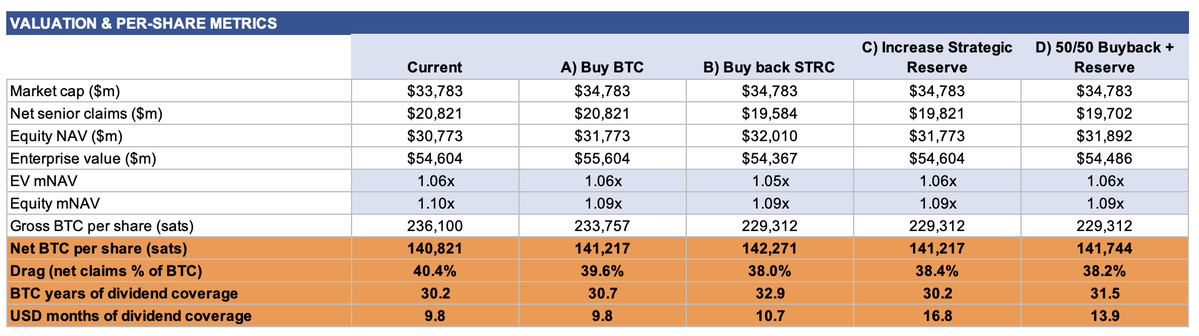
Assuming a $1 billion equity issuance at the current stock price, we simulate the effects of four potential uses for the funds: 1) Increase Bitcoin holdings; 2) Repurchase STRC; 3) Boost cash reserves; 4) A 50/50 split between repurchasing STRC and boosting cash reserves. The issuance price is $94.13 per share; yesterday's STRC closing price was $80.84, a 19% discount to its par value, translating to an actual annualized yield of 14.2%. For every $1 spent on repurchases, $1.24 of STRC at par value can be retired, simultaneously eliminating the 11.5% perpetual dividend.
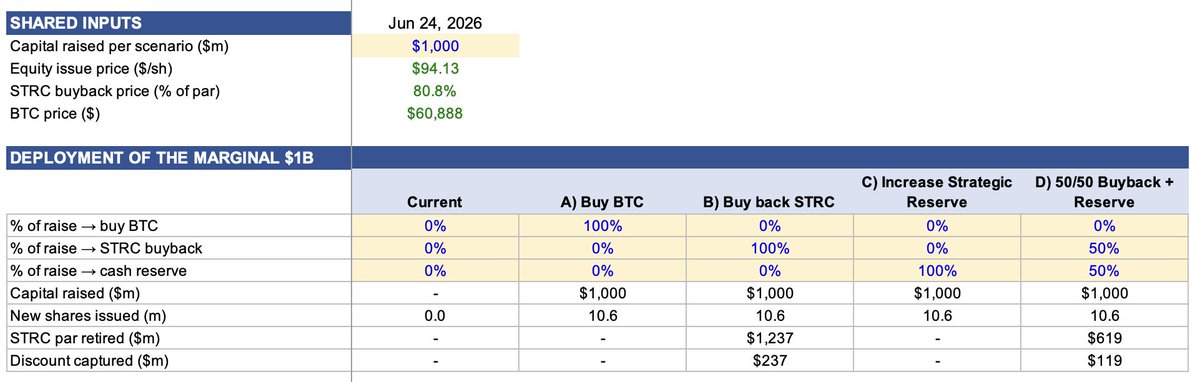


Impact of the Four Scenarios on the Balance Sheet


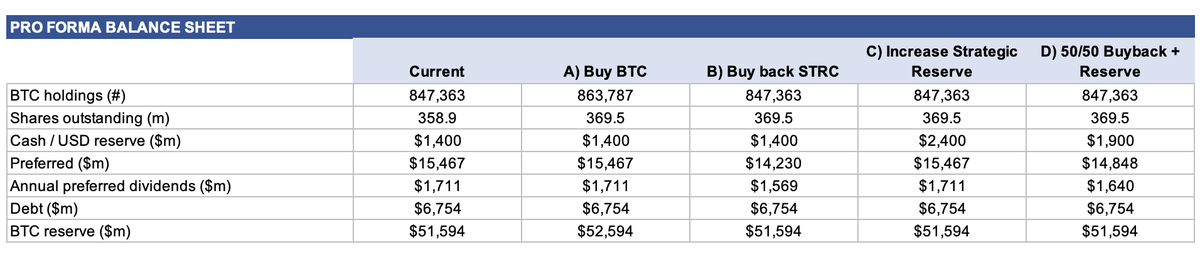
Three of the four scenarios do not increase Bitcoin holdings; they only adjust the structure of the senior claims layer:


Repurchase STRC: Buying back at a 19% discount, $1 billion can retire $1.24 billion of STRC at par value. Annual preferred stock dividend payments decrease from $1.711 billion to $1.569 billion.

Boost Cash Reserves: Cash reserves increase from $1.4 billion to $2.4 billion, with dividend payments unchanged.

50/50 Split Scenario: Cash increases to $1.9 billion, dividend payments decrease to $1.640 billion, and $619 million of STRC at par value is retired.

Increase Bitcoin Holdings: The only scenario that increases Bitcoin reserves, raising total holdings from 847,363 BTC to 863,787 BTC. This is also the weakest choice for improving core metrics.


Calculating total Bitcoin value per share, all four scenarios show dilution. Even if you use the entire $1 billion to purchase Bitcoin, the per-share value decreases from 236,100 satoshis to 233,757 satoshis; in the three scenarios where stock is issued but no Bitcoin is purchased, the per-share value drops even further to 229,312 satoshis. Based on this, you would conclude: the company should do nothing.


However, in terms of net Bitcoin value per share, every option results in an increase:


  • Repurchase STRC: Net Bitcoin per share rises to 142,271 satoshis (+1.0%). Debt-to-assets ratio decreases from 40.4% to 38.0%. This provides the strongest balance sheet repair.
  • 50/50 Split Scenario: Net Bitcoin per share becomes 141,744 satoshis, with a debt-to-assets ratio of 38.2%. Cash coverage for debt service is significantly enhanced.
  • Purely Boosting Cash Reserves or Increasing Bitcoin Holdings: Both result in 141,217 satoshis per share, showing the smallest increase.


The logic for Bitcoin purchases being the least effective is clear. You are issuing stock at 1.1 times net asset value but purchasing assets at 1 times net asset value. This only slightly increases net Bitcoin per share while diluting the widely followed total Bitcoin holdings metric. In contrast, repurchasing STRC at a discount creates immediate value.


The market's current key concern is the dividend cash coverage in months. Strategy currently has $1.4 billion in cash reserves and annual STRC dividend payments of $1.711 billion, meaning cash covers only 9.8 months of dividends:


  • Increase Bitcoin Holdings: Coverage remains at 9.8 months.
  • Repurchase STRC: Improves to 10.7 months.
  • Purely Boost Cash Reserves: Significantly improves to 16.8 months.
  • 50/50 Split Scenario: Improves to 13.9 months.


This is another core banking metric: the liquidity coverage ratio. No one pays attention during loose funding cycles, but during funding contractions, it becomes crucial for corporate survival. The fact that STRC is trading below par is a direct signal of market funding channel tightening.


Company's Own Financial Data Also Confirms This Conclusion


The above analysis is not a subjective judgment; Strategy's Q1 earnings report provides the same break-even threshold. According to the company's own framework, selling MSTR to buy Bitcoin only increases Bitcoin per share when mNAV is above 1.22x. At the current multiple of 1x, such a move directly erodes value by 48 basis points. The company's current EV is 1.06x and mNAV is 1.10x, both below its internal break-even line.


The two core assumptions behind the company's conventional expansion path have now completely failed. Previously, it was assumed that STRC could be issued at par normally and that cash reserves could cover 1.5 years of dividends. Now, STRC trades at $81 and cannot be issued at par, and cash reserves cover less than 10 months of dividends.


What Should Strategy Do?


Within the current valuation range, issuing new equity and deploying the capital into channels that tangibly optimize core financial metrics is key. Both boosting cash reserves and repurchasing STRC at a discount can increase net Bitcoin per share, reduce the debt burden, and repair the market's concern over liquidity coverage. The 50/50 split scenario can achieve all these objectives simultaneously.


Continuing to add Bitcoin at present would only optimize the superficial metrics widely followed by the public, while neglecting the core balance sheet risk of the company carrying $15 billion in priority debt amidst tightening funding channels.


Investors focused solely on the total Bitcoin holdings metric miss the positive feedback loop. Repurchasing STRC directly supports token buy-side pressure and signals confidence in liquidity safety. Once market panic subsides, STRC prices should recover toward the $100 par value; price appreciation corresponds to lower yields, and the current high yield of 14.2% would continue to narrow. A complete positive cycle thus forms: repairing the balance sheet → STRC price recovery → dividend yield declines → the previously closed channel for par-value issuance reopens.


The STRC discount is not something that can only be passively waited out for repair; the current deep discount represents the lowest-cost capital the company can access and is key to restarting other funding channels.


To evaluate Bitcoin reserve companies, one should apply banking valuation standards: price-to-book ratio, per-share book value, and debt servicing capacity under stress environments.


Трендові криптовалюти

Пов'язані питання

QWhat is the core valuation framework proposed by the author for Bitcoin reserve companies like Strategy, and why is it applicable?

AThe author proposes applying a traditional bank valuation framework. The core logic is that these companies are leveraged holders of a single asset (Bitcoin), similar to banks. The key valuation metric is the Price-to-Book ratio, represented as mNAV (market NAV), which is the company's market capitalization divided by its equity net asset value (Bitcoin reserves minus priority debt and preferred stock). This framework is applicable because it focuses on the residual equity value for common shareholders after satisfying priority claims, which is the standard way to value leveraged financial institutions.

QAccording to the author's analysis, what is the least effective use of $1 billion in new equity capital for Strategy at the current valuation, and why?

AUsing the new capital to buy more Bitcoin is the least effective option. The logic is that the company would be issuing equity at a price of 1.1x its net asset value (mNAV) but buying an asset (Bitcoin) priced at 1x its underlying value. This results in only a minimal increase in the key metric of 'Net Bitcoin per share' while diluting the more widely watched 'Total Bitcoin per share' metric. In contrast, using the capital to repurchase discounted STRC preferred shares creates immediate value by reducing debt burden and dividend obligations.

QWhat are the two core assumptions of Strategy's original expansion plan that the author states have now failed?

AThe two failed core assumptions are: 1) That STRC (the company's preferred shares) could be issued continuously at its $100 par value. Currently, it trades at a 19% discount ($81), closing this funding channel. 2) That the company's cash reserves would be sufficient to cover 1.5 years of dividend payments on those preferred shares. Currently, the cash covers less than 10 months of dividends, indicating a liquidity coverage problem.

QWhat positive feedback loop does the author describe as a potential outcome if Strategy uses new capital to repurchase STRC shares?

AThe positive feedback loop is: Repairing the balance sheet by repurchasing discounted STRC → This action supports STRC's market price → As STRC's price rises toward its $100 par value, its dividend yield falls → The previously closed channel for issuing new STRC at par value reopens. This cycle allows the company to improve its financial health and regain access to lower-cost capital.

QWhat key banking metric does the author highlight as crucial during periods of financing tightening, and what is Strategy's current situation regarding this metric?

AThe author highlights 'Liquidity Coverage' or specifically the 'Cash Dividend Coverage Months' as a crucial banking metric during financing tightening. It measures how many months of dividend payments (for priority securities like STRC) the company's cash reserves can cover. Strategy's current cash reserve of $1.4 billion covers only 9.8 months of its $1.711 billion annual STRC dividend, signaling potential liquidity stress in a tighter funding environment.

Пов'язані матеріали

Hackers Steal Nearly $17 Million in 40 Days as 'Zombie Contracts' Become Their ATMs

According to an analysis published by ZeroDrift on June 22, 2026, attackers have stolen approximately $16.9 million over 40 days from five deprecated but still operational smart contracts across various blockchains. The primary issue is not a specific vulnerability but the incomplete decommissioning of legacy contracts. These "zombie contracts" often retain economic value, operational permissions, and callable functions, making them prime targets long after teams cease active development. The most significant loss occurred at DxSale, where an old locker contract lost about $7.3 million due to a forgotten control path becoming accessible again. Other affected projects include TrustedVolumes (~$5.87M), Raydium's legacy AMM pool (~$1.34M), Aztec Connect (~$2.28M), and Huma Finance V1 pool (~$101k). These incidents involved diverse systems—RFQ settlement, credit pools, liquidity lockers, AMMs—demonstrating the widespread nature of the risk. The analysis highlights that automated tools are lowering the cost for attackers to systematically scan for these long-tail targets, which have public code and weaker monitoring. In contrast, defensive practices for contract retirement remain underdeveloped. While the DeFi industry has mature audit processes for new deployments, it lacks strict protocols for securely sunsetting old contracts, which only become truly "retired" after all funds, permissions, authorizations, and trust assumptions are removed.

marsbit56 хв тому

Hackers Steal Nearly $17 Million in 40 Days as 'Zombie Contracts' Become Their ATMs

marsbit56 хв тому

Valuation Rout of Old Titans: The Demise of a Generation's Asset Valuation Framework

"The Old Titans' Valuation Collapse: The Death of an Era's Valuation Framework" Between Alibaba's 2014 NYSE debut at $93.89 and its 2026 price of ~$95, twelve years have passed with zero price appreciation. This stagnation symbolizes a wholesale valuation reset for an entire generation of Chinese internet assets. Companies like Tencent, Pinduoduo, Meituan, Bilibili, and Kuaishou have seen catastrophic declines of 80-98% from their peaks. The core question arises: what framework now prices these companies, or has the framework itself expired? The valuation logic for Chinese internet stocks followed a clear "anchor-setting and anchor-removing" process. From 2014-2017, the dominant narrative was "US comparable discounting" – applying a growth premium and governance discount to US peers' multiples. This anchor loosened with the 2018 US-China trade war and the VIE structure risk, then was violently uprooted by the 2020-2021 regulatory crackdowns (Ant Group, Didi, anti-monopoly fines). The 2022 delisting panic and subsequent 2025-2026 geopolitical shocks (US military lists, AI espionage accusations) completed the demolition. The old "US对标打折" model is dead. However, this is not solely a China story. A structural mirror exists in US "old titan" stocks ("老登股"). In 2026, even Microsoft – with robust fundamentals – saw its PE compress from a 34x median to 22x, its worst performer status among the "Magnificent Seven" driven by a $190 billion annual AI capex crushing free cash flow. The core dilemma is universal: legacy platform giants, whether Alibaba or Microsoft, are spending colossal sums to chase an AI paradigm that may颠覆 their own high-margin, user/subscription-based business models. They have shifted from "companies defining the future" to "companies needing to prove they won't be淘汰ed by the future." This phenomenon of a dying valuation坐标系 has a historical precedent: post-1989 Japan. After its bubble burst, the "Japan premium" narrative ("most efficient manufacturing + perpetual growth") collapsed. A 25-year valuation vacuum ensued until Warren Buffett provided a new language in the 2010s: "low valuation + high dividend + governance reform." China's internet sector is now in a similar vacuum six years into its reset. While different from Japan's deflationary context, the parallel is clear: the old macro assumption of "deep integration with global capital" is falsified, but a new pricing framework is absent. Potential "new languages" for Chinese internet valuations are contradictory. AI transformation requires gutting profitable core businesses (e.g., Alibaba's ad-driven e-commerce) for an unproven consumption-based model, risking a Microsoft-like cash flow crunch. Alternatively, shareholder returns (buybacks/dividends) could build a floor, following Buffett's Japanese playbook, but current scales are insufficient to form a standalone anchor. The current state mirrors mid-1990s Japan: the old framework is dead, the new one unborn. The market waits in a vacuum for a重新定义ing force – a person, event, or proven business model shift – to answer "why buy." This may only be the middle phase of a prolonged re-rating.

marsbit1 год тому

Valuation Rout of Old Titans: The Demise of a Generation's Asset Valuation Framework

marsbit1 год тому

Торгівля

Спот

Популярні статті

Що таке DOGE M

Doge Matrix ($doge m): Нова порода криптовалюти, що керується спільнотою Вступ У постійно змінюваному ландшафті криптовалюти нові проекти постійно з'являються, кожен з яких прагне привернути увагу інвесторів та ентузіастів. Одним з останніх учасників цього домену є Doge Matrix, представлений тикером $doge m. Цей проект привернув увагу завдяки своїм корінням у популярній культурі мемів навколо Dogecoin, закріплюючи своє місце в просторі web3. Ця стаття має на меті надати всебічний аналіз Doge Matrix, охоплюючи його огляд, творця, інвесторів, функціональність, хронологію та помітні аспекти. Що таке Doge Matrix ($doge m)? Doge Matrix — це проект криптовалюти, що керується спільнотою, який, здається, будує на широкій привабливості Dogecoin, цифрової валюти, відомої своїм маскотом Shiba Inu та мем-походженням. Хоча загальні цілі Doge Matrix не є детально визначеними, він характеризується зобов'язанням залучати участь та підтримку спільноти. На відміну від традиційних криптовалют, які часто підкреслюють корисність або внутрішню цінність через підлягаючі технології, Doge Matrix позиціонує себе в просторі, що охоплює культурне явище криптовалют, особливо приваблюючи тих, хто резонує з етикою активів на основі мемів. Спираючись на сильні сторони спільноти Dogecoin, Doge Matrix працює як частина більш широкої екосистеми, запрошуючи участь та залучення користувачів, які поділяють інтерес до криптовалюти та цифрового простору. Хто є творцем Doge Matrix ($doge m)? Особистість творця Doge Matrix залишається невідомою. Ця відсутність прозорості не є рідкісним явищем у сфері криптовалют, де деякі проекти запускаються без розкриття ідентичностей своїх засновників. Відсутність інформації про засновницьку команду може викликати питання серед потенційних інвесторів щодо відповідальності та напрямку проекту. Хто є інвесторами Doge Matrix ($doge m)? На даний момент немає публічно доступної інформації про інвесторів або інвестиційні фонди, які підтримують Doge Matrix. Проект, здається, покладається переважно на підтримку спільноти, а не на інституційні інвестиції. Ця модель узгоджується з природою ініціативи, що керується спільнотою, сприяючи середовищу, де напрям проекту формується його учасниками, а не диктується вибраними фінансовими спонсорами. Як працює Doge Matrix ($doge m)? Специфіка операційних механізмів Doge Matrix є дещо розмитою, відображаючи ширшу тенденцію проектів у просторі мем-коінів, де інноваційні функціональності не завжди чітко сформульовані. Проте Doge Matrix, здається, розроблений для того, щоб використовувати існуючу екосистему криптовалют, заохочуючи участь користувачів, одночасно використовуючи знайомі культурні посилання, пов'язані з Dogecoin. Його потенційно унікальні характеристики походять від взаємодій у спільноті, а не від технологічних досягнень, підкреслюючи спільний досвід та співпрацю серед власників токенів. Хоча точні інновації не були чітко окреслені, проект, здається, створює простір, де члени спільноти можуть взаємодіяти, ділитися ідеями та просувати потенціал проекту вперед. Хронологія Doge Matrix ($doge m) Розглядаючи хронологію проекту, можна виявити помітні події, які визначили його шлях до цього часу: 25 листопада 2024: Doge Matrix досяг свого історичного максимуму, що стало значною віхою в його ранній історії. 1 січня 2025: Навпаки, Doge Matrix досяг свого історичного мінімуму, ілюструючи волатильність, яка часто асоціюється з криптовалютами, особливо на ранніх етапах життєвого циклу проекту. Триває: Проект продовжує активно торгуватися та підтримуватися своєю спільнотою, хоча конкретні майбутні віхи або цілі ще не були розкриті. Ключові моменти про Doge Matrix ($doge m) Орієнтація на спільноту У центрі Doge Matrix лежить зобов'язання до залучення спільноти. Проект процвітає на основі співпраці та спільних цілей серед своїх учасників, підкреслюючи важливість колективних зусиль. На відміну від централізованих проектів, які часто мають визначену структуру керівництва, Doge Matrix наразі демонструє більш гнучкий підхід до управління, де голос кожного члена спільноти має значення. Волатильність Ринок криптовалют відомий своєю волатильністю, і Doge Matrix не є винятком. Його історія цін відображає значні коливання між високими та низькими значеннями, що є типовим для багатьох нових криптовалют, але підкреслює ризики, пов'язані з інвестиціями в нові токени. Відсутність детальної інформації Однією з найпомітніших рис Doge Matrix є брак детальної інформації щодо його технологічних основ та операційних механізмів. Ця невизначеність вимагає від потенційних інвесторів провести ретельну перевірку перед залученням до проекту. Висновок Підсумовуючи, Doge Matrix ($doge m) ілюструє нову хвилю проектів криптовалюти, які сильно покладаються на залучення спільноти та культурну значущість. Хоча йому бракує певних специфікацій — таких як чітке керівництво, визначені цілі та детальна функціональність — проект зміг викликати інтерес у криптоспільноті, використовуючи вже встановлену привабливість культури мемів. Як і з будь-якими інвестиціями в сфері криптовалют, розуміння вроджених ризиків і проведення всебічного дослідження є важливими для потенційних учасників. Doge Matrix слугує нагадуванням про динамічну, іноді непередбачувану природу криптоіндустрії, що відзначається постійною еволюцією та ентузіазмом щодо ініціатив, що керуються спільнотою.

486 переглядів усьогоОпубліковано 2025.02.03Оновлено 2025.02.03

Що таке DOGE M

Що таке $M

Розуміння Mantis ($M): Нова ера в кросчейн-інтероперабельності У постійно змінюваному ландшафті Web3 та криптовалют нові проекти прагнуть запропонувати інноваційні рішення, спрямовані на покращення користувацького досвіду та розширення функціональних можливостей у рамках децентралізованої фінансової екосистеми. Один з таких проектів, що привертає увагу, - це Mantis ($M), піонерський протокол, заснований на принципах кросчейн-інтероперабельності та угод на основі намірів. Ця стаття розглядає основні аспекти Mantis, включаючи його основну функціональність, творців, інвестиційну підтримку, інноваційні особливості та ключові етапи. Що таке Mantis ($M)? Mantis описується як протокол врегулювання намірів у кількох доменах, який спрощує кросчейн-взаємодії, дозволяючи користувачам безперешкодно виконувати складні фінансові транзакції на різних блокчейн-платформах. Протокол працює через три основні шари: Вираження намірів: Користувачі можуть формулювати свої цілі транзакцій, використовуючи природну мову, що забезпечується DISE LLM, передовою мовною моделлю штучного інтелекту. Наприклад, користувач може висловити бажання обміняти Ethereum (ETH) на Solana (SOL) з певною допустимою похибкою в 1%. Виконання: Цей шар використовує мережу розв'язувачів, які змагаються за виконання намірів користувачів. Транзакції виконуються за допомогою механізмів, таких як Coincidence of Wants (CoWs) та Order Flow Auctions (OFAs), які забезпечують оптимальне задоволення запитів користувачів. Врегулювання: Використовуючи протокол міжблокчейн-комунікації (IBC), Mantis дозволяє атомарні кросчейн-транзакції, що дозволяє користувачам працювати на різних підтримуваних ланцюгах, включаючи Ethereum, Solana та Cosmos. Mantis розроблений для впровадження рідної генерації доходу для бездіяльних активів, використовуючи криптографічні докази для підтримки цілісності транзакцій протягом усього процесу. Творці та команда розробників Mantis був задуманий Composable Foundation, дослідницькою організацією, відомою своїм акцентом на рішеннях для блокчейн-інтероперабельності. Ця організація співпрацює з відомими академічними установами, такими як Гарвардський університет та Університет Лісабона, сприяючи широким дослідженням та розробкам, які формують архітектуру та функціональність Mantis. Зобов'язання Composable Foundation сприяти інноваціям у сфері блокчейн-технологій позиціонує Mantis як надійне рішення для зростаючого попиту на інтероперабельність між кількома блокчейн-мережами. Інвестори та підтримка Хоча конкретні деталі про окремих інвесторів не були публічно розкриті, Mantis користується значною підтримкою від різних суб'єктів, включаючи: Гранти екосистеми від ланцюгів, що підтримують IBC, які підтримують зростання протоколу та інтеграцію в децентралізовані фінансові екосистеми. Стратегічні партнерства з постачальниками інфраструктури, які покращують мережеві можливості Mantis та стратегії впровадження. Фінансування через казну Composable Foundation, що забезпечує стабільну фінансову підтримку для поточних розробок та операційних витрат. Ці спільні зусилля відображають консенсус серед зацікавлених сторін щодо важливості покращення кросчейн-функціональності та потенційної корисності інфраструктурних інновацій Mantis. Ключові інновації Mantis вирізняється кількома піонерськими інноваціями, які покращують його функціональність та корисність: Незалежні від ланцюга наміри: Користувачі можуть ініціювати транзакції з будь-якого підтримуваного ланцюга, при цьому врегулюючи їх на іншому. Ця гнучкість надає користувачам більше можливостей, стимулюючи взаємодію між різними платформами. Інтерфейс на базі штучного інтелекту: Інтеграція DISE LLM дозволяє користувачам виконувати складні DeFi-операції, використовуючи природну мову, що спрощує взаємодію та робить технологію блокчейн доступною для ширшої аудиторії. Захоплення MEV у кросдоменному середовищі: Mantis створює внутрішній ринок для максимального екстракційного значення (MEV) через конкуренцію серед розв'язувачів. Цей інноваційний підхід дозволяє досягати більшої ефективності та екстракції вартості в складних транзакціях. Модульний шар врегулювання: Протокол підтримує різні методи верифікації, включаючи нульові знання та оптимістичні роллапи, забезпечуючи універсальну структуру, яка може адаптуватися до нових блокчейн-технологій. Історична хронологія Розвиток Mantis відзначений кількома критичними етапами, які окреслюють його траєкторію та зростання: | Рік | Етап | |————|————————————————————————-| | 2022 | Початкова розробка концепції в дослідницькому підрозділі Composable Foundation. | | Q3 2024 | Запуск тестової мережі з можливостями мосту між Solana та Ethereum. | | Q1 2025 | Очікувана подія генерації токенів (TGE) разом із запуском основної мережі. | | Q2 2025 | Очікувана інтеграція DISE LLM та розширення кросчейн-можливостей. | | 2025 H2 | Запланована підтримка понад 15 ланцюгів через подальші оновлення IBC. | Ця хронологія окреслює еволюцію Mantis, від концептуальних обговорень до активної реалізації та майбутніх етапів зростання. Стратегія зростання екосистеми Стратегія Mantis щодо зростання екосистеми включає кілька ініціатив, спрямованих на заохочення участі користувачів та залучення розробників: Система кредитів: Користувачі можуть заробляти кредити протоколу, надаючи ліквідність та беручи участь у реферальних програмах. Ці кредити можна буде обміняти на винагороди в майбутньому, сприяючи формуванню сильної спільноти користувачів. Модульний набір для розробки програмного забезпечення (SDK): Цей набір інструментів надає розробникам можливість створювати додатки на основі моделей, що керуються намірами, використовуючи інфраструктуру Mantis, тим самим сприяючи інноваціям у його екосистемі. Модель управління: У міру розвитку протоколу, власники токенів $M отримають можливість брати участь в управлінні протоколом, що дозволить їм голосувати за запропоновані оновлення та зміни, підвищуючи залученість спільноти та децентралізацію. Mantis представляє собою значний прогрес у сфері кросчейн-архітектури. Завдяки безперешкодній інтеграції передових алгоритмів штучного інтелекту з надійною структурою врегулювання, Mantis прагне вирішити проблеми фрагментації в багатоланцюгових екосистемах. Його інноваційний підхід ставить на перше місце покращення користувацького досвіду, дотримуючись основоположних принципів децентралізації та безпеки, встановлюючи новий стандарт для майбутньої інтероперабельності блокчейн-технологій. Оскільки Mantis продовжує свій шлях зростання та реалізації, він обіцяє стати проектом, за яким варто уважно стежити в конкурентному середовищі Web3 та децентралізованих фінансів. Зосереджуючись на подоланні кордонів та підвищенні залученості користувачів, Mantis готовий стати невід'ємною частиною майбутніх розробок у сфері криптовалют.

52 переглядів усьогоОпубліковано 2025.03.18Оновлено 2025.03.18

Що таке $M

Як купити M

Ласкаво просимо до HTX.com! Ми зробили покупку MemeCore (M) простою та зручною. Дотримуйтесь нашої покрокової інструкції, щоб розпочати свою криптовалютну подорож.Крок 1: Створіть обліковий запис на HTXВикористовуйте свою електронну пошту або номер телефону, щоб зареєструвати обліковий запис на HTX безплатно. Пройдіть безпроблемну реєстрацію й отримайте доступ до всіх функцій.ЗареєструватисьКрок 2: Перейдіть до розділу Купити крипту і виберіть спосіб оплатиКредитна/дебетова картка: використовуйте вашу картку Visa або Mastercard, щоб миттєво купити MemeCore (M).Баланс: використовуйте кошти з балансу вашого рахунку HTX для безперешкодної торгівлі.Треті особи: ми додали популярні способи оплати, такі як Google Pay та Apple Pay, щоб підвищити зручність.P2P: Торгуйте безпосередньо з іншими користувачами на HTX.Позабіржова торгівля (OTC): ми пропонуємо індивідуальні послуги та конкурентні обмінні курси для трейдерів.Крок 3: Зберігайте свої MemeCore (M)Після придбання MemeCore (M) збережіть його у своєму обліковому записі на HTX. Крім того, ви можете відправити його в інше місце за допомогою блокчейн-переказу або використовувати його для торгівлі іншими криптовалютами.Крок 4: Торгівля MemeCore (M)Легко торгуйте MemeCore (M) на спотовому ринку HTX. Просто увійдіть до свого облікового запису, виберіть торгову пару, укладайте угоди та спостерігайте за ними в режимі реального часу. Ми пропонуємо зручний досвід як для початківців, так і для досвідчених трейдерів.

514 переглядів усьогоОпубліковано 2025.07.02Оновлено 2026.06.02

Як купити M

Обговорення

Ласкаво просимо до спільноти HTX. Тут ви можете бути в курсі останніх подій розвитку платформи та отримати доступ до професійної ринкової інформації. Нижче представлені думки користувачів щодо ціни M (M).

活动图片