Source: Galaxy Research
Translation: Jinse Finance
Bitcoin's closing price in 2025 is expected to be roughly flat compared to the beginning of the year.
In the first ten months of this year, the cryptocurrency market experienced a genuine bullish wave. Regulatory reforms continued to advance, ETFs consistently absorbed funds, and on-chain activity became increasingly vibrant. Bitcoin hit a new all-time high of $126,080 on October 6th.
However, the market did not see the anticipated breakout after the euphoria; instead, it experienced rotation, repricing, and rebalancing. Disappointed macro expectations, a shift in investment narratives, leveraged liquidations, and massive whale sell-offs collectively disrupted the market's equilibrium. Prices fell, confidence waned, and by December, Bitcoin had retreated to lows just above $90,000—with anything but a smooth ride in between.
Although 2025 may end with a price decline, the year still attracted genuine institutional adoption and laid the groundwork for the next phase of real activation in 2026. In the coming year, we expect stablecoins to surpass traditional payment rails, tokenized assets to enter mainstream capital and collateral markets, and enterprise-grade Layer 1 blockchains to move from pilots to actual settlement. Furthermore, we anticipate public blockchains will rethink their value capture methods, DeFi and prediction markets will continue to expand, and AI-driven payments will finally become visible on-chain.
Without further ado, here are Galaxy Research's 26 predictions for the cryptocurrency market in 2026.
1. Bitcoin Price
Prediction 1: There is a probability that BTC reaches $250,000 by the end of 2026.
2026 is difficult to predict due to high market volatility, but Bitcoin hitting a new all-time high in 2026 remains possible.
Current options market pricing indicates that, as of the end of June 2026, the probability of Bitcoin reaching $70,000 is roughly equal to that of reaching $130,000; by the end of 2026, the probabilities of reaching $50,000 or $250,000 are also similar. This wide range reflects the market's high uncertainty regarding near-term direction. At the time of writing, the broader crypto market is deeply entrenched in a bear trend, with Bitcoin failing to firmly regain upward momentum. Until BTC solidly holds above the $100,000-$105,000 range, we believe near-term risks remain skewed to the downside. Other factors in the broader financial markets also contribute uncertainty, such as the pace of AI capital expenditure deployment, the monetary policy environment, and the US midterm elections in November.
This year, we have observed a structural decline in Bitcoin's long-term volatility levels—partly due to the introduction of larger-scale options overwriting/BTC yield strategies. Notably, the current BTC volatility smile shows puts priced with higher implied volatility than calls, which is the opposite of the situation six months ago. This suggests the market is shifting from the skew typically seen in emerging growth markets towards a pricing model closer to traditional macro assets.
This maturation trend is likely to continue. Whether Bitcoin declines near its 200-week moving average or not, the asset class's maturity and institutional adoption rates are steadily increasing. 2026 might be a flat year for Bitcoin, but whether it closes at $70,000 or $150,000, our (longer-term) bullish view only grows stronger. Increasingly open institutional access channels are converging with accommodative monetary policy and a pressing market need for non-dollar hedge assets. Bitcoin is likely to emulate gold over the next two years as a widely adopted hedge against currency debasement.—Alex Thorn (Head of Research, Galaxy Research)
2. Layer-1 and Layer-2
Prediction 2: The total market capitalization of internet capital markets on Solana will surge to $2 billion (currently ~$750 million).
Solana's on-chain economy is maturing, evidenced primarily by market activity shifting from meme-driven cycles to new models and the success of new launchpads focused on channeling capital into real, profitable businesses. Improvements in Solana's market structure and demand for tokens with fundamental value further reinforce this shift. As investor preference moves towards sustainable on-chain businesses rather than transient meme cycles, internet capital markets will become a defining pillar of Solana's economic activity.—Lucas Tcheyan (Research Associate, Galaxy Research)
Prediction 3: At least one live, general-purpose Layer-1 blockchain will build a revenue-generating application directly into the protocol, channeling its value back to the native token.
A deepening reassessment of how Layer-1s capture and sustain value is driving public chains towards more opinionated designs. Hyperliquid's successful integration of a perpetual futures exchange directly into its protocol, coupled with the broad shift of economic value capture from the protocol layer to the application layer (an embodiment of the "fat app theory"), is reshaping expectations of what a neutral base layer should provide. As applications increasingly retain most of the value they create, more public chains are exploring whether to embed certain foundational, revenue-generating functions directly into the protocol to strengthen the economic model at the token level. Early signs are already visible. Ethereum founder Vitalik Buterin's recent call for the development of low-risk, economically meaningful DeFi to backstop ETH value highlights the pressure on Layer-1s to prove their sustainable value capture capabilities. MegaEth's plan to launch a native stablecoin and return its revenue to validators, and Ambient's upcoming AI-focused Layer-1 aiming to internalize inference fees, are examples of a growing willingness for public chains to own and monetize critical applications. This sets the stage for a major mainstream Layer-1 to take the pivotal step in 2026: formally embedding a revenue-generating application at the protocol layer and directing its economic value to the native token.—Lucas Tcheyan (Research Associate, Galaxy Research)
Prediction 4: No Solana inflation reduction proposal will pass in 2026, and the current proposal SIMD-0411 will be withdrawn without a vote.
Solana's inflation rate was a point of community contention last year. Although a new inflation reduction proposal (SIMD-0411) was put forward in November, there remains a lack of consensus on the optimal path; instead, a growing consensus views this as a distraction from higher priorities, such as implementing Solana's market microstructure reforms. Furthermore, adjusting SOL's inflation policy could impact its future positioning as a neutral store of value and monetary asset.—Lucas Tcheyan (Research Associate, Galaxy Research)
Prediction 5: Enterprise-grade L1s will graduate from the pilot phase to become real settlement infrastructure.
At least one Fortune 500 bank, cloud provider, or e-commerce platform will launch a branded enterprise-grade L1 in 2026, settling over $1 billion in real economic activity and operating a production-grade bridge connected to public DeFi.
Early enterprise chains were mostly internal experiments or marketing exercises. The next wave will lean more towards purpose-built base layers for specific verticals, with validator layers permissioned for regulated issuers and banks, while leveraging public chains for liquidity, collateral, and price discovery. This will further highlight the distinction between neutral public L1s and vertically integrated enterprise L1s—the latter integrating issuance, settlement, and distribution within a single corporate tech stack.—Christopher Rosa (Research Analyst, Galaxy Research)
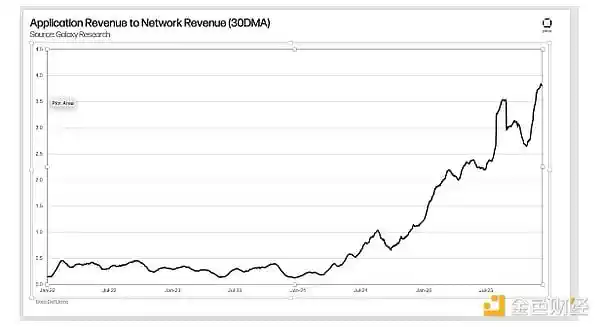
Prediction 6: The ratio of application revenue to network revenue will double in 2026.
As trading, DeFi, wallets, and emerging consumer applications continue to dominate on-chain fee generation, value capture is increasingly shifting away from the base layer. Concurrently, networks are structurally reducing value lost to MEV and pushing fee compression at both L1 and L2 levels, thereby shrinking the revenue base of the infrastructure layer. This will accelerate value capture at the application layer, causing the "fat app theory" to continue leading over the "fat protocol theory".—Lucas Tcheyan (Research Associate, Galaxy Research)
3. Stablecoins and Asset Tokenization
Prediction 7: The U.S. Securities and Exchange Commission (SEC) will provide some form of exemptive relief under its "innovation exemption" program to facilitate the expanded use of tokenized securities in DeFi.
The SEC will provide some form of exemptive relief to foster the development of the on-chain tokenized securities market. This could take the form of a so-called "no-action letter" or under a new type of "innovation exemption"—a concept SEC Chair Paul Atkins has mentioned multiple times. This would allow legitimate, non-wrapped on-chain securities to develop within DeFi markets on public blockchains, rather than just using blockchain technology for back-office capital markets activities (as seen in the recent no-action letter for the Depository Trust & Clearing Corporation). The formal rulemaking initial phase will begin in the second half of 2026, aiming to codify rules for brokers, dealers, exchanges, and other traditional market participants using crypto assets or tokenized securities.—Alex Thorn (Head of Research, Galaxy Research)
Prediction 8: The U.S. Securities and Exchange Commission (SEC) will face litigation from traditional market participants or industry groups over its innovation exemption policy.
Some participants in traditional finance or banking—whether trading firms, market infrastructure providers, or lobbying organizations—will challenge the regulator for providing exemptive treatment to DeFi applications or crypto companies regarding rules for tokenized securities, rather than advancing full rulemaking.—Alex Thorn (Head of Research, Galaxy Research)
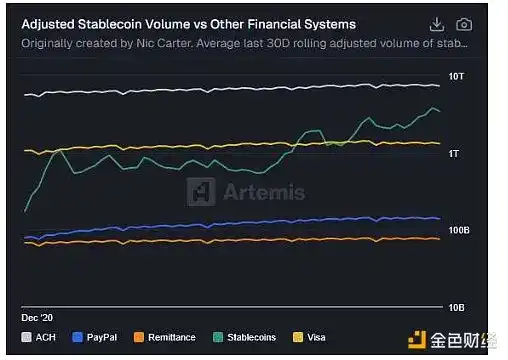
Prediction 9: Stablecoin transaction volume will exceed that of the Automated Clearing House (ACH).
Stablecoin velocity has consistently remained significantly higher compared to traditional payment methods. We have observed stablecoin supply growing at a sustained 30%-40% compound annual growth rate (CAGR), with transaction volume climbing in tandem. Stablecoin transaction volume has already surpassed major credit card networks like Visa and currently processes about half the volume of the Automated Clearing House (ACH). As the specifics of the GENIUS Act become clear in early 2026, we are likely to see stablecoin growth accelerate beyond its historical average CAGR—with existing stablecoins continuing to scale and new entrants vying for a share of the growing market.—Thad Pinakiewicz (Vice President, Researcher, Galaxy Research)
Prediction 10: Consolidation will occur among stablecoins partnering with traditional financial institutions.
Although many US stablecoins emerged in 2025, the market cannot support a large number of widely used options. Consumers and merchants will not use multiple digital dollars simultaneously; they will ultimately gravitate towards the one or two with the broadest acceptance. We already see this consolidation trend in the partnership models of major institutions: nine major banks—Goldman Sachs, Deutsche Bank, Bank of America, Santander, BNP Paribas, Citigroup, MUFG, TD Bank Group, and UBS—are exploring issuing stablecoins denominated in G7 currencies, while PayPal's PYUSD, launched in partnership with Paxos, combines a global payment network with a regulated issuer. These cases show that success depends on distribution scale: the ability to access banks, payment processors, and corporate platforms. Expect more stablecoin issuers to partner with each other or consolidate systems to compete for meaningful market share.—Jianing Wu (Research Associate, Galaxy Research)
Prediction 11: A mainstream bank/broker will accept tokenized stock as collateral.
Tokenized stock remains on the fringes, largely confined to DeFi experiments and private chain pilots led by large banks. However, core infrastructure providers in traditional finance are accelerating their migration to blockchain-based systems, and regulators are increasingly signaling support. In the next year, we are likely to see a mainstream bank or broker begin accepting on-chain tokenized stock as deposits and treating it equivalently to traditional securities.—Thad Pinakiewicz (Vice President, Researcher, Galaxy Research)
Prediction 12: Card networks will connect to public blockchain channels.
At least one of the top three card networks globally will process over 10% of its cross-border settlement volume via public chain stablecoins in 2026, even though the vast majority of end-users will not interact directly with a crypto interface. Issuers and acquirers will continue to display balances and debts in traditional formats, but in the backend, a significant portion of net settlement between regional entities will occur via tokenized dollars to shorten cut-off times, reduce prefunding requirements, and lessen correspondent bank risk. This development will position stablecoins as core financial infrastructure for existing payment networks.—Christopher Rosa (Research Analyst, Galaxy Research)
4. DeFi
Prediction 13: By the end of 2026, decentralized exchanges will account for over 25% of total spot trading volume.
Although centralized exchanges (CEXs) still dominate in terms of new user liquidity and on-ramps, several structural changes are driving an increasing share of spot trading activity on-chain. The two most significant advantages of decentralized exchanges are KYC-free access and a more economically efficient fee structure, both of which are growing in appeal for users and market makers seeking lower friction and higher composability. Currently, depending on the data source, DEXs account for approximately 15%-17% of spot trading volume.—Will Owens (Research Analyst, Galaxy Research)
Prediction 14: Over $500 million in DAO treasury assets will be fully managed by Futarchy governance mechanisms.
Building on our prediction a year ago—that futarchy would gain broader adoption as a governance model—we believe the mechanism has now demonstrated sufficient practical effectiveness that Decentralized Autonomous Organizations (DAOs) will begin using it as the sole decision-making system for capital allocation and strategic direction. Consequently, we expect the amount of DAO-owned capital managed via futarchy to exceed $500 million by the end of 2026. Currently, approximately $47 million in DAO treasury funds are fully managed by this mechanism. We believe growth will come primarily from newly formed futarchy DAOs, but expansion of the treasuries of existing such DAOs will also play a role.—Zack Pokorny (Research Associate, Galaxy Research)
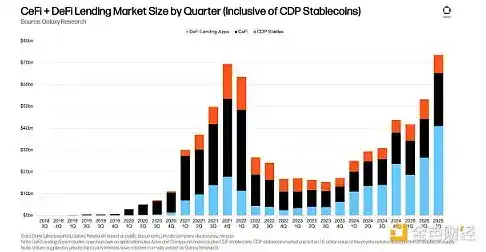
Prediction 15: Total outstanding cryptocurrency-based loans (based on quarter-end snapshots) will exceed $90 billion.
Building on the growth momentum of 2025, the total outstanding loan value in cryptocurrency collateral, across both DeFi and CeFi, will continue to expand in 2026. As institutional participants increasingly rely on DeFi protocols for lending activities, on-chain dominance (i.e., the share of loans originating from decentralized platforms) will continue to rise.—Zack Pokorny (Research Associate, Galaxy Research)
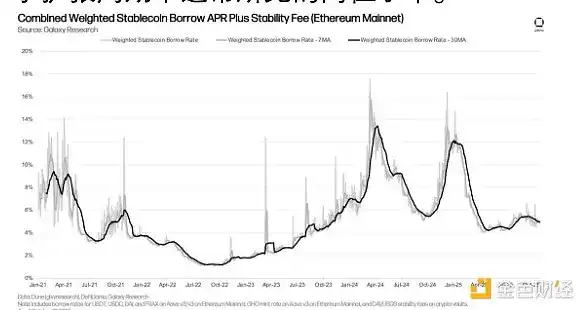
Prediction 16: Stablecoin interest rate volatility will remain subdued, with borrowing costs through DeFi applications not exceeding 10%.
As institutional participation in the on-chain lending market increases, we expect interest rate volatility to decrease significantly due to deepening liquidity and increased capital stickiness (lower turnover). Simultaneously, arbitrage between on-chain and off-chain rates continues to become more accessible, while the barriers to accessing DeFi are rising. With off-chain rates expected to trend downward in 2026, on-chain borrowing rates should remain low even in a bull market environment—with off-chain rates providing a key floor. The core logic is: (1) institutional capital brings stability and persistence to DeFi markets; (2) a declining off-chain rate environment will anchor on-chain rates below the high levels typically seen in expansion cycles.—Zack Pokorny (Research Associate, Galaxy Research)
Prediction 17: By the end of 2026, the total market capitalization of privacy coins will exceed $100 billion.
Privacy coins gained significant market attention in Q4 2025. As investors keep more capital on-chain, on-chain privacy has come into focus. Among the top three privacy coins, Zcash gained approximately 800% in the quarter, Railgun rose about 204%, and Monero saw a more modest 53% gain. Early Bitcoin developers, including the anonymous creator Satoshi Nakamoto, explored ways to make transactions more private or even fully shielded, but practical zero-knowledge technology was not mature or widespread at the time. With more funds held on-chain, users (especially institutions) are questioning whether they truly want their entire crypto asset balance to be public. Whether fully shielded designs or mixing-style solutions ultimately prevail, we expect the total market capitalization of privacy coins to grow from CoinMarketCap's current estimate of $63 billion to over $100 billion.—Christopher Rosa (Research Analyst, Galaxy Research)
Prediction 18: Polymarket's weekly trading volume will consistently exceed $1.5 billion in 2026.
Prediction markets have become one of the fastest-growing categories in crypto, with Polymarket's weekly nominal trading volume approaching $1 billion. We expect this figure to consistently exceed $1.5 billion in 2026, as new capital efficiency layers deepen liquidity and AI-driven order flow increases trading frequency. Polymarket's continuously optimized distribution channels will also continue to accelerate capital inflows.—Will Owens (Research Analyst, Galaxy Research)
5. Traditional Finance
Prediction 19: The U.S. will launch over 50 spot altcoin ETFs, plus another 50 crypto asset ETFs (excluding spot single-asset products).
Following the SEC's approval of a generic listing standard, we expect the pace of spot altcoin ETF launches to accelerate in 2026. In 2025, we already saw over 15 spot ETFs based on Solana, XRP, Hedera, Dogecoin, Litecoin, and Chainlink come to market. We expect the remaining major assets we have identified to follow suit with their own spot ETF filings. Beyond single-asset products, we also anticipate the launch of multi-asset crypto ETFs and leveraged crypto ETFs. Given that over 100 filings are currently in the queue, a continuous stream of new products is expected throughout 2026.—Jianing Wu (Research Associate, Galaxy Research)
Prediction 20: Net inflows into U.S. spot crypto ETFs will exceed $50 billion.
Having achieved $23 billion in net inflows in 2025, we expect this number to accelerate in 2026 as institutional adoption deepens. As major wirehouses lift restrictions on advisors recommending these products and previously hesitant large platforms (like Vanguard) begin to include crypto funds, Bitcoin and Ethereum ETFs alone should surpass 2025 inflow levels simply by entering more investor portfolios. Furthermore, the launch of a large number of new crypto ETFs, particularly spot altcoin products, will release pent-up demand and drive incremental inflows, especially during the initial distribution phase.—Jianing Wu (Research Associate, Galaxy Research)
Prediction 21: A mainstream asset allocation platform will include Bitcoin in its standard model portfolio.
After three of the four major wirehouses (Wells Fargo, Morgan Stanley, and Bank of America) lifted restrictions on advisors recommending Bitcoin to clients and endorsed allocation ranges of 1%-4%, the next step is inclusion on recommended lists and formal research coverage, which would significantly increase client awareness. The final step is entry into model portfolios, which typically requires higher fund Assets Under Management (AUM) and consistent liquidity, but we expect Bitcoin funds to cross these thresholds and enter model portfolios with a strategic weight of 1%-2%.—Jianing Wu (Research Associate, Galaxy Research)
Prediction 22: Over 15 crypto companies will conduct an Initial Public Offering (IPO) or uplist in the United States.
In 2025, 10 crypto-related companies (including Galaxy) successfully completed IPOs or uplistings in the US. Since 2018, over 290 crypto and blockchain companies have completed private funding rounds exceeding $50 million, and we believe a significant number of these are now positioned to seek US public listings for access to US capital markets, especially in a more lenient regulatory environment. Among the most likely candidates, we expect CoinShares (if completed in late 2025), BitGo (application submitted), Chainalysis, and FalconX to advance towards an IPO or uplisting in 2026.—Jianing Wu (Research Associate, Galaxy Research)
Prediction 23: Five or more Digital Asset Treasuries (DATs) will be forced to sell assets, be acquired, or shut down completely.
In Q2 2025, we witnessed a wave of DAT formations. Starting in October, their price-to-net-asset-value multiples began to compress. At the time of writing, the average price-to-book ratio for Bitcoin, Ethereum, and Solana DATs trades below 1. Following the frenzy of companies across industries converting into DATs to leverage favorable market financing conditions, the next phase will distinguish DATs with sustainable competitiveness from those lacking a clear strategy or asset management capabilities. To succeed in 2026, DATs will need sound capital structures, innovative approaches to liquidity management and yield generation, and tight synergy with relevant protocols (if such a relationship doesn't already exist). Scale advantages (like Strategy's large Bitcoin holdings) or jurisdictional positioning (like Japan's Metaplanet) may provide additional edges. However, many DATs that rushed to market during the initial hype lack substantive strategic planning. These DATs will struggle to maintain their price-to-book ratios and may therefore be forced to liquidate assets, be acquired by larger players, or, in the worst case, shut down completely.—Jianing Wu (Research Associate, Galaxy Research)
6. Policy
Prediction 24: Some Democrats will take up "debanking" as an issue—and might see cryptocurrency as a solution.
This prediction has a lower probability of materializing, but consider the context: In late November, the Financial Crimes Enforcement Network (FinCEN) urged financial institutions to "remain vigilant in monitoring, identifying, and reporting suspicious activity related to cross-border funds transfers involving illegal immigration." While FinCEN's alert highlighted risks like human trafficking and drug smuggling, it also noted that Money Services Businesses' (MSBs') responsibility to file Suspicious Activity Reports (SARs) "includes cross-border funds transfers derived from illegal employment." This could involve remittances from undocumented plumbers, farm workers, or service staff—immigrant groups whose employment violates federal law but garners sympathy from left-leaning voters. This alert followed a Geographic Targeting Order (GTO) issued by FinCEN earlier in the year requiring MSBs to automatically report cash transactions as low as $1,000 in designated border counties (far below the $10,000 threshold for Currency Transaction Reports). These measures expand the range of everyday financial behaviors that could trigger federal reporting, increasing the likelihood that immigrants and low-wage workers face frozen funds, denied payments, or other forms of financial exclusion. Consequently, this could make some immigration-supportive Democrats more receptive to the issue of "debanking" (recently a concern primarily of the right) and more open to permissionless, censorship-resistant financial networks. Conversely, for the same reasons, populist, pro-bank, and law-and-order Republicans might begin to view cryptocurrency negatively—despite strong support for the industry from the Trump administration and reformists within the GOP. The continued push by federal banking regulators to modernize Bank Secrecy Act and Anti-Money Laundering compliance requirements will only further highlight the inherent tension between the policy goals of financial inclusion and crime reduction—a tension different political factions will prioritize differently. If this political realignment materializes, it would prove that blockchain does not have a fixed political base. Its permissionless design means acceptance or opposition is not ideological but depends on how it impacts different groups' political priorities at different times.—Marc Hochstein (Vice President, Editor, Galaxy Research)
Prediction 25: A federal investigation will emerge concerning insider trading or match-fixing within prediction markets.
As US regulators greenlight on-chain prediction markets, their trading volume and open interest have surged dramatically. Concurrently, multiple alleged scandals involving the use of insider information for front-running and federal raids on match-fixing rings targeting major sports leagues have occurred. Because traders can participate anonymously rather than through KYC-required betting platforms, insiders now face greater temptation to abuse privileged information or manipulate outcomes. Consequently, we are likely to see investigations triggered by anomalous price movements in on-chain prediction markets, rather than traditional monitoring of regulated sportsbooks.—Thad Pinakiewicz (Vice President, Researcher, Galaxy Research)
7. AI
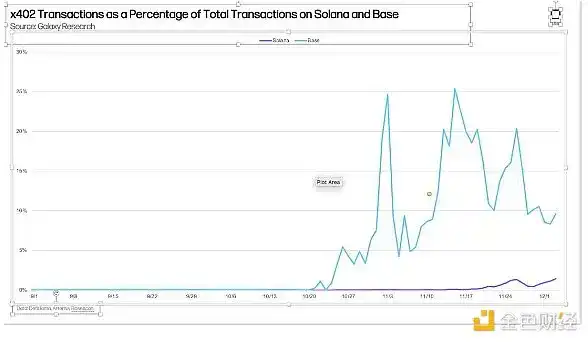
Prediction 26: Payments utilizing the x402 standard will account for 30% of daily transactions on Base and 5% of non-vote transactions on Solana in 2026, marking broader use of on-chain channels for agent interactions.
Improvements in agent capabilities, the continued proliferation of stablecoins, and better developer tools will open the door for x402 and other agent payment standards to drive a larger share of on-chain activity. As AI agents increasingly transact autonomously between services, standardized payment primitives will become a core component of the execution layer. Base and Solana have emerged as leading public chains in this vertical—Base due to Coinbase's role in creating and promoting the x402 standard, and Solana due to its vast developer community and user base. Furthermore, as agent-driven commerce grows, we also expect emerging payment-focused chains like Tempo and Arc to experience rapid growth.—Lucas Tcheyan (Research Associate, Galaxy Research)