In a Losing Bear Market, Who Is Quietly Making a Fortune?

marsbitОпубліковано о 2026-04-10Востаннє оновлено о 2026-04-10

Анотація

In a bear market where most crypto participants are losing money, a few projects continue to generate significant revenue. A look at Defillama’s revenue rankings reveals that profitable projects share simple and clear revenue models, which fall into two main categories: spread and transaction fees. Spread-based revenue models, used by entities like Tether, Circle, Aave, and Lido, act as capital intermediaries. They profit from the difference between lower funding costs and higher returns from deployed capital, relying on the scale and duration of capital deposits. Transaction fee models, employed by platforms such as Hyperliquid, Polymarket, pump.fun, Aerodrome, and Jupiter, generate income by charging fees on trading activities. Their earnings depend on the size and frequency of transactions. Notable cases include Grayscale (traditional asset management fees), Chainlink (data service fees), and Titan Builder (which profited unusually from a major arbitrage incident). The analysis concludes that sustainable profitability in a bear market comes from straightforward revenue models combined with sophisticated product execution and operational excellence.

Author|Azuma(@azuma_eth)

The market continues to slump, with funds underperforming, protocols shutting down, whales staying silent, and retail investors bleeding... It seems like everyone from top to bottom in the industry is losing money. However, even in such a cold market environment, a very few projects are still running their money-printing machines at full throttle.

The latest example is Polymarket, which has fully opened its fee gates. Since recently expanding its fee scope and modifying its fee formula (Recommended reading: "Hardcore Analysis of Polymarket's Fee Formula: How Did the Extreme Rate of 90+% Pop Out?"), Polymarket's revenue generation capability has significantly surged; as of publication, Polymarket's total fee income has exceeded $24 million, with a single-day record of $1.5 million in revenue on April 2.
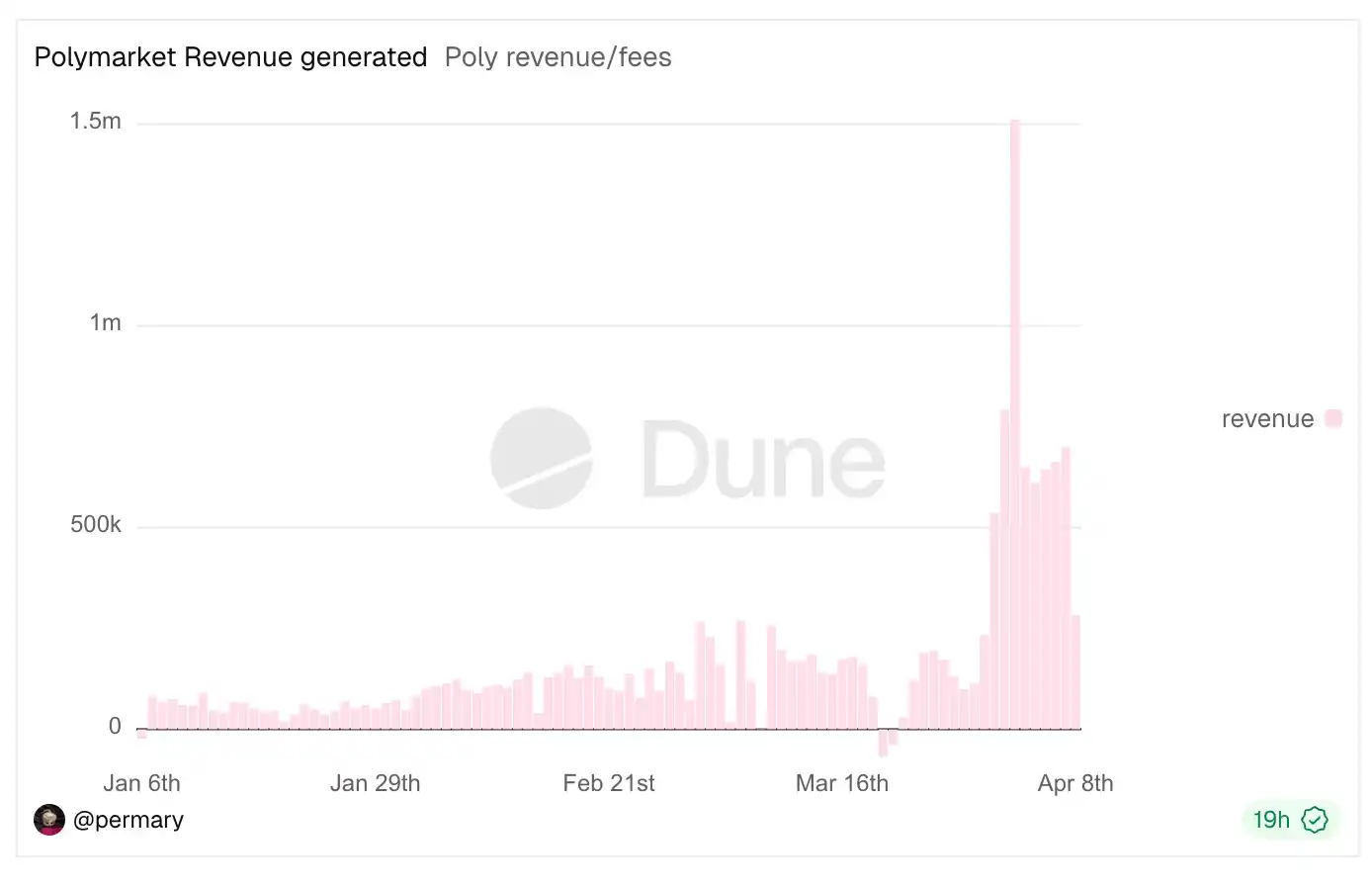
Taking this opportunity, the author checked the revenue rankings on Defillama to see which businesses are still making steady profits in the bear market, and the results were quite surprising: The core businesses and revenue sources of the listed projects are quite clear, even "simple."
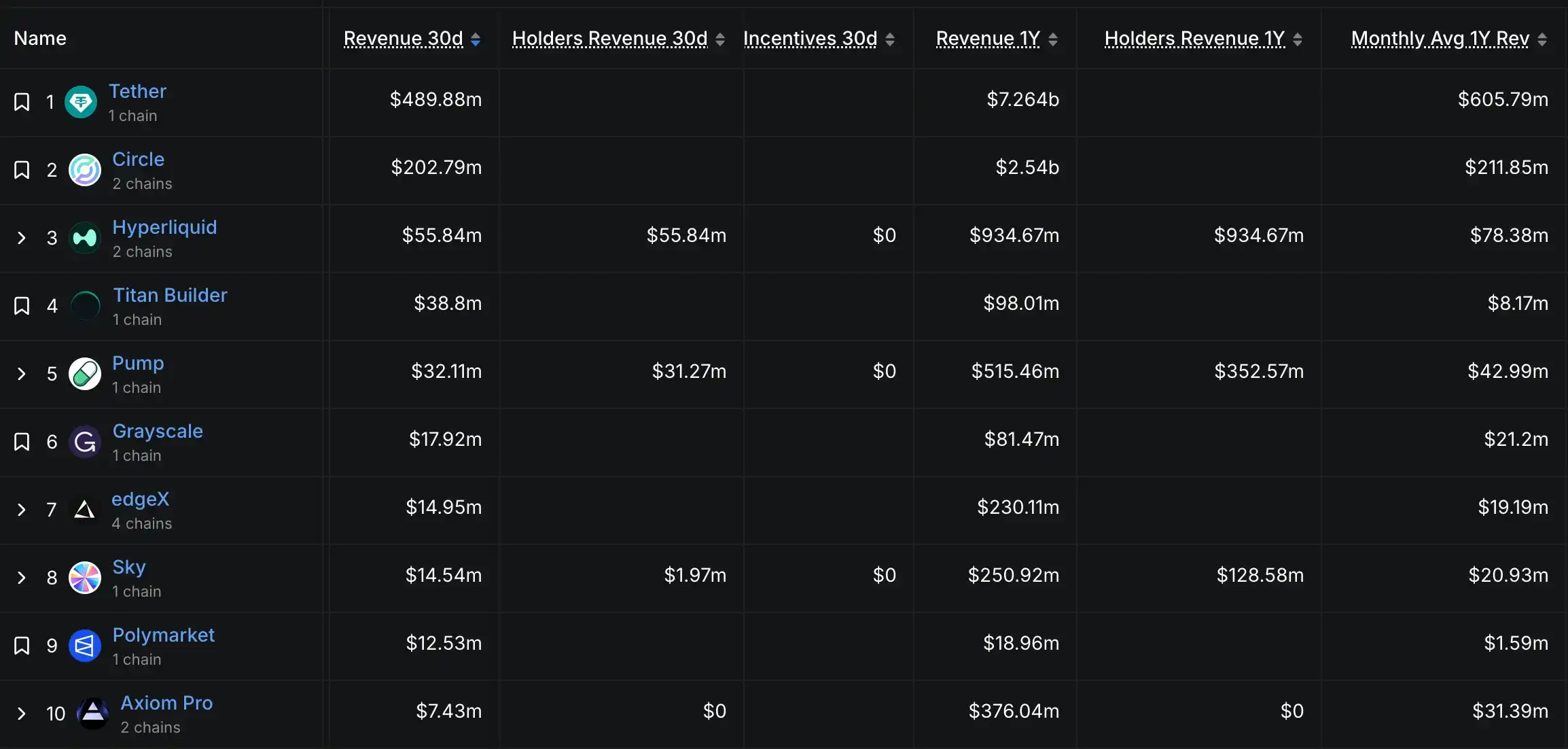
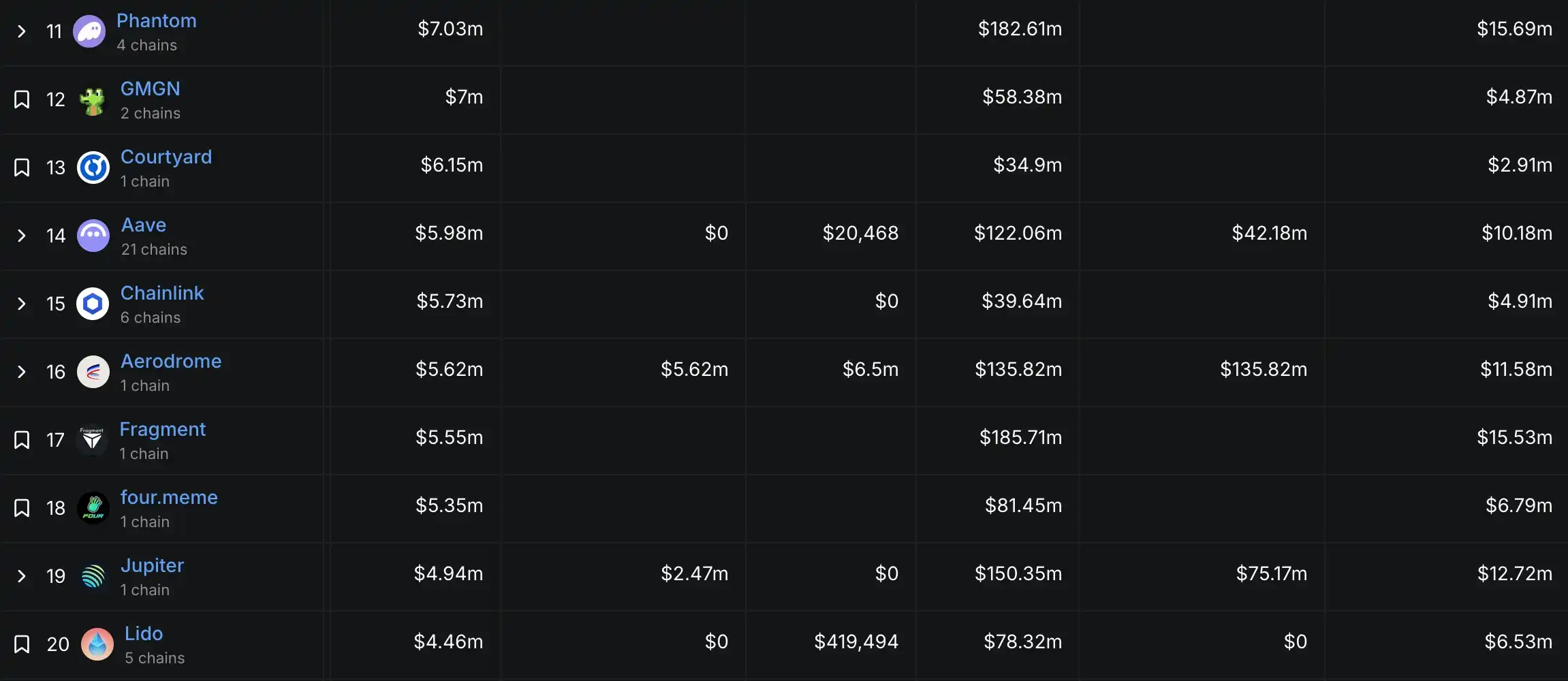
As shown above, I believe most players deeply involved in the crypto market could guess most of these names even without looking at the answers, and probably know exactly what they do. But when these names are neatly listed together, I suddenly realized that the main revenue sources of these profitable businesses are highly convergent, and can basically be summarized into two major categories: one is interest spread, and the other is transaction tax (fees).

First is interest spread, which is essentially acting as a "capital intermediary." The core logic is to absorb funds at a relatively low cost while deploying funds at a relatively high yield, using time to gradually accumulate the difference between the yield and the cost — the profit of such businesses depends on the scale and duration of the capital沉淀 (sedimentation), the larger the scale and the longer the time, the higher the profit.

Stablecoin issuers like Tether and Circle fall into this category. Their main income comes from the interest generated by deploying reserve funds into assets like U.S. Treasury bonds, while the costs mainly involve subsidies paid to partners and users. The difference between the two is the profit. Lending protocols like Aave also belong here; the spread is the difference between the relatively higher borrowing rate and the relatively lower deposit rate. Liquid staking services (LST) like Lido are no exception; they withhold a certain percentage from the native staking rewards as a service fee, which is also a form of interest spread.

Next is transaction tax. This type of business is easier to understand. As long as transaction-related activities (including token creation) occur, the business entity can "levy a tax" in the form of fees on each activity — the profit of such businesses depends on the transaction size per activity and the frequency of activities. The larger the size and the higher the frequency, the higher the profit.

Whether it's Hyperliquid and EdgeX focusing on perpetual contract trading, Polymarket focusing on event trading, pump.fun, GMGN, Axiom, and four.meme focusing on Meme trading, Aerodrome, Jupiter, and Phantom (whose main revenue comes from Swap fees on the wallet frontend) focusing on spot trading, or Courtyard and Fragment focusing on NFT trading (it's quite a surprise this category made the list), their primary revenue source is transaction tax.

The only few special cases in the rankings are Grayscale, Chanilink, and Titan Builder. Grayscale seems a bit out of place here; its core revenue comes from ETF and fund management fees, essentially a traditional asset management business focused on the cryptocurrency market. Chanilink is definitely worth mentioning; its main revenue comes from data service fees paid by projects calling its oracle (which can be categorized as a transaction tax to some extent). This is more like a To B on-chain SaaS business, but as you can see, the Matthew Effect in this path is more significant than in other tracks. Titan Builder is purely a sporadic phenomenon. It is a block builder service provider, not normally a particularly lucrative business. The reason it made the list is that Titan Builder got the biggest piece of the pie in last month's massive AAVE transaction sandwiching incident (see "50M USDT for 35K AAVE: How Did the Disaster Happen?").
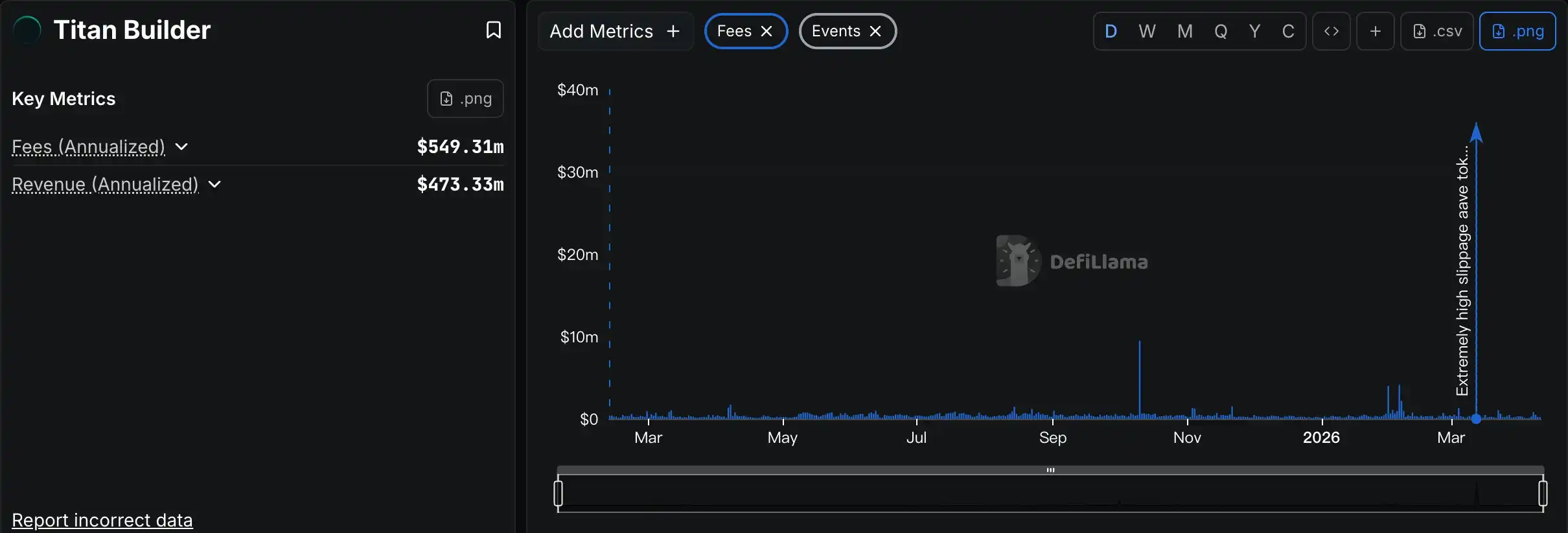
Odaily Note: See what it means to not open for business for three years, but eat for three years when you do.

So the conclusion is clear. The projects that continue to make money in the bear market are not those pursuing complex mechanisms and high-risk opportunities, but those that can operate continuously凭借 (relying on) simple and clear revenue models. In the still volatile cryptocurrency market, simpler revenue models have shown greater resilience and better withstand the test of market fluctuations.

However, a simpler revenue model absolutely does not mean these businesses are "easier to do." On the contrary, behind the simple revenue model often lie more complex product services and精细 (meticulous) operational management. This is where the leading players on the list have truly "competed" their way to differentiation. From interaction design, to liquidity accumulation, to risk management, to user communication and feedback... To stand out in the fierce competition of the存量 (stock) market, one must invest more effort into the product and service.

The crypto winter is not over yet. The projects that can truly survive and even profit are often those that flexibly combine simple revenue models with complex product services. Perhaps, this is the long-term code to穿越 (traverse) bull and bear markets.


Пов'язані питання

QWhat are the two main categories of revenue sources for profitable projects in the crypto bear market, as mentioned in the article?

AThe two main categories are spread (acting as a capital intermediary) and transaction tax (fees).

QWhich project set a single-day revenue record of $1.5 million on April 2nd, according to the article?

APolymarket set a single-day revenue record of $1.5 million on April 2nd.

QWhat is the core revenue source for stablecoin issuers like Tether and Circle, as explained in the article?

ATheir core revenue comes from the interest earned by deploying reserve funds into assets like U.S. Treasury bonds, minus the costs of subsidies to partners and users.

QName one project whose revenue primarily comes from data service fees for oracle calls, as highlighted in the article.

AChanilink primarily earns revenue from data service fees charged for project oracle calls.

QWhat does the article suggest is the key to surviving and profiting in the crypto bear market?

AThe key is combining simple revenue models with complex product services and refined operational management.

Пов'язані матеріали

Must-Watch Events Next Week|CLARITY Act Could Face Senate Vote; SpaceX, Circle to Report Earnings (8.3-8.9)

**Summary: Key Events and Developments to Watch (August 3-9)** The upcoming week is marked by significant financial disclosures, key legislative deadlines, and notable product updates. **Major Financial Events:** Several companies are scheduled to release their Q2 2026 earnings. American Bitcoin (ABTC) will report on August 3, followed by SpaceX and Hut 8 Mining Corp. on August 4, and Circle on August 5. Notably, a significant portion of SpaceX shares (up to 12% of total shares) will be unlocked on August 6 following their earnings release. **Key Legislative Deadline:** The U.S. Senate faces an August 7 deadline to secure 60 votes for the CLARITY Act, a bipartisan bill aiming to establish a federal regulatory framework for cryptocurrencies. The Senate may hold a full vote on the bill during the week. **Economic Data:** The U.S. July Non-Farm Payrolls report will be released on August 7, providing crucial labor market data. **Technology & Product Updates:** * **Shutdowns:** DeFi portfolio tracker Zapper and wallet app Ctrl Wallet will cease operations on August 3. * **Upgrades:** LayerZero will deprecate its v1 relayers on August 3. XRP Ledger's new version 3.3.0, featuring five new functions, is expected next week. * **AI:** Elon Musk announced that the advanced Grok 4.6 AI model is set for release around August 7. * **Bitcoin:** The BIP-110 forced signaling for a potential Bitcoin network change is scheduled to begin around August 8. **Other Notable Events:** Chinese robotics firm Unitree Tech has set its preliminary price inquiry for its IPO for August 5. South Korean exchange Upbit will delist AQT and AERGO tokens on August 3.

marsbit1 год тому

Must-Watch Events Next Week|CLARITY Act Could Face Senate Vote; SpaceX, Circle to Report Earnings (8.3-8.9)

marsbit1 год тому

Stocks Are Plummeting More Sharply Than Cryptocurrencies. Where Has the Money Gone?

Stock Markets Plunge Deeper Than Cryptocurrencies: Where Did the Money Go? In late July, Seoul's Kospi index triggered circuit breakers for two consecutive days, plummeting over 40% from its June high. The collapse was led by heavyweight stocks like SK Hynix, whose record profits still disappointed investors, and devastating leveraged ETFs, with one major product losing over 83% of its value. This signaled a global, forced deleveraging targeting the most crowded trades. Interestingly, while stocks exhibited extreme volatility akin to crypto markets, Bitcoin rose nearly 15% in July after a prior steep drop. Analysis shows the money fleeing equities did not flow into Bitcoin. Instead, Bitcoin had already absorbed its sell-off in May-June, when U.S. spot Bitcoin ETFs saw historic outflows. The true safe-haven beneficiary was gold, whose price rose over 20% year-on-year, highlighting a decoupling between Bitcoin and gold as "digital gold." The sell-off was a targeted unwinding of leveraged positions in tech and semiconductors, accelerated by broker-dealer risk management and shifts in the AI narrative, including new competition from Chinese memory chipmakers. The retreat path was clear: from high-valuation tech stocks to cash and U.S. Treasuries, then to gold. For Bitcoin to attract sustained institutional inflows, conditions like eased global liquidity pressure, a "soft-landing" Fed rate cut, and U.S. regulatory clarity via legislation like the stalled CLARITY Act are needed. Currently, Bitcoin is not a safe haven but an already-cleared asset. Its low correlation with tech stocks, however, makes it a potential diversification play for institutional portfolios once the storm passes. The money isn't here yet, but the positioning is underway.

marsbit1 год тому

Stocks Are Plummeting More Sharply Than Cryptocurrencies. Where Has the Money Gone?

marsbit1 год тому

In Conversation with Ray Dalio: We Are Currently in an AI Bubble, with 1% of My Portfolio in Bitcoin

Ray Dalio, founder of Bridgewater Associates, warns in an interview that the current AI boom shows classic bubble characteristics, which could lead to significant economic downturns as seen in past cycles like 1929 or 2000. He explains that speculative enthusiasm, fueled by debt and overvaluation, often precedes a crash when rising rates or taxation force asset sales, causing widespread losses and recession. Dalio also outlines his "Big Cycle" theory, describing an approximate 80-year pattern where widening wealth gaps, massive government deficits, and shifting geopolitical power (like China's rise) create internal conflict and global instability. He emphasizes that we are in a late-cycle, transitional phase where traditional powers like the US and UK face decline. For personal wealth protection, Dalio advises diversification beyond cash into assets like stocks, bonds, real estate, and particularly gold, which he prefers over Bitcoin. While he holds about 1% of his portfolio in Bitcoin as a non-printable hard asset, he views gold as more secure from technological or governmental threats. Regarding AI's impact, Dalio believes it will disproportionately benefit capital owners, worsening inequality by replacing both physical and cognitive labor. He suggests that human intuition and emotional intelligence, combined with AI, will be key for future workers. On taxation, Dalio argues that wealth taxes are impractical and risk triggering asset sell-offs, reducing productive investment. He points to the UK as a cautionary example of debt, low productivity, and political strife. Geopolitically, Dalio foresees a more regionalized world, with the US showing weakness in prolonged conflicts like with Iran, akin to past imperial declines. The ideal outcome, he suggests, is coexisting powerful blocs (e.g., Americas, China-Asia Pacific) without major war.

marsbit5 год тому

In Conversation with Ray Dalio: We Are Currently in an AI Bubble, with 1% of My Portfolio in Bitcoin

marsbit5 год тому

Торгівля

Спот
活动图片




