World Liberty Financial says, ‘We are nowhere near liquidation’ – But fears remain

ambcryptoОпубліковано о 2026-04-10Востаннє оновлено о 2026-04-10

Анотація

World Liberty Financial (WLFI), backed by the Trump family, has dismissed concerns over its borrowing activities as unfounded "FUD." The DeFi project admitted to being a major borrower and supplier on WLFI Markets, using 5 billion WLFI tokens (worth $429 million) from its treasury as collateral to borrow over $75 million in USDC. This move drained the platform’s liquidity and raised fears of bad debt and contagion risk. WLFI defended its actions, stating it is "nowhere near liquidation" and can supply more collateral if needed. Additionally, concerns persist over upcoming token unlocks, with 70% of WLFI supply still locked. The token has dropped 15% amid the uncertainty, and analysts warn unlocks could trigger further selling pressure.

The Trump family-backed World Liberty Financial [WLFI] has dismissed recent criticism against its borrowing spree as a ‘wrong FUD.’

The DeFi project admitted that it is one of the largest suppliers and borrowers on the Dolomite-powered WLFI Markets.
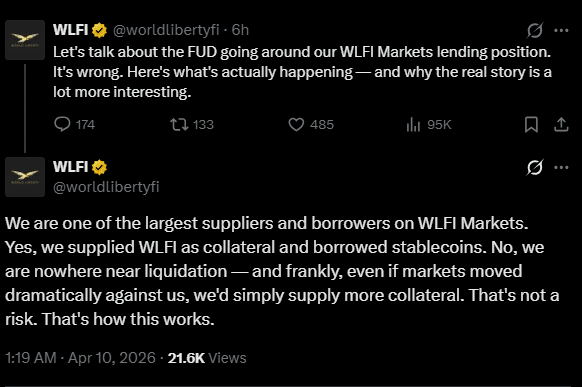
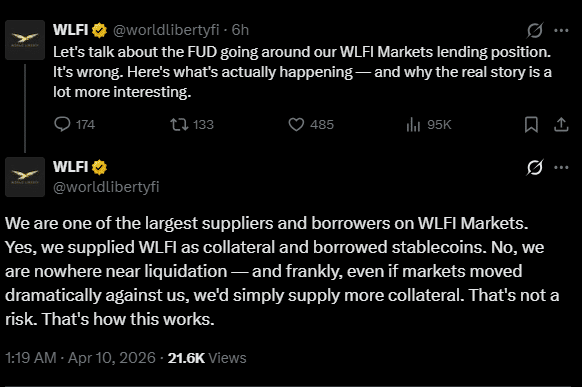
Source: X/WLFI

According to the project, the ongoing liquidation fears were unwarranted, adding that,

We are nowhere near liquidation — and frankly, even if markets moved dramatically against us, we’d simply supply more collateral.

WLFI team countered that whatever they are doing is ‘not risk,’ reminding critics that ‘that’s how this works.’

Why the community is uneasy with WLFI

The community backlash against the DeFi project began after on-chain data revealed that it deposited 3 billion WLFI tokens as collateral into the lending platform WLFI Markets.

As of writing, the collateral was increased to 5 billion WLFI tokens (worth $429M), all from its treasury.
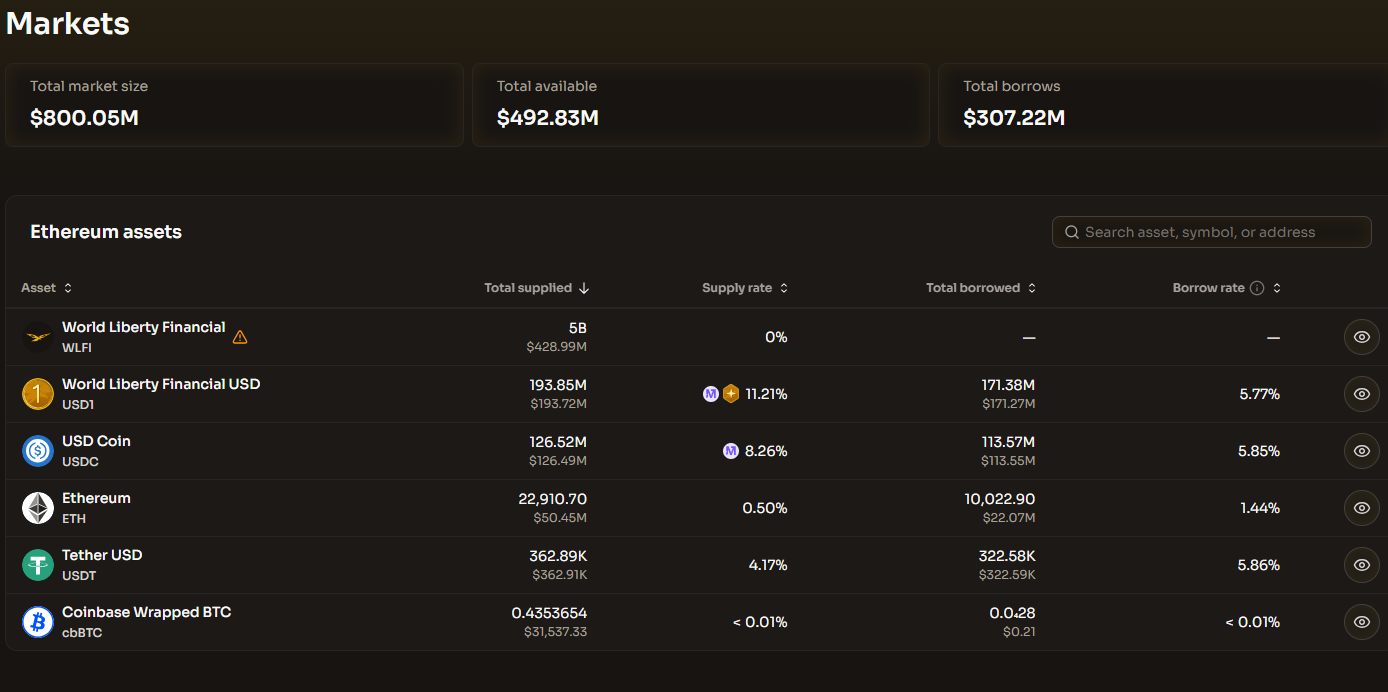
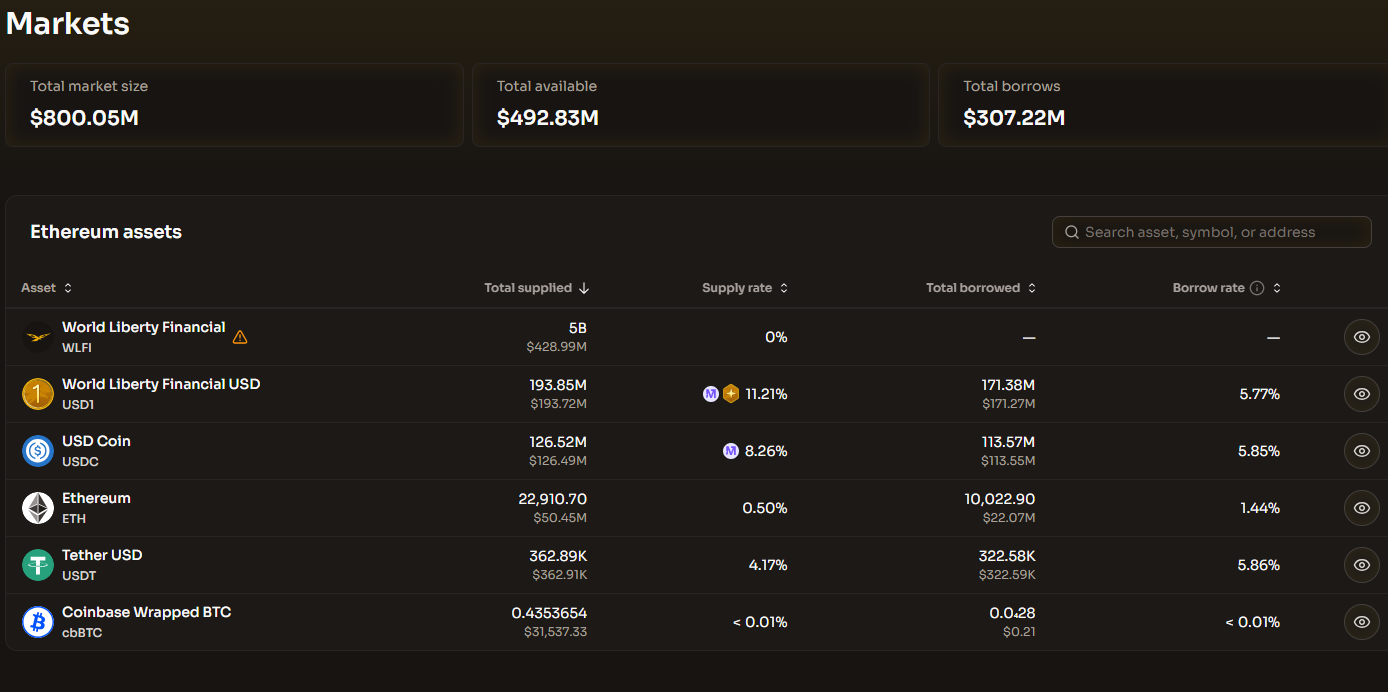
Source: WLFI

Against this collateral, the project borrowed over $75 million of USDC. The result? This drove WLFI Markets’ USDC lending rates to a lucrative 13.5%, but also drained the liquidity pool.

Consequently, those who invested in Dolomite couldn’t withdraw their funds unless the largest borrower, WLFI, repaid the loan.

This sparked more outcry as analysts warned that this could end up being a bad debt. Additionally, it could trigger contagion risk for WLFI token holders, as one user puts it,

Don’t be exit liquidity for Trump’s cartel: Those loans will likely never be repaid. When Trump leaves office, or even after the midterms if Republicans lose, $WLFI will dump, and Dolomite will be stuck with bad bet.

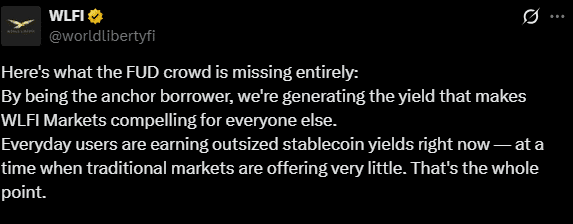
In its defense, the project said it took the massive loan to drive “outsized, compelling yield for everyone.”
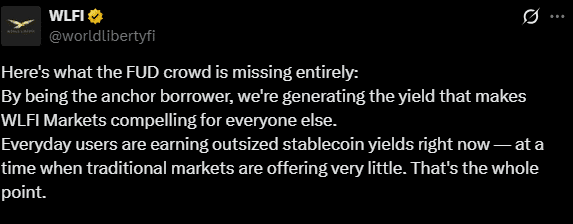
Source: X

Will the unlocks crash WLFI?

Another contention was uncertainty on WLFI token unlocks, especially for early and long-term investors to recoup their investment.

However, the project clarified that there will be a vote next week for a ‘structured, phased approach’ for the unlocks.

Currently, about 70% of the WLFI supply is locked, and only 31 billion tokens are circulating out of the max supply of 100 billion. Amid the rising scrutiny on the project, the early investors will likely dump their holdings when they are unlocked.

In the past three days, the altcoin has dropped by 15% to a yearly low of $0.081 as the FUD intensified. Unless there is a strong incentive to hold the token, the expected unlocks could send WLFI lower.


Final Summary

  • World Liberty Financial clarified that its massive loan, borrowed against 5 billion WLFI tokens, was not a risk, but ‘how things work.’
  • Market watchers warned that the proposed WLFI unlocks could add more selling pressure on the altcoin.


Пов'язані питання

QWhat is World Liberty Financial's response to the recent criticism regarding its borrowing activities?

AWorld Liberty Financial dismissed the criticism as 'wrong FUD' and stated that their actions are 'not risk' but rather 'how this works.' They emphasized they are nowhere near liquidation and could supply more collateral if needed.

QHow much in USDC did WLFI borrow against its collateral, and what was the impact on the lending platform?

AWLFI borrowed over $75 million in USDC against 5 billion WLFI tokens (worth $429 million) as collateral. This drove the USDC lending rates on WLFI Markets to 13.5% but drained the liquidity pool, preventing other investors from withdrawing their funds.

QWhy is the community concerned about WLFI's token unlocks?

AThe community is concerned because about 70% of the WLFI supply is locked, and early investors might dump their holdings when tokens are unlocked, potentially causing the price to drop further. The token has already fallen 15% to a yearly low due to ongoing FUD.

QWhat did critics warn could happen if WLFI's token price drops significantly?

ACritics warned that if the WLFI token price dumps, especially after political events like Trump leaving office or Republicans losing midterms, it could result in bad debt for Dolomite and contagion risk for token holders, as the loans might never be repaid.

QWhat action does WLFI plan to take regarding the unlocked tokens?

AWLFI plans to hold a vote next week for a 'structured, phased approach' to manage the token unlocks, aiming to address concerns and potentially mitigate selling pressure on the altcoin.

Пов'язані матеріали

Will the Next Crypto Bull Run Start with On-Chain Trading of SpaceX?

This article presents a scenario-based forecast for the crypto industry from 2026 to 2029, arguing that the next major cycle will be driven not by technological narratives but by legal access to real-world assets. The author predicts that by mid-2026, pre-IPO perpetual contracts for top private companies like SpaceX, OpenAI, and Anthropic on platforms like Hyperliquid will become the primary gateway for accessing quality assets, as most crypto-native tokens fail to capture real value. The much-hyped AI x Crypto intersection largely fails except for prediction markets, which thrive on betting on AI model supremacy. By 2027, public blockchain foundations are forced to choose between catering to retail speculation or building compliant infrastructure for institutions, with many opting for the latter. Growth in stablecoins and tokenized private credit/equity hits a "triple ceiling" due to regulatory and political uncertainty rather than market demand. The pivotal shift is forecast for 2028. A major liquidation event in pre-IPO perpetuals exposes the structural flaw of synthetic markets lacking a real underlying asset anchor. In response, regulatory changes finally allow the public solicitation of private securities resales to verified accredited investors. This creates a legitimate secondary market for real company equity, which then becomes the core asset class of the new bull market, relegating synthetic perps to a niche role. By 2029, the industry becomes "boring" but foundational. Tokens without claims on real cash flows or assets cease trading. Stablecoin growth is steady but politically capped. Crypto infrastructure fades from view as it gets absorbed into traditional finance backends. The article's central thesis is that the key bottleneck for crypto's next phase is legal and regulatory channels for real asset ownership, not technology.

marsbit1 год тому

Will the Next Crypto Bull Run Start with On-Chain Trading of SpaceX?

marsbit1 год тому

The Value Distribution of Stablecoins

**Summary: The Value Distribution of Stablecoins** The article argues that stablecoins are evolving from mere trading tools into broader channels for dollar access. It divides the stablecoin ecosystem into four layers to analyze how value is distributed: 1. **Issuance Layer:** Mints stablecoins, holds reserve assets, and captures the spread between reserve yield and user costs (e.g., Tether, Circle). This layer currently earns the largest profit margin. 2. **Infrastructure Layer:** Connects stablecoins to the traditional financial system, handling fiat on/off-ramps, banking integration, compliance (KYC/AML), and asset management (e.g., Bridge, BVNK). This is the "unglamorous" but critical work, building the essential bridges between crypto and real-world finance. 3. **Acquiring/Distribution Layer:** Integrates stablecoins into merchant systems, manages payment flows, and provides enterprise financial software (e.g., Stripe, Coinbase). They act as the access point for businesses. 4. **Application Layer:** The end-users and businesses that ultimately use stablecoins for payments, settlements, or as a store of value. They benefit from convenience but have little pricing power. The core thesis is that while the issuance layer currently dominates profits, the often-overlooked **infrastructure layer holds significant long-term potential**. The real challenge and barrier to mass adoption is not the on-chain transfer of stablecoins (which is simple), but the complex "last mile" integration into existing business workflows, banking systems, and regulatory frameworks across different countries. Companies in this layer are currently in a "land grab" phase, investing heavily to build networks, secure bank partnerships, and establish compliance pathways. While their position is currently pressured by the profitable issuers above and distribution platforms below, the article suggests that if stablecoins become a default financial rail for businesses, the infrastructure providers who have done the hard work of integration will ultimately gain strong pricing power and become entrenched, essential players.

marsbit7 год тому

The Value Distribution of Stablecoins

marsbit7 год тому

The Value Distribution of Stablecoins

The Value Distribution of Stablecoins The article argues that stablecoins are evolving from a mere trading tool into a broad "dollar channel." It analyzes the industry's value chain through four layers: 1. **Issuance Layer (e.g., Tether, Circle):** The top layer that mints stablecoins, holds reserve assets, and captures the thickest interest rate spread. 2. **Infrastructure Layer (e.g., Bridge, BVNK):** Connects stablecoins to the traditional financial system, handling critical but complex "dirty work" like fiat on/off-ramps, banking integration, compliance (KYC/AML), and cross-border settlement. 3. **Acquiring/Distribution Layer (e.g., Stripe, Coinbase):** Embeds stablecoins into merchant systems, manages payment flows, and integrates with enterprise software. 4. **Application Layer:** End-users and businesses that ultimately use stablecoins for payments, settlement, or storing value. The author posits that while the issuance layer currently captures the most profit, the most overlooked and potentially critical layer is infrastructure. The core challenge for stablecoin adoption isn't the on-chain transfer (which is simple), but bridging the gap between blockchain and the real-world financial system. This involves solving practical problems for businesses: fiat conversion, reconciliation, tax handling, and user onboarding. Infrastructure companies are currently in a difficult "land-grab" phase—building networks, securing banking relationships, and achieving compliance country-by-country. They face pressure from both the profitable issuance layer above and distribution platforms below. However, the author suggests this layer is building a crucial moat. Once stablecoins become a default business rail, the infrastructure players who have done the hard work of integration may gain significant, durable value and pricing power.

链捕手8 год тому

The Value Distribution of Stablecoins

链捕手8 год тому

Торгівля

Спот
Ф'ючерси

Популярні статті

Як купити WLFI

Ласкаво просимо до HTX.com! Ми зробили покупку Official World Liberty Financial (WLFI) простою та зручною. Дотримуйтесь нашої покрокової інструкції, щоб розпочати свою криптовалютну подорож.Крок 1: Створіть обліковий запис на HTXВикористовуйте свою електронну пошту або номер телефону, щоб зареєструвати обліковий запис на HTX безплатно. Пройдіть безпроблемну реєстрацію й отримайте доступ до всіх функцій.ЗареєструватисьКрок 2: Перейдіть до розділу Купити крипту і виберіть спосіб оплатиКредитна/дебетова картка: використовуйте вашу картку Visa або Mastercard, щоб миттєво купити Official World Liberty Financial (WLFI).Баланс: використовуйте кошти з балансу вашого рахунку HTX для безперешкодної торгівлі.Треті особи: ми додали популярні способи оплати, такі як Google Pay та Apple Pay, щоб підвищити зручність.P2P: Торгуйте безпосередньо з іншими користувачами на HTX.Позабіржова торгівля (OTC): ми пропонуємо індивідуальні послуги та конкурентні обмінні курси для трейдерів.Крок 3: Зберігайте свої Official World Liberty Financial (WLFI)Після придбання Official World Liberty Financial (WLFI) збережіть його у своєму обліковому записі на HTX. Крім того, ви можете відправити його в інше місце за допомогою блокчейн-переказу або використовувати його для торгівлі іншими криптовалютами.Крок 4: Торгівля Official World Liberty Financial (WLFI)Легко торгуйте Official World Liberty Financial (WLFI) на спотовому ринку HTX. Просто увійдіть до свого облікового запису, виберіть торгову пару, укладайте угоди та спостерігайте за ними в режимі реального часу. Ми пропонуємо зручний досвід як для початківців, так і для досвідчених трейдерів.

376 переглядів усьогоОпубліковано 2025.09.01Оновлено 2026.06.02

Як купити WLFI

Обговорення

Ласкаво просимо до спільноти HTX. Тут ви можете бути в курсі останніх подій розвитку платформи та отримати доступ до професійної ринкової інформації. Нижче представлені думки користувачів щодо ціни WLFI (WLFI).

活动图片












