Willy Woo nói rằng các OGs Bitcoin sẽ mua kho báu của Satoshi nếu xảy ra cuộc tấn công lượng tử

cointelegraphОпубліковано о 2025-12-14Востаннє оновлено о 2025-12-14

Анотація

Vào ngày thứ Bảy, một cuộc tranh luận nổ ra trên mạng xã hội về viễn cảnh máy tính lượng tử tấn công và đánh cắp 1 triệu BTC từ ví của Satoshi Nakamoto, sau đó bán ra thị trường. YouTuber Josh Otten dự báo giá BTC có thể lao xuống 3 USD trong kịch bản này. Tuy nhiên, nhà đầu tư Bitcoin lâu năm Willy Woo lạc quan cho rằng các "OG" (người chơi lâu năm) sẽ mua vào mạnh nếu xảy ra sự cố, và mạng lưới Bitcoin sẽ tồn tại vì phần lớn coin không dễ bị tấn công lượng tử ngay lập tức. Woo giải thích rằng khoảng 4 triệu BTC trong các địa chỉ dạng pay-to-public-key (P2PK), bao gồm coin của Satoshi, có thể bị tổn thương vì để lộ public key trên blockchain. Trong khi đó, các loại ví hiện đại an toàn hơn do không tiết lộ public key đầy đủ. Adam Back, đồng sáng lập Blockstream, nhận định mối đe dọa lượng tử còn 20-40 năm nữa mới thành hiện thực, đủ thời gian để áp dụng các tiêu chuẩn mật mã hậu lượng tử. Nhà phân tích James Check đồng tình, cho rằng nguy cơ thực sự là với giá thị trường, vì cộng đồng khó có thể đóng băng coin của Satoshi trước khi chúng bị tấn công và đưa back vào lưu thông.

Một cuộc tranh luận đã nổ ra trên mạng xã hội vào thứ Bảy về những tác động tiềm ẩn của việc máy tính lượng tử hack vào kho Bitcoin (BTC) của Satoshi Nakamoto và sau đó bán tháo những đồng coin đó ra thị trường.

Cuộc tranh luận bắt đầu khi YouTuber Josh Otten chia sẻ một biểu đồ giá về việc BTC lao dốc xuống 3,00 USD và nói rằng điều này có thể xảy ra nếu một máy tính lượng tử đủ mạnh xuất hiện và đánh cắp 1 triệu BTC của người sáng lập Bitcoin ẩn danh Satoshi Nakamoto rồi bán chúng.

“Nhiều OGs sẽ mua vào đợt flash crash đó. Mạng lưới Bitcoin sẽ sống sót; hầu hết các đồng coin không dễ bị tổn thương ngay lập tức,” Willy Woo, một người nắm giữ Bitcoin lâu năm, cho biết.
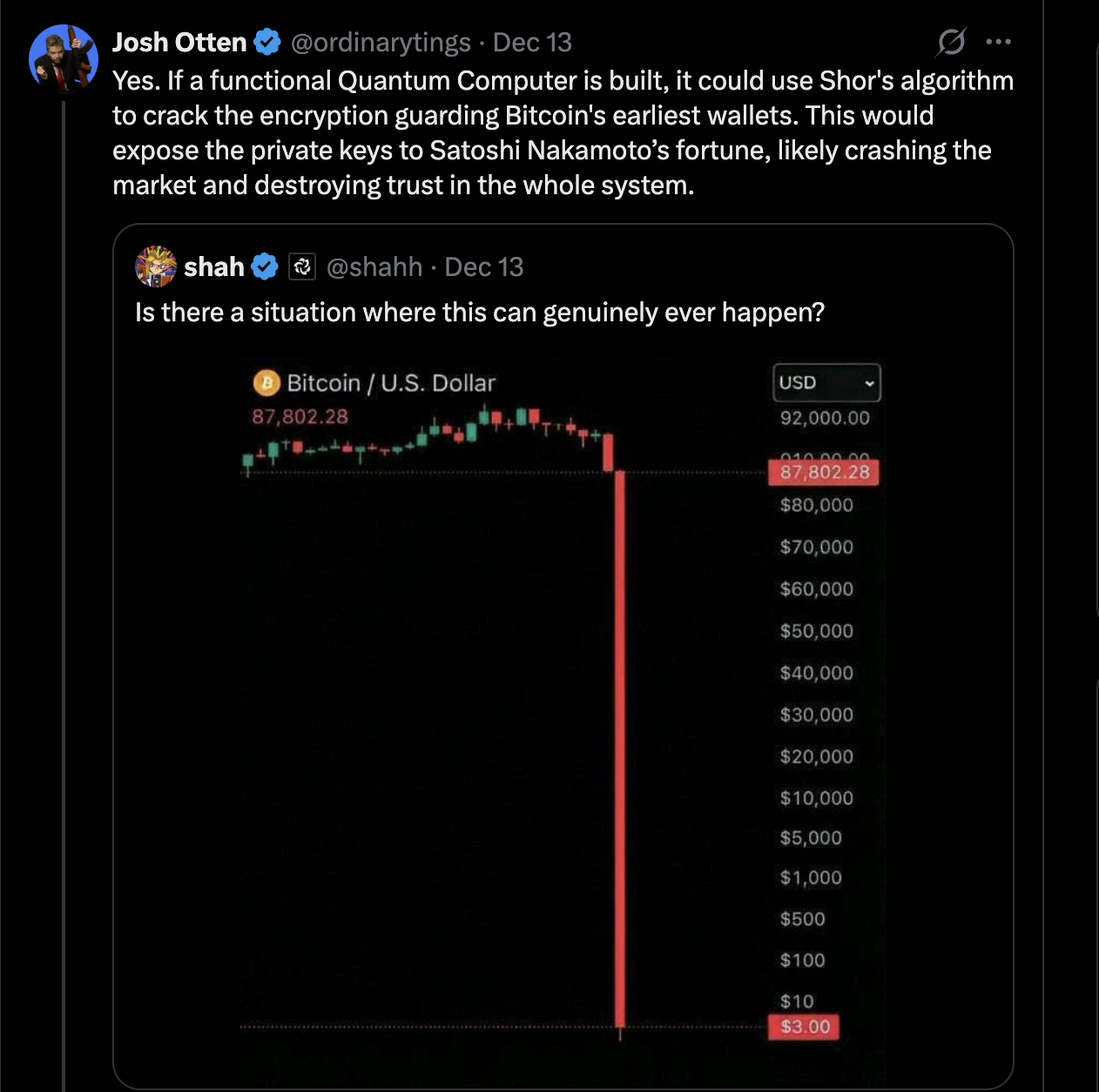
Nguồn: Josh Otten

Tuy nhiên, có khoảng 4 triệu BTC được giữ trong các địa chỉ pay-to-public-key (P2PK), bao gồm cả coin của Satoshi, những địa chỉ này hiển thị toàn bộ public key trên chuỗi khi coin được chi tiêu, khiến chúng dễ bị tấn công lượng tử, Woo nói thêm.

Việc để lộ toàn bộ public key của ví Bitcoin trên chuỗi khiến những ví này dễ bị tấn công lượng tử trong tương lai vì một máy tính lượng tử đủ mạnh về mặt lý thuyết có thể suy ra private key từ public key trong tương lai.

Các loại địa chỉ ví BTC mới hơn không dễ bị tấn công lượng tử vì chúng không để lộ toàn bộ public key trên chuỗi, và nếu public key không được biết đến, thì một máy tính lượng tử không thể tạo ra private key được ghép cặp từ dữ liệu đó.
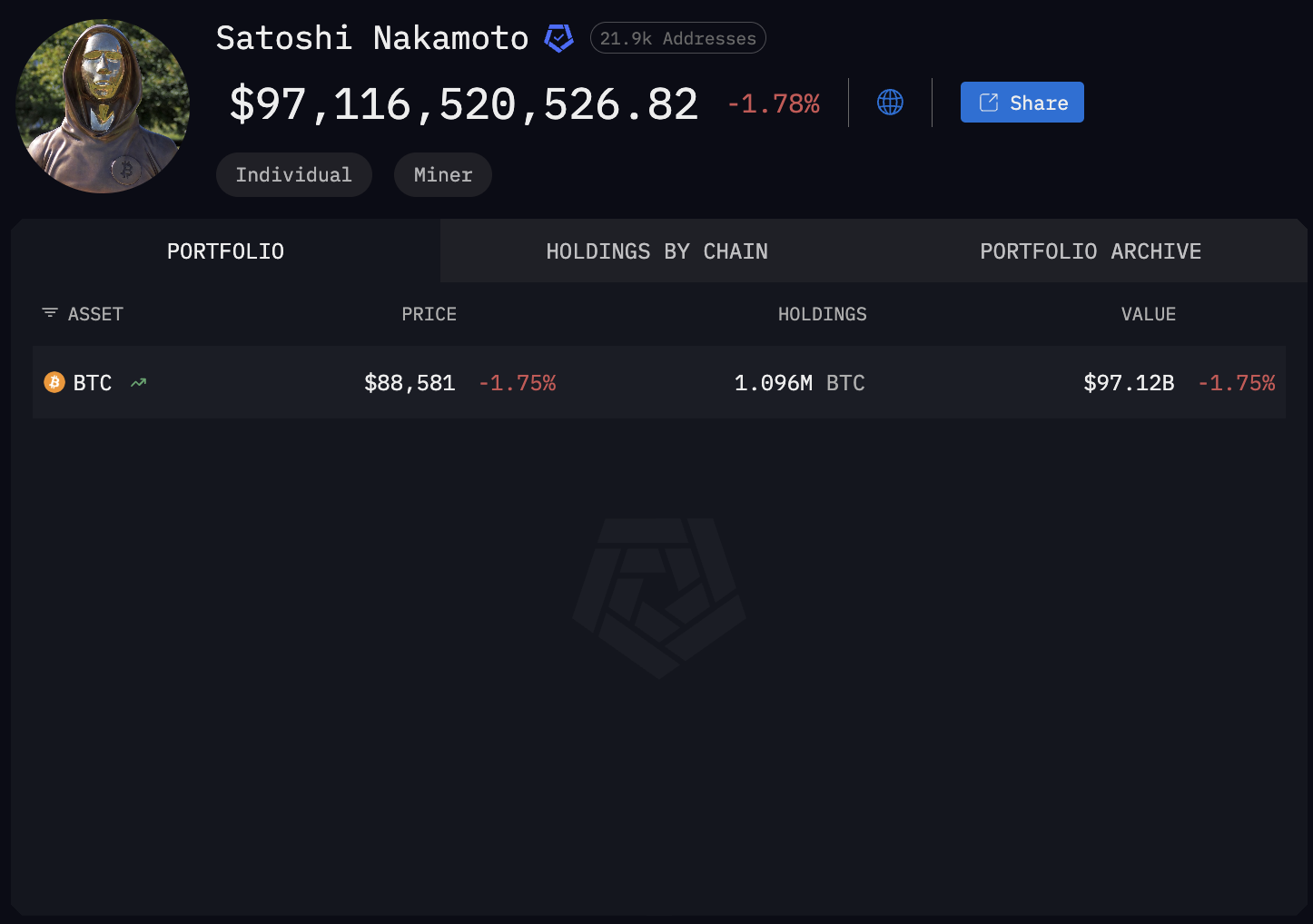
Lượng Bitcoin nắm giữ của Satoshi Nakamoto. Nguồn: Arkham Intelligence

Cộng đồng Bitcoin và tiền mã hóa tiếp tục tranh luận về những tác động tiềm ẩn của điện toán lượng tử đối với Bitcoin và công nghệ mã hóa làm nền tảng cho tiền mã hóa, với một số ý kiến cho rằng điện toán lượng tử sẽ là cái chết của ngành công nghiệp này.

Liên quan: Ông chủ VanEck nghi ngờ tính riêng tư và mã hóa của Bitcoin trước công nghệ lượng tử

Bitcoin OG Adam Back nói mối đe dọa từ máy tính lượng tử còn nhiều thập kỷ nữa

Adam Back, một người nắm giữ Bitcoin từ sớm, một cypherpunk và đồng sáng lập công ty công nghệ Bitcoin Blockstream, cho biết BTC sẽ không phải đối mặt với mối đe dọa lượng tử trong 20-40 năm tới.

Back lập luận rằng có rất nhiều thời gian để áp dụng các tiêu chuẩn mật mã hậu lượng tử, vốn đã tồn tại, trước khi một máy tính lượng tử đủ mạnh để phá vỡ các tiêu chuẩn mã hóa và an ninh mạng hiện đại được chế tạo.

Nhà phân tích thị trường James Check cho biết điện toán lượng tử không đe dọa đến công nghệ của Bitcoin vì người dùng sẽ chuyển sang các địa chỉ kháng lượng tử vào thời điểm một máy tính lượng tử khả thi xuất hiện.

Mối đe dọa lượng tử gây ra mối đe dọa lớn hơn đối với giá thị trường của Bitcoin vì “không có cơ hội” để cộng đồng Bitcoin đồng ý đóng băng coin của Satoshi trước khi một máy tính lượng tử hack vào các ví của ông và đưa những đồng coin đó trở lại lưu thông, Check nói.

Tạp chí: Tấn công lượng tử vào Bitcoin sẽ là phí thời gian: Kevin O’Leary

Трендові криптовалюти

Пов'язані питання

QWilly Woo nói gì về việc sẽ xảy ra nếu máy tính lượng tử hack được ví của Satoshi Nakamoto?

AWilly Woo cho rằng nếu máy tính lượng tử đủ mạnh hack và bán 1 triệu BTC của Satoshi Nakamoto, các Bitcoin OGs (người nắm giữ Bitcoin lâu năm) sẽ mua vào trong đợt flash crash đó, và mạng lưới Bitcoin sẽ vẫn tồn tại.

QTại sao ví Bitcoin kiểu P2PK dễ bị tấn công lượng tử?

AVí kiểu P2PK (pay-to-public-key) dễ bị tấn công lượng tử vì khi chi tiêu, toàn bộ khóa công khai (public key) được hiển thị trên blockchain, cho phép một máy tính lượng tử đủ mạnh trong tương lai có thể suy ra khóa riêng tư (private key) từ khóa công khai đó.

QAdam Back dự đoán mối đe dọa lượng tử đối với Bitcoin trong bao lâu nữa?

AAdam Back, đồng sáng lập Blockstream, cho rằng Bitcoin sẽ không phải đối mặt với mối đe dọa lượng tử trong 20-40 năm tới, và có đủ thời gian để áp dụng các tiêu chuẩn mật mã hậu lượng tử.

QTheo James Check, tại sao công nghệ lượng tử không đe dọa được Bitcoin?

AJames Check lập luận rằng công nghệ lượng tử không đe dọa được Bitcoin vì người dùng sẽ kịp chuyển sang sử dụng các địa chỉ ví có khả năng kháng lượng tử (quantum-resistant) trước khi một máy tính lượng tử khả thi xuất hiện.

QMối đe dọa lượng tử thực sự lớn nhất đối với Bitcoin là gì theo bài viết?

ATheo bài viết, mối đe dọa lượng tử thực sự lớn nhất đối với Bitcoin là tác động đến giá thị trường, vì cộng đồng khó có khả năng đồng ý 'đóng băng' số coin của Satoshi trước khi chúng bị hack và đưa trở lại lưu thông, gây ra một cú sốc cung cấp lớn.

Пов'язані матеріали

Playing the "Decoupling" Card Again? Domestic Optical Modules Face a Stress Test

The U.S. Federal Communications Commission (FCC) is reportedly drafting a ban on importing new models of Chinese-made optical transceiver modules, with a potential implementation target of 2026. This "decoupling" move comes as Chinese firms, led by industry leaders like Zhongji Innolight and Eoptolink, dominate the global optical module market with over 60% share, and hold an even larger position in the high-speed 800G and 1.6T segments critical for AI data centers. Market reactions were mixed: U.S. optical module stocks initially rose, while Chinese A-shares opened lower but largely recovered by the close. Analysis suggests a complete U.S. decoupling from Chinese modules faces significant hurdles. North American cloud giants (Meta, Google, Microsoft, Amazon) and NVIDIA have massive demand for high-speed modules, estimated at around 40 million units in 2026. U.S. manufacturers' combined monthly production capacity for these modules is less than one-fifth that of a single major Chinese player like Zhongji Innolight, which reported production of 23.76 million units in 2025. Chinese companies are heavily reliant on the U.S. market, with over 90% of revenue for top firms coming from overseas, primarily the U.S. However, they have begun mitigating risks by establishing assembly plants in Southeast Asia and Mexico. Industry observers note the final impact depends on whether any potential U.S. restrictions target specific companies or products based on origin. Past U.S. sanctions on Chinese tech firms have often spurred increased domestic R&D and market diversification. Despite initial stock volatility, shares of major Chinese optical module companies pared losses, indicating market belief in the sector's resilience and the practical difficulties of abruptly replacing Chinese supply.

marsbit26 хв тому

Playing the "Decoupling" Card Again? Domestic Optical Modules Face a Stress Test

marsbit26 хв тому

When the Competition in Chip Manufacturing Equipment Stops Being Just About Who Is More Advanced

The competition in chip manufacturing equipment is no longer solely about who has the most advanced technology. While performance, yield, and cost remain key, U.S. export controls are adding a critical new dimension: long-term supply chain reliability. Major chipmakers like Samsung and SK Hynix, despite having mature supply chains with leading American and European vendors, are reportedly evaluating etching equipment from China's AMEC for their Chinese factories. This move is not primarily about immediate replacement or AMEC's current capabilities. Instead, it's a risk mitigation strategy. Companies are concerned that future U.S. policies could disrupt their access to spare parts, software updates, and maintenance for existing equipment over its decade-long lifespan. For chipmakers investing billions in fabs with long planning cycles, this policy-induced uncertainty is a significant new risk. The U.S., through its controls, is inadvertently eroding the very reliability and certainty that were foundational strengths of its equipment suppliers. This creates a pivotal shift for Chinese semiconductor equipment. Previously seen largely as a "domestic replacement" option when foreign gear was unavailable, they are now being assessed as potential "contingency suppliers" by global players—even before a supply disruption occurs. This provides a crucial entry point for validation in real production lines, which is essential for iterative improvement. Chinese equipment, particularly in areas like etching, has progressed from prototypes to participating in mass production within China, gaining valuable experience. However, this does not signify full global competitiveness. Gaps remain in advanced lithography, metrology, and other key tools. The current evaluations are largely confined to foreign firms' China-based fabs, not their global procurement networks. The core change is in the decision-making framework. Efficiency-driven globalization favored single, optimal suppliers. An era of heightened geopolitical risk is forcing companies to value "replaceability." While technical prowess remains paramount, supply chain certainty is now being factored into a device's competitive equation. Ultimately, U.S. policies have not made Chinese equipment more advanced, but they have given global customers a compelling reason to start testing it. The competition has expanded: it's no longer just about who is more advanced, but also about who can be relied upon to stay.

marsbit26 хв тому

When the Competition in Chip Manufacturing Equipment Stops Being Just About Who Is More Advanced

marsbit26 хв тому

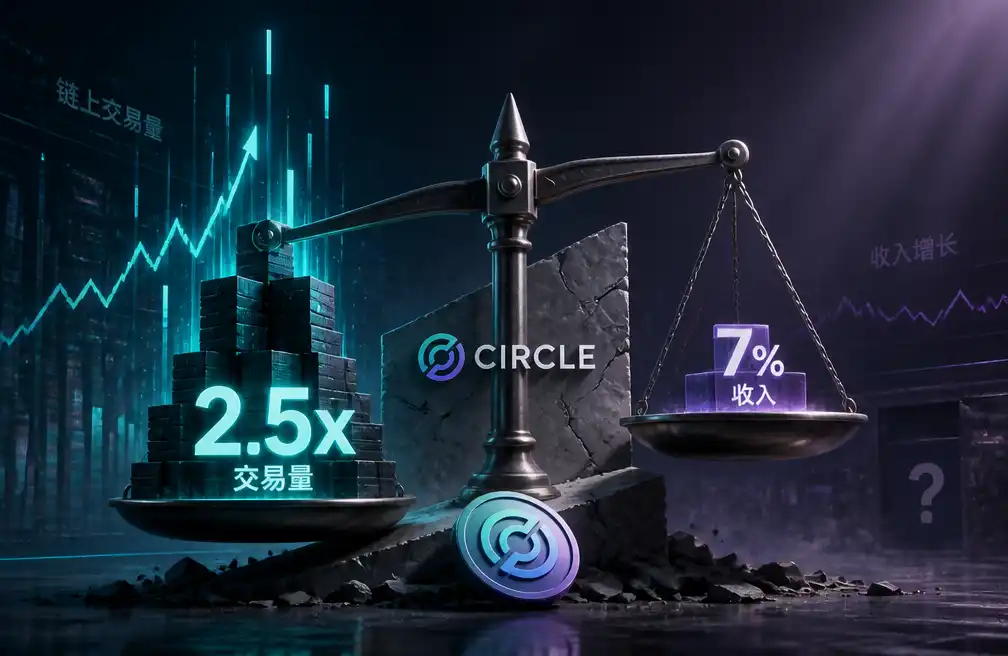
Trading Volume Increased by 2.5x, Why Did Circle's Revenue Only Grow by 7%?

Circle's Q2 performance presents a seemingly contradictory picture: the transaction volume of its stablecoin USDC surged 151% year-over-year to $14.8 trillion, while its "Total Revenue & Reserve Revenue" grew by only 7% to $701 million. This discrepancy highlights the core of Circle's business model. Revenue is primarily driven not by transaction volume, but by the average amount of USDC in circulation and the yield generated from its reserves. Key points: 1. **Revenue Drivers:** Over 90% of revenue comes from "reserve income," which is a function of average USDC circulation (up 25% YoY) and the reserve yield (which fell by 66 basis points). The net effect was a mere ~5% increase in reserve income. 2. **Transaction vs. Revenue:** High transaction volume indicates robust usage of USDC for payments and settlements, but does not translate directly to revenue. It must first convert into a sustained, average circulating balance. 3. **Cost Structure:** After accounting for distribution and other costs, the metric "Revenue Less Direct Costs" (RLDC) grew faster than total revenue, with its margin improving. However, rising operating expenses (up 23% YoY) meant that Adjusted EBITDA growth was limited to 8%. 4. **New Initiatives:** Circle reported progress on new networks like the Circle Payments Network and upcoming products (Arc, Agent Stack), but these are currently measured by adoption metrics (e.g., transaction run-rate, number of services) rather than material revenue contribution this quarter. In summary, the financial results are determined by the interplay of USDC circulation, reserve yields, and cost structures, while high transaction volume signals underlying network strength that has not yet fully flowed through to the income statement.

marsbit43 хв тому

Trading Volume Increased by 2.5x, Why Did Circle's Revenue Only Grow by 7%?

marsbit43 хв тому

Samsung China, Another Step Back

Samsung China Takes Another Step Back Samsung Electronics is further retreating from the Chinese consumer market. Following the exit of its home appliance business in May, its mobile phone division is now reportedly scaling down. Stores with monthly sales below 300,000 RMB are being closed in several cities. Data shows Samsung's smartphone market share in China has plummeted to 0.1% in Q2 2026, a stark contrast to its 22% global leadership. The decline is attributed to intense competition from domestic brands offering better value, higher specs (like faster charging), and superior localization in software and services. Samsung's premium pricing and less adapted One UI system have struggled against rivals like Huawei, Xiaomi, and Honor. This consumer electronics retreat coincides with Samsung's record-breaking semiconductor profits, driven by the AI boom. In Q2 2026, the chip division contributed nearly all operating profit, while the mobile and home appliance unit posted its first-ever operating loss. Internal dynamics, like the chip division charging market prices to the mobile unit, have increased cost pressures. Samsung's strategy now appears to be a focused retreat towards the ultra-premium segment in China, similar to its global push in high-end foldables like the Galaxy Z Fold8. The company is likely to retain only key stores in major cities to serve a niche, high-end clientele. While its deep semiconductor reserves offer a cushion, this shift away from mass-market consumer electronics reduces business diversification. The move is pragmatic but signifies a fundamental transformation; Samsung is ceding mass-market influence and betting heavily on its semiconductor strength and a narrowed premium product focus.

marsbit48 хв тому

Samsung China, Another Step Back

marsbit48 хв тому

Торгівля

Спот

Популярні статті

Як купити WOO

Ласкаво просимо до HTX.com! Ми зробили покупку WOO (WOO) простою та зручною. Дотримуйтесь нашої покрокової інструкції, щоб розпочати свою криптовалютну подорож.Крок 1: Створіть обліковий запис на HTXВикористовуйте свою електронну пошту або номер телефону, щоб зареєструвати обліковий запис на HTX безплатно. Пройдіть безпроблемну реєстрацію й отримайте доступ до всіх функцій.ЗареєструватисьКрок 2: Перейдіть до розділу Купити крипту і виберіть спосіб оплатиКредитна/дебетова картка: використовуйте вашу картку Visa або Mastercard, щоб миттєво купити WOO (WOO).Баланс: використовуйте кошти з балансу вашого рахунку HTX для безперешкодної торгівлі.Треті особи: ми додали популярні способи оплати, такі як Google Pay та Apple Pay, щоб підвищити зручність.P2P: Торгуйте безпосередньо з іншими користувачами на HTX.Позабіржова торгівля (OTC): ми пропонуємо індивідуальні послуги та конкурентні обмінні курси для трейдерів.Крок 3: Зберігайте свої WOO (WOO)Після придбання WOO (WOO) збережіть його у своєму обліковому записі на HTX. Крім того, ви можете відправити його в інше місце за допомогою блокчейн-переказу або використовувати його для торгівлі іншими криптовалютами.Крок 4: Торгівля WOO (WOO)Легко торгуйте WOO (WOO) на спотовому ринку HTX. Просто увійдіть до свого облікового запису, виберіть торгову пару, укладайте угоди та спостерігайте за ними в режимі реального часу. Ми пропонуємо зручний досвід як для початківців, так і для досвідчених трейдерів.

114 переглядів усьогоОпубліковано 2024.12.12Оновлено 2026.06.02

Як купити WOO

Обговорення

Ласкаво просимо до спільноти HTX. Тут ви можете бути в курсі останніх подій розвитку платформи та отримати доступ до професійної ринкової інформації. Нижче представлені думки користувачів щодо ціни WOO (WOO).

活动图片