Introduction: Is the US Ready to 'Decouple' from Chinese Optical Modules?
Yesterday (August 4th), the global optical module market was abruptly exposed to a US version of a 'domestic substitution' plan.
According to media outlets such as "China News Service" and "First Finance," citing overseas media reports, informed sources revealed that the Federal Communications Commission (FCC), which oversees the US telecommunications industry, is drafting a ban on the import of new models of optical transceiver modules from China. The report also stated that US officials hope to announce and implement the ban within 2026. However, sources indicated that the FCC may still modify or shelve the relevant restrictions.
Interestingly, in the span of one day and night, between after-hours in the A-share market and pre-market in the US stock market, the performance of optical module concept stocks diverged across the two major exchanges. US optical module stocks initially strengthened, while A-share stocks like "Yi Zhong Tian" (likely referring to specific stocks) opened lower but narrowed their losses by the close. Tianfu Communication (300394.SZ) even maintained gains.
According to data from the LightCounting research firm, Chinese optical module manufacturers currently hold over 60% of the global optical module market share, with representative companies like Zhongji Innolight and Eoptolink. In the 800G and 1.6T optical module sub-markets, domestic manufacturers command an even larger market share.
Optical modules are primarily used for high-speed fiber optic data transmission within data centers. Currently, global AI computing power is driving strong demand for optical modules, with 800G and 1.6T products being the mainstream offerings in the global market. The continuous upgrades of NVIDIA AI servers are pushing the iteration of optical modules from 800G to 1.6T and even 3.2T. Goldman Sachs predicts the optical module industry is transitioning from the 800G inventory cycle to a new profit cycle driven by 1.6T/3.2T technologies.
Data shows that based on 2025 optical interconnect revenue, Zhongji Innolight accounted for approximately 21.2% of the global market share. In the high-speed (400G and above) data center optical interconnect market, it held a 28.1% market share, making it the world's largest provider of optical interconnect solutions.
The advantage of domestic manufacturers in this critical field of optical modules is beginning to unsettle the United States. However, for the US to 'decouple' from Chinese optical modules is not so simple.
Will US Giants Agree to 'Decouple' from Chinese Optical Modules?
What is the true landscape of the global optical module market? Simply put, China and the US dominate the primary market.
Data from LightCounting, one of the most authoritative third-party agencies in the optical module sector, shows that from 2018 to 2024, the ranks of Chinese optical module manufacturers among the global top ten expanded rapidly. In 2018, there were only three Chinese companies; by 2022, seven Chinese manufacturers had entered the top ten and have remained stable since.
In 2024, the remaining three spots in the global top ten were held by the US, ranking second, fifth, and eighth in LightCounting's list.
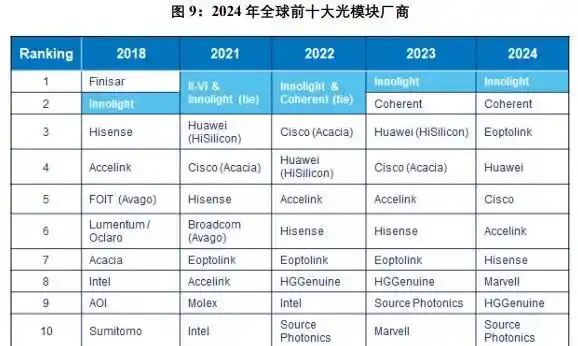
Source: Company Financial Reports; Data: LightCounting
Looking at it this way, US optical module companies still hold a position. If the US ultimately completely bans the purchase of Chinese optical modules, could domestic US companies meet the domestic demand?
Here's the conclusion first: absolutely not.
US companies' strengths lie upstream in optical chips, DSP (Digital Signal Processor) chips, and silicon photonics technology. In large-scale manufacturing of complete optical modules, cost control, and delivery responsiveness, they lag behind Chinese manufacturers. Currently, US domestic production capacity cannot fully meet the AI computing optical module demands of North American cloud providers; they can only serve as partial supplemental suppliers.
According to an article titled "2026 Optical Module Market Analysis and Forecast" published on the ETU-LINK official website, the combined demand for 800G optical modules from North American cloud providers like Meta, Google, Microsoft, and Amazon is about 27.5 to 29.5 million units. Meta has the largest demand (at least 10 million, potentially up to 12 million units), Google and Microsoft have a combined demand of about 12 million units, and Amazon requires about 5.5 million units. In the 1.6T optical module market, NVIDIA's demand for 2025 is estimated at 2.5 to 3.5 million units (80% of global share), increasing to over 5 million units in 2026. Google's demand is about 4 million units, and Meta's is about 1 million units.
In summary, the total demand from major vendors for high-speed optical modules in 2026 is around 40 million units.
Industry analysis indicates that the monthly production capacity of 800G optical modules from major US manufacturers is only about 40,000 units. Coherent's assembly capacity is largely located in overseas foundries. AAOI's US production lines are still ramping up; it previously announced expansions at its new Texas plant and facilities in Taiwan, China, but its near-term goal is merely to increase monthly production of 800G and 1.6T products to over 500,000 units by the end of 2026.
Overall, the combined monthly production capacity of all US domestic high-speed modules is less than one-fifth of that of a single leading Chinese manufacturer. For instance, Zhongji Innolight's production capacity for optical communication transceiver modules exceeded 28 million units in 2025, with actual output of 23.76 million units and sales of 21.09 million units. For Eoptolink's optical interconnect products in 2025, capacity was about 17.47 million units, actual output was 16.34 million units, and sales were 16.03 million units.
The actual output of just these two giants exceeds 40 million units. Moreover, in the high-speed data center market, Chinese manufacturers hold a global market share of 65% to 70%, with Zhongji Innolight and Eoptolink combined approaching 50%.
Well-known financial commentator Liu Xiaobo believes that the main US players—Coherent, Lumentum, and AAOI—are completely outmatched by Chinese manufacturers. The expansion cycle for high-speed optical modules generally takes 18-24 months; capacity cannot be instantly realized just by spending money.
Another statistic also highlights the high dependence of the US market on Chinese optical modules.
Data from Zhongji Innolight shows that in 2025, over 90% of its revenue exceeding 38.2 billion yuan came from overseas, indicating the strong demand from international clients. Another optical module giant, Eoptolink, had revenue exceeding 24.8 billion yuan in 2025, with overseas income accounting for over 96%.
In its Hong Kong IPO prospectus, Zhongji Innolight further disclosed that a majority of its revenue derives from US customers.
For the periods ended March 31, 2023, 2024, 2025, and 2026, revenue from US customers accounted for 75.9%, 60.5%, 57.3%, and 61.7% of Zhongji Innolight's total revenue, respectively.
However, Zhongji Innolight also acknowledges that its business, financial condition, and operating performance are susceptible to changes in the US economy, politics, laws, regulations, and market conditions, as well as changes in the purchasing patterns, demand, financial conditions, and business strategies of its US customers.
Is Building Overseas Factories a Good Solution?
In reality, the US has not yet formally issued new rules targeting Chinese optical module products, and most of the content circulating is unverified.
Media outlets like "China News Service - JWei" also quoted responses from major optical module companies like Zhongji Innolight, Eoptolink, and Tianfu Communication regarding the event, all stating that the FCC has not yet released restrictive documents in this area and that the information cannot be verified by authoritative sources.
In fact, within the AI industry competition, US restrictions on China-related AI products have been ongoing, such as limiting NVIDIA's sales of H200 chips to China and outright banning the sale of NVIDIA's latest chips to China, as well as the more widely known ban on selling EUV lithography machines to China.
The US has previously placed the "optical module leader" Zhongji Innolight on concerning lists.
"Alpha Factory" notes that Zhongji Innolight mentioned in its prospectus that on June 8th of this year, the US Department of War added Zhongji Innolight to the Chinese Military-Industrial Complex Companies list. However, so far, no customer orders have been canceled, suspended, reduced, or delayed in large numbers due to this, nor have any customer relationships been terminated.
Zhongji Innolight stated that its products are designed for commercial technology in civilian industries and integrated into such technology, not developed as customized military products. Moreover, "the Chinese Military-Industrial Complex Companies list is not an economic sanctions list and, in the absence of other applicable restrictions, does not itself restrict our business with US customers."
Against the backdrop of Sino-US AI competition, although the US has not yet imposed specific bans on China's optical module industry, how the situation evolves in the future indeed warrants market attention and vigilance.
Some industry insiders analyzed that even without a clear ban now, it is necessary to guard against potential future changes. In terms of response measures, the key is to watch if the US announces a ban in the future, "whether it restricts companies or restricts products."
The person believes that if the US adopts restrictions targeting corporate entities, then regardless of whether Chinese optical module companies build factories in Vietnam, Thailand, Malaysia, or Mexico, as long as the company itself is on the restricted list, products from overseas factories may similarly be barred from entering the US market.
If restrictions are only on the country of origin of the product, then building overseas factories theoretically still offers some space for circumvention.
Based on public information, nearly all leading domestic data center optical module companies have established overseas assembly plants, mostly concentrated in Southeast Asia (Malaysia, Thailand), with some located in Mexico and Europe. For example, Zhongji Innolight, Eoptolink, Huagong Tech, and Accelink have already built or are building production bases in Thailand.
However, the aforementioned person believes that, judging from the restriction paths experienced by Huawei and SMIC in the past, the US typically does not leave obvious loopholes open for long. Initially, restrictions might target only certain products, technologies, or origins, but they often gradually expand to corporate entities, affiliated companies, supply chain partners, and end-uses.
If it ultimately evolves into restricting corporate entities and affiliates, then the final coping strategy might involve seeking overseas OEM arrangements or other sales channels. Ultimately, it depends on how the final US rules define corporate control, actual manufacturers, sources of core components, and ultimate beneficiaries.
The above is merely an analysis combining industry insiders' views on the industry, market, and related companies. Looking at decades of Sino-US competition, unilateral US restrictions ultimately cannot completely halt the development of any industry. In fact, Chinese companies might even accelerate their development under pressure.
The US's persistent restrictions on Chinese companies will instead amplify the domestic resolve for independent R&D, resource investment, and market space for import substitution. While some overseas markets may be squeezed, it will also prompt the opening of new growth curves in the domestic market + other global markets. The overall industrial strength, technology stack, and global share may actually improve.
Examples include Yangtze Memory Technologies, which was added to the US Entity List, DJI, which faced US bans, and the photovoltaic industry chain, which was subjected to high tariffs...
In today's international market, the global supply chain pattern is an overarching trend, and major production capacities for products like optical modules remain in China. A unilateral US procurement ban is difficult to implement as a complete "one-size-fits-all" measure.
After sharp initial volatility, A-share stocks of major optical module companies saw their losses narrow. For instance, Zhongji Innolight opened at 880 yuan/share but closed at 947.74 yuan/share, down 7.27%; Eoptolink opened at 400 yuan/share and closed at 424.3 yuan/share, down 5.29%; Tianfu Communication, after opening lower, reversed losses during the session and finally closed at 216.85 yuan/share, up 2.29%.
What is your view on the future prospects for domestic optical module manufacturers?
This article is from the WeChat public account "Alpha Factory Research Institute," author: Alpha