Willy Woo says Bitcoin OGs will buy Satoshi's stash if a quantum hack occurs

cointelegraphОпубліковано о 2025-12-14Востаннє оновлено о 2025-12-14

Анотація

A debate emerged on social media regarding the potential scenario of a quantum computer hacking and dumping Satoshi Nakamoto’s 1 million BTC. YouTuber Josh Otten suggested this could crash Bitcoin's price to $3, but long-term holder Willy Woo countered that many original Bitcoin investors (OGs) would buy such a flash crash, ensuring the network's survival. Woo noted that around 4 million BTC in older "pay-to-public-key" (P2PK) addresses, including Satoshi's, are vulnerable because they expose public keys onchain, which a powerful quantum computer could use to derive private keys. Newer wallet types are more secure as they don’t reveal public keys. While some fear quantum computing could destroy crypto, experts like Blockstream’s Adam Back believe the threat is decades away, allowing time to adopt quantum-resistant cryptography. Analyst James Check added that the bigger risk is to Bitcoin’s market price, as the community is unlikely to preemptively freeze Satoshi’s coins before a quantum attack.

A debate broke out on social media on Saturday about the potential effects of a quantum computer hacking Satoshi Nakamoto’s Bitcoin (BTC) stash and then dumping those coins onto the market.

The debate began when YouTuber Josh Otten shared a price chart of BTC crashing to $3.00 and said that this could happen if a sufficiently powerful quantum computer emerges and steals pseudonymous Bitcoin creator Satoshi Nakamoto’s 1 million BTC and sells them.

“Many OGs would buy the flash crash. The Bitcoin network would survive; most coins are not immediately vulnerable,” long-term Bitcoin holder Willy Woo said.
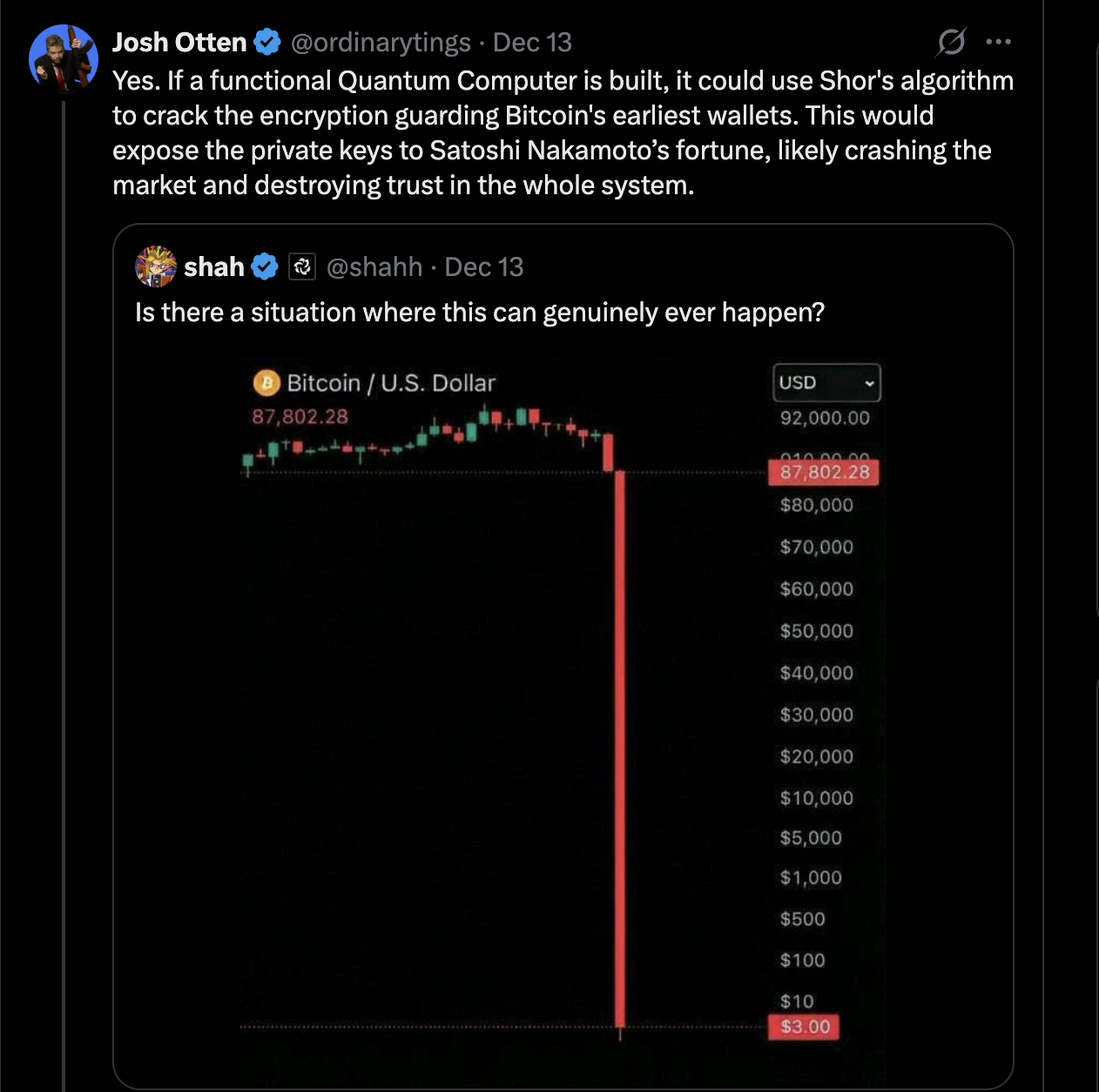
Source: Josh Otten

However, there are about 4 million BTC held in pay-to-public-key (P2PK) addresses, including Satoshi’s coins, which show the full public key onchain when coins are spent, making them vulnerable to quantum attacks, Woo added.

Exposing a Bitcoin wallet’s full public key onchain exposes these wallets to quantum attacks in the future because a sufficiently powerful quantum computer could theoretically derive the private key from the public key in the future

Newer types of BTC wallet addresses are not as vulnerable to quantum attacks because they do not expose the full public keys onchain, and if the public key is not known, then a quantum computer cannot generate the paired private key from that data.
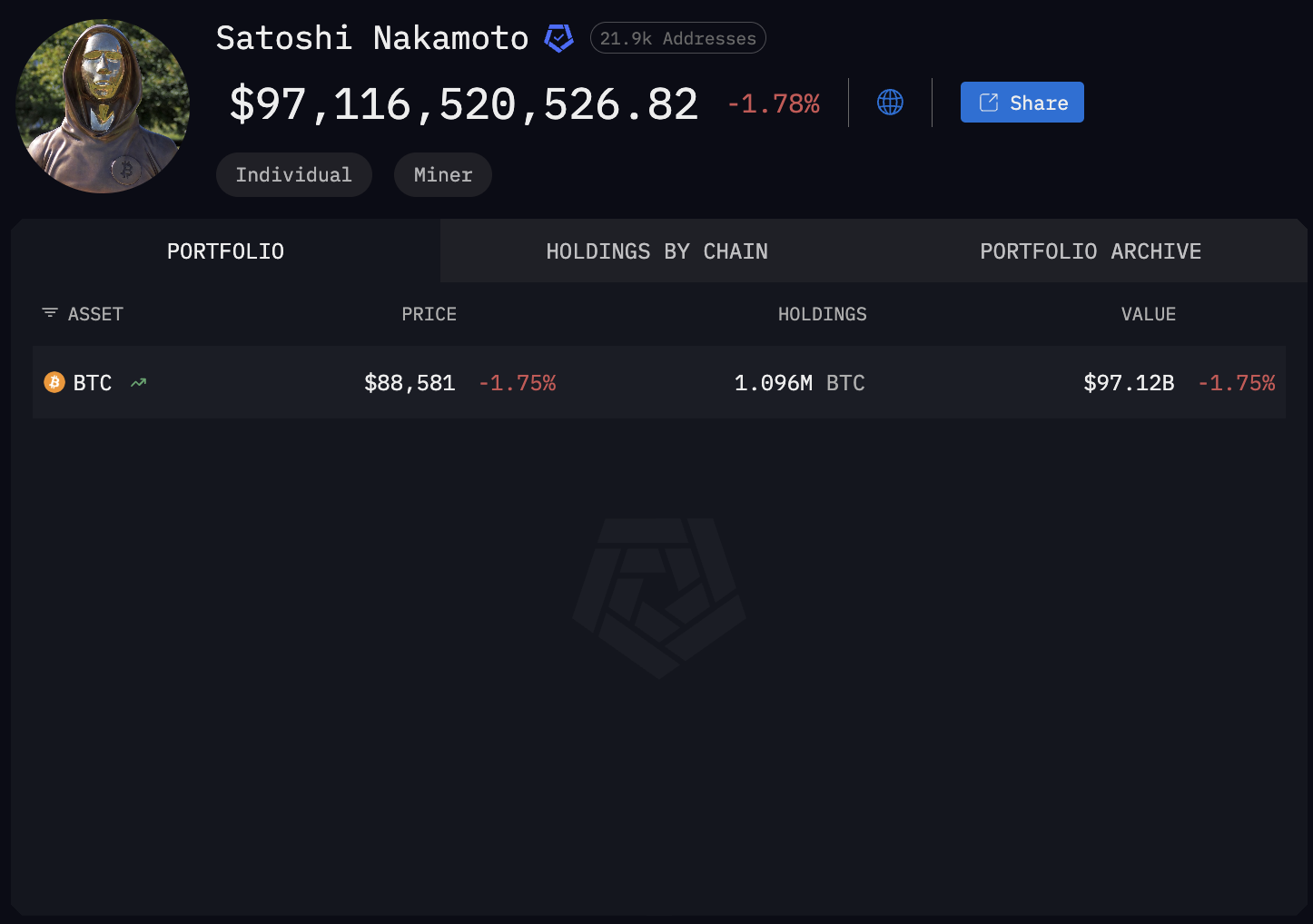
Satoshi Nakamoto’s Bitcoin holdings. Source: Arkham Intelligence

The Bitcoin and crypto communities continue to debate the potential effects of quantum computing on Bitcoin and the encryption technology that underpins cryptocurrencies, with some arguing that quantum computing will be the death of the industry.

Related: VanEck boss questions Bitcoin’s privacy, encryption against quantum tech

Bitcoin OG Adam Back says the threat of quantum computers is decades away

Adam Back, an early Bitcoin holder, cypherpunk and co-founder of Bitcoin technology company Blockstream, said that BTC will not face a quantum threat in the next 20-40 years.

Back argued that there is plenty of time to adopt post-quantum cryptography standards, which already exist, before a quantum computer powerful enough to crack modern encryption and cybersecurity standards is built.

Market analyst James Check said that quantum computing does not threaten Bitcoin’s technology because users will migrate to quantum-resistant addresses by the time a viable quantum computer emerges.

The quantum threat poses more of a threat to Bitcoin’s market price because there is “no chance” that the Bitcoin community will agree to freeze Satoshi’s coins before a quantum computer hacks his wallets and puts the coins back into circulation, Check said.

Magazine: Quantum attacking Bitcoin would be a waste of time: Kevin O’Leary

Трендові криптовалюти

Пов'язані матеріали

Latin America's Payments Landscape Is Not What You Think It Is

This report challenges common misconceptions about Latin America's payment landscape, based on over 500 hours of firsthand research. Key findings include: 1) Crypto card transaction volume primarily comes from high-net-worth individuals receiving USDT salaries, not retail spending. 2) QR code payments (e.g., Brazil's Pix, Argentina's Mercado Pago) are the dominant payment method across most emerging markets, not cards. 3) A major untapped opportunity lies in enabling cross-border interoperability between domestic instant payment systems. 4) Payment competition is shifting from customer acquisition to owning the settlement layer (e.g., acquiring banks). 5) Latin America is not a single market; Brazil, Mexico, Argentina, and smaller "forgotten five" countries (e.g., Guatemala, Honduras) have vastly different dynamics. 6) Stablecoin-to-fiat conversion margins are collapsing toward zero, pushing companies to build value-added services on top. 7) Future payment winners will be multi-country brands, not single-corridor specialists. 8) Marketing must target specific user segments (e.g., digital nomads, unbanked immigrants) with tailored messaging, not a generic "Brazilian" audience. 9) Contrary to perception, Latin American regulators are often ahead of the US in creating frameworks for digital assets and instant payments, with clear licensing deadlines. The core takeaway is that the region's payment rules are being rewritten, moving beyond cards and stablecoin arbitrage towards integrated, cross-border QR-based solutions.

链捕手5 хв тому

Latin America's Payments Landscape Is Not What You Think It Is

链捕手5 хв тому

Vitalik's Algorithmic Stablecoin Vision: Interpreting the Mechanism and Challenges from an Options Perspective

Vitalik Buterin's recent algorithmic stablecoin proposal envisions using an option-like mechanism to create a stablecoin without the liquidation risks inherent in traditional collateralized debt position (CDP) models. The design splits one unit of ETH into two components: a 'stable' leg (P) that maintains value up to a certain strike price, and an 'upside' leg (N) that captures any appreciation above that price. Together, they always sum to one ETH, eliminating the need for debt or liquidation mechanisms. From an options perspective, the stable leg essentially functions as a synthetic, covered call position. However, significant challenges exist. For the stable asset to maintain its peg, it must continuously roll deep in-the-money call options, leading to potential rollover slippage, predictable trading paths vulnerable to front-running, and liquidity issues. Crucially, the system's scalability depends on a constant demand for the upside leg—a form of leveraged ETH long position without funding rates or liquidation risk. It's unclear if such persistent, specific demand will materialize from speculators or market makers who have simpler alternatives like perpetual swaps. The author, drawing from experience with Rysk, argues that DeFi options have struggled as standalone trading products due to complexity and fragmented liquidity. Their potential lies instead as foundational infrastructure underpinning more complex financial primitives like stablecoins, structured yields, or index products—transforming from a direct product into a core pricing and risk distribution engine for the next generation of on-chain finance.

marsbit1 год тому

Vitalik's Algorithmic Stablecoin Vision: Interpreting the Mechanism and Challenges from an Options Perspective

marsbit1 год тому

GPT-5.6 Countdown: Abandon the Illusion of a Single API, Computational Iteration Can't Outpace a Single Page of Compliance

In mid-June, three seemingly independent industry events—the compliance-driven throttling of Fable 5, the open-sourcing of GLM-5.2, and the leaked release timeline for GPT-5.6—are pushing the global AI industry toward a watershed moment. These shifts signal a fundamental restructuring of the industry's underlying logic. First, **"usability" has substantially overtaken "advanced capabilities"** as the primary weight, pushing the global large language model (LLM) supply chain into a "dual-track" phase of controlled closed-source and local open-source coexistence. Second, **the competitive moats of closed-source giants are shifting**. Their technical focus is moving from "language intelligence" toward "spatial intelligence (world models)"—a domain heavily reliant on computing power. Third, faced with常态化 transnational compliance risks, **a "model-agnostic" decoupled design has become a survival necessity for application-layer developers to maintain business continuity.** The article details how Anthropic's Fable 5, despite its advanced engineering feats, was restricted for non-U.S. citizens within 72 hours of launch, highlighting how geopolitical compliance can instantly limit even the most advanced models. In response, the open-source camp, exemplified by Zhipu AI's MIT-licensed GLM-5.2, is gaining market share by offering stable performance improvements and significant cost advantages (up to 70% savings for enterprises), while achieving full adaptation with domestic semiconductor platforms. Meanwhile, closed-source leaders like OpenAI are pivoting. The anticipated GPT-5.6 reportedly shifts focus from language to spatial intelligence and world models, aiming to rebuild a generational gap in areas like 3D understanding, simulation, and industrial design that demand immense compute. The core conclusion is that the LLM supply chain's logic has changed. Enterprises must now evaluate infrastructure based on a composite of technical performance and policy compliance. For developers, complete reliance on a single closed-source API poses unacceptable risk. Implementing a truly model-agnostic architecture—enabling swift switches to compliant, locally deployable open-source alternatives—is no longer just good practice but a fundamental baseline for business continuity.

marsbit4 год тому

GPT-5.6 Countdown: Abandon the Illusion of a Single API, Computational Iteration Can't Outpace a Single Page of Compliance

marsbit4 год тому

Торгівля

Спот
Ф'ючерси

Популярні статті

Як купити WOO

Ласкаво просимо до HTX.com! Ми зробили покупку WOO (WOO) простою та зручною. Дотримуйтесь нашої покрокової інструкції, щоб розпочати свою криптовалютну подорож.Крок 1: Створіть обліковий запис на HTXВикористовуйте свою електронну пошту або номер телефону, щоб зареєструвати обліковий запис на HTX безплатно. Пройдіть безпроблемну реєстрацію й отримайте доступ до всіх функцій.ЗареєструватисьКрок 2: Перейдіть до розділу Купити крипту і виберіть спосіб оплатиКредитна/дебетова картка: використовуйте вашу картку Visa або Mastercard, щоб миттєво купити WOO (WOO).Баланс: використовуйте кошти з балансу вашого рахунку HTX для безперешкодної торгівлі.Треті особи: ми додали популярні способи оплати, такі як Google Pay та Apple Pay, щоб підвищити зручність.P2P: Торгуйте безпосередньо з іншими користувачами на HTX.Позабіржова торгівля (OTC): ми пропонуємо індивідуальні послуги та конкурентні обмінні курси для трейдерів.Крок 3: Зберігайте свої WOO (WOO)Після придбання WOO (WOO) збережіть його у своєму обліковому записі на HTX. Крім того, ви можете відправити його в інше місце за допомогою блокчейн-переказу або використовувати його для торгівлі іншими криптовалютами.Крок 4: Торгівля WOO (WOO)Легко торгуйте WOO (WOO) на спотовому ринку HTX. Просто увійдіть до свого облікового запису, виберіть торгову пару, укладайте угоди та спостерігайте за ними в режимі реального часу. Ми пропонуємо зручний досвід як для початківців, так і для досвідчених трейдерів.

92 переглядів усьогоОпубліковано 2024.12.12Оновлено 2026.06.02

Як купити WOO

Обговорення

Ласкаво просимо до спільноти HTX. Тут ви можете бути в курсі останніх подій розвитку платформи та отримати доступ до професійної ринкової інформації. Нижче представлені думки користувачів щодо ціни WOO (WOO).

活动图片